Aminopyrine
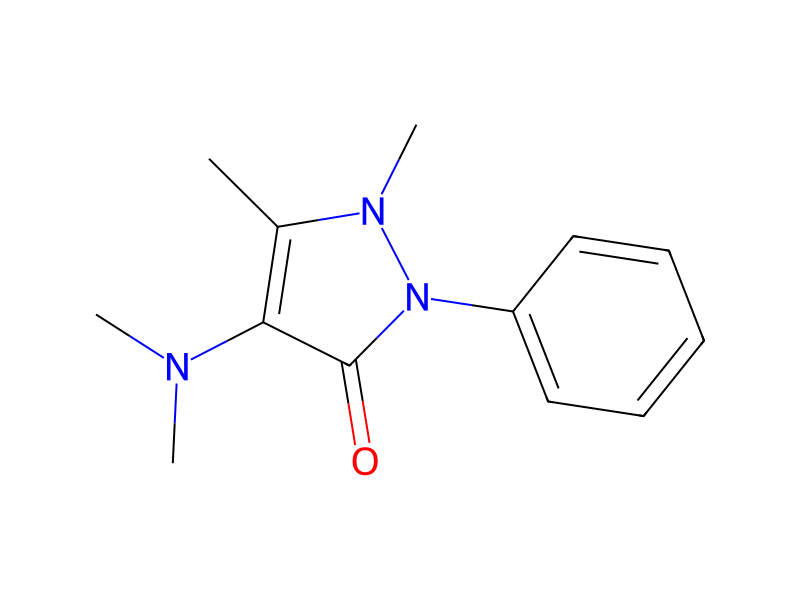
Grundinformationen
- CAS
91419-95-3- Standard-SMILES
Cc1c(N(C)C)c(=O)n(-c2ccccc2)n1C- InChIKey
RMMXTBMQSGEXHJ-UHFFFAOYSA-N- Summenformel
- C13H17N3O
- Durchschnittliche Molmasse
- 231,29 g/mol
Überblick
Small colorless crystals or white crystalline powder. Aqueous solution slightly alkaline to litmus. pH (5% water solution) 7.5-9. Odorless. Slightly bitter taste. (NTP, 1992)
Namen und Bezeichner
- Bevorzugter Name
- Aminopyrine
- IUPAC
- 4-(dimethylamino)-1,5-dimethyl-2-phenylpyrazol-3-one
- Englischer Name
- 4-DiMethylaMino Antipyrine-d6
- Summenformel
- C13H17N3O
- Molmasse
- 231.29358
Namen und Synonyme
aminophenazoneAMINOPYRINEAmidopyrine58-15-14-DimethylaminoantipyrineDipyrineAmidazopheneAmidopyrazolineAminopyrinPyramidonDimethylaminoantipyrineAmidazophen
Weitere Namen anzeigen
Anafebrina-d6AMinopyrine-d6Brivudine Impurity 43(DiMethylaMino-d6)phenazone(DiMethylaMino-d6)analgesine4-DiMethylaMino Antipyrine-d6[2H6]-4-Dimethylamino Antipyrine4-Dimethylaminoantipyrine-D6(Aminophenazone-D6)4-(DiMethylaMino-d6)-2,3-diMethyl-1-phenyl-3-pyrazolin-5-one4-(DiMethylaMino-d6)-1,2-dihydro-1,5-diMethyl-2-phenyl-3H-pyrazol-3-one
AmidophenBrufaneuxolItamidoneDereumaFebronDimethylaminoazopheneAmidofebrinAmidophenazone
Datenbank-Bezeichner
- CAS
91419-95-3- ChEMBL
CHEMBL288470
Eigenschaften
Berechnete Struktureigenschaften
- XLogP
- 1
- Polarare Oberfläche (TPSA)
- 26,8 Ų
- H-Brücken-Donoren
- 0
- H-Brücken-Akzeptoren
- 3
- Frei drehbare Bindungen
- 2
- Schwere Atome
- 17
- Formalladung
- 0
- Komplexität
- 343
Experimentelle und physikochemische Eigenschaften
Drugs
DEA NFLIS-Drug Category -> Analgesics
Pharmaceuticals -> Listed in ZINC15
Pharmaceuticals -> Metabolite of Metamizole
pHAQ SOLN IS SLIGHTLY ALKALINE TO LITMUS
SpringerMaterials PropertiesCrystal structure
LogP
1.00
0.89
OdorODORLESS
Color/Form
LEAFLETS FROM LIGROIN
COLORLESS LEAFLETS
PRISM OR PLATELETS FROM PETROLEUM ETHER OR ETHYL ACETATE
Solubility
greater than or equal to 100 mg/mL at 72 °F (NTP, 1992)
IN PRESENCE OF WATER, READILY ATTACKED BY MILD OXIDIZING AGENTS; ADDITION OF SODIUM BENZOATE TO WATER INCR SOLUBILITY
1 G SOL IN 1.5 ML ALC, 12 ML BENZENE, 1 ML CHLOROFORM, 13 ML ETHER, 18 ML WATER
SOL IN PETROLEUM ETHER
2.25e+01 g/L
Human DrugsPharmaceuticals
Sicherheit und Regulatorisches
GHS-Klassifizierung
GHS Classification
Danger
H301 (96.5%): Toxic if swallowed [Danger Acute toxicity, oral]
P261, P264, P264+P265, P270, P271, P280, P301+P316, P302+P352, P304+P340, P305+P351+P338, P319, P321, P330, P332+P317, P337+P317, P362+P364, P403+P233, P405, and P501 (click each P-code to see the statement)
Aggregated GHS information provided per 57 reports by companies from 9 notifications to the ECHA C&L Inventory. Each notification may be associated with multiple companies.
Gefahrenhinweise
Regulatory Information
Chemical: 3H-Pyrazol-3-one, 4-(dimethylamino)-1,2-dihydro-1,5-dimethyl-2-phenyl-
3H-Pyrazol-3-one, 4-(dimethylamino)-1,2-dihydro-1,5-dimethyl-2-phenyl-: Does not have an individual approval but may be used as a component in a product covered by a group standard. It is not approved for use as a chemical in its own right.
Other Safety InformationIMAP assessments - 3H-Pyrazol-3-one, 4-(dimethylamino)-1,2-dihydro-1,5-dimethyl-2-phenyl-: Environment tier I assessment
DOT LabelPoison
Fire HazardsFlash point data for this chemical are not available; however, it is probably combustible. (NTP, 1992)
Health Hazards
SYMPTOMS: Symptoms of exposure to this compound include allergic reactions, strong spasmolytic effect on smooth muscle of peripheral blood vessels, irritability, palsy, copious sweating, dilated pupils, sharp drop then rise in body temperature, dysuria, dyspnea, anxiety, tenesmus, urinary frequency, intermittent fever, fatty infiltration of the liver, heart muscle degeneration and death due to circulatory failure following cardiovascular collapse. Agranulocytosis often occurs. Ingestion may cause central nervous system stimulation, vomiting, convulsions, cyanosis, tinnitus, leukopenia, kidney damage and coma. Ingestion may also lead to nausea, mental disturbances, methemoglobinemia, chocolate-colored blood, dizziness, epigastric pain, difficulty in hearing, thready pulse and liver damage. Other symptoms reported via ingestion include hemolytic anemia, porphyria and severe gastrointestinal bleeding. Bone marrow depression also occurs. Rare eye effects include acute transient myopia. Chronic symptoms include anorexia, edema, oliguria, urticaria, hypersensitivity, aplastic anemia, sore throat, fever, pharyngeal membrane, jaundice enlargement of the liver and spleen, exfoliative dermatitis, gastric or duodenal erosion with perforation or bleeding, adrenal necrosis, thrombocytopenic purpura and acute leukemia.
Chemie und Industrie
Pharmakologische Informationen
ATC Code
N02BB03
N - Nervous system
QN - Nervous system
PharmacodynamicsAminophenazone exhibits analgesic, anti-inflammatory, and antipyretic properties.
Mechanism of Action
Aminophenazone is metabolized very slowly by normal newborn babies. In older infants, a higher amount of exhaled 13-CO2 is observed.
VET: AMIDOPYRINE IS KNOWN TO CAUSE AGRANULOCYTOSIS IN MAN, BUT IT HAS BEEN FOUND IMPOSSIBLE TO REPRODUCE THIS EFFECT IN THE DOG & OTHER LABORATORY ANIMALS.
Metabolism/Metabolites
...URINARY METABOLITE OF AMINOPYRINE HAS BEEN IDENTIFIED AS 4-ACETYLAMINO-3-METHYL-1-PHENYLPYRAZOLONE IN TREATED SUCKLINGS, INFANTS, & ADULT. ... FORMATION.../OF THIS METABOLITE/ IMPLICATES EXHAUSTIVE OXIDATIVE N-DEALKYLATION OF.../AMINOPYRINE/ FOLLOWED BY ACETYLATION OF RELEASED AMINO-GROUP.
...BIOTRANSFORMATION OF AMINOPYRINE. MAN & DOG EXCRETE RUBAZONIC ACID...& N-METHYLRUBAZONIC ACID...WHOSE FORMATION INVOLVES NUMBER OF METABOLIC STEPS. FOLLOWING FORMATION OF 4-HYDROXYANTIPYRINE, THIS METABOLITE IS N-DEMETHYLATED... & DEHYDROGENATED TO HYPOTHETICAL DIKETO INTERMEDIATE...LATTER CMPD...UNDERGOES FINAL COUPLING...WITH ANOTHER METABOLITE, 4-AMINOANTIPYRINE...
CIRCADIAN RHYTHMS...OFTEN SEEN WITHIN A GIVEN ANIMAL SPECIES. VARIATION IN RATE OF METABOLISM IS OFTEN CORRELATED WITH VARIATIONS IN ENDOCRINE FUNCTION AS INFLUENCED BY THE LIGHT-DARK CYCLE TO WHICH THE ANIMAL IS EXPOSED. ...IN VITRO METABOLISM OF...AMINOPYRINE...BY THE HEPATIC CYTOCHROME P450 MONOOXYGENASE SYSTEM OF RATS IS VARIABLE DEPENDING ON THE TIME OF DAY OF SACRIFICE OF THE ANIMAL.
AMINOPHENAZONE AND ITS METABOLITES; 4-AMINOANTIPYRINE, N-ACETYLAMINOANTIPYRINE AND 4-FORMYLAMINOANTIPYRINE WERE DETECTED IN STUDIES ON HEALTHY SUBJECTS.
Absorption, Distribution and Excretion
IT IS ABSORBED RAPIDLY FOLLOWING ORAL ADMIN...EXCRETED IN URINE UNCHANGED OR CONJUGATED WITH GLUCURONIC & SULFURIC ACIDS.
...SLIGHTLY BOUND TO PLASMA PROTEIN...
THREE METABOLITES OF AMINOPYRINE WERE DETECTED IN THE URINE, SERUM, AND SALIVA OF HEALTH SUBJECTS AFTER INGESTION OF AMINOPYRINE.
Zugehörige Reaktionen
0
Keine Reaktionsaufzeichnungen unter den aktuellen Filterkriterien.
Notizen zur Verbindung
Wird geladen…