Grundinformationen
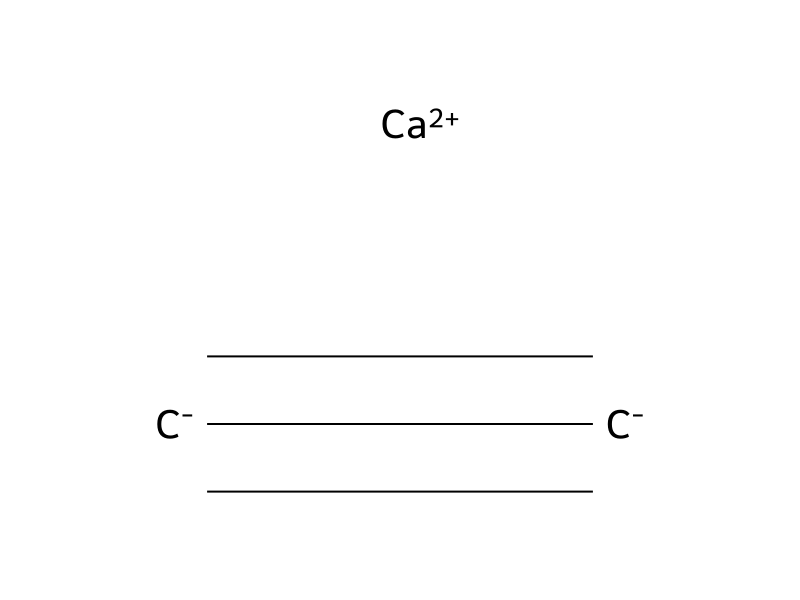
- Standard-SMILES
[C-]#[C-].[Ca+2]- InChIKey
UIXRSLJINYRGFQ-UHFFFAOYSA-N- Summenformel
- C2Ca
- Durchschnittliche Molmasse
- 64,1 g/mol
Namen und Bezeichner
- Bevorzugter Name
- CID 6352
- IUPAC
- calcium acetylide
- Lokaler Name
- Calciumacetylid
- Englischer Name
- Calcium carbide
- Summenformel
- C2Ca
- Molmasse
- 64.1
Namen und Synonyme
Datenbank-Bezeichner
- CAS
75-20-7
Eigenschaften
Berechnete Struktureigenschaften
- Polarare Oberfläche (TPSA)
- 0 Ų
- H-Brücken-Donoren
- 0
- H-Brücken-Akzeptoren
- 2
- Frei drehbare Bindungen
- 0
- Schwere Atome
- 3
- Formalladung
- 0
- Komplexität
- 8
Physikochemische Eigenschaften
- Schmelzpunkt
- 447 °C · 447°C
- Siedepunkt
- 2300 °C · 2300°C
- Dichte
- 2.22 g/mL · 2.22 g/mL at 25 °C(lit.)
- storage temp.
- water-free area
- Löslichkeit
- 2 O · reacts with H2O
- Aggregatzustand
- pieces
- Farbe
- Gray-black
- Wichte
- 2.22 · 2.22
- Wasserlöslichkeit
- hydrolyses
- Spezifische Wärmekapazität
- 0.98 J/ · Cp(crystal): 0.98 J/(g·K), at 25℃
- Merck
- 14 · 14,1656
- BRN
- 3909011 · 3909011
- Dielectric constant
- 5.8 · 5.8 - 7.0(0.0℃)
- Stabilität
- Stability Reacts violently with water liberating highly flammable gas (acetylene). Do not use water if this material is involved in a fire. Incompatible with moisture, water, strong oxidizing agents, alcohols, hydrogen chloride, magnesium.
- InChI
- 1S/C2.Ca/c1-2;/q-2;+2
- InChIKey
- UIXRSLJINYRGFQ-UHFFFAOYSA-N
- SMILES
- [Ca++].[C-]#[C-]
- EPA chemische Informationen
- Calcium carbide (75-20-7)
Sicherheit und Regulatorisches
Sicherheitsdaten
- F
- 10-21
- wgk
- 1
- tsca
- TSCA listed
- ridadr
- UN 1402 4.3/PG I/II (CALCIUM CARBIDE)
- hs_code
- 28491000
- risk_code
- 15-41-37/38
- hazard_code
- F
- safety_code
- 8-43-43A-39-26
- hazard_class
- 4.3
- packing_group
- II
- Speicherklasse
- 4.3 - Hazardous materials which set free flammable gases upon contact with water
- Giftige Stoffe Daten
- 75-20-7(Hazardous Substances Data)
- Hazard Classifications
- Eye Dam. 1Skin Irrit. 2STOT SE 3Water-react 1
Chemie und Industrie
Anwendungen
BeschreibungCalcium carbide,is a binary salt. It is a grayish-black hard solid that reacts with water to produce acetylene gas, a solid corrosive that is calcium hydroxide, and release heat. Acetylene gas is manufactured by reacting calcium carbide with water. Because acetylene is so unstable, it is not shipped in bulk quantities. Calcium carbide is shipped to acetylene-generating plants where it is reacted with water in a controlled reaction. After the reaction process, the acetylene gas is placed into specially designed containers with a honeycombed mesh inside for shipment and use. It is dissolved in acetone for stability. Calcium carbide has a specific gravity of 2.22, which is heavier than water. The four-digit UN identification number for calcium carbide is 1402. The NFPA 704 designation is health 3, flammability 3, and reactivity 2. The white section at the bottom of the diamond contains a W with a slash through it, indicating water reactivity. It is shipped in metal cans, drums, and specially designed covered bins on railcars and trucks. When shipped and stored, it should be kept in a cool, dry place. Primary uses are in the generation of acetylene gas for welding, vinyl acetate monomer, and as a reducing agent.
VerwendenCalcium carbide is the most relevant carbide industrially because of its important role as the basis of acetylene industry. In locations where there is shortage of petroleum, Calcium Carbide is used as the starting material for the production of acetylene (1 kg of carbide yields ~300 liters acetylene), which, in turn, can be used as a building block for a range of organic chemicals (e.g. vinyl acetate, acetaldehyde and acetic acid). In some locations, acetylene is also used to produce vinyl chloride, the raw material for the production of PVC. A less important use of Calcium Carbide is related to the ferilizers industry. It reacts with nitrogen to form calcium cyanamide, which is the starting material for the production of cyanamide (CH2N2). Cyanamide is a common agricultural product used to stimulate early foliation. Calcium Carbide can also be employed as desulfurizing agent for producing low-sulfur carbon steel. Also, it is used as a reducing agent to produce metals from their salts, e.g., for direct reduction of copper sulfide to metallic copper.
Darstellung
synthetischeCalcium carbide (CaC2) is manufactured by heating a lime and carbon mixture to 2000 to 2100°C (3632 to 3812°F) in an electric arc furnace. At those temperatures, the lime is reduced by carbon to calcium carbide and carbon monoxide (CO), according to the following reaction: CaO + 3C → CaC2 + CO Lime for the reaction is usually made by calcining limestone in a kiln at the plant site. The sources of carbon for the reaction are petroleum coke, metallurgical coke, and anthracite coal. Because impurities in the furnace charge remain in the calcium carbide product, the lime should contain no more than 0.5 percent each of magnesium oxide, aluminum oxide, and iron oxide, and 0.004 percent phosphorus. Also, the coke charge should be low in ash and sulfur. Analyses indicate that 0.2 to 1.0 percent ash and 5 to 6 percent sulfur are typical in petroleum coke. About 991 kilograms (kg) (2,185 pounds [lb]) of lime, 683 kg (1,506 lb) of coke, and 17 to 20 kg (37 to 44 lb) of electrode paste are required to produce 1 megagram (Mg) (2,205 lb) of calcium carbide.
Vor- und nachgelagerte Produkte
Vorgelagerte Rohstoffe
Nachgelagerte Produkte
Anbieter50 Anbieter
Zugehörige Reaktionen
Keine Reaktionsaufzeichnungen unter den aktuellen Filterkriterien.
Verknüpfte Notizen
Wird geladen…