Azide
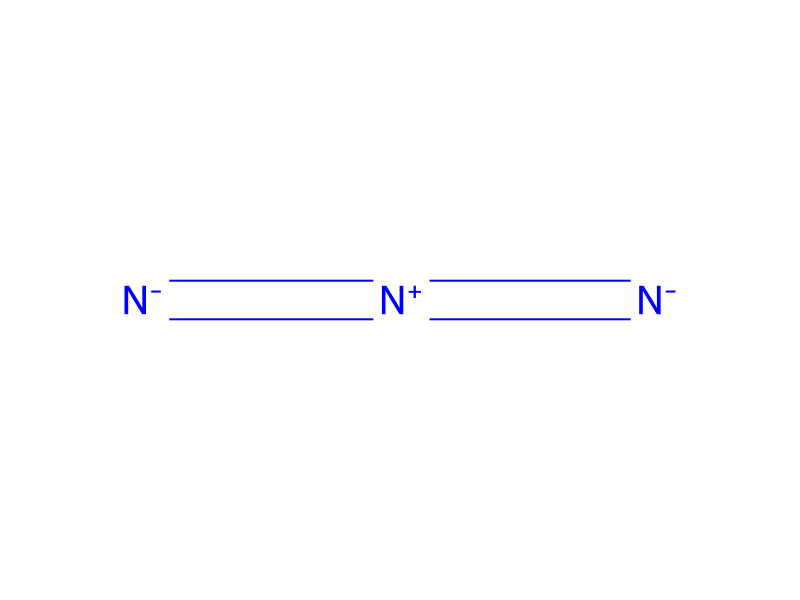
Grundinformationen
- CAS
68132-00-3- Standard-SMILES
[N-]=[N+]=[N-]- InChIKey
IVRMZWNICZWHMI-UHFFFAOYSA-N- Summenformel
- N3-
- Durchschnittliche Molmasse
- 42,021 g/mol
Überblick
Azide anion is a pseudohalide anion. It has a role as a mitochondrial respiratory-chain inhibitor. It is a conjugate base of a hydrogen azide.
Namen und Bezeichner
- Bevorzugter Name
- Azide
- IUPAC
- azide
- Englischer Name
- Polycyclopentadiene
- Summenformel
- N3-
- Molmasse
- 42.0201
Namen und Synonyme
Weitere Namen anzeigen
Datenbank-Bezeichner
- CAS
68132-00-3- ChEMBL
CHEMBL79455- ChEBI
CHEBI:40910- UNII
- 88BIA49L8P
- Nikkaji
- J231.714A
Eigenschaften
Berechnete Struktureigenschaften
- XLogP
- 1,5
- Polarare Oberfläche (TPSA)
- 3 Ų
- H-Brücken-Donoren
- 0
- H-Brücken-Akzeptoren
- 2
- Frei drehbare Bindungen
- 0
- Schwere Atome
- 3
- Formalladung
- -1
- Komplexität
- 15,5
Experimentelle und physikochemische Eigenschaften
Physikochemische Eigenschaften
- Kosmetik-Inhaltsstoffe Funktionen
- VISCOSITY CONTROLLING
- EPA chemische Informationen
- Naphtha (petroleum), light steam-cracked debenzenized polymers hydrogenated (68132-00-3)
Sicherheit und Regulatorisches
Gefahrenhinweise
Hazards Summary
All azide salts are unstable, and some explode after heat or shock. Organic azides are sensitized by metal salts or strong acids. Azides emit toxic fumes when heated to decomposition. [Sax] The azide group (N3) has an affinity for ferric iron in mitochondrial cytochrome oxidase. Like cyanide poisoning, azide poisoning disrupts cellular aerobic metabolism. [AHLS, p. 202] Most of the fulminates and azides of heavy metals are sensitive explosives. These materials do not make efficient explosives; their sole attraction is their sensitivity. [Reference #1] See Sodium azide.
Toxikologische Informationen
Sicherheitsdaten
- tsca
- TSCA listed
Chemie und Industrie
Anbieter3 Anbieter
Zugehörige Reaktionen
Keine Reaktionsaufzeichnungen unter den aktuellen Filterkriterien.
Notizen zur Verbindung
Wird geladen…