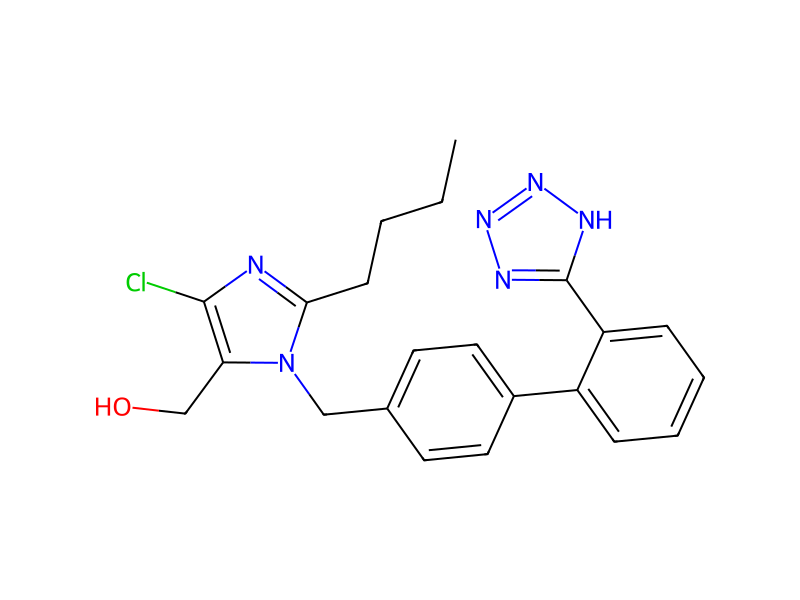
Grundinformationen
- Standard-SMILES
CCCCc1nc(Cl)c(CO)n1Cc1ccc(-c2ccccc2-c2nnn[nH]2)cc1- InChIKey
PSIFNNKUMBGKDQ-UHFFFAOYSA-N- Summenformel
- C22H23ClN6O
- Durchschnittliche Molmasse
- 422,9 g/mol
Überblick
Losartan is a biphenylyltetrazole where a 1,1'-biphenyl group is attached at the 5-position and has an additional trisubstituted imidazol-1-ylmethyl group at the 4'-position. It has a role as an antihypertensive agent, an anti-arrhythmia drug, an endothelin receptor antagonist and an angiotensin receptor antagonist. It is a member of imidazoles and a biphenylyltetrazole. It is a conjugate acid of a losartan(1-).
Namen und Bezeichner
- Bevorzugter Name
- Losartan
- IUPAC
- [2-butyl-5-chloro-3-[[4-[2-(2H-tetrazol-5-yl)phenyl]phenyl]methyl]imidazol-4-yl]methanol
- Englischer Name
- Losartan Impurity 15
- Summenformel
- C22H23ClN6O
- Molmasse
- 422.91062
Namen und Synonyme
Weitere Namen anzeigen
Datenbank-Bezeichner
- CAS
914465-66-0- ChEMBL
CHEMBL191- ChEBI
CHEBI:6541- UNII
- JMS50MPO89
- EC Number
- 601-329-8
- Nikkaji
- J276.444J
Eigenschaften
Berechnete Struktureigenschaften
- XLogP
- 4,3
- Polarare Oberfläche (TPSA)
- 92,5 Ų
- H-Brücken-Donoren
- 2
- H-Brücken-Akzeptoren
- 5
- Frei drehbare Bindungen
- 8
- Schwere Atome
- 30
- Formalladung
- 0
- Komplexität
- 520
Experimentelle und physikochemische Eigenschaften
Drugs
Pharmaceuticals -> Used in Switzerland
Pharmaceuticals
Pharmaceuticals -> Antihypertensives
Pharmaceuticals -> Listed in ZINC15
LogP
6.1
2.53
Solubility
<1mg/mL
4.70e-03 g/L
Human Drugs
Breast Feeding; Lactation; Milk, Human; Antihypertensive Agents; Angiotensin II Type 1 Receptor Blockers
Pharmaceuticals
Antihypertensive medicines
Melting Point
178-184
183.5-184.5 °C
183.5 - 184.5 °C
Dissociation Constants
5.5
pKa: 5-6
Collision Cross Section
201.6 Ų [M+H]+ [CCS Type: DT; Buffer gas: N2; Ionization: APCI+; Dataset: TOXCAST; Source Identifier: DTXSID3044209]
200.3 Ų [M+H]+ [CCS Type: TW; Method: Major Mix IMS/Tof Calibration Kit (Waters)]
199.2 Ų [M+H]+ [CCS Type: TW; Method: calibrated with polyalanine and drug standards]
197.63 Ų [M+H]+ [CCS Type: TW; Method: calibrated with polyalanine and drug standards]
200.49 Ų [M+H]+
Sicherheit und Regulatorisches
GHS-Klassifizierung
GHS Classification
Danger
H315 (48.1%): Causes skin irritation [Warning Skin corrosion/irritation]
P203, P260, P261, P263, P264, P264+P265, P270, P271, P272, P273, P280, P302+P352, P304+P340, P305+P351+P338, P318, P319, P321, P332+P317, P333+P317, P337+P317, P362+P364, P403+P233, P405, and P501 (click each P-code to see the statement)
Aggregated GHS information provided per 81 reports by companies from 10 notifications to the ECHA C&L Inventory. Each notification may be associated with multiple companies.
Gefahrenhinweise
FDA Requirements
The Approved Drug Products with Therapeutic Equivalence Evaluations identifies currently marketed prescription drug products, including losartan potassium, approved on the basis of safety and effectiveness by FDA under sections 505 of the Federal Food, Drug, and Cosmetic Act. /Losartan potassium/
Sicherheit und Schutzausrüstung
Fire Fighting Procedures
Suitable extinguishing media: Use water spray, alcohol-resistant foam, dry chemical or carbon dioxide.
Advice for firefighters: Wear self contained breathing apparatus for fire fighting if necessary.
Storage Conditions
Store at 25 °C (77 °F); excursions permitted to 15-30 °C (59-86 °F). Keep container tightly closed. Protect from light.
Conditions for safe storage, including any incompatibilities: Keep container tightly closed in a dry and well-ventilated place. Store under inert gas. Moisture sensitive.
Cleanup Methods
Accidental Release Measures. Personal precautions, protective equipment and emergency procedures: Avoid dust formation. Avoid breathing vapours, mist or gas. Environmental precautions: Do not let product enter drains. Methods and materials for containment and cleaning up: Sweep up and shovel. Keep in suitable, closed containers for disposal.
Disposal Methods
SRP: Expired or waste pharmaceuticals shall carefully take into consideration applicable DEA, EPA, and FDA regulations. It is not appropriate to dispose by flushing the pharmaceutical down the toilet or discarding to trash. If possible return the pharmaceutical to the manufacturer for proper disposal being careful to properly label and securely package the material. Alternatively, the waste pharmaceutical shall be labeled, securely packaged and transported by a state licensed medical waste contractor to dispose by burial in a licensed hazardous or toxic waste landfill or incinerator.
SRP: At the time of review, regulatory criteria for small quantity disposal are subject to significant revision, however, household quantities of waste pharmaceuticals may be managed as follows: Mix with wet cat litter or coffee grounds, double bag in plastic, discard in trash.
Waste treatment methods: Product: Offer surplus and non-recyclable solutions to a licensed disposal company. Contaminated packaging: Dispose of as unused product.
Preventive Measures
Precautions for safe handling: Provide appropriate exhaust ventilation at places where dust is formed. Normal measures for preventive fire protection.
Appropriate engineering controls: General industrial hygiene practice.
Gloves must be inspected prior to use. Use proper glove removal technique (without touching glove's outer surface) to avoid skin contact with this product. Dispose of contaminated gloves after use in accordance with applicable laws and good laboratory practices. Wash and dry hands.
SRP: Local exhaust ventilation should be applied wherever there is an incidence of point source emissions or dispersion of regulated contaminants in the work area. Ventilation control of the contaminant as close to its point of generation is both the most economical and safest method to minimize personnel exposure to airborne contaminants. Ensure that the local ventilation moves the contaminant away from the worker.
Personal Protective Equipment (PPE)
Eye/face protection: Use equipment for eye protection tested and approved under appropriate government standards such as NIOSH (US) or EN 166(EU).
Skin protection: Handle with gloves.
Body Protection: Choose body protection in relation to its type, to the concentration and amount of dangerous substances, and to the specific work-place., The type of protective equipment must be selected according to the concentration and amount of the dangerous substance at the specific workplace.
Respiratory protection: Respiratory protection is not required. Where protection from nuisance levels of dusts are desired, use type N95 (US) or type P1 (EN 143) dust masks. Use respirators and components tested and approved under appropriate government standards such as NIOSH (US) or CEN (EU).
Toxikologische Informationen
Interactions
... This study was undertaken to evaluate how the chronic administration of deoxycortisone acetate (DOCA) modifies the effects of losartan on BP, renal injury, and other variables in /N(G)-nitro-L-arginine methyl ester (L-NAME)/ hypertensive rats. The following groups were used: Control, DOCA, L-NAME, L-NAME + losartan, L-NAME + DOCA, and L-NAME + DOCA + losartan. Tail systolic BP was measured twice a week. After 4-wk evolution, mean arterial pressure and metabolic, morphologic, and renal variables were measured. The final mean arterial pressure values were 116 +/- 6 mm Hg for control, 107 +/- 2 mmHg for DOCA, 151 +/- 5 mmHg for L-NAME, 123 +/- 2 mmHg for L-NAME + losartan, 170 +/- 3 mm Hg for L-NAME + DOCA, and 171 +/- 5.5 mmHg for L-NAME + DOCA + losartan. Losartan prevented microalbuminuria, hyaline arteriopathy, and glomerulosclerosis of L-NAME hypertension but was ineffective in L-NAME + DOCA-treated rats. ... Plasma renin activity was suppressed in the DOCA (0.55 +/- 0.2) and L-NAME + DOCA (0.60 +/- 10.2) groups but unsuppressed in the L-NAME + DOCA + losartan group (5.8 +/- 1). The conclusion is that DOCA blocks the preventive effect of losartan on the increased BP and renal injury of L-NAME hypertension ... These data also suggest that losartan prevents L-NAME hypertension by blocking the activity of systemic Ang II. /Salt not specified/
NSAIDs are known to attenuate the effects of some antihypertensive medications ... A multicenter study assessing the effect of indomethacin on the antihypertensive effects of losartan and captopril /was conducted/. After 4 weeks of placebo washout, hypertensive patients received 6 weeks of active antihypertensive therapy with ... 50 mg losartan once daily (n=111) ... This was followed by 1 week of concomitant therapy with indomethacin (75 mg daily). The primary outcome measure was the change in mean 24-hour ambulatory diastolic blood pressure after the addition of indomethacin. ... Losartan significantly lowered ambulatory diastolic blood pressure (losartan -5.3 mm Hg, P:<0.001 ...) after 6 weeks of therapy. Indomethacin significantly attenuated the 24-hour ambulatory diastolic blood pressure for ... losartan (2.2 mm Hg, P:<0.05) ... Changes in daytime diastolic blood pressure (7:00 AM to 11:00 PM) were similar to the 24-hour response in both groups. Nighttime diastolic blood pressure (11:01 PM to 6:59 AM) ... with losartan was unaffected (0.4 mm Hg). Thus, concurrent treatment with indomethacin similarly attenuates the 24-hour antihypertensive response to losartan ... /Salt not specified/
Potential pharmacologic interaction (attenuated hypotensive effects) when angiotensin II receptor antagonists are used concomitantly with nonsteroidal anti-inflammatory agents (NSAIAs), including selective cyclooxygenase-2 (COX-2) inhibitors. Possible deterioration of renal function in geriatric, volume-depleted (including those receiving concomitant diuretic therapy), or renally impaired patients; renal function should be monitored periodically in patients receiving concomitant therapy with losartan and an NSAIA, including selective COX-2 inhibitors.
Decreased plasma concentrations of losartan and its active metabolite observed when losartan potassium is used concomitantly with rifampin.
For more Interactions (Complete) data for Losartan (20 total), please visit the HSDB record page.
Environmental Fate
TERRESTRIAL FATE: Based on a classification scheme(1), an estimated Koc value of 1.4X10+5(SRC), determined from a structure estimation method(2), indicates that losartan is expected to be immobile in soil(SRC). The pKa of losartan is 5.05(3), indicating that this compound will exist partially in the cation form in the environment and cations generally adsorb more strongly to soils containing organic carbon and clay than their neutral counterparts(4). Volatilization of losartan from moist soil surfaces is not expected to be an important fate process(SRC) given an estimated Henry's Law constant of 3.3X10⁻¹⁶ atm-cu m/mole(SRC), using a fragment constant estimation method(5). Losartan is not expected to volatilize from dry soil surfaces(SRC) based upon an estimated vapor pressure of 5.4X10⁻¹⁸ mm Hg at 25 °C(SRC), determined from a fragment constant method(2). Biodegradation data in soil were not available(SRC, 2014).
AQUATIC FATE: Based on a classification scheme(1), an estimated Koc value of 1.4X10+5(SRC), determined from a structure estimation method(2), indicates that losartan is expected to adsorb to suspended solids and sediment(SRC). Volatilization from water surfaces is not expected(3) based upon an estimated Henry's Law constant of 3.3X10⁻¹⁶ atm-cu m/mole(SRC), developed using a fragment constant estimation method(4). According to a classification scheme(5), an estimated BCF of 110(SRC), from an estimated log Kow of 4.01(2) and a regression-derived equation(2), suggests the potential for bioconcentration in aquatic organisms is high(SRC). Biodegradation data in water were not available(SRC, 2014).
ATMOSPHERIC FATE: According to a model of gas/particle partitioning of semivolatile organic compounds in the atmosphere(1), losartan, which has an estimated vapor pressure of 5.4X10⁻¹⁸ mm Hg at 25 °C(SRC), determined from a fragment constant method(2), is expected to exist solely in the particulate phase in the ambient atmosphere. Particulate-phase losartan may be removed from the air by wet and dry deposition(SRC). Losartan contains chromophores that absorb at wavelengths >290 nm(3) and, therefore, may be susceptible to direct photolysis by sunlight(SRC).
Toxicity Summary
IDENTIFICATION AND USE: Losartan is a light yellow solid that is formulated into oral tablets. Losartan is an angiotensin II type 1 (AT1) receptor antagonist. It is used alone or in combination with other classes of antihypertensive agents in the management of hypertension. It is also used to reduce the risk of stroke in patients with hypertension and left ventricular hypertrophy and for the treatment of diabetic nephropathy in patients with type 2 diabetes and a history of hypertension. HUMAN EXPOSURE AND TOXICITY: The most likely manifestations of losartan overdose include hypotension and tachycardia; bradycardia could be encountered if parasympathetic (vagal) stimulation occurs. The use of lorsartan during pregnancy is contraindicated. While use during the first trimester does not suggest a risk of major anomalies, use during the second and third trimester may cause teratogenicity and severe fetal and neonatal toxicity. Fetal toxic effects may include anuria, oligohydramnios, fetal hypocalvaria, intrauterine growth restriction, premature birth, and patent ductus arteriosus. Anuria-associated oligohydramnios may produce fetal limb contractures, craniofacial deformation, and pulmonary hypoplasia. Severe anuria and hypotension that is resistant to both pressor agents and volume expansion may occur in the newborn following in utero exposure to losartan. ANIMAL STUDIES: Losartan potassium was not carcinogenic when administered at maximally tolerated dosages to rats and mice. Female rats given losartan had a slightly higher incidence of pancreatic acinar adenoma. Also, fertility and reproductive performance were not affected in studies with male rats given oral doses of losartan. The administration of toxic dosage levels in females was associated with a significant decrease in the number of corpora lutea/female, implants/female, and live fetuses/female at C-section. The relationship of these findings to drug-treatment is uncertain since there was no effect at these dosage levels on implants/pregnant female, percent post-implantation loss, or live animals/litter at parturition. Losartan has been shown to produce adverse effects in rat fetuses and neonates, including decreased body weight, delayed physical and behavioral development, mortality and renal toxicity. With the exception of neonatal weight gain doses associated with these effects exceeded 25 mg/kg. These findings are attributed to drug exposure in late gestation and during lactation. Losartan was negative in the microbial mutagenesis and V-79 mammalian cell mutagenesis assays and in the in vitro alkaline elution assay and in vitro and in vivo chromosomal aberration assays. In addition, the active metabolite showed no evidence of genotoxicity in the microbial mutagenesis, in vitro alkaline elution assay, and in vitro chromosomal aberration assays.
In a recent case report, a female patient aged 34 with a medical history of asthma, hypertension, and chronic respiratory failure had an overdose of losartan. She intentionally ingested 30 tablets of 25 mg of losartan in a suicide attempt. Illicit substance use was ruled out through a negative urine drug screen. During her hospitalization, the patient developed acute kidney injury and hyperkalemia. Based on the patient's complaint of diffuse abdominal pain, elevated lipase levels (161 U/L), and computed tomography (CT) imaging findings, acute pancreatitis was diagnosed. Supportive care, including fluid resuscitation, pain management, and continuous monitoring of laboratory parameters, was provided, gradually improving her condition. The healthcare team should be mindful of the possibility of drug-induced acute pancreatitis following an overdose of losartan from acute kidney injury and hyperkalemia.
Soil Adsorption/Mobility
Using a structure estimation method based on molecular connectivity indices(1), the Koc of losartan can be estimated to be 1.4X10+6(SRC). According to a classification scheme(2), this estimated Koc value suggests that losartan is expected to be immobile in soil. The pKa of losartan is 5.50(3), indicating that this compound will exist partially in the cation form in the environment and cations generally adsorb more strongly to soils containing organic carbon and clay than their neutral counterparts(4).
Human Toxicity Excerpts
/HUMAN EXPOSURE STUDIES/ In this preliminary, single-dose, open-label, cross-over study conducted in 12 healthy volunteers, psychomotor assessment was carried out by four tests: Simple reaction time (SRT), multiple choice reaction time test (MCRT), critical flicker fusion frequency threshold test (CFFT), and tracking performance test (TPT). Each volunteer received a single dose of each of the three test drugs with a washout period of 10 days between different test sessions and then evaluated for post-drug scores at 2-hr intervals up to 12 hr and then at 24 hr. The changes from the baseline scores by the test drug were statistically analyzed. All the three antihypertensive drugs caused significant improvement in a similar fashion on SRT, MCRT calculated as error index, CFFT, and TPT. Aliskiren caused numerically more improvement than the other two test drugs, suggesting better cognitive profile. However, inter-drug comparisons were nonsignificant. The results of the study highlight improvement of the cognitive functions equally by ramipril, losartan, and aliskiren. The results of the study could be of immense clinical utility in ambulatory hypertensive patients especially engaged in sensory-motor coordination tasks like driving and operating on mechanical tools.
/SIGNS AND SYMPTOMS/ Limited data are available in regard to overdosage in humans. The most likely manifestation of overdosage would be hypotension and tachycardia; bradycardia could occur from parasympathetic (vagal) stimulation.
/CASE REPORTS/ The fetotoxic effects of angiotensin converting enzyme inhibitors when used during the second half of pregnancy are well known. The more recently developed angiotensin II receptor antagonists appear to yield similar fetal abnormalities. We report a premature infant born to a 41-year-old mother with a long history of infertility who had received losartan therapy for hypertension throughout an undetected pregnancy. Ultrasound examination 2 days prior to delivery identified a single fetus at 29 weeks gestation, anhydramnios, and an empty fetal bladder. The neonatal course was complicated by oliguria, hyperkalemia, marked renal dysfunction, respiratory failure, joint contractures, and a large anterior fontanelle with widely separated sutures. Hypotension (mean arterial pressure <25 torr) on day 1 responded to volume expansion, dopamine, and hydrocortisone. Serum creatinine reached a maximum of 2.7 mg/dL on day 6 and decreased to 0.4 by day 56. No formal urinalysis was performed, but the urine was reported to be visually clear throughout the course. Although a renal ultrasound on day 2 was normal, a follow-up study at 7 months revealed bilateral generalized parenchymal echogenicity, consistent with medical renal disease. Since then, weight and length have been at the 5th percentile or less, with apparent renal tubular acidosis necessitating the addition of sodium citrate supplements. ...
/CASE REPORTS/ A case of losartan-induced azotemia in a 46-yr-old male diabetic recipient of a kidney transplant who received treatment with 50-100 mg/day of losartan for unsatisfactory blood pressure control is reported. The patient was first on enalapril, but was changed to losartan when renal function deteriorated. On losartan, the patient also had increased serum creatinine concentration and renal insufficiency.
For more Human Toxicity Excerpts (Complete) data for Losartan (12 total), please visit the HSDB record page.
Drug Induced Liver Injury
Drug-Induced Liver Injury Severity and Toxicity (DILIst)
losartan
DILI Positive
Oral
DOI:10.1016/j.drudis.2019.09.022
Environmental Bioconcentration
An estimated BCF of 110 was calculated in fish for losartan(SRC), using an estimated log Kow of 4.01(1) and a regression-derived equation(1). According to a classification scheme(2), this BCF suggests the potential for bioconcentration in aquatic organisms is high(SRC).
Volatilization from Water/Soil
The Henry's Law constant for losartan is estimated as 3.3X10⁻¹⁶ atm-cu m/mole(SRC) using a fragment constant estimation method(1). This Henry's Law constant indicates that losartan is expected to be essentially nonvolatile from water and moist soil surfaces(2). Losartan is not expected to volatilize from dry soil surfaces(SRC) based upon an estimated vapor pressure of 5.4X10⁻¹⁸ mm Hg(SRC), determined from a fragment constant method(3).
Regulatorische Informationen
FDA Requirements
The Approved Drug Products with Therapeutic Equivalence Evaluations identifies currently marketed prescription drug products, including losartan potassium, approved on the basis of safety and effectiveness by FDA under sections 505 of the Federal Food, Drug, and Cosmetic Act. /Losartan potassium/
Chemie und Industrie
Pharmakologische Informationen
ATC Code
C09CA01
C - Cardiovascular system
QC - Cardiovascular system
C09CA01
Pharmacodynamics
Losartan is an angiotensin II receptor blocker used to treat hypertension, diabetic nephropathy, and to reduce the risk of stroke. Losartan has a long duration of action as it is given once daily. Patients taking losartan should be regularly monitored for hypotension, renal function, and potassium levels.
Mechanism of Action
Losartan reversibly and competitively prevents angiotensin II binding to the AT<sub>1</sub> receptor in tissues like vascular smooth muscle and the adrenal gland. Losartan and its active metabolite bind the AT<sub>1</sub> receptor with 1000 times more affinity than they bind to the AT<sub>2</sub> receptor. The active metabolite of losartan is 10-40 times more potent by weight than unmetabolized losartan as an inhibitor of AT<sub>1</sub> and is a non-competitive inhibitor. Losartan's prevention of angiotensin II binding causes vascular smooth muscle relaxation, lowering blood pressure. Angiotensin II would otherwise bind to the AT<sub>1</sub> receptor and induce vasoconstriction, raising blood pressure.
Angiotensin II (formed from angiotensin I in a reaction catalyzed by angiotensin converting enzyme (ACE, kininase II)), is a potent vasoconstrictor, the primary vasoactive hormone of the renin-angiotensin system and an important component in the pathophysiology of hypertension. It also stimulates aldosterone secretion by the adrenal cortex. Losartan and its principal active metabolite block the vasoconstrictor and aldosterone-secreting effects of angiotensin II by selectively blocking the binding of angiotensin II to the AT1 receptor found in many tissues, (e.g., vascular smooth muscle, adrenal gland). There is also an AT2 receptor found in many tissues but it is not known to be associated with cardiovascular homeostasis. Both losartan and its principal active metabolite do not exhibit any partial agonist activity at the AT1 receptor and have much greater affinity (about 1000-fold) for the AT1 receptor than for the AT2 receptor. In vitro binding studies indicate that losartan is a reversible, competitive inhibitor of the AT1 receptor. The active metabolite is 10 to 40 times more potent by weight than losartan and appears to be a reversible, non-competitive inhibitor of the AT1 receptor. Neither losartan nor its active metabolite inhibits ACE (kininase II, the enzyme that converts angiotensin I to angiotensin II and degrades bradykinin); nor do they bind to or block other hormone receptors or ion channels known to be important in cardiovascular regulation.
We investigated the effects of angiotensin II (Ang II) type 1 receptor blockade with losartan on the renin-angiotensin-aldosterone system in hypertensive patients (supine diastolic blood pressure, 95 to 110 mm Hg). Qualifying patients (n = 51) were allocated to placebo, 25 or 100 mg losartan, or 20 mg enalapril. Blood pressure, plasma drug concentrations, and renin-angiotensin-aldosterone system mediators were measured on 4 inpatient days: end of placebo run-in, after first dose, and 2 and 6 weeks of treatment. Plasma drug concentrations were similar after the first and last doses of losartan. At 6 weeks, 100 mg losartan and 20 mg enalapril showed comparable antihypertensive activity. Four hours after dosing, compared with the run-in day, 100 mg losartan increased plasma renin activity 1.7-fold and Ang II 2.5-fold, whereas enalapril increased plasma renin activity 2.8-fold and decreased Ang II 77%. Both drugs decreased plasma aldosterone concentration. For losartan, plasma renin activity and Ang II increases were greater at 2 than at 6 weeks. Effects of losartan were dose related. After the last dose of losartan, plasma renin activity and Ang II changes were similar to placebo changes by 36 hours. These results indicate that long-term blockade of the feedback Ang II receptor in hypertensive patients produces modest increases of plasma renin activity and Ang II that do not appear to affect the antihypertensive response to the antagonist. /Salt not specified/
IL-1beta is a potent proinflammatory, pro-fibrogenetic and pro-athrosclerosis cytokine which has been shown to play an important role in an expanding number of noninfectious, chronic inflammatory conditions including cardiovascular disease, renal fibrosis, rheumatoid arthritis and even type 2 diabetes. Losartan is an angiotensin II receptor antagonist widely used for the treatment of hypertension, diabetic nephropathy and congestive heart failure. In this study, we attempted to clarify whether losartan has an inhibitory effect on IL-1beta. To further elucidate the molecular mechanism underlying the anti-IL-1beta property of losartan, we studied the LPS+ATP-induced activation of NALP3 inflammasome which controls the muturation and secretion of IL-1beta. LPS and ATP were used to stimulate the release of IL-1beta from thioglycollate-elicited macrophages from BALB/c mice. The production of IL-1beta was evaluated by ELISA assay and NALP3, caspase-1, IL-beta mRNA levels were determined by reverse transcription-polymerase chain reaction. In cultured thioglycollate-elicited macrophages, we observed that LPS + ATP greatly enhanced IL-1 beta secretion (6938.00 +/- 83.45; P < 0.05) and the mRNA levels of NALP3, caspase-1 which are two main components of NALP3 inflammasome (60.88 +/- 8.28; 1.31 +/- 0.04, P < 0.05 for both). The macrophages co-cultured with losartan showed low production of IL-1beta (3907.50 +/- 143.61; P < 0.05) and low production of NALP3, caspase-1mRNA (29.82 +/- 6.92; 1.12 +/- 0.05, P < 0.05 for both). Losartan did not reduce IL-1beta mRNA(P > 0.05). Our results show that the NALP3 inflammasome is up-regulated and activated in the mouse macrophage in response to LPS + ATP stimulation. Losartan is able to suppress the LPS + ATP-induced production of IL-1beta protein. In addition, this effectmay be partially mediated by suppressing NALP3 inflammasome activation.
The present study aimed to investigate the molecular pharmacodynamic mechanisms of losartan used in the treatment of hypertension. A total of 12 spontaneously hypertensive rats (SHR) were divided randomly into an SHR group treated with saline and LOS group treated with losartan. Six Wistar-kyoto rats (WKY) were enrolled as the WKY group with saline in the study. The LOS group received 30 mg/kg/day losartan by intragastric injection, while the SHR and WKY were fed the same volume of saline. The dosage was modulated according to the weekly weight. Changes in blood pressure were measured by the indirect tail cuff method. Angiotensin (Ang) II production in the plasma and renal tissue was measured by an immunoradiometric method. Na+/H+ exchanger (NHE)3 and serum and glucocorticoid-inducible kinase (SGK)1 were assessed by quantitative polymerase chain reaction (qPCR) and western blot analysis. When compared with the WKY group, the blood pressure of the SHR and LOS groups were higher prior to treatment with losartan. Following two weeks, blood pressure was reduced and the trend continued to decrease over the following six weeks. The plasma and renal tissue levels of Ang II in the SHR and LOS groups were significantly higher than those in the WKY group. NHE3 and SGK1 were increased at the mRNA and protein level in the SHR group, and losartan reduced the expression of both of them. The results suggested that in hypertensive rats, the circular and tissue renin angiotensin systems were activated, and the increased Ang II stimulated the expression of NHE3 and SGK1, which was reduced by losartan. Therefore, the effects of losartan in hypertension may be associated with the Ang II-SGK1-NHE3 of intra-renal tissue.
For more Mechanism of Action (Complete) data for Losartan (7 total), please visit the HSDB record page.
Biological Half-Life
The terminal elimination half life of losartan is 1.5-2.5 hours while the active metabolite has a half life of 6-9 hours.
The terminal half-life of losartan is about 2 hours and of the metabolite is about 6-9 hours.
Metabolism/Metabolites
Losartan is metabolized to an aldehyde intermediate, E-3179, which is further metabolized to a carboxylic acid, E-3174, by cytochrome P450s like CYP2C9. Losartan can also be hydroxylated to an inactive metabolite, P1. Approximately 14% of losartan is metabolized to E-3174. Losartan can be metabolized by CYP3A4, CYP2C9, and CYP2C10. Losartan can also be glucuronidated by UGT1A1, UGT1A3, UGT1A10, UGT2B7, and UGT 2B17.
Losartan is an orally active agent that undergoes substantial first-pass metabolism by cytochrome P450 enzymes. It is converted, in part, to an active carboxylic acid metabolite that is responsible for most of the angiotensin II receptor antagonism that follows losartan treatment. Losartan metabolites have been identified in human plasma and urine. In addition to the active carboxylic acid metabolite, several inactive metabolites are formed. Following oral and intravenous administration of (14)C-labeled losartan potassium, circulating plasma radioactivity is primarily attributed to losartan and its active metabolite. In vitro studies indicate that cytochrome P450 2C9 and 3A4 are involved in the biotransformation of losartan to its metabolites. Minimal conversion of losartan to the active metabolite (less than 1% of the dose compared to 14% of the dose in normal subjects) was seen in about one percent of individuals studied.
Losartan has known human metabolites that include Losartan carboxylic acid and 2-[5-[2-[4-[[2-butyl-5-chloro-4-(hydroxymethyl)-1H-imidazol-3-ium-3-yl]methyl]phenyl]phenyl]-1,5-dihydrotetrazol-2-yl]-6-(dihydroxymethyl)oxane-3,4,5-triol.
FDA Pharmacological Classification
JMS50MPO89
LOSARTAN
Mechanisms of Action [MoA] - Angiotensin 2 Receptor Antagonists
Established Pharmacologic Class [EPC] - Angiotensin 2 Receptor Blocker
Losartan is an Angiotensin 2 Receptor Blocker. The mechanism of action of losartan is as an Angiotensin 2 Receptor Antagonist.
LOSARTAN
MeSH Pharmacological Classification
Agents used for the treatment or prevention of cardiac arrhythmias. They may affect the polarization-repolarization phase of the action potential, its excitability or refractoriness, or impulse conduction or membrane responsiveness within cardiac fibers. Anti-arrhythmia agents are often classed into four main groups according to their mechanism of action: sodium channel blockade, beta-adrenergic blockade, repolarization prolongation, or calcium channel blockade.
Drugs used in the treatment of acute or chronic vascular HYPERTENSION regardless of pharmacological mechanism. Among the antihypertensive agents are DIURETICS; (especially DIURETICS, THIAZIDE); ADRENERGIC BETA-ANTAGONISTS; ADRENERGIC ALPHA-ANTAGONISTS; ANGIOTENSIN-CONVERTING ENZYME INHIBITORS; CALCIUM CHANNEL BLOCKERS; GANGLIONIC BLOCKERS; and VASODILATOR AGENTS.
Agents that antagonize ANGIOTENSIN II TYPE 1 RECEPTOR. Included are ANGIOTENSIN II analogs such as SARALASIN and biphenylimidazoles such as LOSARTAN. Some are used as ANTIHYPERTENSIVE AGENTS.
Absorption, Distribution and Excretion
Losartan is approximately 33% orally bioavailable. Losartan has a Tmax of 1 hour and the active metabolite has a Tmax of 3-4 hours. Taking losartan with food decreases the Cmax but does only results in a 10% decrease in the AUC of losartan and its active metabolite. A 50-80mg oral dose of losartan leads to a Cmax of 200-250ng/mL.
A single oral dose of losartan leads to 4% recovery in the urine as unchanged losartan, 6% in the urine as the active metabolite. Oral radiolabelled losartan is 35% recovered in urine and 60% in feces. Intravenous radiolabelled losartan is 45% recovered in urine and 50% in feces.
The volume of distribution of losartan is 34.4±17.9L and 10.3±1.1L for the active metabolite (E-3174).
Losartan has a total plasma clearance of 600mL/min and a renal clearance of 75mL/min. E-3174, the active metabolite, has a total plasma clearance of 50mL/min and a renal clearance of 25mL/min.
It is not known whether losartan is excreted in human milk, but significant levels of losartan and its active metabolite were shown to be present in rat milk.
Following oral administration, losartan is well absorbed (based on absorption of radiolabeled losartan) and undergoes substantial first-pass metabolism; the systemic bioavailability of losartan is approximately 33%. About 14% of an orally-administered dose of losartan is converted to the active metabolite. Mean peak concentrations of losartan and its active metabolite are reached in 1 hour and in 3-4 hours, respectively. While maximum plasma concentrations of losartan and its active metabolite are approximately equal, the AUC of the metabolite is about 4 times as great as that of losartan. A meal slows absorption of losartan and decreases its Cmax but has only minor effects on losartan AUC or on the AUC of the metabolite (about 10% decreased).
Verwendung und Herstellung
Uses
Angiotensin II Type 1 Receptor Blockers; Anti-Arrhythmia Agents; Antihypertensive Agents
MEDICATION
Use (kg; approx.) in Germany (2009): >5000
Formulations/Preparations
Table: Losartan Potassium Preparations [Table#6662]
Table: Losartan Potassium Combination Preparations [Table#6663]
Use Classification
Pharmaceuticals -> Cardiovascular system -> Antihypertensions
Pharmaceuticals
General Manufacturing Information
The main ingredient in the drug Cozaar ... (tablets)
The main ingredient in the drug Hyzaar ... (tablets) /Losartan potassium - hydrochlorothiazide/
Anbieter8 Anbieter
Zugehörige Reaktionen
Keine Reaktionsaufzeichnungen unter den aktuellen Filterkriterien.
Verknüpfte Notizen
Wird geladen…