StartseiteMCPWorkbenchSkills
StartseiteWorkbenchBenachrichtigungenMein Bereich
llms.txt · MCP-AnleitungDatenschutz · Nutzungsbedingungen · Supportv1.8.3
  1. Startseite
  2. /Verbindung

1,1'-(1,3-Phenylen)bis-1H-pyrrol-2,5-dion

N,N'-1,3-Phenylenedimaleimide

HCID 18156
Neue Reaktion
Drucken
GrundinformationenNamen und BezeichnerEigenschaftenSicherheit und RegulatorischesChemie und IndustrieZugehörige ReaktionenNotizen zur Verbindung
TeilstruktursucheÄhnliche Strukturen suchen

Grundinformationen

CAS
3006-93-7
Standard-SMILES
O=C1C=CC(=O)N1c1cccc(N2C(=O)C=CC2=O)c1
InChIKey
IPJGAEWUPXWFPL-UHFFFAOYSA-N
Summenformel
C14H8N2O4
Durchschnittliche Molmasse
268,22 g/mol
Monoisotopische Masse
268,04840674

Namen und Bezeichner

Bevorzugter Name
N,N'-1,3-Phenylenedimaleimide
IUPAC
1-[3-(2,5-dioxopyrrol-1-yl)phenyl]pyrrole-2,5-dione
Lokaler Name
1,1'-(1,3-Phenylen)bis-1H-pyrrol-2,5-dion
Englischer Name
N,N'-1,3-Phenylene bismaleimide
Summenformel
C14H8N2O4
Molmasse
268.22

Namen und Synonyme

3006-93-7N,N'-1,3-Phenylenedimaleimidem-Dimaleimidobenzenem-PhenylenedimaleimideN,N'-m-Phenylenedimaleimidem-Phenylenebismaleimide1,3-Dimaleimidobenzene1,3-Bismaleimidobenzene1,3-PhenylenebismaleimideM-PhdmHVA 2HVA-2 curing agent
Weitere Namen anzeigen
hva2N,N'-1,3-PHENYLENEBISMALEIMIDE1,3-PDMVANAX MBM1,1'-(1,3ON61250000HVA-2(PDM)
N,N'-m-Phenylenemaleimide1H-Pyrrole-2,5-dione, 1,1'-(1,3-phenylene)bis-N,N'-(m-Phenylene)bismaleimideNSC 19639N,N'-(m-Phenylenedimaleimide)DTXSID3044415Maleimide, N,N'-m-phenylenedi-mDimaleimidobenzene

Datenbank-Bezeichner

CAS
3006-93-7
PubChem CID
18156
DTXSID
DTXSID3044415
ChEMBL
CHEMBL573689
UNII
MD8KF155CT
EC Number
221-112-8
Nikkaji

Eigenschaften

Berechnete Struktureigenschaften

XLogP
0,2
Polarare Oberfläche (TPSA)
74,8 Ų
H-Brücken-Donoren
0
H-Brücken-Akzeptoren
4
Frei drehbare Bindungen
2
Schwere Atome
20
Formalladung
0
Komplexität
480

Experimentelle und physikochemische Eigenschaften

PolymersPlastics & Rubber -> Curing Agents (Aromatic)
Physical Description · 2 Einträge

Dry Powder; Wet Solid

Yellow powder; [Aldrich MSDS] Yellow to light brown odorless powder; [R.T. Vanderbilt MSDS]

Collision Cross Section155.0 Ų [M-H]- [CCS Type: DT; Buffer gas: N2; Ionization: ESI-; Dataset: TOXCAST; Source Identifier: DTXSID3044415]

Physikochemische Eigenschaften

Schmelzpunkt
198 · 198-201 °C(lit.)
Siedepunkt
411.39 °C · 411.39°C (rough estimate)
Dichte
1.314 · 1.3140 (rough estimate)
Dampfdruck
0 Pa · 0Pa at 25℃
Brechungsindex
1.591 · 1.5910 (estimate)
Flammpunkt
208 ℃ · >208℃
storage temp.
Sealed in dry,Room Temperature

Sicherheit und Regulatorisches

Sicherheitsangaben dienen nur zur Orientierung und ersetzen weder das Sicherheitsdatenblatt (SDB) des Lieferanten noch geltende Vorschriften oder eine fachliche Bewertung.

GHS-Klassifizierung

GHS Classification · 5 Einträge

This chemical does not meet GHS hazard criteria for 0.8% (7 of 872) of reports.

Danger

H302 (88.5%): Harmful if swallowed [Warning Acute toxicity, oral]

P260, P261, P262, P264, P264+P265, P270, P271, P272, P280, P284, P301+P317, P302+P352, P304+P340, P305+P354+P338, P316, P317, P320, P321, P330, P333+P317, P361+P364, P362+P364, P403+P233, P405, and P501 (click each P-code to see the statement)

Aggregated GHS information provided per 872 reports by companies from 24 notifications to the ECHA C&L Inventory. Each notification may be associated with multiple companies.

Gefahrenhinweise

Regulatory Information · 4 Einträge

Chemical: 1H-Pyrrole-2,5-dione, 1,1'-(1,3-phenylene)bis-

1H-Pyrrole-2,5-dione, 1,1'-(1,3-phenylene)bis- is listed on the EPA's Chemical Data Reporting (CDR) system. Manufacturers and importers of 1H-Pyrrole-2,5-dione, 1,1'-(1,3-phenylene)bis- are required to report information about their production and use of this chemical to the EPA under the Toxic Substances Control Act (TSCA). (40 eCFR Part 711)

REACH registered substance: 1,1'-(1,3-phenylene)bis-1H-pyrrole-2,5-dione (EC: 221-112-8)

1H-Pyrrole-2,5-dione, 1,1'-(1,3-phenylene)bis-: Does not have an individual approval but may be used as a component in a product covered by a group standard. It is not approved for use as a chemical in its own right.

Hazards Summary · 1 Eintrag

May cause irritation; Harmful by ingestion; Highly toxic by inhalation; Toxic by skin absorption; [Aldrich MSDS] Dust may form combustible mixtures with air; A severe eye irritant (may have corrosive effects); May cause skin sensitization; May be fatal by inhalation; [R.T. Vanderbilt MSDS] May cause permanent eye injury; May cause skin sensitization; Inhalation may cause altered respiratory rate, delayed lung injury, or death; Contains less than 3% petroleum distillates that cause skin irritation; [DuPont Performance Elastomers MSDS]

Chemie und Industrie

Verwendung und Herstellung

Uses · 3 Einträge

Used as an elastomer curing adjuvant; [R.T. Vanderbilt MSDS]

Should not be used in medical applications that result in permanent implantation in the human body; [DuPont Performance Elastomers MSDS]

Plastic Composites Manufacturing [Category: Industry]

U.S. Production2023: 250,000 - <400,000 lb
Consumer UsesProcessing aids not otherwise specified
Industry UsesAdhesion/cohesion promoter
General Manufacturing Information · 2 Einträge

All Other Chemical Product and Preparation Manufacturing

1H-Pyrrole-2,5-dione, 1,1'-(1,3-phenylene)bis-: ACTIVE

Anwendungen · 1 Eintrag

VerwendenN,N'-1,3-Phenylene bismaleimide and sulfur coordination to prevent reversion to improve the heat resistance, reduce heat, anti-aging, improve adhesion of the rubber and tire cord and vulcanized rubber modulus.PDM is a non-sulfur vulcanizing agents solve copper wire and copper electrical contacts because of sulfur vulcanizing agent to generate black copper sulfide pollution problems.

Vor- und nachgelagerte Produkte

Vorgelagerte Rohstoffe

Magnesium acetate tetrahydrate

Zugehörige Reaktionen

7
Reaktionsaufzeichnung erstellen
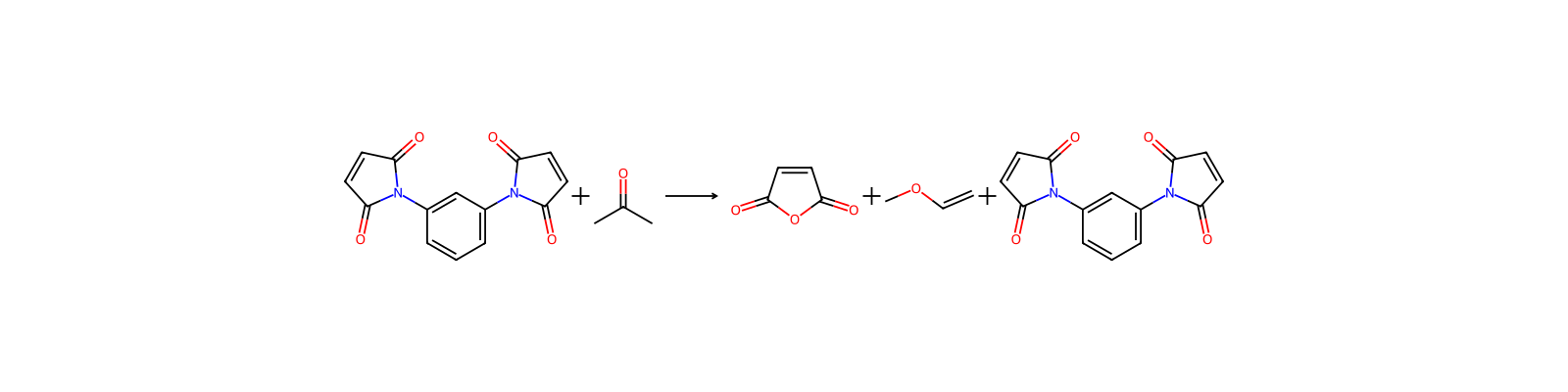
Reaktionsgleichung von HRID 262415
HRID 262415als Edukt
Reaktionsgleichung von HRID 262416
HRID 262416als Produkt
Reaktionsgleichung von HRID 262417
HRID 262417als Produkt
Reaktionsgleichung von HRID 262422
HRID 262422als Produkt
Reaktionsgleichung von HRID 262423
HRID 262423als Produkt
Reaktionsgleichung von HRID 1069253
HRID 1069253als Edukt
Reaktionsgleichung von HRID 1903355
HRID 1903355als Edukt

Notizen zur Verbindung

Auf dieser SeiteGrundinformationenNamen und BezeichnerEigenschaftenSicherheit und RegulatorischesChemie und IndustrieZugehörige ReaktionenNotizen zur Verbindung
J12.979H
pka
-1.67 · -1.67±0.20(Predicted)
Aggregatzustand
powder to crystal
Farbe
Light yellow to Brown to Dark green
Wasserlöslichkeit
negligible soluble
InChI
InChI=1S/C14H8N2O4/c17-11-4-5-12(18)15(11)9-2-1-3-10(8-9)16-13(19)6-7-14(16)20/h1-8H
InChIKey
IPJGAEWUPXWFPL-UHFFFAOYSA-N
SMILES
C1(N2C(=O)C=CC2=O)=CC=CC(N2C(=O)C=CC2=O)=C1
LogP
0.67 at · 0.67 at 24℃
CAS Datenbank
3006 · 3006-93-7(CAS DataBase Reference)
EPA chemische Informationen
1 H-Pyrrole-2,5-dione, · 1H-Pyrrole-2,5-dione, 1,1'-(1,3-phenylene)bis- (3006-93-7)
Hazard Classes and CategoriesAcute Tox. 4 (88.5%)

Toxikologische Informationen

Toxicity DataLC50 (rat) = 55 mg/m3/4hr

Sicherheitsdaten

wgk
3
tsca
TSCA listed
ridadr
UN 2811 6.1/PG 2
hs_code
2925190090
RTECS-Nr.
ON6125000
risk_code
23/24/25-36/37/38-26-22
Toxizität
LD50 oral in rat: 1370mg/kg
hazard_code
T,Xi,T+
hazard_note
Irritant
safety_code
27-28-36/37/39-45-38-28A
hazard_class
6.1
packing_group
II
Speicherklasse
6.1A - Combustible acute toxic Cat. 1 and 2very toxic hazardous materials
Hazard Classifications
Acute Tox. 2 InhalationAcute Tox. 4 Oral