1,4,7-Triazacyclononane
HCID 188318

Grundinformationen
- CAS
4730-54-5- Standard-SMILES
C1CNCCNCCN1- InChIKey
ITWBWJFEJCHKSN-UHFFFAOYSA-N- Summenformel
- C6H15N3
- Durchschnittliche Molmasse
- 129,2 g/mol
- Monoisotopische Masse
- 129,12659749
Überblick
1,4,7-triazonane is a saturated organic heteromonocyclic parent, a crown amine and an azacycloalkane.
Namen und Bezeichner
- Bevorzugter Name
- 1,4,7-Triazacyclononane
- IUPAC
- 1,4,7-triazonane
- Englischer Name
- 1,4,7-Triazacyclononane
- Summenformel
- C6H15N3
- Molmasse
- 129.2
Namen und Synonyme
1,4,7-Triazacyclononane4730-54-51H-1,4,7-Triazonine, octahydro-2UIF93C5H3DTXSID50197095NSC-681101RefChem:415824DTXCID60119586637-157-51,4,7-TriazonanetacnOctahydro-1H-1,4,7-triazonine
Weitere Namen anzeigen
157715Triazacyclononane1,4,8-Triazacyclononane1,4,7-Triazacyclonomane1,4,7-triazacycloheptaneTriazacyclononanewhitextl
MFCD00012358Triethylenetriamine[9]aneN3SCHEMBL132539CHEBI:374051,4,7-Triazacyclononane, 95%NSC681101EN300-213777
Datenbank-Bezeichner
- CAS
4730-54-5- PubChem CID
- 188318
- DTXSID
DTXSID50197095- ChEMBL
CHEMBL1650628- ChEBI
CHEBI:37405- UNII
- 2UIF93C5H3
- EC Number
- 637-157-5
- Nikkaji
- J351.553B
Eigenschaften
Berechnete Struktureigenschaften
- XLogP
- -1,9
- Polarare Oberfläche (TPSA)
- 36,1 Ų
- H-Brücken-Donoren
- 3
- H-Brücken-Akzeptoren
- 3
- Frei drehbare Bindungen
- 0
- Schwere Atome
- 9
- Formalladung
- 0
- Komplexität
- 45,1
Experimentelle und physikochemische Eigenschaften
Chemical ClassesNitrogen Compounds -> Other Nitrogen Compounds
Physical DescriptionWhite crystals; [MSDSonline]
Physikochemische Eigenschaften
- Schmelzpunkt
- 42 · 42-45 °C (lit.)
- Siedepunkt
- 110 · 110-130 °C/7 mmHg (lit.)
- Dichte
- 0.9987 · 0.9987 (rough estimate)
- Brechungsindex
- 1.462 · 1.4620 (estimate)
- Flammpunkt
- 230 °F · >230 °F
- storage temp.
- 2 · 2-8°C
- Wasserlöslichkeit
- Soluble in water
- Löslichkeit
- Chloroform (Slightly), Methanol (Slightly)
- Aggregatzustand
- crystal
- pka
- 10.57 · 10.57±0.20(Predicted)
- Farbe
- white
Sicherheit und Regulatorisches
Sicherheitsangaben dienen nur zur Orientierung und ersetzen weder das Sicherheitsdatenblatt (SDB) des Lieferanten noch geltende Vorschriften oder eine fachliche Bewertung.
GHS-Klassifizierung
GHS Classification
Danger
H314 (100%): Causes severe skin burns and eye damage [Danger Skin corrosion/irritation]
P260, P264, P280, P301+P330+P331, P302+P361+P354, P304+P340, P305+P354+P338, P316, P321, P363, P405, and P501 (click each P-code to see the statement)
Aggregated GHS information provided per 41 reports by companies from 2 notifications to the ECHA C&L Inventory.
Gefahrenhinweise
Hazards SummaryCorrosive--causes burns; Inhalation of high concentration may cause chemical pneumonitis; [MSDSonline]
Hazard Classes and CategoriesSkin Corr. 1B (100%)
Toxikologische Informationen
Adverse EffectsDermatotoxin - Skin burns.
Sicherheitsdaten
- F
- 3-10-34
- wgk
- 3
- ridadr
- UN 3259 8/PG 2
- hs_code
- 2933990099
- risk_code
- 34
- hazard_code
- C
- safety_code
- 26-36/37/39-45
- hazard_class
- 8
- packing_group
- III
Chemie und Industrie
Anwendungen
Beschreibung1,4,7-Triazacyclononane, known as "TACN" which is pronounced "tack-en," is a cyclic organic compound with the formula C6H12(NH)3. TACN is derived, formally speaking, from cyclononane by replacing three equidistant CH2 groups with NH groups. TACN is one of the oligomers derived from aziridine, C2H4NH. Other members of the series include diazacyclohexane, C4H8(NH)2, and the cyclic tetramer 1,4,7,10-tetraazacyclododecane.
Verwenden1,4,7-Triazacyclononane (TACN) is a versatile platform from which various ligands can be derived to form effective chelators for (radio)copper(II) complexation. The ability of TACN-derivatives to form highly stable complexes with copper(II) is greatly influenced by the number and type of substituents on the macrocyclic ring. The formed copper(II) complexes show a broad variability in their thermodynamic stability and kinetic inertness, varying in structure from square-pyramidal to distorted octahedral. TACN-based BFCAs have also been used for indirect radiolabelling of biomolecules, rendering them suitable for imaging and therapy.
Darstellung
synthetischeThe ligand is prepared from diethylene triamine as follows by macrocyclization using ethyleneglycol ditosylate.H2NCH2CH2NHCH2CH2NH2 + 3 TsCl → Ts(H)NCH2CH2N(Ts)CH2CHH2N(H)Ts + 3 HCl Ts(H)NCH2CH2N(Ts)CH2CH2N(H)Ts + 2 NaOEt → Ts(Na)NCH2CH2N(Ts)CH2CH2N(Na)Ts Ts(Na)NCHH2CH2N(Ts)CH2CH2N(Na)Ts + TsOCH2CH2OTs + → [(CH2CH2N(Ts)]3 + 2 NaOTs [(CH2CH2N(Ts)]3 + 3 H2O → [CH2CH2NH]3 + 3 HOTs
Vor- und nachgelagerte Produkte
Vorgelagerte Rohstoffe
Nachgelagerte Produkte
Zugehörige Reaktionen
41

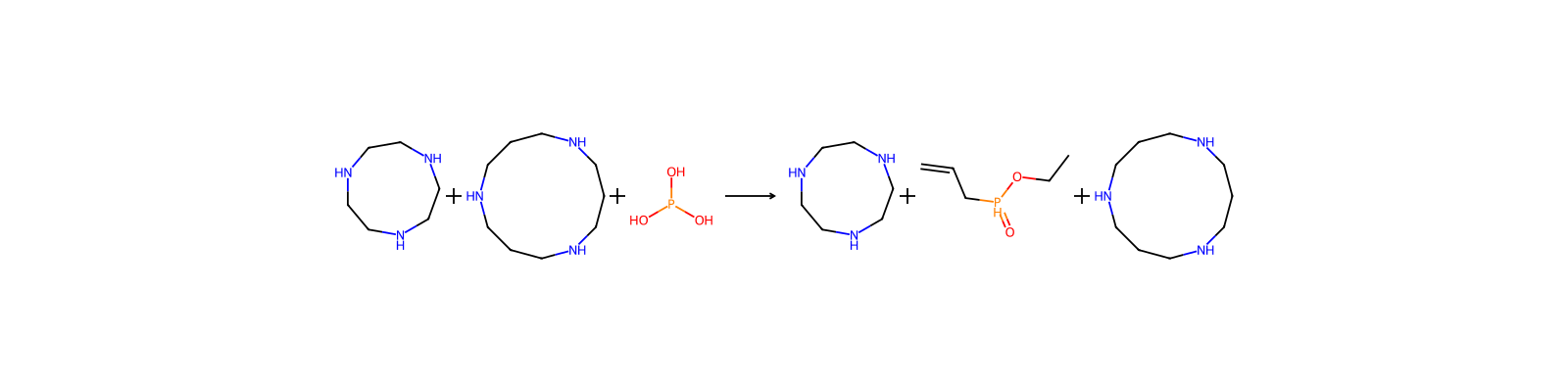
HRID 66215als Edukt

HRID 66216als Edukt

HRID 109125als Edukt

HRID 363726als Edukt

HRID 397368als Edukt

HRID 397369als Edukt

HRID 655902als Edukt