
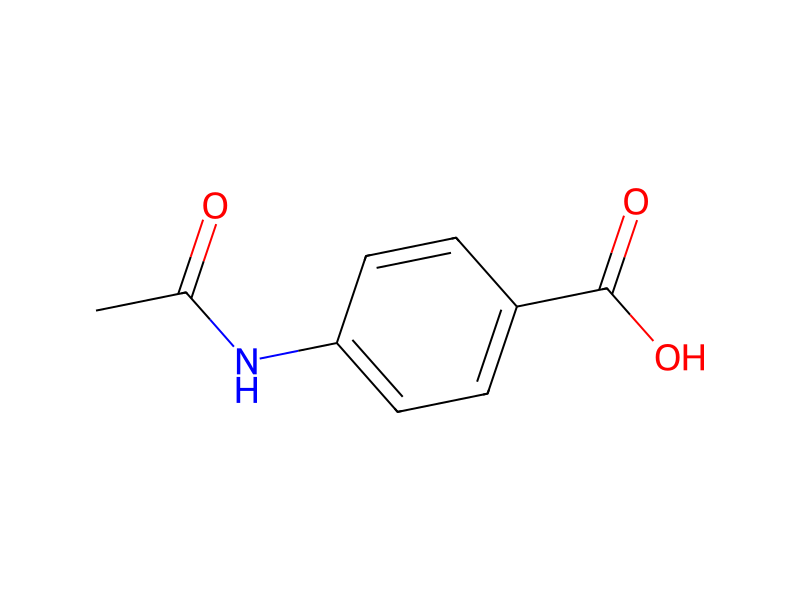
Grundinformationen
- Standard-SMILES
CC(=O)Nc1ccc(C(=O)O)cc1- InChIKey
QCXJEYYXVJIFCE-UHFFFAOYSA-N- Summenformel
- C9H9NO3
- Durchschnittliche Molmasse
- 179,17 g/mol
- Monoisotopische Masse
- 179,05824315
Überblick
P-acetamidobenzoic acid appears as needles or off-white powder. (NTP, 1992)
Namen und Bezeichner
- Bevorzugter Name
- p-Acetamidobenzoic acid
- IUPAC
- 4-acetamidobenzoic acid
- Lokaler Name
- Acedoben
- Englischer Name
- 4-acetamidobenzoic acid
- Summenformel
- C9H9NO3
- Molmasse
- 179.17
Namen und Synonyme
4-Acetamidobenzoic acid556-08-1Acedobenp-Acetamidobenzoic acid4-(Acetylamino)benzoic acid4-Acetylaminobenzoic acid4-CarboxyacetanilideBenzoic acid, 4-(acetylamino)-p-Acetylaminobenzoic acidp-Acetoaminobenzoic acidN-Acetyl-p-aminobenzoic acidPAAB
Weitere Namen anzeigen
p-acetamidobenzoic4-ACETAMIDOBENZOIC ACID FOR SYNTHESISp-Acetylamino benzoic acido benzoic acidLR-64PAABA
Acedobenep-Acetaminobenzoic acidN-Acetyl-PABAPara Acetamido Benzoic AcidAcedobenumBenzoic acid, p-acetamido-DTXSID5024392NSC-4002
Datenbank-Bezeichner
- CAS
556-08-1- PubChem CID
- 19266
- DTXSID
DTXSID5024392- ChEMBL
CHEMBL112687- ChEBI
CHEBI:46171- UNII
- 04Z20NMK31
- EC Number
- 209-114-7
- Nikkaji
- J95.026B
Eigenschaften
Berechnete Struktureigenschaften
- XLogP
- 1,3
- Polarare Oberfläche (TPSA)
- 66,4 Ų
- H-Brücken-Donoren
- 2
- H-Brücken-Akzeptoren
- 3
- Frei drehbare Bindungen
- 2
- Schwere Atome
- 13
- Formalladung
- 0
- Komplexität
- 207
Experimentelle und physikochemische Eigenschaften
Chemical Classes
Nitrogen Compounds -> Aminobenzoic Acids
Industrial compound
DrugsPharmaceuticals -> Listed in ZINC15
SpringerMaterials Properties13C nuclear magnetic resonance spectrum
LogP1.27
Solubility
less than 1 mg/mL at 70 °F (NTP, 1992)
>26.9 [ug/mL] (The mean of the results at pH 7.4)
Melting Point493.7 °F (NTP, 1992)
Vapor Pressure0.00000071 [mmHg]
Physical Description
P-acetamidobenzoic acid appears as needles or off-white powder. (NTP, 1992)
Off-white solid; [CAMEO] White powder, insoluble in water; [MSDSonline]
Physikochemische Eigenschaften
- Schmelzpunkt
- 259 · 259-262 °C (dec.)(lit.)
- Siedepunkt
- 311.69 °C · 311.69°C (rough estimate)
- Dichte
- 1.2822 · 1.2822 (rough estimate)
- Brechungsindex
- 1.56 · 1.5600 (estimate)
- storage temp.
- Sealed in dry,Room Temperature
- Löslichkeit
- DMSO (Slightly), Methanol (Slightly)
- pka
- 1 · pK1: 4.28 (25°C)
- Aggregatzustand
- Powder
- Farbe
- Off-white to slightly beige
- Wasserlöslichkeit
- 0.1 g/100 · <0.1 g/100 mL at 21 ºC
- BRN
- 390602 · 390602
- Stabilität
- Stable. Combustible. Incompatible with strong oxidizing agents.
- Major Application
- peptide synthesis
- InChI
- 1S/C9H9NO3/c1-6(11)10-8-4-2-7(3-5-8)9(12)13/h2-5H,1H3,(H,10,11)(H,12,13)
- InChIKey
- QCXJEYYXVJIFCE-UHFFFAOYSA-N
- SMILES
- CC(=O)Nc1ccc(cc1)C(O)=O
- CAS Datenbank
- 556 · 556-08-1(CAS DataBase Reference)
- NIST chemische Informationen
- N-(4-Carboxyphenyl)acetic acid amide(556-08-1)
- EPA chemische Informationen
- 4 · Benzoic acid, 4-(acetylamino)- (556-08-1)
Sicherheit und Regulatorisches
GHS-Klassifizierung
GHS Classification
This chemical does not meet GHS hazard criteria for 53.3% (8 of 15) of all reports.
Warning
H315 (46.7%): Causes skin irritation [Warning Skin corrosion/irritation]
P261, P264, P264+P265, P271, P280, P302+P352, P304+P340, P305+P351+P338, P319, P321, P332+P317, P337+P317, P362+P364, P403+P233, P405, and P501 (click each P-code to see the statement)
Aggregated GHS information provided per 15 reports by companies from 5 notifications to the ECHA C&L Inventory. Each notification may be associated with multiple companies.
Gefahrenhinweise
Regulatory Information
Status: Active Update: 24-05-2018 https://echa.europa.eu/registration-dossier/-/registered-dossier/21117
Benzoic acid, 4-(acetylamino)-: Does not have an individual approval but may be used under an appropriate group standard
Fire HazardsFlash point data for this chemical are not available; however, it is probably combustible. (NTP, 1992)
Hazards SummaryAn irritant to the skin, eyes, and respiratory tract; Stable under recommended storage conditions. [MSDSonline]
Reactive GroupAcids, Carboxylic
Reactivity ProfileSimultaneously an amide and a carboxylic acid.
Air and Water ReactionsWater insoluble.
Hazard Classes and CategoriesSkin Irrit. 2 (46.7%)
Sicherheit und Schutzausrüstung
Fire FightingFires involving this material can be controlled with a dry chemical, carbon dioxide or Halon extinguisher. (NTP, 1992)
First Aid
EYES: First check the victim for contact lenses and remove if present. Flush victim's eyes with water or normal saline solution for 20 to 30 minutes while simultaneously calling a hospital or poison control center. Do not put any ointments, oils, or medication in the victim's eyes without specific instructions from a physician. IMMEDIATELY transport the victim after flushing eyes to a hospital even if no symptoms (such as redness or irritation) develop.
Nonfire Spill Response
SMALL SPILLS AND LEAKAGE: Should a spill occur while you are handling this chemical, FIRST REMOVE ALL SOURCES OF IGNITION, then you should dampen the solid spill material with 60-70% ethanol and transfer the dampened material to a suitable container. Use absorbent paper dampened with 60-70% ethanol to pick up any remaining material. Seal the absorbent paper, and any of your clothes, which may be contaminated, in a vapor-tight plastic bag for eventual disposal. Solvent wash all contaminated surfaces with 60-70% ethanol followed by washing with a soap and water solution. Do not reenter the contaminated area until the Safety Officer (or other responsible person) has verified that the area has been properly cleaned.
Personal Protective Equipment (PPE)
RECOMMENDED RESPIRATOR: Where the neat test chemical is weighed and diluted, wear a NIOSH-approved half face respirator equipped with an organic vapor/acid gas cartridge (specific for organic vapors, HCl, acid gas and SO2) with a dust/mist filter. (NTP, 1992)
Sicherheitsdaten
- wgk
- 3
- tsca
- TSCA listed
- hs_code
- 29242995
- risk_code
- 36/37/38
- safety_code
- 24/25
- Speicherklasse
- 11 - Combustible Solids
Chemie und Industrie
Verwendung und Herstellung
General Manufacturing InformationBenzoic acid, 4-(acetylamino)-: ACTIVE
Anwendungen
Beschreibung4-Acetamidobenzoic acid (PAcBA) is a naturally occurring acetylated metabolite of 4-aminobenzoic acid and is a component of the antiviral and immunostimulatory drug inosine pranobex (Inosiplex; Isoprinosine; Methisoprinol).
Verwendenimmune stimulant (component)
Vor- und nachgelagerte Produkte
Vorgelagerte Rohstoffe
Nachgelagerte Produkte
Anbieter50 Anbieter
国药集团化学试剂有限公司86-21-63210123 · [email protected]
梯希爱(上海)化成工业发展有限公司021-67121386 · [email protected]
上海阿拉丁生化科技股份有限公司400-6206333 13167063860 · [email protected]
河北创海生物科技有限公司+86-86-13131129325 · [email protected]
爱斯特(成都)生物制药股份有限公司+86-28-85122536 85324413 · [email protected]
南京兰亚化工贸易有限公司+86-25-8331-5620 · [email protected]
陕西德莱维特生物科技有限公司15780788769 18292741956 · [email protected]
韶远科技(上海)有限公司021-50795510 4000665055 · [email protected]
科瑞迪化学400-821-5857 021-64326257 · [email protected]
上海将来实业股份有限公司400-0066400 13621662912 · [email protected]
Syntechem Co.,Ltd[email protected]
上海迈瑞尔生化科技有限公司4006356688 18621169109 · [email protected]
北京华威锐科化工有限公司0757-86329057 18934348241 · [email protected]
阿法埃莎(中国)化学有限公司400-6106006 · [email protected]
上海德默医药科技有限公司400-021-7337 2355568890 · [email protected]
安耐吉化学&3A(安徽泽升科技股份有限公司)400-0056266 · [email protected]
上海瀚鸿科技股份有限公司021-54306202 13764082696 · [email protected]
常州市淇奥化工有限公司0519-85607258
上海诗丹德标准技术服务有限公司021-021-57127007-6622-6622 17621252073 · [email protected]
山东洛克化工有限公司17653113209 13065062079 · [email protected]
山东西亚化学有限公司13355009207 13355009207 · [email protected]
玛雅试剂+86 (573) 82222445 (0)18006601000 452520369 · [email protected]
四川库利南科技有限公司400-1166-196 18981987031 · [email protected]
上海耐士化工科技有限公司400-188-0725 +86 21 34310725 13611771617
天津希恩思生化科技有限公司400 638 7771 · [email protected]
河南多贝化工有限公司0370-2785118 17550508557 · [email protected]
上海思域化工科技有限公司86-21-34053660 · [email protected]
赛默飞世尔科技(中国)有限公司800-810-5118 · [email protected]
北京伊诺凯科技有限公司400-810-7969 010-59572699 · [email protected]
张家港保税区凯利特化工有限公司18606289633 15862625988 · [email protected]
TCI AMERICA800-4238616 · [email protected]
TOKYO CHEMICAL INDUSTRY CO., LTD.03-36680489 · [email protected]
TCI Europe320-37350700 · [email protected]
上海贤鼎生物科技有限公司4009209199 · [email protected]
深圳振强药物研发有限公司0755-66853366 13670046396 · [email protected]
深圳康特腾科技有限公司86-0755-86635001 · [email protected]
上海将来实业股份有限公司400-0066400 13621662912 · [email protected]
上海将来实业股份有限公司021-61552785 · [email protected]
HBCChem, Inc.+1-510-219-6317 · [email protected]
上海笛柏生物科技有限公司400-008-9730,021-54359730 400-008-9730 · [email protected]
上海石洋化工有限公司021-56795766 · [email protected]
常州市阳光药业有限公司0519-83138357 , 13706121722 15906111278 · [email protected]
常州市尚科医药化工材料有限公司0519-85269522 15906111708 · [email protected]
成都零六生物科技有限公司400-1166-196 13458535857 · [email protected]
常州市卓燊医药化工材料有限公司519-519-85286950 13338194135 · [email protected]
上海馨远医药科技有限公司021-24206007 13764915196 · [email protected]
上海御略医药科技有限公司021-60345187 13671753212 · [email protected]
杭州杰恒化工有限公司0571-87396432 · [email protected]
上海嵩爰化工科技有限公司010-1234567 18521000990 · [email protected]
上海孚一生物科技有限公司+86 (21) 61124340
Ergänzende Hinweise
DefinitionChEBI: 4-acetamidobenzoic acid is a amidobenzoic acid that consists of benzoic acid bearing an acetamido substituent at position 4. It is functionally related to a 4-aminobenzoic acid. It is a conjugate acid of a 4-acetamidobenzoate.
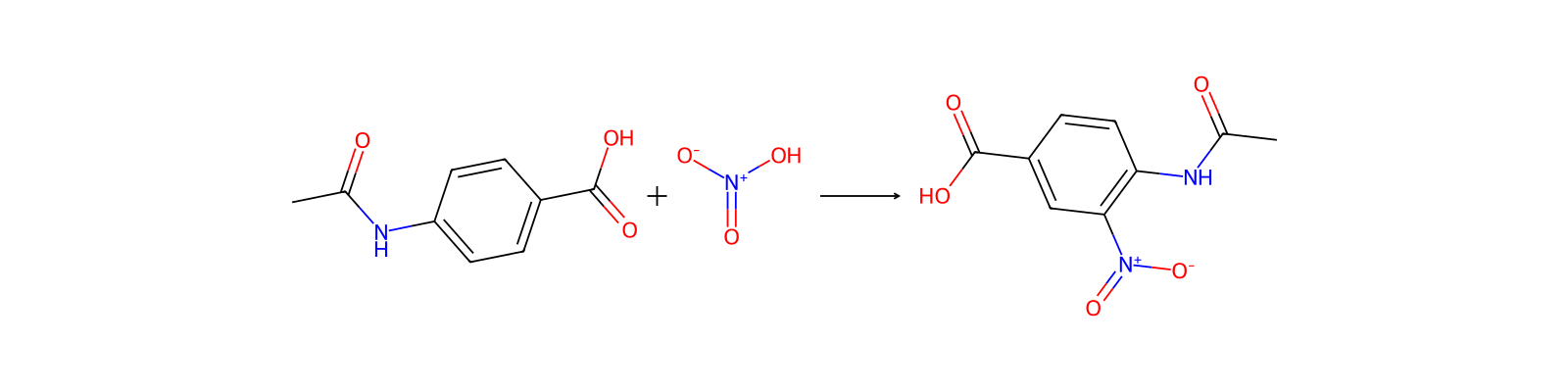
Zugehörige Reaktionen
81




Verknüpfte Notizen
Wird geladen…