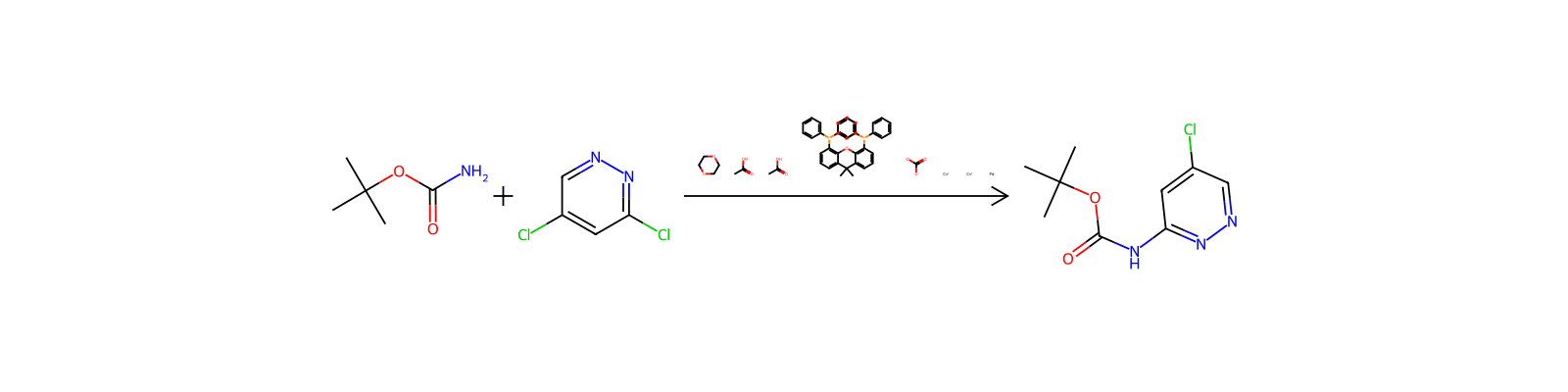
3,5-Dichloropyridazine

Grundinformationen
- CAS
1837-55-4- Standard-SMILES
Clc1cnnc(Cl)c1- InChIKey
JZSAUQMXKHBZEO-UHFFFAOYSA-N- Summenformel
- C4H2Cl2N2
- Durchschnittliche Molmasse
- 148,98 g/mol
- Monoisotopische Masse
- 147,9595035
Namen und Bezeichner
- Bevorzugter Name
- 3,5-Dichloropyridazine
- IUPAC
- 3,5-dichloropyridazine
- Englischer Name
- 3,5-Dichloropyridazine
- Summenformel
- C4H2Cl2N2
- Molmasse
- 148.98
Namen und Synonyme
3,5-Dichloropyridazine1837-55-4DTXSID20601477RefChem:271701DTXCID80552234692-072-03,5-Dichloro-pyridazineMFCD106980483,5-Dichlor-pyridazinPYRIDAZINE, 3,5-DICHLORO-SCHEMBL400310CHEBI:194771
Weitere Namen anzeigen
SA0295195-DichloropyridazinePyridazine,3,5-dichloro-3,5-Dichloropyridazine>3,5-Dichloropyridazine ISO 9001:2015 REACH
CS-D0778AB61136AC-25155AS-18922D4447EN300-96061Z1198278268BCP22319
Datenbank-Bezeichner
- CAS
1837-55-4- PubChem CID
- 19959687
- DTXSID
DTXSID20601477- ChEBI
CHEBI:194771- UNII
- 74Q8S45BRC
- EC Number
- 692-072-0
Eigenschaften
Berechnete Struktureigenschaften
- XLogP
- 1,4
- Polarare Oberfläche (TPSA)
- 25,8 Ų
- H-Brücken-Donoren
- 0
- H-Brücken-Akzeptoren
- 2
- Frei drehbare Bindungen
- 0
- Schwere Atome
- 8
- Formalladung
- 0
- Komplexität
- 78
Physikochemische Eigenschaften
- Schmelzpunkt
- 60 to · 60.0 to 64.0 °C
- Siedepunkt
- 280.8 · 280.8±20.0 °C(Predicted)
- Dichte
- 1.493 · 1.493±0.06 g/cm3(Predicted)
- storage temp.
- Keep in dark place,Sealed in dry,Room Temperature
- Löslichkeit
- DMSO (Sparingly), Methanol (Slightly)
- Aggregatzustand
- Solid
- pka
- -0.25 · -0.25±0.10(Predicted)
- Farbe
- Yellow to Dark Orange
- InChI
- InChI=1S/C4H2Cl2N2/c5-3-1-4(6)8-7-2-3/h1-2H
- InChIKey
- JZSAUQMXKHBZEO-UHFFFAOYSA-N
- SMILES
- C1(Cl)=NN=CC(Cl)=C1
Sicherheit und Regulatorisches
GHS-Klassifizierung
GHS Classification
Warning
H302+H312+H332 (82.4%): Harmful if swallowed, in contact with skin or if inhaled [Warning Acute toxicity, oral; acute toxicity, dermal; acute toxicity, inhalation];H302 (97.1%): Harmful if swallowed [Warning Acute toxicity, oral];H312 (88.2%): Harmful in contact with skin [Warning Acute toxicity, dermal];H315 (97.1%): Causes skin irritation [Warning Skin corrosion/irritation];H319 (97.1%): Causes serious eye irritation [Warning Serious eye damage/eye irritation];H332 (88.2%): Harmful if inhaled [Warning Acute toxicity, inhalation];H335 (94.1%): May cause respiratory irritation [Warning Specific target organ toxicity, single exposure; Respiratory tract irritation]
P261, P264, P264+P265, P270, P271, P280, P301+P317, P302+P352, P304+P340, P305+P351+P338, P317, P319, P321, P330, P332+P317, P337+P317, P362+P364, P403+P233, P405, and P501 (click each P-code to see the statement)
Aggregated GHS information provided per 34 reports by companies from 7 notifications to the ECHA C&L Inventory. Each notification may be associated with multiple companies.;Information may vary between notifications depending on impurities, additives, and other factors. The percentage value in parenthesis indicates the notified classification ratio from companies that provide hazard codes. Only hazard codes with percentage values above 10% are shown. For more detailed information, please visit ECHA C&L website.
Gefahrenhinweise
Hazard Classes and CategoriesAcute Tox. 4 (97.1%);Acute Tox. 4 (88.2%);Skin Irrit. 2 (97.1%);Eye Irrit. 2A (97.1%);Acute Tox. 4 (88.2%);STOT SE 3 (94.1%)
Sicherheitsdaten
- wgk
- WGK 3
- hs_code
- 29339900
- risk_code
- 22
- hazard_code
- Xn
- Speicherklasse
- 11 - Combustible Solids
- Hazard Classifications
- Acute Tox. 4 Oral
Chemie und Industrie
Anwendungen
Verwenden3,5-Dichloropyridazine used in the treatment of asthma and allergy. Potential for antinociceptive and antiinflammatory effects
Darstellung
synthetischePreparation of 3,5-Dichloropyridazine:2,4,4,4-Tetrachlorocrotonaldehyde is dissolved in a solvent, and a mixture of semicarbazide hydrochloride, water, and solvent is added dropwise under controlled temperature conditions. The reaction is stirred for 5 hours. Afterward, the reaction mixture is concentrated under reduced pressure to remove the solvent. Water is added, and the temperature is lowered to 5°C, allowing a solid to precipitate. The solid is filtered and recrystallized using a dichloromethane/petroleum ether mixture, yielding 3,5-dichloropyridazine as a white crystalline solid.
Vor- und nachgelagerte Produkte
Nachgelagerte Produkte
Anbieter100 Anbieter
常州帝通化工有限公司+86-0519-88298848 · [email protected]
梯希爱(上海)化成工业发展有限公司021-67121386 · [email protected]
Shandong chuangyingchemical Co., Ltd.18853181302 · [email protected]
Dayang Chem (Hangzhou) Co.,Ltd.+86-0571-88938639 17705817739 · [email protected]
韶远科技(上海)有限公司021-50795510 4000665055 · [email protected]
上海将来实业股份有限公司400-0066400 13621662912 · [email protected]
Jinan Liheng Biotechnology Co., Ltd.15865262812 · [email protected]
南部县诚信科技有限公司0838-5675166 15883665058 · [email protected]
上海波以尔化工有限公司[email protected]
安耐吉化学&3A(安徽泽升科技股份有限公司)400-0056266 · [email protected]
上海瀚鸿科技股份有限公司021-54306202 13764082696 · [email protected]
Shangchem Co., Ltd.+86-21-68182121
上海相辉医药科技有限公司13761987713 · [email protected]
上海景颜化工科技有限公司13817811078 · [email protected]
嘉兴市艾森化工有限公司0573-85285100 18627885956 · [email protected]
郑州研德生物科技有限公司0371-63682289 15538176268 · [email protected]
杰达维(上海)医药科技发展有限公司/J & W PharmLab021-64340559 · [email protected]
济南精合医药科技有限公司0531-88811783 · [email protected]
skychemical Co.Ltd021-20958197 20965099 · [email protected]
济南恒茂医药科技有限公司0531-88262980 13156180564 · [email protected]
同创医药(苏州)有限公司0512-63263366 18912765016 · [email protected]
赛默飞世尔科技(中国)有限公司800-810-5118 · [email protected]
江苏艾康生物医药研发有限公司025-66113011 13913916777 · [email protected]
上海健超生物科技有限公司150-2103-5486 18017383231 · [email protected]
TCI AMERICA800-4238616 · [email protected]
TOKYO CHEMICAL INDUSTRY CO., LTD.03-36680489 · [email protected]
TCI Europe320-37350700 · [email protected]
赛纳斯特化学(欢迎点击联系)021-60343070
越林试剂021-62960152 · [email protected]
上海敏寒医药科技有限公司17612188245 · [email protected]
山东益众新材料有限公司0531-69958783 15508681609 · [email protected]
上海宸香医药科技有限公司021-20960837 · [email protected]
上海将来实业股份有限公司400-0066400 13621662912 · [email protected]
上海将来实业股份有限公司021-61552785 · [email protected]
上海毕得医药科技股份有限公司400-164-7117 18317119277 · [email protected]
嘉兴诺华化工有限公司18957373295
上海马氏化学科技有限公司19916721580 · [email protected]
上海寰川实业有限公司021-61478794 · [email protected]
上海嵩爰化工科技有限公司010-1234567 18521000990 · [email protected]
湖北巨胜科技有限公司027-59599241 18871490274 · [email protected]
Accela ChemBio Inc.+1(858) 699-3322 · [email protected]
江苏倍达医药科技有限公司0512-63009836 18994340901 · [email protected]
上海皓之翔生物科技有限公司(原上海拓青化工有限公司)526763801 13301653310 · [email protected]
九鼎化学(上海)科技有限公司4009209199 · [email protected]
北京禾兴源科技有限公司18511709189 · [email protected]
Henan Alfa Chemical Co., Ltd+8618339805032 · [email protected]
郑州阿尔法化工有限公司0371-53765687 18937137882 · [email protected]
湖北创联康成药物化学有限公司027-65388397 18164111589 · [email protected]
上海天习化工有限公司021-20960837,QQ1332204249 · [email protected]
上海思言生物科技有限公司021-50908862,442785678,326799392 18721037013 · [email protected]
Zugehörige Reaktionen
17


Notizen zur Verbindung
Wird geladen…