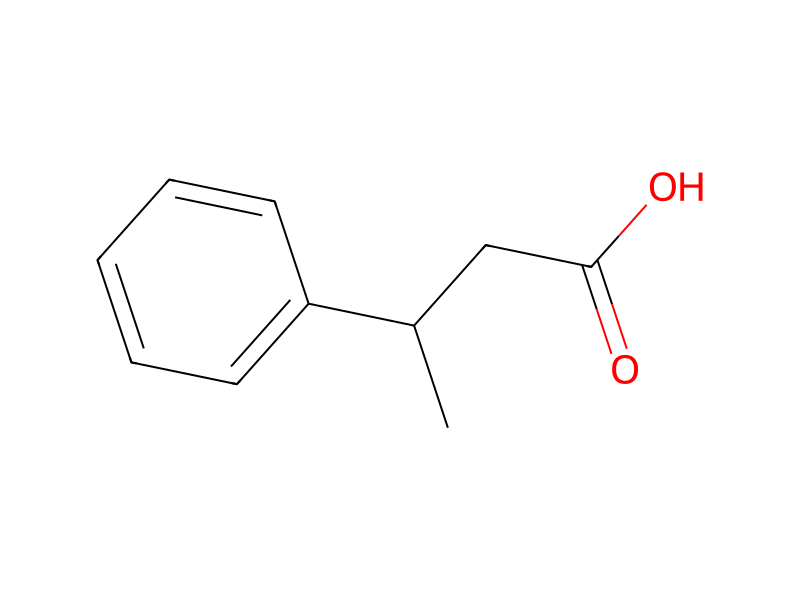
3-Phenylbutyrsaeure
3-Phenylbutyric acid
Daten werden ergänzt – lade die Seite später neu, um den aktuellen Stand zu sehen
Grundinformationen
- CAS
4593-90-2- Standard-SMILES
CC(CC(=O)O)c1ccccc1- InChIKey
ZZEWMYILWXCRHZ-UHFFFAOYSA-N- Summenformel
- C10H12O2
- Durchschnittliche Molmasse
- 164,2 g/mol
- Monoisotopische Masse
- 164,08372962
Überblick
3-phenylbutyric acid is a monocarboxylic acid that is butanoic acid substituted by a phenyl group at position 3. It has a role as an antibacterial agent and a bacterial xenobiotic metabolite. It is a member of benzenes and a monocarboxylic acid. It is functionally related to a 3-phenylpropionic acid.
Namen und Bezeichner
- Bevorzugter Name
- 3-Phenylbutyric acid
- IUPAC
- 3-phenylbutanoic acid
- Lokaler Name
- 3-Phenylbutyrsaeure
- Englischer Name
- 3-Phenylbutyric acid
- Summenformel
- C10H12O2
- Molmasse
- 164.2
Namen und Synonyme
3-Phenylbutanoic acid3-PHENYLBUTYRIC ACID4593-90-2DTXSID10863421RefChem:95326DTXCID00812044224-987-4beta-Phenylbutyric acid3-PhenylbutyrateMFCD000027253-phenylbutanoatebeta-Methylhydrocinnamic acid
Weitere Namen anzeigen
3-PhenylbutyrsaeureRARECHEM AL BE 0683(/-)-3-PHENYLBUTYRIC ACID3-PHENYLBUTYRIC ACID 99%BETA-PHENYL-N-BUTYRIC ACID(+/-)-3-phenylbutyric acidb-methyl benzenepropanoic acidBenzenepropanoic acid, b-methyl-
.beta.-Phenyl-n-butyric acidbeta-Methylbenzenepropanoic acidBenzenepropanoic acid, .beta.-methyl-772-17-83-Phenylbutanoic acid #b-Phenylbutyratebeta-PhenylbutyrateBenzenepropanoic acid, beta-methyl-
Datenbank-Bezeichner
- CAS
4593-90-2、772-17-8
Eigenschaften
Berechnete StruktureigenschaftenWird ergänzt
- XLogP
- 2,2
- Polarare Oberfläche (TPSA)
- 37,3 Ų
- H-Brücken-Donoren
- 1
- H-Brücken-Akzeptoren
- 2
- Frei drehbare Bindungen
- 3
- Schwere Atome
- 12
- Formalladung
- 0
- Komplexität
- 148
Experimentelle und physikochemische Eigenschaften
LogP
2.18
2.18
Melting Point39 - 37 °C
Physical DescriptionSolid
Physikochemische Eigenschaften
- Schmelzpunkt
- 35 · 35-38 °C(lit.)
- Siedepunkt
- 170 · 170-172 °C20 mm Hg(lit.)
- Dichte
- 1.515 g/mL · 1.515 g/mL at 25 °C(lit.)
- Brechungsindex
- 1.516 · 1.5160 (estimate)
- Flammpunkt
- 77 °F · 77 °F
- storage temp.
- -20 °C · Store at -20°C
- pka
- 4.67 · 4.67±0.10(Predicted)
- Aggregatzustand
- Solid
- Farbe
- White to off-white
- Wasserlöslichkeit
- 9.254 g/L · 9.254g/L(30 ºC)
Sicherheit und Regulatorisches
Sicherheitsangaben dienen nur zur Orientierung und ersetzen weder das Sicherheitsdatenblatt (SDB) des Lieferanten noch geltende Vorschriften oder eine fachliche Bewertung.
GHS-Klassifizierung
GHS Classification
Warning
H315 (100%): Causes skin irritation [Warning Skin corrosion/irritation]
P261, P264, P264+P265, P271, P280, P302+P352, P304+P340, P305+P351+P338, P319, P321, P332+P317, P337+P317, P362+P364, P403+P233, P405, and P501 (click each P-code to see the statement)
Aggregated GHS information provided per 34 reports by companies from 3 notifications to the ECHA C&L Inventory. Each notification may be associated with multiple companies.
Gefahrenhinweise
Hazard Classes and CategoriesSkin Irrit. 2 (100%)
Sicherheitsdaten
- wgk
- 3
- ridadr
- 1325
- hs_code
- 2916399090
- risk_code
- 36/37/38-10
- hazard_code
- Xi,F
- safety_code
- 22-24/25-36-26-16
- hazard_class
- 4.1
- packing_group
- III
- Speicherklasse
- 11 - Combustible Solids
- Hazard Classifications
- Eye Irrit. 2Skin Irrit. 2STOT SE 3
Chemie und Industrie
Pharmakologische Informationen
Cellular LocationsMembrane
Anwendungen
Verwenden3-Phenylbutyric acid is used to isolate Rhodococcus rhodochrous PB1 from compost soil.
Vor- und nachgelagerte Produkte
Vorgelagerte Rohstoffe
Zugehörige Reaktionen
21


Notizen zur Verbindung
Wird geladen…