
StartseiteMCPWorkbenchSkills
StartseiteWorkbenchBenachrichtigungenMein Bereich
llms.txt · MCP-AnleitungDatenschutz · Nutzungsbedingungen · Supportv1.8.0
  1. Startseite
  2. /Verbindung

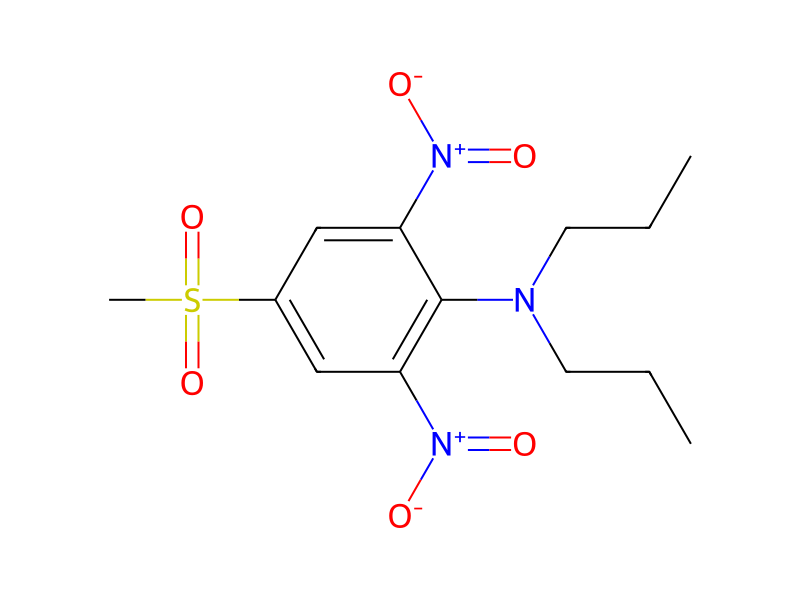
Nitralin

HCID 20848
Neue NotizNeue ReaktionAnfrage stellen
Druckvorschau

Daten werden ergänzt – lade die Seite später neu, um den aktuellen Stand zu sehen
GrundinformationenÜberblickNamen und BezeichnerEigenschaftenSicherheit und RegulatorischesChemie und IndustrieZugehörige ReaktionenNotizen zur Verbindung
TeilstruktursucheÄhnliche Strukturen suchen

Grundinformationen

CAS
4726-14-1
Standard-SMILES
CCCN(CCC)c1c([N+](=O)[O-])cc(S(C)(=O)=O)cc1[N+](=O)[O-]
InChIKey
UMKANAFDOQQUKE-UHFFFAOYSA-N
Summenformel
C13H19N3O6S
Durchschnittliche Molmasse
345,37 g/mol
Monoisotopische Masse
345,09945633

Überblick

Nitralin is a light yellow to orange solid with a mild odor. Sinks in water. (USCG, 1999)

Namen und Bezeichner

Bevorzugter Name
Nitralin
IUPAC
4-methylsulfonyl-2,6-dinitro-N,N-dipropylaniline
Lokaler Name
Nitralin
Englischer Name
NITRALIN
Summenformel
C13H19N3O6S
Molmasse
345.37

Namen und Synonyme

NITRALIN4726-14-1PlanavinNitralinePlanuinPlanavin 75SD 118312,6-Dinitro-4-methylsulfonyl-N,N-dipropylanilineAniline, 4-(methylsulfonyl)-2,6-dinitro-N,N-dipropyl-DTXSID9042203Benzenamine, 4-(methylsulfonyl)-2,6-dinitro-N,N-dipropyl-4-(Methylsulfonyl)-2,6-dinitro-N,N-dipropylaniline
Weitere Namen anzeigen
Niralinsd11831planavin75PLANAVIN(R)
697W0VS4HQ4-(Methylsulfonyl)-2,6-dinitro-N,N-dipropylbenzenamine4-(Methylsulfonyl)-2,6-dinitro-N,N-dipropylbenzeneamineSD-11831Aniline, 2,6-dinitro-N,N-dipropyl-4-(methylsulfonyl)-DTXCID70222032,6-DINITRO-4-METHYLSULFONYL-N-N-DI-N-PROPYLANILINEDNA-nitralin

Datenbank-Bezeichner

CAS
4726-14-1
PubChem CID
20848
DTXSID
DTXSID9042203
ChEMBL
CHEMBL1256763
ChEBI
CHEBI:82190
UNII
697W0VS4HQ

Eigenschaften

Berechnete StruktureigenschaftenWird ergänzt

XLogP
3,7
Polarare Oberfläche (TPSA)
137 Ų
H-Brücken-Donoren
0
H-Brücken-Akzeptoren
7
Frei drehbare Bindungen
6
Schwere Atome
23
Formalladung
0
Komplexität
491

Experimentelle und physikochemische Eigenschaften

SpringerMaterials PropertiesFusion temperature
Pesticides · 3 Einträge

Herbicides

Active substance -> EU Pesticides database: Not approved

Pesticides -> Herbicides, Nitroaromatic

OdorMILD CHEMICAL ODOR
Densitygreater than 1 at 68 °F (est) (USCG, 1999)
Color/Form · 3 Einträge

GOLDEN-ORANGE CRYSTALLINE SOLID

FINE CRYSTALLINE, LIGHT YELLOW TO ORANGE

Orange prisms

Solubility · 2 Einträge

SOLUBILITY @ 22 °C: 0.6 MG/L IN WATER; 360 G/L IN ACETONE; 330 G/L IN DIMETHYLSULFOXIDE; POORLY SOL IN COMMON HYDROCARBON AND AROMATIC SOLVENTS AND IN COMMON ALCOHOLS

Solubility at 25 °C: methanol 1.1%, isopropanol 0.18%, benzene less than 12.5%

CorrosivityNoncorrosive
Human DrugsPharmaceuticals

Sicherheit und Regulatorisches

Sicherheitsangaben dienen nur zur Orientierung und ersetzen weder das Sicherheitsdatenblatt (SDB) des Lieferanten noch geltende Vorschriften oder eine fachliche Bewertung.

GHS-Klassifizierung

GHS Classification · 4 Einträge

Warning

H400 (100%): Very toxic to aquatic life [Warning Hazardous to the aquatic environment, acute hazard]

P273, P391, and P501 (click each P-code to see the statement)

Aggregated GHS information provided per 42 reports by companies from 3 notifications to the ECHA C&L Inventory.

Gefahrenhinweise

Regulatory Information2002/2076
DOT LabelClass 9
Fire HazardsSpecial Hazards of Combustion Products: Irritating oxides of sulfur and nitrogen are formed in fire.
Health HazardsDust irritates eyes. Other forms of exposure produce no observable symptoms. (USCG, 1999)
Hazards SummaryA worker developed skin sensitivity with cross-reaction to dinitrochlorobenzene; No effect levels of 2000 mg/kg diet in 2-year feeding studies of rats and dogs; [HSDB] Dust is an eye irritant; [CAMEO] May cause irritation; [MSDSonline]
Reactive GroupNitro, Nitroso, Nitrate, and Nitrite Compounds, Organic
Special Reports · 1 Eintrag

DINITROANILINE HERBICIDES. COMPARATIVE SUMMARY; CHEMOSPHERE 9 (1): 67-9 (1980). A COMPARATIVE SUMMARY OF DINITROANILINE HERBICIDES. REVIEW OF DINITROANILINE HERBICIDES IS GIVEN. THE CHEMICAL STRUCTURES ARE INCLUDED. METABOLITES, THE QUALITATIVE COMPOSITION OF RESIDUES, LOCATION IN WHICH VARIOUS METABOLITES MAY BE FOUND FOLLOWING AGRICULTURAL USAGE AND PERSISTENCE ARE DISCUSSED.

Chemie und Industrie

Pharmakologische Informationen

Mechanism of ActionNITRALIN IS SELECTIVE HERBICIDE ACTING BY DISRUPTION OF PRIMARY CELL WALL FORMATION DURING CELL DIVISION.
Metabolism/Metabolites · 3 Einträge

PLANAVIN WAS FED TO A CATHETERIZED LACTATING COW AT 5 PPM IN THE FEED RATION FOR 4 DAYS. PLANAVIN OR POSSIBLE SULFUR-CONTAINING METABOLITES WERE NOT DETECTED IN MILK, URINE OR FECES BY ELECTRON AFFINITY & SULFUR-FLAME PHOTOMETRIC GAS CHROMATOGRAPHIC ANALYSIS. THE SULFUR DETECTOR SHOWED THAT THE HERBICIDE RAPIDLY (15 MIN) DECOMPOSED IN FRESH RUMEN FLUID WITH PRODUCTION OF THREE SULFUR-CONTAINING /SRP: METABOLITES NOT DEFINATELY IDENTIFIED/.

Plant metabolites are 2,6-dinitro-4-methylsulfonyl-N-propylaniline, 2,6-dinitro-4-methyl-sulphonylaniline /and/ 2,6-dinitro-4-methylsulfonylphenol.

(14)C-Nitralin was dosed orally to rats 150 mg/kg). The radioactivity was quantitatively (199.8%) between 0-72 hr after dosing. Most of this was distributed equally between the urine and feces; 1.5% was found in the carcass skin and intestines. Structural analysis of the urinary metabolites showed that the metabolism proceeded via a complex multistep series of biotransformations involving nitro-group reduction side-chain oxidation and removal and the subsequent formation of a variety of heterocyclic ring structures. A major metabolite was 7-amino-2-ethyl-5-methylsulfonyl-1-propylbenzimidazole; this accounted for only 3-4% of the ingested radioactivity and was 1 of 5 metabolites produced in this yield. Seven other metabolites were identified none of which was derived from single-step biotransformation of nitralin. The latter simpler metabolites were detected on the incubation of nitralin with rat liver enzymes of the type used in microbial mutagenicity testing. Two pathways nitro-reduction and N-dealkylation) were observed under aerobic conditions but the former greatly predominated under anaerobic conditions.

Absorption, Distribution and Excretion · 3 Einträge

NITRALIN IS NOT ABSORBED BY PLANT FOLIAGE & THEREFORE IS NOT A POSTEMERGENCE HERBICIDE. ABSORPTION BY SEED OR ROOTS OF PLANTS IS MEDIATED BY IMBIBITION OF WATER.

Nitralin, as the (14)C-ring-labeled cmpd, has been studied in soybeans, peanuts, peas, and carrots grown under modified field conditions in which the herbicide was soil incorporated at 0.6, 0.75, and 1.0 lb/acre, respectively. In soybeans, the whole plant contained 0.02 ppm equivalents of nitralin. The seeds contained less than 0.01 ppm equivalents of nitralin. Similarly, whole plant parts from peanuts and peas contained an equivalent of 0.03 ppm equivalents of nitralin, with the seeds in a range similar to that of soybeans. Carrots were grown...under greenhouse conditions 11 wk after the initial incorporation study with soybeans. Six wk after planting, carrots were harvested and the roots were divided into peel and cores for analysis. The roots contained 0.006 ppm equivalents of nitralin with 78 and 22% of the radioactivity residing in the peel and cores, respectively.

Zugehörige Reaktionen

3

Reaktionsaufzeichnung erstellen
Reaktionsgleichung von HRID 3625
HRID 3625als Eduktuspto-grants-1998_03
Reaktionsgleichung von HRID 488342
HRID 488342als Eduktuspto-grants-1994_03
Reaktionsgleichung von HRID 1608880
HRID 1608880als Eduktuspto-grants-1995_03

Notizen zur Verbindung

Wird geladen…

Auf dieser SeiteGrundinformationenÜberblickNamen und BezeichnerEigenschaftenSicherheit und RegulatorischesChemie und IndustrieZugehörige ReaktionenNotizen zur Verbindung
Weitere Aktionen
Neue NotizNeue ReaktionAnfrage stellen
EC Number
225-219-0
Nikkaji
J3.067H
Boiling Point
greater than 437 °F at 760 mmHg (decomposes) (USCG, 1999)
Melting Point · 2 Einträge

304 °F (USCG, 1999)

151-152 °C

Vapor Pressure · 2 Einträge

0.00000001 [mmHg]

9.3X10⁻⁹ mm Hg at 20 °C; 3.3X10⁻⁸ mm Hg at 30 °C

Physical Description · 2 Einträge

Nitralin is a light yellow to orange solid with a mild odor. Sinks in water. (USCG, 1999)

Light yellow to orange solid; [HSDB] Yellow solid; [MSDSonline]

Physikochemische Eigenschaften

Schmelzpunkt
151 · 151-152℃
Siedepunkt
507.2 · 507.2±50.0 °C(Predicted)
Dichte
1.3809 · 1.3809 (rough estimate)
Brechungsindex
1.639 · 1.6390 (estimate)
storage temp.
0 · 0-6°C
pka
-3.17 · -3.17±0.50(Predicted)
Wasserlöslichkeit
0.6 mg/L · 0.6mg/L(25 ºC)
BRN
2821337 · 2821337
Henry's Law Constant
1.4 · 1.4×103 mol/(m3Pa) at 25℃, HSDB (2015)
EPA chemische Informationen
Nitralin (4726-14-1)
Reactivity Profile
NITRALIN decomposes vigorously in a self-sustaining reaction at or above 225 °C (USCG, 1999).
Air and Water ReactionsNo rapid reaction with air. No rapid reaction with water.
Hazard Classes and CategoriesAquatic Acute 1 (100%)
Explosive Limits and PotentialDecomposes vigorously and exothermically at about 225 °C /Differential Thermal Analyzer at 5C/min/. The estimated heat of decomposition is 250 cal/g.

Sicherheit und Schutzausrüstung

Fire FightingFire Extinguishing Agents: Water (USCG, 1999)
First AidNo cases of clinical toxicity on record. Supportive and symptomatic medical treatment recommended if massive overexposure occurs.
Nonfire Spill ResponseExcerpt from ERG Guide 171 [Substances (Low to Moderate Hazard)]:
Disposal Methods · 1 Eintrag

SRP: At the time of review, criteria for land treatment or burial (sanitary landfill) disposal practices are subject to significant revision. Prior to implementing land disposal of waste residue (including waste sludge), consult with environmental regulatory agencies for guidance on acceptable disposal practices.

Preventive MeasuresCONTACT WITH CONCENTRATED BASES OR TEMP GREATER THAN 200 °C SHOULD BE AVOIDED
Isolation and EvacuationExcerpt from ERG Guide 171 [Substances (Low to Moderate Hazard)]:
Personal Protective Equipment (PPE) · 2 Einträge

Dust mask; rubber gloves. (USCG, 1999)

Overalls and neoprene or PVC gloves. Conform with normal, safe handling procedures for any pesticide.

Toxikologische Informationen

Ecotoxicity Values · 2 Einträge

LD50 CHUKARS ORAL MUCH GREATER THAN 2000 MG/KG, MALES & FEMALES, 2-3 MO OF AGE /CONDITIONS OF BIOASSAY NOT SPECIFIED/

LD50 MALLARD DUCKS ORAL MUCH GREATER THAN 2000 MG/KG, MALES & FEMALES, LESS THAN 4 MO OF AGE /CONDITIONS OF BIOASSAY NOT SPECIFIED/

Environmental Fate · 3 Einträge

TERRESTRIAL FATE: Based on a recommended classification scheme(1), an estimated Koc value of 980(SRC), determined from a structure estimation method(2), indicates that nitralin will have low mobility in soil(SRC). Volatilization of nitralin is not expected to be important from moist or dry soil surfaces(SRC) given an estimated vapor pressure of 9.3X10⁻⁹ mm Hg(3) and an estimated Henry's Law constant of 7X10⁻⁹ atm-cu m/mole (calculated from an experimental vapor pressure of 9.3X10⁻⁹ mm Hg(3) and an experimental water solubility of 0.6 mg/L at 25 deg(4)). A study on the volatility of dinitroaniline herbicides found that no vapor losses of nitralin were detected at 50 °C from moist Lakeland sand(5) which confirms this prediction(SRC). No losses due to photodecomposition were reported on the surface of a dry Taloka silt loam(6) or on Lakeland sand(7). Nitralin will biodegrade in both aerobic and anaerobic conditions(8) and has half-lives of 2.4 and 3.7 months in Drummer and Cisne soils, respectively(9).

AQUATIC FATE: Based on a recommended classification scheme(1), an estimated Koc value of 980(SRC), determined from a structure estimation method(2), indicates that nitralin may adsorb to suspended solids and sediment(SRC) in the water. Nitralin is not expected to volatilize from water surfaces based on an estimated Henry's Law constant of 7X10⁻⁹ atm-cu m/mole(SRC), calculated using an experimental vapor pressure of 9.3X10⁻⁹ mm Hg(3) and an experimental water solubility of 0.6 mg/L at 25 deg(4). An estimated BCF value of 820(4,SRC), from an experimental water solubility of 0.6 mg/l(4), suggests that nitralin will bioconcentrate in aquatic organisms(SRC) according to a recommended classification scheme(5).

ATMOSPHERIC FATE: According to a suggested classification scheme(1), an experimental vapor pressure of 9.3X10⁻⁹ mm Hg at 20 °C(2) indicates that nitralin will exist primarily in the particulate phase in the ambient atmosphere. Vapor-phase nitralin is degraded in the atmosphere by reaction with photochemically produced hydroxyl radicals(SRC); the half-life for this reaction in air is estimated to be about 0.64 days(3,SRC). Particulate-phase nitralin may be physically removed from the air by wet and dry deposition(SRC).

Adverse EffectsSkin Sensitizer - An agent that can induce an allergic reaction in the skin.
Acute Toxicity LinkChemical: NITRALIN
Soil Adsorption/Mobility · 2 Einträge

IT IS RELATIVELY IMMOBILE IN SOIL & 50% LOSS OCCURS IN ABOUT 30-50 DAYS.

Using a structure estimation method based on molecular connectivity indexes(1), the Koc for nitralin can be estimated to be about 980(SRC). Another value has been experimentally determined to be 960(3). An average value of Koc for nitralin has been determined to be 500 in soil with an organic carbon content of 1-5%(4). According to a recommended classification scheme(2), these Koc values suggest that nitralin has medium to low mobility in soil(SRC).

Human Toxicity ExcerptsA pruritic scaly erythema developed in a 50-yr-old factory worker who was found to be sensitive to 4-methylsulfonyl-2,6-dinitro-N,N-dipropyianiline (DNA-nitralin); cross-sensitivity to dinitrochlorobenzene was also detected. ...
Artificial Pollution SourcesNitralin's former production and use as a selective pre-emergence herbicide(1) may have resulted in its release to the environment(SRC).
Environmental Biodegradation · 1 Eintrag

Investigations with nitralin demonstrates that degradation of the dinitroanilines in soil is affected by aerobic and anaerobic conditions(1). The aerobic pathway proceeds by a series of oxidative dealkylation steps; the anaerobic pathway is initiated via a sequential reduction of the nitro groups(1). Nitralin half-lives in Drummer and Cisne soils in the laboratory are 3.7 and 2.4 months respectively(2).

Environmental Bioconcentration · 1 Eintrag

An estimated BCF value of 820 was calculated for nitralin(SRC), using an experimental water solubility of 0.6 mg/L(1) and a recommended regression-derived equation(2). According to a classification scheme, this BCF value suggests that bioconcentration in aquatic organisms will be high(3).

Volatilization from Water/Soil · 1 Eintrag

The Henry's Law constant for nitralin is estimated as 7X10⁻⁹ atm-cu m/mole(SRC) from its experimental values for vapor pressure, 9.3X10⁻⁹ mm Hg(1), and water solubility, 0.6 mg/L(2). This value indicates that nitralin will be essentially nonvolatile from water surfaces(3,SRC). Nitralin's low vapor pressure(1) and low Henry's Law constant(1,2,SRC) indicate that volatilization from dry and moist soil is not expected to occur(SRC).

Non-Human Toxicity Excerpts · 5 Einträge

IN 2-YEAR FEEDING TRIALS 'NO EFFECT' LEVELS FOR RATS AND DOGS WAS 2000 MG/KG DIET.

AT.../10-4 MOLAR NITRALIN/ NET PHOSPHORUS UPTAKE /IN ISOLATED MITOCHONDRIA/ WAS REDUCED BY MORE THAN 50% IN SORGHUM & CORN. PHOSPHORUS UPTAKE IN SOYBEAN WAS REDUCED BY SAME MAGNITUDE WITH.../NITRALIN/ CONCN @ 10-6 MOLAR.

A FEW SIGNS SUCH AS MILD SALIVATION & DIARRHEA HAVE BEEN ELICITED BY FEEDING LABORATORY ANIMALS EXCESSIVE AMOUNTS.

THE 30 DAY EMLD /EMPIRICAL MINIMUM LETHAL DOSAGE/ FOR MALLARDS & CHUKARS IS GREATER THAN 100 MG/KG/DAY. MALLARDS GIVEN 100 PPM IN THEIR DIETS FOR 30 DAYS SHOWED NO GROSS EFFECTS OTHER THAN SLIGHTLY REDUCED FEED INTAKE.

For more Non-Human Toxicity Excerpts (Complete) data for NITRALIN (6 total), please visit the HSDB record page.

Environmental Abiotic Degradation · 2 Einträge

CHEMICAL STRUCTURE SIMILARITY OF BENEFIN & NITRALIN & THEIR INSTABILITY TO LIGHT SUGGEST A SIMILAR PATHWAY OF PHOTODECOMPOSITION.

The rate constant for the vapor-phase reaction of nitralin with photochemically produced hydroxyl radicals has been estimated as 2.5X10⁻¹¹ cu cm/molecule-sec at 25 °C(SRC) using a structure estimation method(1,SRC). This corresponds to an atmospheric half-life of about 0.64 days at an atmospheric concentration of 5X10+5 hydroxyl radicals per cu cm(1,SRC). When nitralin was applied to the surface of a dry Taloka silt loam (at 1 kg/ha) and exposed to a UV light band of 375-385 nm, 88 and 76 percent remained after 24 hours at 5 and 45 °C, respectively(2). After 24 and 72 hours, no significant losses due to photodecomposition (ultraviolet light at 2900-3400 Ang) were reported for nitralin when comparing radiated and unradiated soil surface treated samples (Lakeland sand) at 26 °C(3). After 7 days of exposing nitralin to unfiltered solar radiation (July) 40.6 percent of the original sample decomposed as a result of photodecomposition(4). After investigating the irradation of nitralin on glass, silica gel, and in acetone or methanol it was found that the reaction proceeded quite rapidly and it was suggested that dimerization occurred at the methylsulfonyl group(5).

Sicherheitsdaten

wgk
2
ridadr
UN 3077 9/PG 3
RTECS-Nr.
CY0380000
risk_code
50-22
hazard_code
N,Xn
safety_code
60-61
Giftige Stoffe Daten
4726-14-1(Hazardous Substances Data)

(14)C-ring-labeled nitralin fed to rats was rapidly excreted, with 52% of the radioactivity being in the urine and 47% in the feces. No (14)CO2 was observed in an expt run in a metabolism cage. Multiple metabolic products were observed. Guernsey cows were fed nitralin at 50 ppm in their ration. Exam of milk revealed no detectable residues of nitralin or its degradation products 4-methylsulfonyl-2,6-dinitro-N-propylaniline, 4-methylsulfonyl-2,6-dinitrophenol and 4-methylsulfonyl-2,6-dinitroaniline. Analyses of various tissues, feces, and urine showed no detectable residues of nitralin or 4-methylsulfonyl-2,-6-dinitrophenol.

Verwendung und Herstellung

Uses · 4 Einträge

Used as selective pre-emergence herbicide for beans, cotton, soy beans, peanuts, alfalfa, vegetables, and other crops; Formerly manufactured by Shell Chemical Co.; [HSDB]

Farming (Pesticides) [Category: Industry]

SELECTIVE PRE-EMERGENCE HERBICIDE; FOR WEED CONTROL IN BEANS, COLZA, SUNFLOWER

FORMERLY FOR WEED CONTROL IN COTTON, OKRA, SOYBEANS, SAFFLOWER, PEANUTS, ALFALFA, CERTAIN VEGETABLE CROPS

U.S. Production · 2 Einträge

(1975) NOT CURRENTLY PRODUCED IN USA

2 million pounds (1971)

Methods of Manufacturing · 2 Einträge

FORMERLY BY NITRATION OF METHYL-P-CHLOROPHENYL SULFONE FOLLOWED BY REACTION WITH DI-N-PROPYLAMINE

REACTING DIPROPYL AMINE WITH 4-CHLORO-3,5-DINITROPHENYLMETHYLSULFONE YIELDS NITRALIN.

Formulations/Preparations · 2 Einträge

WETTABLE POWDER 75%, 89% MILLED CONCENTRATED.

WATER DISPERSABLE LIQUID 425 G AI/L

Household ProductsInformation on 4 consumer products that contain Nitraline in the following categories is provided:
Use Classification · 2 Einträge

Pharmaceuticals

HERBICIDES

General Manufacturing Information · 5 Einträge

FORMERLY MANUFACTURED BY SHELL CHEMICAL CO: SHELL INTERNATIONAL CHEMICAL CO.

PLANAVIN IS...REGISTERED FOR USE IN CALIFORNIA ONLY ON POME AND STONE FRUITS, ALMONDS, AND GRAPES.

COMPATIBLE WITH HARD WATER; USE ONLY IN RECOMMENDED COMBINATIONS WITH OTHER PESTICIDES AND FERTILIZERS. CLEANING GLASSWARE AND SPRAY EQUIPMENT: WASH WITH DETERGENT & WATER.

PRE-EMERGENCE WEED CONTROL OF ANNUAL GRASSES & MANY BROAD LEAVED WEEDS IS SUCCESSFUL IN...GROUNDNUTS, RAPE, AND TRANSPLANTED CROPS SUCH AS TOBACCO, TOMATOES, BRASSICAS USING 0.5-0.75 KG AI/HA ON LIGHT SOILS, 1.0-1.5 KG/HA ON HEAVIER SOILS (UP TO 5% OM), NOT USED IN HIGHLY ORGANIC OR PEAT SOILS. SHALLOW MECHANICAL INCORPORATION INTO UPPER 2-4 CM OF SOIL IS RECOMMENDED.

Wheat root growth inhibited at 0.02 mg/kg.

Anwendungen

VerwendenHerbicide.

Ergänzende Hinweise

DefinitionA herbicide used largely to control weeds in cotton and soybeans. Research indicates possible use in plant breeding; treatment of corn roots induces abnormal chromosome formation and cell-wall deterioration.