
Grundinformationen
- Standard-SMILES
CCCCc1oc2ccccc2c1C(=O)c1cc(I)c(OCCN(CC)CC)c(I)c1- InChIKey
IYIKLHRQXLHMJQ-UHFFFAOYSA-N- Summenformel
- C25H29I2NO3
- Durchschnittliche Molmasse
- 645,3 g/mol
- Monoisotopische Masse
- 645,02368979
Überblick
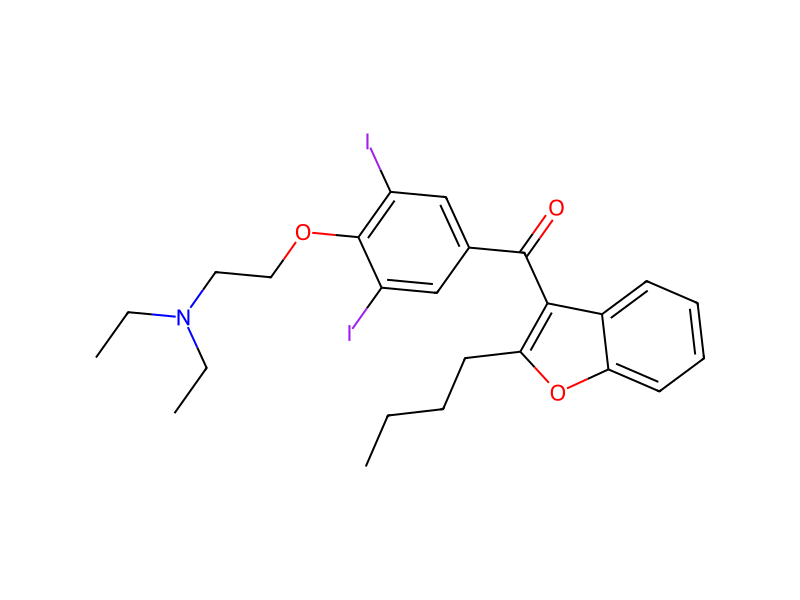
Amiodarone is a member of the class of 1-benzofurans that is 1-benzofuran substituted by a butyl group at position 2 and a 4-[2-(diethylamino)ethoxy]-3,5-diiodobenzoyl group at position 3. It is a cardiovascular drug used for the treatment of cardiac dysrhythmias. It has a role as a cardiovascular drug. It is an organoiodine compound, a member of 1-benzofurans, a tertiary amino compound and an aromatic ketone.
Namen und Bezeichner
- Bevorzugter Name
- Amiodarone
- IUPAC
- (2-butyl-1-benzofuran-3-yl)-[4-[2-(diethylamino)ethoxy]-3,5-diiodophenyl]methanone
- Lokaler Name
- Amiodaron
- Englischer Name
- Amiodarone
- Summenformel
- C25H29I2NO3
- Molmasse
- 645.31
Namen und Synonyme
amiodarone1951-25-3AmiodaronaAmiodaronum2-Butyl-3-(3,5-diiodo-4-(2-diethylaminoethoxy)benzoyl)benzofuran2-n-Butyl-3',5'-diiodo-4'-N-diethylaminoethoxy-3-benzoylbenzofuranDTXSID7022592N3RQ532IUT2-Butyl-3-benzofuranyl 4-(2-(diethylamino)ethoxy)-3,5-diiodophenyl ketoneAtlansil(2-butyl-1-benzofuran-3-yl){4-[2-(diethylamino)ethoxy]-3,5-diiodophenyl}methanoneMethanone, (2-butyl-3-benzofuranyl)(4-(2-(diethylamino)ethoxy)-3,5-diiodophenyl)-
Weitere Namen anzeigen
Amiodarone BaseAncaronSedacoronAMidoroneSedacoroneAmiodaronsTranquerone
CHEBI:2663DTXCID702592Methanone, (2-butyl-3-benzofuranyl)[4-[2-(diethylamino)ethoxy]-3,5-diiodophenyl]-Kordaron{2-[4-(2-butyl-1-benzofuran-3-carbonyl)-2,6-diiodophenoxy]ethyl}diethylamineAmiodarex2-Butyl-3-benzofuranyl 4-[2-(diethylamino)ethoxy]-3,5-diiodophenyl ketone(2-(4-(2-butyl-1-benzofuran-3-carbonyl)-2,6-diiodophenoxy)ethyl)diethylamine
Datenbank-Bezeichner
- CAS
1951-25-3- PubChem CID
- 2157
- DTXSID
DTXSID7022592- ChEMBL
CHEMBL633- ChEBI
CHEBI:2663- UNII
- N3RQ532IUT
- EC Number
- 217-772-1
- Nikkaji
- J7.829H
Eigenschaften
Berechnete Struktureigenschaften
- XLogP
- 7,6
- Polarare Oberfläche (TPSA)
- 42,7 Ų
- H-Brücken-Donoren
- 0
- H-Brücken-Akzeptoren
- 4
- Frei drehbare Bindungen
- 11
- Schwere Atome
- 31
- Formalladung
- 0
- Komplexität
- 547
Experimentelle und physikochemische Eigenschaften
Drugs
Pharmaceuticals -> Listed in ZINC15
Pharmaceuticals
Pharmaceuticals -> Used in Switzerland
LogP
7.9
6.59
Solubility
Low
4.76e-03 g/L
Human Drugs
Breast Feeding; Lactation; Milk, Human; Antiarrhythmics
Pharmaceuticals
Antiarrhythmic medicines
Endocrine DisruptorsPotential endocrine disrupting compound
Physical DescriptionSolid
Ionization Efficiency
Positive
4.701691025
2.7
Thermo LTQ
Electrospray ionization
formic acid (5.3nM)
Dissociation Constants
9.06
6.56 ± 0.06
Collision Cross Section
223.8 Ų [M+H]+ [CCS Type: DT; Buffer gas: N2; Ionization: APCI+; Dataset: TOXCAST; Source Identifier: DTXSID7037185]
224.84 Ų [M+H]+ [CCS Type: TW; Method: calibrated with polyalanine and drug standards]
226.4 Ų [M+H]+ [CCS Type: TW; Method: Major Mix IMS/Tof Calibration Kit (Waters)]
Physikochemische Eigenschaften
- Schmelzpunkt
- 54 · 54 - 55°C
- Siedepunkt
- 635.1 · 635.1±55.0 °C(Predicted)
- Dichte
- 1.573 · 1.5730 (estimate)
- storage temp.
- 2 · 2-8°C
- Löslichkeit
- Chloroform (Slightly), Methanol (Slightly)
- Aggregatzustand
- Solid
- pka
- 6.56 · 6.56(at 25℃)
- Farbe
- Colourless to Pale Yellow
- Wasserlöslichkeit
- 716.4 mg/L · 716.4mg/L(25 ºC)
- Stabilität
- Stable. Incompatible with strong oxidizing agents.
- InChI
- InChI=1S/C25H29I2NO3/c1-4-7-11-22-23(18-10-8-9-12-21(18)31-22)24(29)17-15-19(26)25(20(27)16-17)30-14-13-28(5-2)6-3/h8-10,12,15-16H,4-7,11,13-14H2,1-3H3
- InChIKey
- IYIKLHRQXLHMJQ-UHFFFAOYSA-N
- SMILES
- C(C1C2=CC=CC=C2OC=1CCCC)(C1=CC(I)=C(OCCN(CC)CC)C(I)=C1)=O
- CAS Datenbank
- 1951 · 1951-25-3(CAS DataBase Reference)
- EPA chemische Informationen
- 2 · Methanone, (2-butyl-3-benzofuranyl)[4-[2-(diethylamino)ethoxy]-3,5-diiodophenyl]- (1951-25-3)
Sicherheit und Regulatorisches
GHS-Klassifizierung
GHS Classification
This chemical does not meet GHS hazard criteria for 96.4% (53 of 55) of all reports.
Not Classified
Aggregated GHS information provided per 55 reports by companies from 3 notifications to the ECHA C&L Inventory.
Gefahrenhinweise
Regulatory InformationAmiodarone: Does not have an individual approval but may be used under an appropriate group standard
Other Safety InformationIMAP assessments - Methanone, (2-butyl-3-benzofuranyl)[4-[2-(diethylamino)ethoxy]-3,5-diiodophenyl]-: Human health tier I assessment
Hazard Classes and CategoriesNot Classified
Toxikologische Informationen
Health EffectsSome side effects have a significant mortality rate: specifically, hepatitis, exacerbation of asthma and congestive failure, and pneumonitis.
Hepatotoxicity
While liver injury from amiodarone is uncommon, it is not rare. Serum enzyme elevations are reported to occur in 15% to 50% of patients on long term therapy, but with lower doses (200 to 300 mg daily), ALT elevations are less common. Often these elevations resolve despite continuation of amiodarone, and liver biopsy may reveal minimal changes, or accumulation of granular material in macrophages without other evidence of injury. Patients taking amiodarone are recommended to have ALT and AST values taken at baseline and then every six months, and to discontinue therapy if levels are persistently greater than twice the upper limit of the normal range. The efficacy of this approach, even if followed, in preventing serious liver injury from amiodarone is unclear.
Adverse Effects
Adverse effects from amiodarone therapy can be as high as 15% within the initial year of use and may reach 50% with long-term treatment. The risk-to-benefit ratio frequently results in the discontinuation of amiodarone within the first year of treatment, particularly for patients with atrial fibrillation. The most prevalent adverse effect is the development of corneal microdeposits, which occur in at least 90% of patients taking amiodarone. This occurrence is believed to result from amiodarone being secreted in the lacrimal gland and subsequently taken up by the corneal epithelium. However, only about 10% of these patients will develop actual visual symptoms. Additional ocular adverse effects include photophobia, optic neuropathy, and visual halos. A baseline ophthalmological assessment is recommended for patients initiating amiodarone therapy.
Exposure RoutesSlow and variable (about 20 to 55% of an oral dose is absorbed).
Toxicity Summary
Signs and Symptoms of Overdose
The antiarrhythmic effect of amiodarone may be due to at least two major actions. It prolongs the myocardial cell-action potential (phase 3) duration and refractory period and acts as a noncompetitive a- and b-adrenergic inhibitor.
Carcinogen ClassificationNo indication of carcinogenicity to humans (not listed by IARC).
Drug Induced Liver Injury
Benchmark Dataset for the Liver Toxicity Knowledge Base (LTKB)
amiodarone
Cordarone®
Antiarrhythmics
8
most-DILI-concern
Effects During Pregnancy and Lactation◉ Summary of Use during Lactation
Toxicity DataIntravenous, mouse: LD<sub>50</sub> = 178 mg/kg.
EPA Human Health Benchmarks for Pharmaceuticals
Amiodarone
9.3
39.4
When adequate arrhythmia control is achieved, or if side effects become prominent, amiodarone dose should be reduced to 600 to 800 mg/day for one month and then to the maintenance dose, usually 400 mg/day.
Data used to generate the benchmarks include the following: Lowest Daily Dose (LDD): 400 mg/day, Lowest Therapeutic Dose (LTD): 5.0 mg/kg-day, and Screening Dose: 0.002 mg/kg-day.
15-Dec-21
Sicherheitsdaten
- wgk
- 3
- RTECS-Nr.
- OB1361000
- risk_code
- 20/21/22
- hazard_code
- Xn
- safety_code
- 36
Chemie und Industrie
Pharmakologische Informationen
ATC Code
C01BD01
C - Cardiovascular system
QC - Cardiovascular system
C01BD01
Protein BindingThe protein binding of amiodarone is about 96%.
Pharmacodynamics
After intravenous administration, amiodarone acts to relax smooth muscles that line vascular walls, decreases peripheral vascular resistance (afterload), and increases the cardiac index by a small amount. Administration by this route also decreases cardiac conduction, preventing and treating arrhythmias. When it is given orally, however, amiodarone does not lead to significant changes in the left ventricular ejection fraction. Similar to other anti-arrhythmic agents, controlled clinical trials do not confirm that oral amiodarone increases survival. Amiodarone prolongs the QRS duration and QT interval. In addition, a decreased SA (sinoatrial) node automaticity occurs with a decrease in AV node conduction velocity. Ectopic pacemaker automaticity is also inhibited. Thyrotoxicosis or hypothyroidism may also result from the administration of amiodarone, which contains high levels of iodine, and interferes with normal thyroid function.
Mechanism of Action
Amiodarone is considered a class III anti-arrhythmic drug. It blocks potassium currents that cause repolarization of the heart muscle during the third phase of the cardiac action potential. As a result amiodarone increases the duration of the action potential as well as the effective refractory period for cardiac cells (myocytes). Therefore, cardiac muscle cell excitability is reduced, preventing and treating abnormal heart rhythms. Unique from other members of the class III anti-arrhythmic drug class, amiodarone also interferes with the functioning of beta-adrenergic receptors, sodium channels, and calcium channels channels. These actions, at times, can lead to undesirable effects, such as hypotension, bradycardia, and Torsades de pointes (TdP). In addition to the above, amiodarone may increase activity of peroxisome proliferator-activated receptors, leading to steatogenic changes in the liver or other organs. Finally, amiodarone has been found to bind to the thyroid receptor due to its iodine content, potentially leading to amiodarone induced hypothyroidism or thyrotoxicosis.
Biological Half-Life
The terminal half-life of amiodarone varies according to the patient, but is long nonetheless, and ranges from about 9-100 days. The half-life duration varies according to different sources. According to the prescribing information for amiodarone, the average apparent plasma terminal elimination half-life of amiodarone is of 58 days (ranging from 15 to 142 days). The terminal half-life range was between 14 to 75 days for the active metabolite, (DEA). The plasma half-life of amiodarone after one dose ranges from 3.2 to 79.7 hours, according to one source.
Metabolism/Metabolites
This drug is metabolized to the main metabolite desethylamiodarone (DEA) by the CYP3A4 and CYP2C8 enzymes. The CYP3A4 enzyme is found in the liver and intestines. A hydroxyl metabolite of DEA has been identified in mammals, but its clinical significance is unknown.
Amiodarone has known human metabolites that include N-Desethylamiodarone.
Amiodarone is extensively metabolized in the liver via CYP2C8 (under 1% unchanged in urine), and can effect the metabolism of numerous other drugs. The major metabolite of amiodarone is desethylamiodarone (DEA), which also has antiarrhythmic properties. The metabolism of amiodarone is inhibited by grapefruit juice, leading to elevated serum levels of amiodarone. Route of Elimination: Amiodarone is eliminated primarily by hepatic metabolism and biliary excretion and there is negligible excretion of amiodarone or DEA in urine. Half Life: 58 days (range 15-142 days)
FDA Pharmacological Classification
N3RQ532IUT
AMIODARONE
Established Pharmacologic Class [EPC] - Antiarrhythmic
Mechanisms of Action [MoA] - Cytochrome P450 3A Inhibitors
Mechanisms of Action [MoA] - P-Glycoprotein Inhibitors
Mechanisms of Action [MoA] - Cytochrome P450 1A2 Inhibitors
MeSH Pharmacological Classification
Agents used for the treatment or prevention of cardiac arrhythmias. They may affect the polarization-repolarization phase of the action potential, its excitability or refractoriness, or impulse conduction or membrane responsiveness within cardiac fibers. Anti-arrhythmia agents are often classed into four main groups according to their mechanism of action: sodium channel blockade, beta-adrenergic blockade, repolarization prolongation, or calcium channel blockade.
Drugs used to cause dilation of the blood vessels.
A class of drugs that act by inhibition of potassium efflux through cell membranes. Blockade of potassium channels prolongs the duration of ACTION POTENTIALS. They are used as ANTI-ARRHYTHMIA AGENTS and VASODILATOR AGENTS.
A class of drugs that act by inhibition of sodium influx through cell membranes. Blockade of sodium channels slows the rate and amplitude of initial rapid depolarization, reduces cell excitability, and reduces conduction velocity.
Drugs and compounds which inhibit or antagonize the biosynthesis or actions of CYTOCHROME P-450 CYP1A2.
Drugs and compounds which inhibit or antagonize the biosynthesis or actions of CYTOCHROME P-450 CYP2C9.
Absorption, Distribution and Excretion
The Cmax of amiodarone in the plasma is achieved about 3 to 7 hours after administration. The general time to onset of action of amiodarone after one dose given by the intravenous route is between 1 and 30 minutes, with therapeutic effects lasting from 1-3 hours. Steady-state concentrations of amiodarone in the plasma ranges between 0.4 to 11.99 μg/ml; it is advisable that steady-state levels are generally maintained between 1.0 and 2.5 μg/ml in patients with arrhythmias. Interestingly, its onset of action may sometimes begin after 2 to 3 days, but frequently takes 1 to 3 weeks, despite the administration of higher loading doses. The bioavailability of amiodarone varies in clinical studies, averaging between 35 and 65%. Effect of food In healthy subjects who were given a single 600-mg dose immediately after consuming a meal high in fat, the AUC of amiodarone increased by 2.3 and the Cmax by 3.8 times. Food also enhances absorption, reducing the Tmax by about 37%.
Amiodarone is eliminated primarily by hepatic metabolism and biliary excretion. A small amount of desethylamiodarone (DEA) is found in the urine.
In a pharmacokinetic study of 3 healthy individuals and 3 patients diagnosed with supraventricular tachycardia (SVT), the volume of distribution was found to be 9.26-17.17 L/kg in healthy volunteers and 6.88-21.05 L/kg in the SVT patients. Prescribing information mentions that the volume of distribution of amiodarone varies greatly, with a mean distribution of approximately 60 L/kg. It accumulates throughout the body, especially in adipose tissue and highly vascular organs including the lung, liver, and spleen. One major metabolite of amiodarone, desethylamiodarone (DEA), is found in even higher proportions in the same tissues as amiodarone.
The clearance of amiodarone after intravenous administration in patients with ventricular fibrillation and ventricular tachycardia ranged from 220 to 440 ml/hr/kg in one clinically study. Another study determined that the total body clearance of amiodarone varies from 0.10 to 0.77 L/min after one intravenous dose. Renal impairment does not appear to affect the clearance of amiodarone, but hepatic impairment may reduce clearance. Patients with liver cirrhosis exhibited significantly lower Cmax and mean amiodarone concentration for DEA, but not for amiodarone. Severe left ventricular dysfunction prolongs the half-life of DEA. A note on monitoring No guidelines have been developed for adjusting the dose of amiodarone in renal, hepatic, or cardiac abnormalities. In patients on chronic amiodarone treatment, close clinical monitoring is advisable, especially for elderly patients and those with severe left ventricular dysfunction.
Cellular LocationsMembrane
Metabolite PathwaysAmiodarone Action Pathway
Verwendung und Herstellung
Uses
Use (kg) in Switzerland (2009): >1000
Intravenously, for initiation of treatment and prophylaxis of frequently recurring ventricular fibrillation and hemodynamically unstable ventricular tachycardia in patients refractory to other therapy. Orally, for the treatment of life-threatening recurrent ventricular arrhythmias such as recurrent ventricular fibrillation and recurrent hemodynamically unstable ventricular tachycardia.
Use ClassificationPharmaceuticals
Anwendungen
BeschreibungFrom the chemical point of view, amiodarone is completely different from other antiarrhythmics. It has two iodide atoms and a diethylaminoethanol group as substituents in the benzoyl part, and overall it is very similar to the structure of thyroxin-like molecules.
Verwendenantibacterial
Vor- und nachgelagerte Produkte
Vorgelagerte Rohstoffe
Anbieter50 Anbieter
北京华美互利生物化工010-56205725 · [email protected]
南通飞宇生物科技有限公司0513-68819626 15152877458 · [email protected]
Hebei Chuanghai Biotechnology Co., Ltd+86-17732866630 · [email protected]
武汉英诺医药科技有限公司+86-027-59232304 15387063101 · [email protected]
艾吉析科技(上海)有限公司17717235263 · [email protected]
咸宁深蓝生物医药研发有限公司18171815831 · [email protected]
杭州品高化工有限公司0571-87658025 · [email protected]
武汉布林科技有限公司3456065315 13260619011 · [email protected]
上海毕得医药科技股份有限公司400-1647117 13681763483 · [email protected]
普善实业(陕西)有限公司029-81310890 18165209495 · [email protected]
湖北科乐精细化工有限公司027-59101668 19945030958 · [email protected]
Sinoway Industrial co., ltd.+86-0592-5800732 +86-13806035118 · [email protected]
Syntechem Co.,Ltd[email protected]
欧利希(湖北)医药科技有限公司17316404525 17316404525 · [email protected]
广东云星生物技术有限公司0751-18902340975/189023400307 18902340307 · [email protected]
江苏艾康生物医药研发有限公司025-5885952 15955137747 · [email protected]
西安泽邦生物科技有限公司[email protected]
上海相辉医药科技有限公司13761987713; 13761987713 · [email protected]
銳迪國際科技有限公司18024082417 · [email protected]
武汉丰泰威远科技有限公司+86-27-8746-5837 +86-18627785180 · [email protected]
上海瀚香生物科技有限公司177-54423994 17754423994 · [email protected]
武汉丰泰威远科技有限公司027-87465837 19945049750 · [email protected]
深圳菲斯生物科技有限公司0755-83725681-603
南京生利德生物科技有限公司025-57798810 18652991625 · [email protected]
上海陶素生化科技有限公司021-33632979 · [email protected]
Cato Research Chemicals Inc.020-81960175 · [email protected]
HBCChem, Inc.+1-510-219-6317 · [email protected]
Shijiazhuang Jianxin Biotechnology Co., LTD+undefined-86-1906231316-9 +86-19062313169 · [email protected]
上海创赛科技有限公司400-6087598 15021221957 · [email protected]
天津普西唐生物医药科技有限公司010-60605840 · [email protected]
杭州杰恒化工有限公司0571-87396432 · [email protected]
上海寰川实业有限公司021-61478794 · [email protected]
池州凯隆进出口贸易有限公司[email protected]
上海陶术生物科技股份有限公司+1-781-999-5354; +1-00000000000 · [email protected]
西安美川生物科技有限公司029-89275612 +8618991951683 · [email protected]
安耐吉化学&3A(安徽泽升科技股份有限公司)400-0056266 · [email protected]
Hangzhou Hyper Chemicals Limited+86-0086-57187702781 +86-13675893055 · [email protected]
上海阿拉丁生化科技股份有限公司6206333 13167063860 · [email protected]
江西弗莱医药科技有限公司15870833005 · [email protected]
武汉多普乐生物医药有限公司+86-02787215551 19945035818 · [email protected]
上海药禾平生物医药科技有限公司57540919 13120888836 · [email protected]
风咏生物(AbMole)021-10000000 13000000000 · [email protected]
陕西缔都医药化工有限公司+86-29-81139210 +86-17392587031 · [email protected]
Anhuyan (Hainan) Biotechnology Co., LTD+86-18163349544 · [email protected]
上海源叶生物科技有限公司13636370518 · [email protected]
上海麦克林生化科技股份有限公司50706066 15221275939 · [email protected]
武汉沃格达生物科技有限公司15071299552 · [email protected]
Henan Bao Enluo International TradeCo.,LTD+86-17331933971 · [email protected]
杭州洁汉化工有限公司+86-571-86217390; +8618058761490 · [email protected]
Musechem+1-800-259-7612 · [email protected]
Ergänzende Hinweise
DefinitionChEBI: A member of the class of 1-benzofurans that is 1-benzofuran substituted by a butyl group at position 2 and a 4-[2-(diethylamino)ethoxy]-3,5-diiodobenzoyl group at position 3. It is a cardiovascular drug used for the treatment of cardiac dysrhythmias.
Zugehörige Reaktionen
2

Verknüpfte Notizen
Wird geladen…