
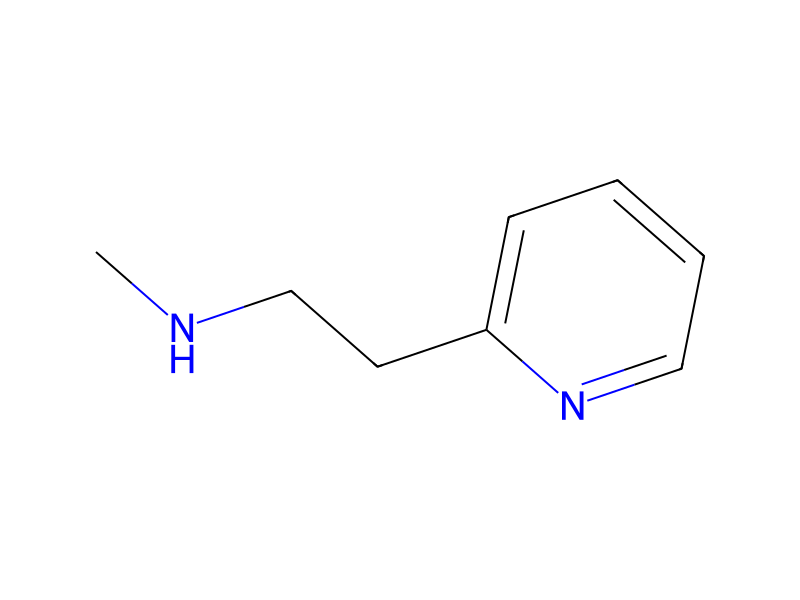
Grundinformationen
- Standard-SMILES
CNCCc1ccccn1- InChIKey
UUQMNUMQCIQDMZ-UHFFFAOYSA-N- Summenformel
- C8H12N2
- Durchschnittliche Molmasse
- 136,19 g/mol
- Monoisotopische Masse
- 136,10004838
Überblick
Betahistine is an aminoalkylpyridine that is pyridine substituted by a 2-(methylamino)ethyl group at position 2. It acts as a histamine agonist and a vasodilator, and is thought to improve the microcirculation of the labyrinth, resulting in reduced endolymphatic pressure. It is used (generally as the hydrochloride or mesylate salt) to reduce the symptoms of vertigo, tinnitus, and hearing loss associated with Mnire's disease. It has a role as a vasodilator agent and a H1-receptor agonist. It is an aminoalkylpyridine and a secondary amino compound.
Namen und Bezeichner
- Bevorzugter Name
- Betahistine
- IUPAC
- N-methyl-2-pyridin-2-ylethanamine
- Lokaler Name
- Betahistin
- Englischer Name
- Betahistine
- Summenformel
- C8H12N2
- Molmasse
- 136.19
Namen und Synonyme
betahistine5638-76-6N-Methyl-2-pyridineethanamineVasomotal2-Pyridineethanamine, N-methyl-Betahistina2-[2-(Methylamino)ethyl]pyridineN-methyl-2-pyridin-2-ylethanamineBetahistinummethyl[2-(pyridin-2-yl)ethyl]amineBetaistina2-(2-(Methylamino)ethyl)pyridine
Weitere Namen anzeigen
n-methyl-2-(pyridin-2-yl)ethan-1-amineY-G 14-d3PT 9 baseSerc baseβ-HistineNSC 42617-d3AKOS BBS-00002883Sinmenier (free base)
Vestibo(2-(2-Pyridyl)ethyl)methylamine[2-(2-Pyridyl)ethyl]methylamine2-(beta-Methylaminoethyl)pyridineHISTALEANX32KK4201DN-Methyl-2-(2-pyridinyl)ethanamineNSC-42617
Datenbank-Bezeichner
- CAS
5638-76-6- PubChem CID
- 2366
- DTXSID
DTXSID3022665- ChEMBL
CHEMBL24441- ChEBI
CHEBI:35677- UNII
- X32KK4201D
- EC Number
- 227-086-4
- Nikkaji
- J8.042J
Eigenschaften
Berechnete Struktureigenschaften
- XLogP
- 0,4
- Polarare Oberfläche (TPSA)
- 24,9 Ų
- H-Brücken-Donoren
- 1
- H-Brücken-Akzeptoren
- 2
- Frei drehbare Bindungen
- 3
- Schwere Atome
- 10
- Formalladung
- 0
- Komplexität
- 83,3
Experimentelle und physikochemische Eigenschaften
Drugs
Pharmaceuticals -> Used in Switzerland
Pharmaceuticals -> Listed in ZINC15
Pharmaceuticals
LogP0.68
Boiling Point210.9±15.0 °C
Melting Point150-144
Physical DescriptionSolid
Dissociation Constants3.5, 9.7
Collision Cross Section128.98 Ų [M+Na]+ [CCS Type: TW; Method: calibrated with polyalanine and drug standards]
Physikochemische Eigenschaften
- Siedepunkt
- 113 · 113-114 °C30 mm Hg(lit.)
- Dichte
- 0.984 g/mL · 0.984 g/mL at 25 °C(lit.)
- Dampfdruck
- 17.7 Pa · 17.7Pa at 25℃
- Brechungsindex
- 20 · n20/D 1.518(lit.)
- Flammpunkt
- 206 °F · 206 °F
- storage temp.
- Keep in dark place,Inert atmosphere,Room temperature
- Löslichkeit
- Chloroform (Slightly), DMSO (Sparingly), Ethyl Acetate (Slightly), Methanol (Slightly)
- pka
- 3.46 · pKa 3.46 (Uncertain)
- Aggregatzustand
- Oil
- Farbe
- Light Yellow to Yellow
- Wasserlöslichkeit
- 1000 g/L · 1000g/L at 25℃
- Merck
- 13 · 13,1181
- InChI
- 1S/C8H12N2/c1-9-7-5-8-4-2-3-6-10-8/h2-4,6,9H,5,7H2,1H3
- InChIKey
- UUQMNUMQCIQDMZ-UHFFFAOYSA-N
- SMILES
- CNCCc1ccccn1
- LogP
- 0.68 · 0.68
- CAS Datenbank
- 5638 · 5638-76-6(CAS DataBase Reference)
- EPA chemische Informationen
- 2 · 2-Pyridineethanamine, N-methyl- (5638-76-6)
Sicherheit und Regulatorisches
GHS-Klassifizierung
GHS Classification
Warning
H315 (100%): Causes skin irritation [Warning Skin corrosion/irritation]
P261, P264, P264+P265, P271, P280, P302+P352, P304+P340, P305+P351+P338, P319, P321, P332+P317, P337+P317, P362+P364, P403+P233, P405, and P501 (click each P-code to see the statement)
Aggregated GHS information provided per 47 reports by companies from 5 notifications to the ECHA C&L Inventory. Each notification may be associated with multiple companies.
Gefahrenhinweise
Regulatory InformationStatus: Active Update: 01-10-2019 https://echa.europa.eu/registration-dossier/-/registered-dossier/18902
Hazard Classes and CategoriesSkin Irrit. 2 (100%)
Toxikologische Informationen
Drug Induced Liver Injury
Drug-Induced Liver Injury Severity and Toxicity (DILIst)
betahistine
DILI Positive
Oral
DOI:10.1016/j.drudis.2019.09.022
Sicherheitsdaten
- wgk
- 2
- tsca
- TSCA listed
- hs_code
- 2933399990
- RTECS-Nr.
- UT5552000
- risk_code
- 36/37/38
- hazard_code
- Xi,C
- hazard_note
- Corrosive
- safety_code
- 26-37/39
- Speicherklasse
- 10 - Combustible liquids
- Hazard Classifications
- Eye Irrit. 2Skin Irrit. 2STOT SE 3
Chemie und Industrie
Pharmakologische Informationen
ATC Code
N07CA01
N - Nervous system
QN - Nervous system
Protein BindingThe plasma protein binding of betahistine is reported to be less than 5%.
PharmacodynamicsThrough its actions on the histamine receptors, betahistine provides relief from vertigo associated with Ménière's disease.
Mechanism of Action
OBE101 is a H1 receptor agonist and partial H3 receptor antagonist. Because inhibition of H1 receptors increases feeding, agonism of H1 receptors by OBE101 should reduce feeding. By also partially antagonizing H3, OBE101 impedes a negative feedback loop that essentially prolongs stimulation of the H1 receptors.
Vertigo is a disturbing sensation of movement caused by dysfunction of the labyrinth (inner ear), vestibular nerve, cerebellum, brainstem, or Central Nervous System (CNS). Vestibular forms of vertigo are often accompanied by auditory dysfunctions such as hyperacusis, hearing loss, and tinnitus. In most cases, adaptive mechanisms of the CNS lead to functional recovery after episodes of vertigo, however, syndromes such as Ménière's disease tend to cause the recurrence of vertigo symptoms. This significantly impacts the quality of life and the ability to carry out daily activities. **H1-receptor activity** The mechanism of action of betahistine is multifactorial. Ménière's disease is thought to result from a disruption of endolymphatic fluid homeostasis in the ear. Betahistine mainly acts as a histamine H1-receptor agonist. The stimulation of H1-receptors in the inner ear causes a vasodilatory effect leading to increased permeability of blood vessels and a reduction in endolymphatic pressure; this action prevents the rupture of the labyrinth, which can contribute to the hearing loss associated with Ménière's disease. Betahistine is also purported to act by reducing the asymmetrical functioning of sensory vestibular organs and increasing vestibulocochlear blood flow, relieving symptoms of vertigo. **H3-receptor activity** In addition to the above mechanisms, betahistine also acts as a histamine H3-receptor antagonist, increasing the turnover of histamine from postsynaptic histaminergic nerve receptors, subsequently leading to an increase in H1-agonist activity. H3-receptor antagonism elevates levels of neurotransmitters including serotonin in the brainstem, inhibiting the activity of vestibular nuclei, thus restoring proper balance and decreasing vertigo symptoms.
Biological Half-LifeThe half-life of betahistine is 3-4 hours.
Metabolism/MetabolitesBetahistine is metabolized primarily into the inactive metabolite 2-pyridylacetic acid. There is both clinical and in vitro evidence that monoamine oxidase enzymes are responsible for the metabolism of betahistine.
MeSH Pharmacological Classification
Drugs used to cause dilation of the blood vessels.
Drugs that bind to and activate histamine receptors. Although they have been suggested for a variety of clinical applications histamine agonists have so far been more widely used in research than therapeutically.
Absorption, Distribution and Excretion
When given orally, betahistine is rapidly and almost completely absorbed from the gastrointestinal tract. In the fasted state, Cmax is achieved within 1 hour of administration; in the fed state, Cmax is delayed, but the total drug absorption is similar. Food, therefore, has little effect on the absorption of betahistine.[A220563,16388]
Betahistine is mainly excreted in the urine; with approximately 85-91% being detected in urine samples within 24 hours of administration.
In a pharmacokinetic study of rats, betahistine was found to be distributed throughout the body. Human data for betahistine's volume of distribution is not readily available.
Cellular LocationsMembrane
Metabolite PathwaysBetahistine H1-Antihistamine Action
Verwendung und Herstellung
UsesUse (kg; approx.) in Germany (2009): >1000
General Manufacturing Information2-Pyridineethanamine, N-methyl-: INACTIVE
Anwendungen
BeschreibungBetahistine is an analogue of histamine with weak agonist properties at histamine H1 receptors and more potent antagonistic effects at histamine H3 receptors.This drug is broadly used worldwide, except for the USA, since it has not been approved by the US Food and Drug Administration. Betahistine is a structural analog of histamine that acts as a weak partial postsynaptic histamine H1 receptor agonist and presynaptic H3 receptor antagonist, with no effect on postsynaptic H2 receptors (Gbahou et al, 2010). The mechanism of action of the drug appears to depend mainly on its action on H3 receptors mediated by two metabolites, aminoethylpyridine and hydroxyethylpyridine (Bertich et al, 2014).
VerwendenBetahistine is a vasodilator, a mild H1 histamine agonist, and a potent H3 histamine antagonist. The mechanism of action in Meniere's disease is unknown, but theories include reducing the endolymphatic pressure through improved circulation in the stria vascularis or inhibiting activity in the vestibular nuclei. It has been found to be a safe drug with a very low side effect profile. Betahistine was FDA approved for Meniere's disease in the US market for a short period of time in the 1970s, but approval was then rescinded due to lack of evidence supporting its efficacy. However, based on clinical experience and several observational studies, it is still widely used elsewhere in the world.
Vor- und nachgelagerte Produkte
Vorgelagerte Rohstoffe
Nachgelagerte Produkte
Anbieter50 Anbieter
北京华美互利生物化工010-56205725 · [email protected]
成都超九八生物科技有限公司13348960310 13348960310 · [email protected]
广州佳途科技股份有限公司81960175 18933936954 · [email protected]
上海毕得医药科技股份有限公司400-1647117 13681763483 · [email protected]
湖北海克斯生化有限公司17362916295; 17362916295 · [email protected]
湖北科乐精细化工有限公司027-59101668 19945030958 · [email protected]
Dayang Chem (Hangzhou) Co.,Ltd.+86-0571-88938639 17705817739 · [email protected]
Jai Radhe Sales+(91)-(79)-26431096/65255722 · [email protected]
LGM Pharma1-(800)-881-8210 · [email protected]
湖北辰心化工有限公司18696113233 · [email protected]
Syntechem Co.,Ltd[email protected]
安耐吉化学&3A(安徽泽升科技股份有限公司)400-0056266 · [email protected]
常州科化生物科技有限公司0519-68985668 13685222090 · [email protected]
南京诺利斯医药科技有限公司13901585132 · [email protected]
山东沃德森生物科技有限公司0531-88723173 18596073690 · [email protected]
Zhejiang J&C Biological Technology Co.,Limited+1-2135480471 · [email protected]
Aceschem Inc.+1-817863-6948 +1-(817)863-6948 · [email protected]
赛默飞世尔科技(中国)有限公司800-810-5118 · [email protected]
上海遐瑞医药科技有限公司+86 21 61551611
南京生利德生物科技有限公司025-57798810 18652991625 · [email protected]
陕西麟邦实业有限公司17709134430 · [email protected]
苏州爱玛特生物科技有限公司0512-56316828 4008675858 · [email protected]
天津普西唐生物医药科技有限公司010-60605840 · [email protected]
上海麦克林生化科技股份有限公司15221275939 15221275939 · [email protected]
上海技毅生物科技有限公司13621943973 · [email protected]
陕西缔都医药化工有限公司029-81024372 17792795018 · [email protected]
Shenzhen Shengda Pharmaceutical co Limited755-85269922 · [email protected]
普善实业(陕西)有限公司029-81310890 18165209495 · [email protected]
Sigma-Aldrich西格玛奥德里奇(上海)贸易有限公司021-61415566 800-8193336 · [email protected]
湖州清硫硅生物科技有限公司13626726938 · [email protected]
上海陶术生物科技股份有限公司+1-781-999-5354; +1-00000000000 · [email protected]
九鼎化学(上海)科技有限公司4009209199 · [email protected]
BOC Sciences16314854226; +8616314854226 · [email protected]
HANGZHOU LEAP CHEM CO., LTD.+86-571-87711850 +86-15355479329 · [email protected]
武汉聚成源生物科技有限公司400-027-6007 18062142210 · [email protected]
湖北辰心化工有限公司17362916295
艾吉析科技(上海)有限公司17721401538;17717235263 17721401538 · [email protected]
上海阿拉丁生化科技股份有限公司6206333 13167063860 · [email protected]
风咏生物(AbMole)021-10000000 13000000000 · [email protected]
上海珞珐生化科技有限公司021-51111890 15317326293 · [email protected]
上海思言生物科技有限公司021-50908862,442785678,326799392 18721037013 · [email protected]
上海前衍生物科技有限公司02781293128 · [email protected]
上海源叶生物科技有限公司13636370518 · [email protected]
深圳市创鑫生物科技有限公司13417589054 · [email protected]
上海颖心实验室设备有限公司021-021-59178156 15300768757 · [email protected]
南京罗迈美生物科技有限公司[email protected]
常州美泰生物科技有限公司0519-83246372 13585352506
滁州市科迈尔化工科技有限公司0550-5196001 15000891977 · [email protected]
南京凯姆铂医药科技有限公司025-66162170
上海康曼生物科技有限公司18800375331 · [email protected]
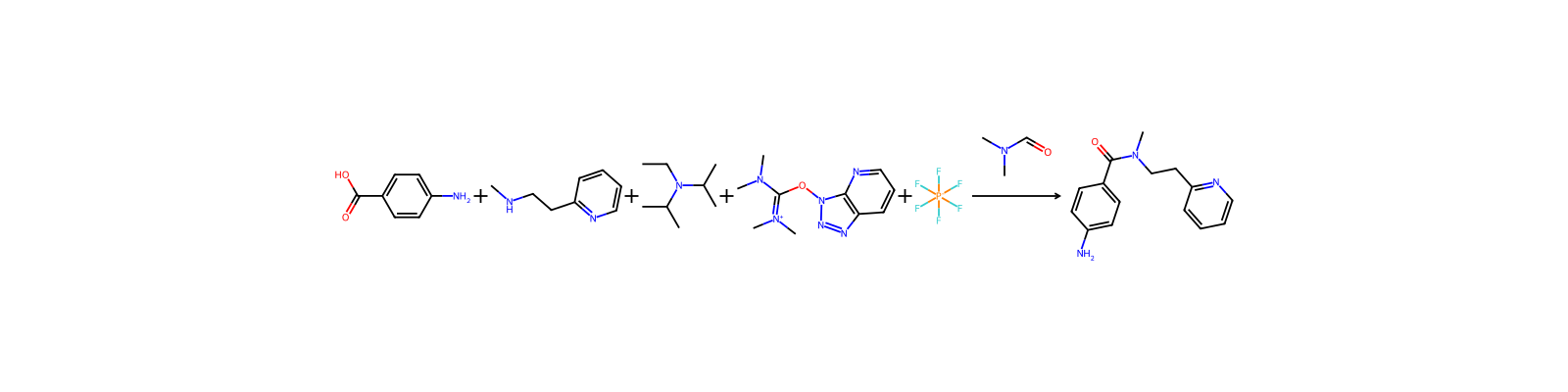
Zugehörige Reaktionen
64




Verknüpfte Notizen
Wird geladen…