StartseiteMCPWorkbenchSkills
StartseiteWorkbenchBenachrichtigungenMein Bereich
llms.txt · MCP-AnleitungDatenschutz · Nutzungsbedingungen · Supportv1.8.3
  1. Startseite
  2. /Verbindung

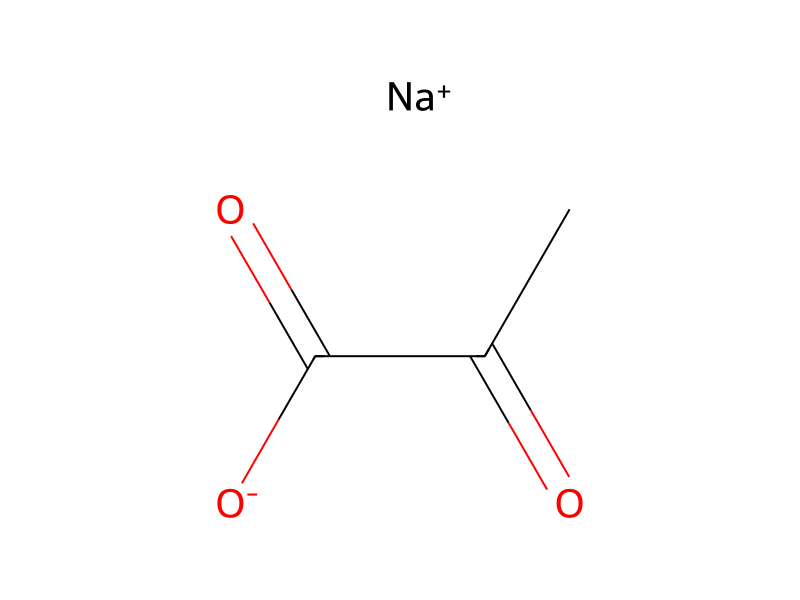
Sodium pyruvate

HCID 23662274
Neue Reaktion
Drucken
GrundinformationenÜberblickNamen und BezeichnerEigenschaftenSicherheit und RegulatorischesChemie und IndustrieZugehörige ReaktionenNotizen zur Verbindung
TeilstruktursucheÄhnliche Strukturen suchen

Grundinformationen

CAS
113-24-6
Standard-SMILES
CC(=O)C(=O)[O-].[Na+]
InChIKey
DAEPDZWVDSPTHF-UHFFFAOYSA-M
Summenformel
C3H3NaO3
Durchschnittliche Molmasse
110,04 g/mol
Monoisotopische Masse
109,99798824

Überblick

Sodium pyruvate is an organic sodium salt. It contains a pyruvate.

Namen und Bezeichner

Bevorzugter Name
Sodium pyruvate
IUPAC
sodium 2-oxopropanoate
Englischer Name
Sodium pyruvate
Summenformel
C3H5NaO3
Molmasse
112.06

Namen und Synonyme

SODIUM PYRUVATE113-24-6Pyruvic acid, sodium saltPropanoic acid, 2-oxo-, sodium saltNatrum pyruvicumDTXSID6040614NatriumpyruvatPOD38AIF08SODIUM PYRUVATE [MART.]SODIUM PYRUVATE [WHO-DD]Propanoic acid, 2-oxo-, sodium salt (1:1)EINECS 204-024-4
Weitere Namen anzeigen
PYRUVATEPYRUVIC ACID SODIUM SALTSODIUM 2-OXOPROPANOATEpyruvic acid sodiumSodiuM pyruvat2-KETOPROPIONIC ACID SODIUM SALTPYR NAp.A.,100gbinrongsuannaSodium pyruate
NATRUM PYRUVICUM [HPUS]DTXCID4020614CHEBI:50144SODIUM PYRUVATE (MART.)RefChem:887848SODIUM PYRUVATE [INCI]Propanoic acid, 2oxo, sodium salt204-024-4

Datenbank-Bezeichner

CAS
113-24-6
PubChem CID
23662274
DTXSID
DTXSID6040614
ChEMBL
CHEMBL181886
ChEBI
CHEBI:50144

Eigenschaften

Berechnete Struktureigenschaften

Polarare Oberfläche (TPSA)
57,2 Ų
H-Brücken-Donoren
0
H-Brücken-Akzeptoren
3
Frei drehbare Bindungen
1
Schwere Atome
7
Formalladung
0
Komplexität
88,2

Experimentelle und physikochemische Eigenschaften

Chemical ClassesBiological Agents -> Other Biomolecules
Melting Point300 °C
Physical Description · 2 Einträge

Liquid; CBI; Dry Powder

White to pale yellow powder; [Alfa Aesar MSDS]

Physikochemische Eigenschaften

Schmelzpunkt
300 °C · >300 °C (lit.)
Siedepunkt
300 ℃ · >300℃
Dichte
1 · 1,267g/cm
Dampfdruck
0 Pa · 0Pa at 20℃
Brechungsindex
1 · 1,426-1,43
storage temp.
2 · 2-8°C
Löslichkeit
2 O: · H2O: 100 mg/mL
Aggregatzustand
solution
Farbe
White to Pale Yellow
PH
pH(100g/l, 25℃) : 4.0~8.0

Sicherheit und Regulatorisches

Sicherheitsangaben dienen nur zur Orientierung und ersetzen weder das Sicherheitsdatenblatt (SDB) des Lieferanten noch geltende Vorschriften oder eine fachliche Bewertung.

GHS-Klassifizierung

GHS Classification · 5 Einträge

This chemical does not meet GHS hazard criteria for 29.7% (70 of 236) of reports.

Warning

H317 (69.9%): May cause an allergic skin reaction [Warning Sensitization, Skin]

P261, P264+P265, P272, P280, P302+P352, P305+P351+P338, P321, P333+P317, P337+P317, P362+P364, and P501 (click each P-code to see the statement)

Aggregated GHS information provided per 236 reports by companies from 5 notifications to the ECHA C&L Inventory. Each notification may be associated with multiple companies.

Gefahrenhinweise

Regulatory Information · 4 Einträge

Chemical: Propanoic acid, 2-oxo-, sodium salt

Propanoic acid, 2-oxo-, sodium salt (1:1) is listed on the EPA's Chemical Data Reporting (CDR) system. Manufacturers and importers of Propanoic acid, 2-oxo-, sodium salt (1:1) are required to report information about their production and use of this chemical to the EPA under the Toxic Substances Control Act (TSCA). (40 eCFR Part 711)

Status: Active Update: 03-06-2022 https://echa.europa.eu/registration-dossier/-/registered-dossier/24266

Sodium pyruvate: Does not have an individual approval but may be used under an appropriate group standard

Hazards SummaryMay cause irritation; [Alfa Aesar MSDS]
Hazard Classes and CategoriesSkin Sens. 1 (69.9%)

Sicherheit und Schutzausrüstung

Protective Action Criteria (PAC) · 3 Einträge

12 [mg/m3]

130 [mg/m3]

Chemie und Industrie

Verwendung und Herstellung

UsesIntermediate in carbohydrate, protein, and fat metabolism; [ChemIDplus] Can be added to cell and tissue cultures as an energy source and antioxidant; [REPROTOX]
U.S. Production2023: 50,000 - <75,000 lb
Consumer UsesLaboratory chemicals
Industry UsesNot Known or Reasonably Ascertainable
General Manufacturing Information · 2 Einträge

All Other Basic Organic Chemical Manufacturing

Propanoic acid, 2-oxo-, sodium salt (1:1): ACTIVE

Anwendungen · 2 Einträge

BeschreibungSodium pyruvate is the sodium salt of pyruvate. It is frequently supplemented to the cell culture medium to act as a source of energy since it is a key intermediate during the production of the high-energy ATP molecules inside cells. For example, it can be used as a carbon source for bacteria. It may also protect cell against hydrogen peroxide, an oxidant to scavenger oxygen radicals. It is an important metabolic intermediate in many essential metabolic pathways such as carbohydrate metabolism. For example, it is converted into acetyl coenzyme A and enters into the TCA cycle (Kreb’s cycle) in organisms. It is also involved in the amino acid metabolism in organisms.

VerwendenSodium pyruvate is used in cell culture media as an additional source of energy. It acts as an antioxidant and finds protective effects against oxygen radicals. It serves as an intermediate in many metabolic pathways such as sugar metabolism. It is converted into acetyl coenzyme A and enters the trichloroacetic acid cycle. In addition, it is involved with amino acid metabolism and initiates the Kreb's cycle. It plays an important role as a free radical scavenger.

Darstellung · 1 Eintrag

Zugehörige Reaktionen

41
Reaktionsaufzeichnung erstellen
Reaktionsgleichung von HRID 133674
HRID 133674als Edukt
Reaktionsgleichung von HRID 252669
HRID 252669als Edukt
Reaktionsgleichung von HRID 262806
HRID 262806als Edukt
Reaktionsgleichung von HRID 386362
HRID 386362als Edukt
Reaktionsgleichung von HRID 576485
HRID 576485als Edukt
Reaktionsgleichung von HRID 613450
HRID 613450als Edukt
Reaktionsgleichung von HRID 621749
HRID 621749als Edukt
Reaktionsgleichung von HRID 649731
HRID 649731als Edukt
ZurückSeite 1 von 6

Notizen zur Verbindung

Auf dieser SeiteGrundinformationenÜberblickNamen und BezeichnerEigenschaftenSicherheit und RegulatorischesChemie und IndustrieZugehörige ReaktionenNotizen zur Verbindung
UNII
POD38AIF08
EC Number
204-024-4
Nikkaji
J186.572B
Biologische Quelle
synthetic (organic)
Wasserlöslichkeit
Soluble in water.
BRN
3568341 · 3568341
Stabilität
Stable. Incompatible with strong oxidizing agents.
Kosmetik-Inhaltsstoffe Funktionen
SKIN CONDITIONING
InChI
1S/C3H4O3.Na/c1-2(4)3(5)6;/h1H3,(H,5,6);/q;+1/p-1
InChIKey
DAEPDZWVDSPTHF-UHFFFAOYSA-M
SMILES
[Na+].CC(=O)C([O-])=O
LogP
-3.83 at · -3.83 at 20℃
CAS Datenbank
113 · 113-24-6(CAS DataBase Reference)
EPA chemische Informationen
Sodium pyruvate (113-24-6)

790 [mg/m3]

Sicherheitsdaten

wgk
3
tsca
TSCA listed
hs_code
29183000
risk_code
36/38-36/37/38
hazard_code
Xi
safety_code
37/39-26-24/25-36
Speicherklasse
11 - Combustible Solids
Hazard Classifications
Eye Irrit. 2Skin Sens. 1B

synthetischeThe preparation of sodium pyruvate is as follows:Synthesis of pyruvate, a salt of a compound of formula (II) by ozonolysis of methacrylic acid, a compound of formula (II) A solution of methacrylic acid obtained in Example la or lb (15.31 g, 178 mmol) in dichloromethane/methanol (5 % methanol, 50 ml) was cooled to -78 0C and a stream of ozone was passed through until the solution turned blue. Dimethylsulfide (12.41 g, 200 mmol) was added and the mixture was allowed to reach room temperature. Excess dimethylsulfide was removed by passing a stream of nitrogen through the reaction mixture. The reaction mixture was evaporated in vacuo at 30 0C. To the residue was added water (100 ml) and then slowly added a solution of aq. NaOH (IM, 178 ml). The mixture was concentrated and left for crystallisation at 4 °C. The white crystalline material obtained was filtered and washed with acetone (3x100 ml). Yield: 14.50 g (92 %). Purity: 95 %.

Vor- und nachgelagerte Produkte

Vorgelagerte Rohstoffe

BrenztraubensureKaliumhydrogensulfat

Nachgelagerte Produkte

CalciumcarbonatEthanol(+-)-WeinsureBrenztraubensureMilchsureKaliumhydrogensulfatNatriumcarbonatButanoic acid, 2-hydroxy-3-oxo- (9CI)7-bromoquinoline-4-carboxylic acid2-Oxovaleriansure(R)-sec-Butylamin3-Chloro-L-tyrosineD-AlaninChinolin-4-carbonsure3-Methylchinoxalin-2-ol