
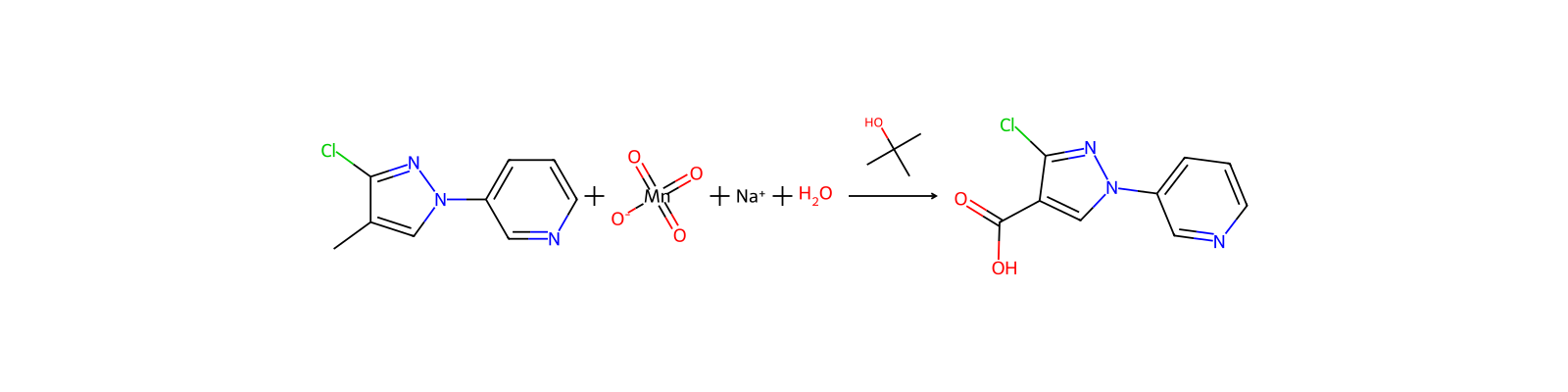
HRID 1196991als Edukt
Sodium Permanganate

10101-50-5[Na+].[O]=[Mn](=[O])(=[O])[O-]WPWYHBSOACXYBB-UHFFFAOYSA-NSodium permanganate appears as a purplish colored crystalline solid. Noncombustible but accelerates the burning of combustible material. If the combustible material is finely divided the mixture may be explosive. May spontaneously ignite in contact with liquid combustible materials. Contact with sulfuric acid may cause fires or explosions. Used in medicine, as a disinfectant, and for many other uses.
10101-50-5、79048-36-51.972 g/cu cm
Red-black hydroscopic crystals; MW 195.972; decompose @ 170 °C; very soluble in water; density 2.47g/cu cm; reacts with ethanol /Trihydrate/
1.972 @25 °C
Sodium permanganate appears as a purplish colored crystalline solid. Noncombustible but accelerates the burning of combustible material. If the combustible material is finely divided the mixture may be explosive. May spontaneously ignite in contact with liquid combustible materials. Contact with sulfuric acid may cause fires or explosions. Used in medicine, as a disinfectant, and for many other uses.
Large Crystals; Liquid
Trihydrate: Reddish-black solid; Very hygroscopic; [Merck Index] Red solid; [HSDB] Purplish solid; [CAMEO] Black-brown crystals; [MSDSonline]
Sicherheitsangaben dienen nur zur Orientierung und ersetzen weder das Sicherheitsdatenblatt (SDB) des Lieferanten noch geltende Vorschriften oder eine fachliche Bewertung.
This chemical does not meet GHS hazard criteria for 1.4% (3 of 220) of reports.
Danger
H272 (97.7%): May intensify fire; oxidizer [Danger Oxidizing liquids; Oxidizing solids]
P210, P220, P260, P264, P264+P265, P270, P273, P280, P301+P317, P301+P330+P331, P302+P361+P354, P304+P340, P305+P354+P338, P316, P317, P319, P321, P330, P363, P370+P378, P391, P405, and P501 (click each P-code to see the statement)
Aggregated GHS information provided per 220 reports by companies from 14 notifications to the ECHA C&L Inventory. Each notification may be associated with multiple companies.
Danger
Chemical: Permanganic acid (HMnO4), sodium salt
List II Chemical: A chemical, other than a List I chemical, specified by regulation that, in addition to legitimate uses, is used in manufacturing a controlled substance in violation of the Act. (21 eCFR 1310.02)
Permanganic acid (HMnO4), sodium salt is listed on the EPA's Chemical Data Reporting (CDR) system. Manufacturers and importers of Permanganic acid (HMnO4), sodium salt are required to report information about their production and use of this chemical to the EPA under the Toxic Substances Control Act (TSCA). (40 eCFR Part 711)
REACH registered substance: Sodium permanganate (EC: 233-251-1)
Permanganic acid, sodium salt: HSNO Approval: HSR001354 Approved with controls
Excerpt from ERG Guide 140 [Oxidizers]:
CAUTION: Ammonium nitrate products may explode if involved in fire or contaminated with hydrocarbons (fuels), organic matter, other contaminants or when hot molten and contained. Treat as an explosive (GUIDE 112).
Manganese is absorbed mainly via ingestion, but can also be inhaled. It binds to alpha-2-macroglobulin, albumin, or transferrin in the plasma and is distributed to the brain and all other mammalian tissues, though it tends to accumulate more in the liver, pancreas, and kidney. Manganese is capable of existing in a number of oxidation states and is believed to undergo changes in oxidation state within the body. Manganese oxidation state can influence tissue toxicokinetic behavior, and possibly toxicity. Manganese is excreted primarily in the faeces. (L228)
Used as an oxidizing agent, disinfectant , bactericide, and antidote (poisoning by morphine, curare, or phosphorus); [Hawley] Used to etch plastic parts in printed circuit boards; Formerly used as an astringent in the treatment of urethritis; [HSDB]
Oxidizing agent; disinfectant; bactericide; manufacture of saccharin; antidote for poisoning by morphine, curare, and phosphorus. /Trihydrate/
Etching of plastic parts such as printed circuit boards, as well as some special organic oxidation reactions, particularly if the presence of potassium ion is undesirable.
Aqueous solutions of sodium permanganate are used as etchants in printed circuitry. (L243)
Sodium manganate is dissolved in water and chlorine or ozone passed in. The solution is concentrated and crystallized. /Trihydrate/
Made by anodic oxidation of ferromanganese in sodium carbonate solution, via aluminum permanganate, or from potassium permanganate by the hexafluorosilicate method. /Monohydrate/




DTXSID2051504Excerpt from ERG Guide 140 [Oxidizers]:
· Inhalation, ingestion or contact (skin, eyes) with vapors or substance may cause severe injury, burns or death.
A strong oxidizing agent; Fire hazard on contact with organic substances; [Hawley] A strong oxidizing agent; May ignite combustible substances; [CAMEO] Corrosive to skin and eyes; [eChemPortal: ERMA] Potassium permanganate crystals and concentrated solutions (greater than1:5000 strength) are corrosive (release potassium hydroxide when contact water); Permanganates can induce methemoglobinemia after ingestion; [Olson, p. 133] May cause fire on contact with combustible materials; A severe skin and eye irritant; [MSDSonline] See Manganese and linked occupational diseases.
USEPA; Locating and Estimating Air Emissions from Sources of Manganese (1985) EPA-450/4-84-007h
USEPA; Health Assessment Document: Manganese (1984) EPA-600/8-83-013F
WHO; Environ Health Criteria: Manganese (1981)
WHO; Environ Health Criteria: Manganese-Executive Summary (1981)
Acetic acid or acetic anhydride can explode with permanganates if not kept cold [Von Schwartz 1918 p. 34]. Explosions can occur when permanganates that have been treated with sulfuric acid come in contact with benzene, carbon disulfide, diethyl ether, ethyl alcohol, petroleum, or organic matter.
· CALL 911. Then call emergency response telephone number on shipping paper. If shipping paper not available or no answer, refer to appropriate telephone number listed on the inside back cover.
· Keep combustibles (wood, paper, oil, etc.) away from spilled material.
Excerpt from ERG Guide 140 [Oxidizers]:
General First Aid:
· Wear positive pressure self-contained breathing apparatus (SCBA).
0.2 [mg/m3], as Mn (inhalable fraction), 0.02 mg/m3, as Mn (respirable fraction)[German Research Foundation (DFG)]
If material on fire or involved in fire: Flood with water. Cool all affected containers with flooding quantities of water. Apply water from as far a distance as possible.
Evacuation: If fire becomes uncontrollable - consider evacuation of one-half (1/2) mile radius.
SRP: At the time of review, criteria for land treatment or burial (sanitary landfill) disposal practices are subject to significant revision. Prior to implementing land disposal of waste residue (including waste sludge), consult with environmental regulatory agencies for guidance on acceptable disposal practices.
SRP: Local exhaust ventilation should be applied wherever there is an incidence of point source emissions or dispersion of regulated contaminants in the work area. Ventilation control of the contaminant as close to its point of generation is both the most economical and safest method to minimize personnel exposure to airborne contaminants.
If material not on fire and not involved in fire: Keep sparks, flames, and other sources of ignition away. Keep material out of water sources and sewers.
Personnel protection: ... Do not handle broken packages unless wearing appropriate personal protective equipment. Wash away any material which may have contacted the body with copious amounts of water or soap and water. ...
Excerpt from ERG Guide 140 [Oxidizers]:
Immediate precautionary measure
0.02 [mg/m3], as Mn (respirable fraction), 0.1 mg/m3, as Mn (inhalable fraction)
8 hr Time Weighted Avg: 0.2 mg/cu m /Manganese and inorganic compounds, as Mn/
Excursion Limit Recommendation: Excursions in worker exposure levels may exceed 3 times the TLV-TWA for no more than a total of 30 minutes during a work day, and under no circumstances should they exceed 5 times the TLV-TWA, provided that the TLV-TWA is not exceeded. /Manganese and inorganic compounds, as Mn/
0.12 [mg/m3]
1.3 [mg/m3]
63 [mg/m3]
EYES: irrigate opened eyes for several minutes under running water. INGESTION: do not induce vomiting. Rinse mouth with water (never give anything by mouth to an unconscious person). Seek immediate medical advice. SKIN: should be treated immediately by rinsing the affected parts in cold running water for at least 15 minutes, followed by thorough washing with soap and water. If necessary, the person should shower and change contaminated clothing and shoes, and then must seek medical attention. INHALATION: supply fresh air. If required provide artificial respiration.
Manganese mainly affects the nervous system and may cause behavioral changes and other nervous system effects, which include movements that may become slow and clumsy. This combination of symptoms when sufficiently severe is referred to as “manganism”. (L228)
Manganese is a cellular toxicant that can impair transport systems, enzyme activities, and receptor functions. It primarily targets the central nervous system, particularily the globus pallidus of the basal ganglia. It is believed that the manganese ion, Mn(II), enhances the autoxidation or turnover of various intracellular catecholamines, leading to increased production of free radicals, reactive oxygen species, and other cytotoxic metabolites, along with a depletion of cellular antioxidant defense mechanisms, leading to oxidative damage and selective destruction of dopaminergic neurons. In addition to dopamine, manganese is thought to perturbations other neurotransmitters, such as GABA and glutamate. In order to produce oxidative damage, manganese must first overwhelm the antioxidant enzyme manganese superoxide dismutase. The neurotoxicity of Mn(II) has also been linked to its ability to substitute for Ca(II) under physiological conditions. It can enter mitochondria via the calcium uniporter and inhibit mitochondrial oxidative phosphorylation. It may also inhibit the efflux of Ca(II), which can result in a loss of mitochondrial membrane integrity. Mn(II) has been shown to inhibit mitochondrial aconitase activity to a significant level, altering amino acid metabolism and cellular iron homeostasis. (L228)
Manganese mainly affects the nervous system and may cause behavioral changes and other nervous system effects, which include movements that may become slow and clumsy. This combination of symptoms when sufficiently severe is referred to as “manganism”. (L228)
PERMANGANATE ... OXIDIZES GASTRIC MUCOSAL CELLS. /PERMANGANATE/
MOST BACTERIA ARE KILLED WITHIN 1 HR BY PERMANGANATES IN DILUTION OF 1:10,000, BUT SOME MICROORGANISMS SURVIVE EXPOSURE TO MUCH HIGHER CONCN. GERMICIDAL EFFICIENCY ... IS GREATLY REDUCED IN PRESENCE OF ORG MATTER. /PERMANGANATES/
Basic treatment: Establish a patent airway. Suction if necessary. Watch for signs of respiratory insufficiency and assist ventilations if necessary. Administer oxygen by nonrebreather mask at 10 to 15 L/min. Monitor for pulmonary edema and treat if necessary ... . Monitor for shock and treat if necessary ... . For eye contamination, flush eyes immediately with water. Irrigate each eye continuously with normal saline during transport ... . Do not use emetics. For ingestion, rinse mouth and administer 5 ml/kg up to 200 ml of water for dilution if the patient can swallow, has a strong gag reflex, and does not drool ... . /Manganese and related compounds/
Advanced treatment: Consider orotracheal or nasotracheal intubation for airway control in the patient who is unconscious or in severe respiratory distress. Monitor cardiac rhythm and treat arrhythmias if necessary ... . Start an IV with D5W /SRP: "To keep open", minimal flow rate/. Use lactated Ringer's if signs of hypovolemia are present. Consider drug therapy for pulmonary edema ... . For hypotension with signs of hypovolemia, administer fluid cautiously. Consider vasopressors for hypotension with a normal fluid volume. Watch for signs of fluid overload ... . Use proparacaine hydrochloride to assist eye irrigation ... . /Manganese and related compounds/
Listed as a hazardous air pollutant (HAP) generally known or suspected to cause serious health problems. The Clean Air Act, as amended in 1990, directs EPA to set standards requiring major sources to sharply reduce routine emissions of toxic pollutants. EPA is required to establish and phase in specific performance based standards for all air emission sources that emit one or more of the listed pollutants. Sodium permanganate is included on this list.
... Substances for which a Federal Register notice has been published that included consideration of the serious health effects, including cancer, form ambient air exposure to the substance. Manganese (50 FR 32627; Aug. 13, 1985) is included on this list. /Manganese/
Grades: technical; sold commercially in solution. /Trihydrate/
Crystals and 40% solution /available/
Sodium Permanganate
A chemical, other than a List I chemical, specified by regulation that, in addition to legitimate uses, is used in manufacturing a controlled substance in violation of the Act. (21 eCFR 1310.02)
Utilities
Permanganic acid (HMnO4), sodium salt: ACTIVE
VerwendenSodium permanganate (NaMnO4) is a purple crystal that is soluble in water and is used as an oxidizing agent, disinfectant, and bactericide and as an antidote for morphine poisoning.