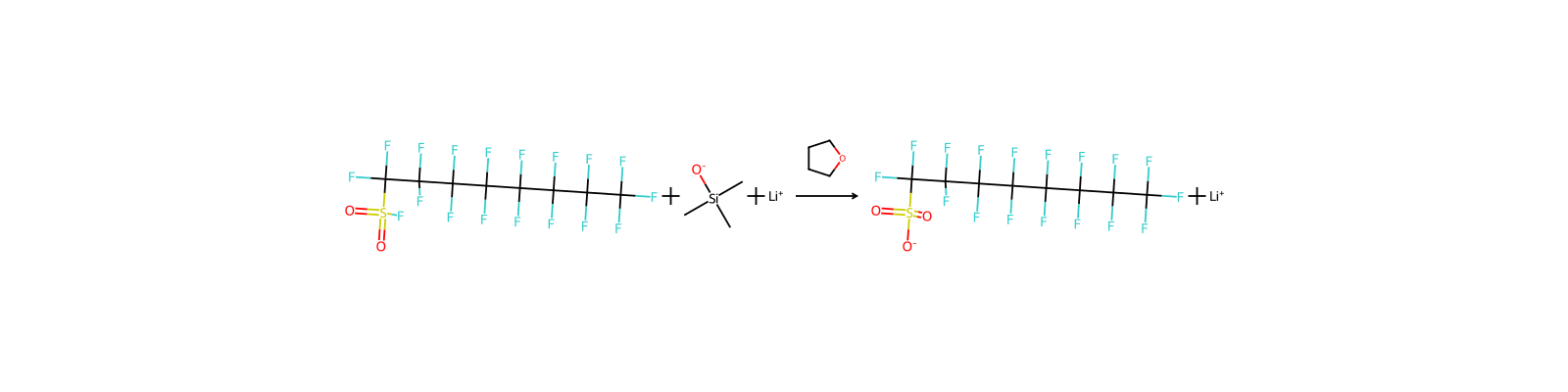
Lithium (perfluorooctane)sulfonate
Daten werden ergänzt – meist innerhalb einer Minute fertig

Grundinformationen
- CAS
29457-72-5- Standard-SMILES
O=S(=O)([O-])C(F)(F)C(F)(F)C(F)(F)C(F)(F)C(F)(F)C(F)(F)C(F)(F)C(F)(F)F.[Li+]- InChIKey
XVCUGNWRDDNCRD-UHFFFAOYSA-M- Summenformel
- C8F17LiO3S
- Durchschnittliche Molmasse
- 506,1 g/mol
- Monoisotopische Masse
- 505,94567415
Namen und Bezeichner
- Bevorzugter Name
- Lithium (perfluorooctane)sulfonate
- IUPAC
- lithium 1,1,2,2,3,3,4,4,5,5,6,6,7,7,8,8,8-heptadecafluorooctane-1-sulfonate
Namen und Synonyme
Lithium perfluorooctanesulfonate29457-72-5Lithium perfluorooctane sulfonateLithium PFOSLPOSFluorad FC 94Lithium perfluoro-1-octanesulfonateDTXSID2032421Lithium (perfluorooctane)sulfonateFT 208SULFOTINERAID-TVK
Weitere Namen anzeigen
Lithium 1,1,2,2,3,3,4,4,5,5,6,6,7,7,8,8,8-heptadecafluoro-1-octanesulfonateFLUORAD FC-94141721Y4CUDTXCID0012421Lithium heptadecafluorooctane-1-sulfonateJ250.850HEPA PESTICIDE CHEMICAL CODE 075004RefChem:799593
Datenbank-Bezeichner
- CAS
29457-72-5- PubChem CID
- 23677927
- DTXSID
DTXSID2032421- ChEMBL
CHEMBL3186076- UNII
- 141721Y4CU
- EC Number
- 249-644-6
- Nikkaji
- J250.850H
Eigenschaften
Berechnete StruktureigenschaftenWird ergänzt
- Polarare Oberfläche (TPSA)
- 65,6 Ų
- H-Brücken-Donoren
- 0
- H-Brücken-Akzeptoren
- 20
- Frei drehbare Bindungen
- 7
- Schwere Atome
- 30
- Formalladung
- 0
- Komplexität
- 733
Experimentelle und physikochemische Eigenschaften
PFAS
PFAS -> OECD Category
PFAS -> non-polymer
PFAS -> Perfluoroalkyl acids (PFAAs)
PFAS -> Other/unspecified
pHpH = 4.4 (no concentration provided)
PesticidesPesticides -> Other Insecticides
LogPlog Kow = 4.13 /Estimated/
OdorSlightly pungent odor
Density0.56 g/mL (9.6 lbs/gal) (no temperature provided)
Color/FormOff-white powder
DecompositionDecomposes at 308 °C. /Technical grade/
Melting PointDecomposes at 308 °C
Physical DescriptionOff-white solid; [HSDB] White powder; [MSDSonline]
Sicherheit und Regulatorisches
GHS-Klassifizierung
GHS Classification
Danger
H302: Harmful if swallowed [Warning Acute toxicity, oral]
P203, P260, P261, P263, P264, P270, P271, P273, P280, P301+P317, P304+P340, P317, P318, P319, P330, P391, P405, and P501 (click each P-code to see the statement)
Danger
H302 (100%): Harmful if swallowed [Warning Acute toxicity, oral]
P203, P260, P261, P263, P264, P270, P271, P273, P280, P301+P317, P304+P340, P317, P318, P319, P330, P391, P405, and P501 (click each P-code to see the statement)
Gefahrenhinweise
Regulatory Information
Chemical: 1-Octanesulfonic acid, 1,1,2,2,3,3,4,4,5,5,6,6,7,7,8,8,8-heptadecafluoro-, lithium salt
Hazard Traits - Bioaccumulation; Environmental Persistence; Reproductive Toxicity
PMN - indicates a commenced PMN (Pre-Manufacture Notices) substance.
Substance: Lithium heptadecafluorooctanesulphonate
Other Safety InformationIMAP assessments - Direct precursors to perfluorooctanesulfonate (PFOS): Environment tier II assessment
Hazards SummaryAn eye irritant; Toxic by inhalation and ingestion; [eChemPortal: ERMA] See Perfluorooctane sulfonic acid.
Special Reports
California Environmental Protection Agency/Department of Pesticide Regulation; Toxicology Data Review Summaries. Available from: http://www.cdpr.ca.gov/docs/toxsums/toxsumlist.htm on Lithium Perfluorooctane Sulfonate (29457-72-5) as of October 4, 2004
Hazard Classes and Categories
Acute Tox. 4 (100%)
Carcinogenicity - category 2
Carc. 2
Sicherheit und Schutzausrüstung
Disposal Methods
SRP: The most favorable course of action is to use an alternative chemical product with less inherent propensity for occupational exposure or environmental contamination. Recycle any unused portion of the material for its approved use or return it to the manufacturer or supplier. Ultimate disposal of the chemical must consider: the material's impact on air quality; potential migration in soil or water; effects on animal, aquatic, and plant life; and conformance with environmental and public health regulations.
Toxikologische Informationen
Ecotoxicity Values
LD50 Colinus virginianus (Northern bobwhite quail) oral 42 mg/kg
LD50 Anas platyrhynchos (Mallard duck) oral 81 mg/kg
LC50 Colinus virginianus (Northern bobwhite quail) dietary 220 ppm/5 days
LC50 Anas platyrhynchos (Mallard duck) dietary 324 ppm/5 days
For more Ecotoxicity Values (Complete) data for LITHIUM PERFLUOROOCTANE SULFONATE (7 total), please visit the HSDB record page.
Environmental Fate
PFOS is persistent in the environment and has been shown to bioconcentrate in fish. It has been detected in a number of species of wildlife, including marine mammals. Its persistence, presence in the environment and bioaccumulation potential indicate cause for concern(1). /Perfluorooactane solfonate/
Adverse EffectsNeurotoxin - Other CNS neurotoxin
Non-Human Toxicity Excerpts
/LABORATORY ANIMALS: Subchronic or Prechronic Exposure/ Ten male rats/group were dosed orally in the drinking water with 0, 0.3, 1.0 or 3.0 mg/kg/day of /Lithium perfluorooctane sulfonate/ (LPOS) (purity: 96.87%) for 90 days. Ten female rats/group were likewise treated with 0, 0.02, 0.06 or 0.20 mg/kg/day of the test material for 90 days. When the high dose females failed to demonstrate any treatment-related effects, an additional study was instituted with ten females/group treated with 0 or 0.60 mg/kg/day of the test material for 91 days. No mortality nor clinical signs resulted from the treatment. The mean body weights for the respective high dose male and female groups were 87.5 (p<0.05) and 90.6% of those of the control after 13 weeks of treatment. Mean values for red blood cell counts, hemoglobin and hematocrit for the males were affected in a dose-related manner with lower mean values noted for both 1.0 and 3.0 mg/kg/day groups (p<0.05). Similarly, the mean rbc count and hematocrit were lower for the females at 0.6 mg/kg/day (p<0.05). For the males, mean serum total bilirubin was elevated in the 3.0 mg/kg/day group (p<0.05). In contrast, the mean serum cholesterol and triglyceride levels were decreased in a dose-related manner, with significance (p<0.05) noted for cholesterol in the 1.0 mg/kg/day group and triglycerides in the 0.3 mg/kg/day group. The mean blood urea nitrogen was increased in the 1.0 and 3.0 mg/kg/day groups (p<0.05). The mean absolute liver and relative liver weights were increased in a treatment-related manner with significance (p<0.05) noted for the 1.0 and 3.0 mg/kg/day groups. The mean relative kidney and testes weights were increased in the 3.0 mg/kg/day group. Histopathologic examination of the livers in the 3.0 mg/kg/day treatment group revealed an increased incidence and severity of hepatocytic vacuolation. Target Organ: liver and blood parameters. No adverse effect indicated. NOEL: (M) <0.3 mg/kg/day (based upon the reduction of serum triglycerides in the 0.3 mg/kg/day treatment group), (F) 0.2 mg/kg/day (based upon the lower rbc count and hematocrit and greater mean liver weight in the 0.6 mg/kg/day treatment group).
/LABORATORY ANIMALS: Developmental or Reproductive Toxicity/ In the developmental study in rabbits, maternal toxicity was observed at 1 mg/kg/day and above, based on reduced body weight gains during the dosing period, followed by a rebound in body weight gains post-dosing. Developmental toxicity was observed at the highest dose tested, 4 mg/kg/day. Effects included feto-lethality, skeletal variations (unossified skull bones, sternebrae, talus, pubis and extra full rib) and decreased fetal body weights. A maternal NOAEL was not established and the maternal LOAEL was 1 mg/kg/day, based on reduced body weight gains. The developmental NOAEL was 2 mg/kg/day. In the rat developmental study, maternal toxicity was observed at 6 mg/kg/day based on reductions in mean body weights, mean body weight gains, food consumption and clinical signs (hunched and few feces in one animal). The maternal NOAEL is 3 mg/kg/day. The developmental NOAEL is 6 mg/kg/day and the LOAEL is 12 mg/kg/day based on increased fetolethality, lower fetal body weights, external and soft tissue malformations, and skeletal variations.
/LABORATORY ANIMALS: Developmental or Reproductive Toxicity/ Twenty four or 25 mated female Crl:CD rats/group were treated by oral gavage with 0, 3, 6, or 12 mg/kg/day of /Lithium perfluorooctane sulfonate/ (LPOS) (purity: 96%) (lot no. 101) from day 6 through day 15 of gestation. Four of the females in the high dose group were euthanized in extremis on gestation days 17 or 19. Another female in that group was found dead on day 18. Clinical signs of hunched posture, recumbency and staining of the anogenital region were noted for the high dose animals. In addition, one of the animals which died displayed tremors and convulsions with rigid and flaccid body tone. Lower mean body weight gain was demonstrated by both the 6 and 12 mg/kg/day groups (p<0.01) over the course of the treatment period. Likewise, mean daily food consumption was lower for these two groups during the treatment period (p<0.01). In addition, the mean daily food consumption for the 3 mg/kg/day treatment group was lower than that of the control from days 12 to 16 of gestation (p<0.01). Late resorptions and fetal death occurred in the high dose group. The mean fetal weight of the 12 mg/kg/day treatment group was lower than that of the control group (p<0.01). The high dose group suffered from cleft palate (84/107), and edema (93/259) as well as an increased incidence of unossified bones. ... Maternal NOEL: < 3 mg/kg/day (based upon reduced food consumption by the 3 mg/kg/day group), Developmental NOEL: 6 mg/kg/day (based upon lower mean fetal weight and incidence of late resorptions, fetal death, cleft palate and edema in the fetuses of the 12 mg/kg/day treatment group)
/LABORATORY ANIMALS: Developmental or Reproductive Toxicity/ Sixteen mated female New Zealand White rabbits/group were treated by oral gavage with 0, 1, 2, or 4 mg/kg/day of /Lithium perfluorooctane sulfonate/ (LPOS) (purity: 96%) (lot no. 101) from day 7 through day 19 of gestation. One doe each in the 2 and 4 mg/kg/day treatment groups died. One doe in the 1 mg/kg/day and 3 does in the 4 mg/kg/day aborted their offspring between days 21 and 25 of gestation. Three other females in the high dose group delivered their litters early (days 28 or 29). There was a dose-related decrease in body weight gain over the treatment period (1 mg/kg/day: p<0.05; 2 and 4 mg/kg/day, p<0.01). The number of does producing few or no feces during the dosing period increased in a treatment-related manner. The number of early and late resorptions suffered by the high dose females was greater than that of the control animals (p<0.05). The 4 mg/kg/day treatment level was toxic to the does based upon the lower mean body weight and the increased incidence of abortion. The mean body weight of the fetuses in the 4 mg/kg/day group was lower than that of the controls (p<0.01). In accordance with the lower body weight, skeletal development was retarded with a greater incidence of unossified bones in the high dose offspring. ... Maternal NOEL:<1 mg/kg/day (based upon the lower body weight gain and decreased fecal production in the 1 mg/kg/day treatment group), Developmental NOEL: 2 mg/kg/day (based upon the increased number of resorptions and lower mean fetal weight for the 4 mg/kg/day treatment group).
For more Non-Human Toxicity Excerpts (Complete) data for LITHIUM PERFLUOROOCTANE SULFONATE (9 total), please visit the HSDB record page.
Antidote and Emergency Treatment
/SRP:/ Basic treatment: Establish a patent airway. Suction if necessary. Watch for signs of respiratory insufficiency and assist ventilations if needed. Administer oxygen by nonrebreather mask at 10 to 15 L/min. Monitor for pulmonary edema and treat if necessary ... . Monitor for shock and treat if necessary ... . Anticipate seizures and treat if necessary ... . For eye contamination, flush eyes immediately with water. Irrigate each eye continuously with normal saline during transport ... . Do not use emetics. For ingestion, rinse mouth and administer 5 ml/kg up to 200 ml of water for dilution if the patient can swallow, has a strong gag reflex, and does not drool ... . Cover skin burns with dry sterile dressings after decontamination ... . /Poison A and B/
/SRP:/ Advanced treatment: Consider orotracheal or nasotracheal intubation for airway control in the patient who is unconscious, has severe pulmonary edema, or is in respiratory arrest. Positive pressure ventilation techniques with a bag valve mask device may be beneficial. Monitor cardiac rhythm and treat arrhythmias as necessary ... . Start an IV with D5W /SRP: "To keep open", minimal flow rate/. Use lactated Ringer's if signs of hypovolemia are present. Watch for signs of fluid overload. Consider drug therapy for pulmonary edema ... . For hypotension with signs of hypovolemia, administer fluid cautiously. Watch for signs of fluid overload ... . Treat seizures with diazepam (Valium) ... . Use proparacaine hydrochloride to assist eye irrigation ... . /Poison A and B/
Toxicity DataLC50 (rat) = 160 mg/m3
Non-Human Toxicity ValuesLD50 Rat oral 154 mg/kg
Chemie und Industrie
Verwendung und Herstellung
Uses
Used as insecticide in wasp and hornet baits; Not currently registered with the EPA for use in the US; [HSDB]
For lithium perfluorooctane sulfonate (USEPA/OPP Pesticide Code: 075004) there are 0 labels match. /SRP: Not registered for current use in the U.S., but approved pesticide uses may change periodically and so federal, state and local authorities must be consulted for currently approved uses./
/Former use:/ Insecticide ...for manufacturing use in the formulation of wasp/hornet bait stations. ...For use outdoors around patios, decks, fruit trees, trash containers, doors, and windows.
• Wetting agents in etching solutions for plastics [Ref: Kissa, Erik. 2001. Fluorinated Surfactants and Repellents. Marcel Dekker AG.]
non-polymer PFAS -> Pesticides -> Active ingredients
Formulations/PreparationsTrade Name: Sulfotine, RAID TVK
Use ClassificationPFAS (per- and polyfluoroalkyl substances) -> OECD Category
General Manufacturing Information
1-Octanesulfonic acid, 1,1,2,2,3,3,4,4,5,5,6,6,7,7,8,8,8-heptadecafluoro-, lithium salt (1:1): ACTIVE
Lithium perfluorooctanesulfonate (LPOS) is registered in the United states for outdoor residential nonfood use only...
Anbieter8 Anbieter
国药集团化学试剂有限公司86-21-63210123 · [email protected]
安耐吉化学&3A(安徽泽升科技股份有限公司)400-0056266 · [email protected]
上海艾梯西生物科技有限公司18721763493
TOKYO CHEMICAL INDUSTRY CO., LTD.03-36680489 · [email protected]
深圳聚合生化科技有限公司+86-400-002-6226 · [email protected]
陕西缔都医药化工有限公司029-029-029-81148696 18161915376 · [email protected]
上海宝杨宝欣生物科技有限公司021-56698539 19921169802 · [email protected]
梯尔希(南京)药物研发有限公司18012923235 · [email protected]
Zugehörige Reaktionen
1
Notizen zur Verbindung
Wird geladen…