
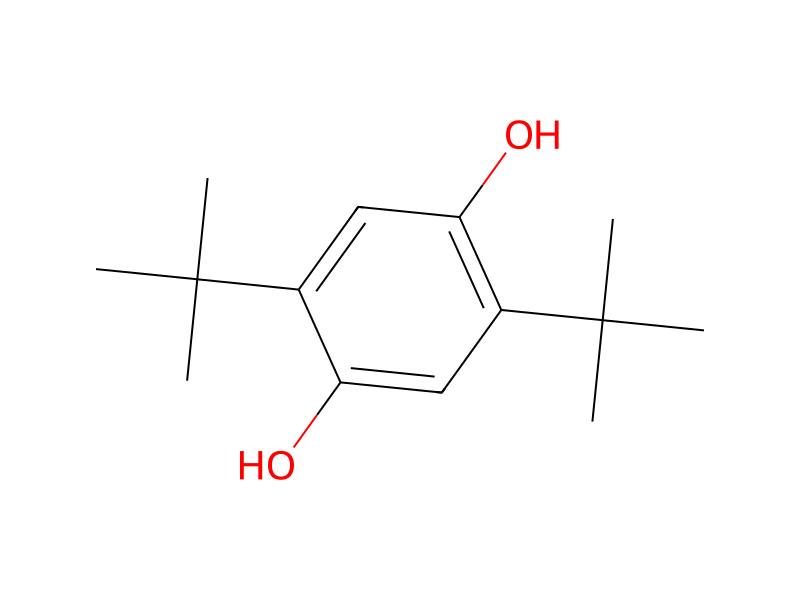
2,5-Di-tert-butylhydrochinon
2,5-Di-tert-butylhydroquinone
Grundinformationen
- CAS
1322-72-1- Standard-SMILES
CC(C)(C)c1cc(O)c(C(C)(C)C)cc1O- InChIKey
JZODKRWQWUWGCD-UHFFFAOYSA-N- Summenformel
- C14H22O2
- Durchschnittliche Molmasse
- 222,32 g/mol
- Monoisotopische Masse
- 222,16197994
Überblick
2,5-di-tert-butylbenzene-1,4-diol is a member of the class of hydroquinones that is benzene-1,4-diol substituted by tert-butyl groups at position 2 and 5.
Namen und Bezeichner
- Bevorzugter Name
- 2,5-Di-tert-butylhydroquinone
- IUPAC
- 2,5-ditert-butylbenzene-1,4-diol
- Lokaler Name
- 2,5-Di-tert-butylhydrochinon
- Englischer Name
- 2,5-Di-tert-butylhydroquinone
- Summenformel
- C14H22O2
- Molmasse
- 222.32
Namen und Synonyme
2,5-Di-tert-butylhydroquinone88-58-42,5-Di-tert-butylbenzene-1,4-diolDTBHQDibugDybugDi-t-butylhydroquinoneSantovar O2,5-Di-tert-butylquinolNonflex AlbaNaugard 451Antage DBH
Weitere Namen anzeigen
BHQDBHQBlack Hole QuencherProbesANTIOXIDANT DTBHQDibutylhydroquinone2,5-ditertiary butyl hydroquinone2-carbamoyl-2-propylpentanoic acid
Nocrac NS 71,4-Benzenediol, 2,5-bis(1,1-dimethylethyl)-2,5-Di-tert-butyl-1,4-benzenediol2,5-Di-tert-butyl-1,4-hydroquinonedi-tert-butylhydroquinone1,4-Dihydroxy-2,5-di-tert-butylbenzene2,5-Di-tert-butyl-1,4-benzohydroquinoneDTXSID8041248
Datenbank-Bezeichner
- CAS
1322-72-1、88-58-4- PubChem CID
- 2374
- DTXSID
Eigenschaften
Berechnete Struktureigenschaften
- XLogP
- 4,6
- Polarare Oberfläche (TPSA)
- 40,5 Ų
- H-Brücken-Donoren
- 2
- H-Brücken-Akzeptoren
- 2
- Frei drehbare Bindungen
- 2
- Schwere Atome
- 16
- Formalladung
- 0
- Komplexität
- 208
Experimentelle und physikochemische Eigenschaften
Chemical ClassesOther Classes -> Phenols
DrugsPharmaceuticals -> Listed in ZINC15
Cosmetics
Cosmetic ingredients (Di-t-Butylhydroquinone) -> CIR (Cosmetic Ingredient Review)
Antioxidant
Food Contact SubstancesFCS -> FDA Inventory of Food Contact Substances Listed in 21 CFR
Physical Description
CBI
Off-white crystalline powder; [Alfa Aesar MSDS]
Collision Cross Section155.1 Ų [M]+ [CCS Type: DT; Buffer gas: N2; Ionization: APCI+; Dataset: TOXCAST; Source Identifier: DTXSID8041248]
Physikochemische Eigenschaften
- Schmelzpunkt
- 216 · 216-218 °C(lit.)
- Siedepunkt
- 321 °C · 321°C
- Dichte
- 1 · 1,07 g/cm3
Sicherheit und Regulatorisches
Sicherheitsangaben dienen nur zur Orientierung und ersetzen weder das Sicherheitsdatenblatt (SDB) des Lieferanten noch geltende Vorschriften oder eine fachliche Bewertung.
GHS-Klassifizierung
GHS Classification
This chemical does not meet GHS hazard criteria for 0.7% (2 of 279) of reports.
Danger
H301 (46.6%): Toxic if swallowed [Danger Acute toxicity, oral]
P260, P261, P264, P264+P265, P270, P271, P272, P273, P280, P301+P316, P301+P317, P302+P352, P304+P340, P305+P351+P338, P319, P321, P330, P332+P317, P333+P317, P337+P317, P362+P364, P391, P403+P233, P405, and P501 (click each P-code to see the statement)
Aggregated GHS information provided per 279 reports by companies from 19 notifications to the ECHA C&L Inventory. Each notification may be associated with multiple companies.
Gefahrenhinweise
Regulatory Information
Chemical: 1,4-Benzenediol, 2,5-bis(1,1-dimethylethyl)-
1,4-Benzenediol, 2,5-bis(1,1-dimethylethyl)- is listed on the EPA's Chemical Data Reporting (CDR) system. Manufacturers and importers of 1,4-Benzenediol, 2,5-bis(1,1-dimethylethyl)- are required to report information about their production and use of this chemical to the EPA under the Toxic Substances Control Act (TSCA). (40 eCFR Part 711)
REACH registered substance: 2,5-di-tert-butylhydroquinone (EC: 201-841-8)
2,5-Di-tert-butylhydroquinone: Does not have an individual approval but may be used under an appropriate group standard
Hazards Summary
Causes lung and liver changes in 2-day intermittent oral studies of mice; Causes changes in clotting factors in 3-week constant oral studies rats; [RTECS] A skin and strong eye irritant; Harmful by ingestion; [Alfa Aesar MSDS] See t-Butylhydroquinone. See 2,5-Di-t-pentylhydroquinone.
Hazard Classes and CategoriesAcute Tox. 3 (46.6%)
Sicherheit und Schutzausrüstung
Chemie und Industrie
Pharmakologische Informationen
MeSH Pharmacological Classification
Naturally occurring or synthetic substances that inhibit or retard oxidation reactions. They counteract the damaging effects of oxidation in animal tissues.
Compounds or agents that combine with an enzyme in such a manner as to prevent the normal substrate-enzyme combination and the catalytic reaction.
Verwendung und Herstellung
Uses
CIR ingredient: Di-t-Butylhydroquinone
Ca2+-ATPase antagonist. [ChemIDplus]
U.S. Production2023: 75,000 - <500,000 lb
Consumer UsesNot Known or Reasonably Ascertainable
Industry UsesNot Known or Reasonably Ascertainable
Use ClassificationCosmetics -> Antioxidant
General Manufacturing Information
All Other Basic Organic Chemical Manufacturing
1,4-Benzenediol, 2,5-bis(1,1-dimethylethyl)-: ACTIVE
Anwendungen
Beschreibung2,5-Di-tert-butylhydroquinone, also known as 2,5-TBHQ or DTBHQ, belongs to the class of organic compounds known as phenylpropanes. These are organic compounds containing a phenylpropane moiety. It is a phenol derivative containing 2 phenol groups and 2 alkyl groups, each consisting of three methyl groups.
Verwenden2,5-Di-tert-butylhydroquinone is the oxidation substrate used to measure the catalytic activity of the copper(II) enzyme-like catalysts.
Zugehörige Reaktionen
22





Notizen zur Verbindung
Wird geladen…