
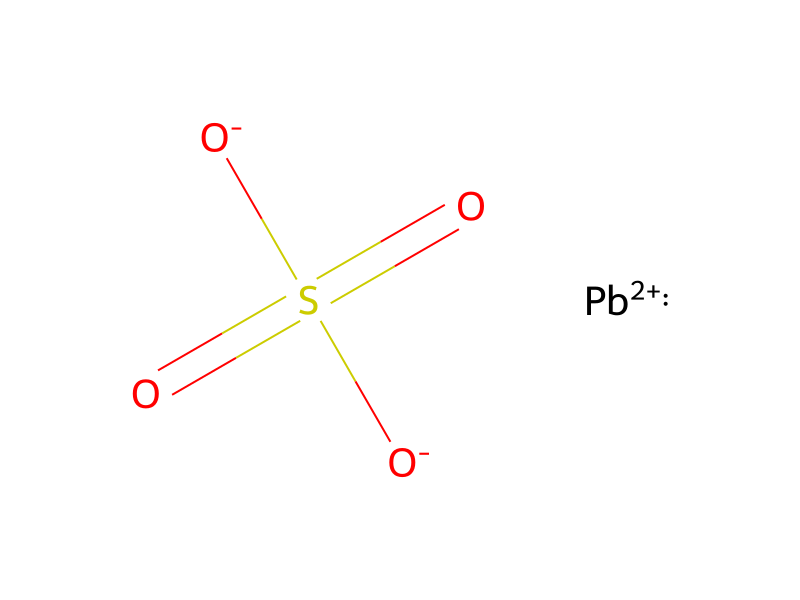
Grundinformationen
- Standard-SMILES
O=S(=O)([O-])[O-].[Pb+2]- InChIKey
KEQXNNJHMWSZHK-UHFFFAOYSA-L- Summenformel
- PbSO4
- Durchschnittliche Molmasse
- 303 g/mol
- Monoisotopische Masse
- 303,92838158
Überblick
Lead sulfate appears as a white crystalline solid. Insoluble in water and sinks in water. Contact may irritate skin, eyes, and mucous membranes. May be mildly toxic by ingestion, inhalation and skin absorption. Used to make other chemicals. Use: in lithography, battery acid solution treated fabrics, used in varnishes.
Namen und Bezeichner
- Bevorzugter Name
- Lead sulfate
- IUPAC
- lead(2+) sulfate
- Lokaler Name
- Bleisulfat
- Englischer Name
- LEAD(II) SULFATE
- Summenformel
- O4PbS
- Molmasse
- 303.26
Namen und Synonyme
LEAD SULFATELead sulphateAnglisliteanglesiteMulhouse WhiteLead BottomsLead monosulfateFast WhiteMilk WhiteNatural anglesiteFreemans White LeadLead(+2) sulfate
Weitere Namen anzeigen
ci77630milkwhitec.i.77630fastwhiteC.I. 77630Bleisulfat
Tetrabasic lead sulfateSulfate de plombTS 100 (sulfate)Lead(II) Sulfate (1:1)Lead sulfate, tetrabasicHB 2000CI 77630PbSO4
Datenbank-Bezeichner
- CAS
15739-80-7、52732-72-6、7446-14-2、90583-07-6- PubChem CID
- 24008
- DTXSID
DTXSID50883502- UNII
- C516H654O8
- EC Number
- 231-198-9、239-831-0、258-142-6、292-204-3
- Nikkaji
- J3.738I
Eigenschaften
Berechnete Struktureigenschaften
- Polarare Oberfläche (TPSA)
- 88,6 Ų
- H-Brücken-Donoren
- 0
- H-Brücken-Akzeptoren
- 4
- Frei drehbare Bindungen
- 0
- Schwere Atome
- 6
- Formalladung
- 0
- Komplexität
- 62,2
Experimentelle und physikochemische Eigenschaften
Chemical Classes
Metals -> Lead Compounds, Inorganic
Carcinogens
Density
6.2 at 68 °F (USCG, 1999) - Denser than water; will sink
6.2 g/cu cm
6.2 @25 °C
Color/Form
White, heavy crystal powder
White monoclinic or rhombic crystals
Solubility
In water, 0.0404 g/100 mL at 25 °C; slightly soluble in alkaline solutions.
Soluble in about 2225 parts water; more soluble in nitric acid; soluble in sodium hydroxide, ammonium acetate or tartrate solution; soluble in concentrated hydriodic acid; insoluble in alcohol.
In water, 32 mg/L at 15 °C
DecompositionWhen heated to decomposition it emits very toxic fumes /of lead and sulfur oxides./
Melting Point
2138 °F (USCG, 1999)
1170 °C
1087 °C
Refractive IndexIndex of refraction: 1.877, 1.822, 1.894
Physical Description
Lead sulfate appears as a white crystalline solid. Insoluble in water and sinks in water. Contact may irritate skin, eyes, and mucous membranes. May be mildly toxic by ingestion, inhalation and skin absorption. Used to make other chemicals. Use: in lithography, battery acid solution treated fabrics, used in varnishes.
Dry Powder; Wet Solid; Other Solid; Wet Solid; Liquid; Other Solid
Wet Solid; Dry Powder
Wet Solid
White powder that is insoluble in water; [CAMEO]
Other Experimental Properties
Lead is derived from the decay of radon. /Inorganic lead/
Natural lead is a mixture of four stable isotopes: Pb-204 (1.4%), Pb-206 (25.2%), Pb-207 (21.7%) and Pb-208 (51.7%). Lead isotopes are the end-products of each of the three series of naturally occurring radioactive elements: Pb-206 for the uranium series, Pb-207 for the actinium series and Pb-208 for the thorium series. Forty-three other isotopes of lead, all of which are radioactive, are recognized.
Divalent lead has a strong affinity for inorganic ions containing oxygen (eg, carbonate) or sulfur (sulfide). Lead can also complex with electron rich ligands in many organic cmpd such as amino acids, proteins, and humic acid.
Physikochemische Eigenschaften
- Schmelzpunkt
- 1170 °C · 1170 °C
- Dichte
- 6.2 g/mL · 6.2 g/mL at 25 °C(lit.)
- Löslichkeit
- insoluble in acid solutions; slightly soluble in alkaline solutions
- Aggregatzustand
- Powder/Lump
- Wichte
- 6.2 · 6.2
- Farbe
- White
- Wasserlöslichkeit
- 3 · Partially soluble in water, dilute HCl and HNO{3}. Soluble in sodium hydroxide, ammonium acetate or tartrate, concentrated hydriodic acid. Insoluble in alcohol
- Spezifische Wärmekapazität
- 0.34 J/ · Cp(crystal): 0.34 J/(g·K), at 25℃
- Merck
- 14 · 14,5420
- Dielectric constant
- 14.3 · 14.3(0.0℃)
- Stabilität
- Stable.
- InChI
- 1S/H2O4S.Pb/c1-5(2,3)4;/h(H2,1,2,3,4);/q;+2/p-2
- InChIKey
- KEQXNNJHMWSZHK-UHFFFAOYSA-L
- SMILES
- [PbH2++].[O-]S([O-])(=O)=O
- CAS Datenbank
- 7446 · 7446-14-2(CAS DataBase Reference)
- EPA chemische Informationen
- Lead(II) sulfate (7446-14-2)
Sicherheit und Regulatorisches
GHS-Klassifizierung
GHS Classification
Danger
H302+H332 (59.1%): Harmful if swallowed or if inhaled [Warning Acute toxicity, oral; acute toxicity, inhalation]
P203, P260, P261, P264, P270, P271, P273, P280, P301+P317, P304+P340, P317, P318, P319, P330, P391, P405, and P501 (click each P-code to see the statement)
Aggregated GHS information provided per 215 reports by companies from 11 notifications to the ECHA C&L Inventory. Each notification may be associated with multiple companies.
Danger
H351: Suspected of causing cancer [Warning Carcinogenicity]
Gefahrenhinweise
Regulatory Information
Chemical: Sulfuric acid, lead(2+) salt (1:1)
Chemical: Sulfuric acid, lead salt
Chemical: Sulfuric acid, lead salt, tetrabasic
Sulfuric acid, lead(2+) salt (1:1) is listed on the EPA's Chemical Data Reporting (CDR) system. Manufacturers and importers of Sulfuric acid, lead(2+) salt (1:1) are required to report information about their production and use of this chemical to the EPA under the Toxic Substances Control Act (TSCA). (40 eCFR Part 711)
Sulfuric acid, lead salt, tetrabasic is listed on the EPA's Chemical Data Reporting (CDR) system. Manufacturers and importers of Sulfuric acid, lead salt, tetrabasic are required to report information about their production and use of this chemical to the EPA under the Toxic Substances Control Act (TSCA). (40 eCFR Part 711)
Sulfuric acid, lead salt (1:?) is listed on the EPA's Chemical Data Reporting (CDR) system. Manufacturers and importers of Sulfuric acid, lead salt (1:?) are required to report information about their production and use of this chemical to the EPA under the Toxic Substances Control Act (TSCA). (40 eCFR Part 711)
Other Safety Information
IMAP assessments - Selected lead-based pigments: Human health tier II assessment
IMAP assessments - Selected lead-based pigments: Human health tier II assessment
IMAP assessments - Selected lead-based pigments: Human health tier II assessment
DOT LabelCorrosive
Fire Hazards
Special Hazards of Combustion Products: Toxic metal fumes (USCG, 1999)
· Non-combustible, substance itself does not burn but may decompose upon heating to produce corrosive and/or toxic fumes.
Fire PotentialNot flammable
Health Hazards
INHALATION: Joint and muscle pains, headache, dizziness and insomnia. Weakness, frequently of extensor muscles of hand and wrist (unilateral or bilateral). Heavy contamination. Brain damage. Stupor progressing to coma - with or without convulsion, often death. Excitation, confusion, and mania less common. Cerebrospinal pressure may be increased. EYES: Caused a moderat purulent reaction and general inflammation of the rabbit eye. INGESTION: Abdominal pain, diarrhea, constipation, loss of appetite, muscular weakness, headache, blue line on gums, metallic taste, nausea and vomiting. (USCG, 1999)
· TOXIC and/or CORROSIVE; inhalation, ingestion or skin contact with material may cause severe injury or death.
Hazards SummaryA strong irritant; [Hawley] Corrosive to skin and eyes; Toxic by ingestion; [Sax] See Lead and linked occupational diseases.
DOT ID and Guide1794 154
Reactive GroupNon-Redox-Active Inorganic Compounds
Special Reports
National Toxicology Program. Eleventh Report on Carcinogens (2005). The Report on Carcinogens is an informational scientific and public health document that identifies and discusses substances (including agents, mixtures, or exposure circumstances) that may pose a carcinogenic hazard to human health. Lead and Lead Compounds are listed as reasonably anticipated to be human carcinogens. /Lead and Lead Compounds/[Available from, as of July 31, 2009: http://ntp.niehs.nih.gov/ntp/roc/eleventh/profiles/s101lead.pdf]
WHO; Environmental Health Criteria 85: Lead - Environmental Aspects (1989). EHC are designed for scientists and administrators responsible for the establishment of safety standards and regulations and provide basic scientific risk evaluations of a wide range of chemicals and groups of chemicals.
RCRA Requirements
D008; A solid waste containing lead may or may not become characterized as a hazardous waste when subjected to the Toxicity Characteristic Leaching Procedure listed in 40 CFR 261.24, and if so characterized, must be managed as a hazardous waste. /Lead/
The Environmental Protection Agency is ... /promulgated/ regulations concerning ground-water monitoring with regard to screening suspected contamination at land based hazardous waste treatment, storage, and disposal facilities. ... /There are/ new requirements to analyze for a specified core list of chemicals plus those chemicals specified by the Regional Administrator on a site-specific basis. ... /Total lead (all species) is included on this list./ /Total lead (all species)/
OSHA Standards
Permissible Exposure Limit: The employer shall assure that no employee is exposed to lead at concentrations greater than 50 ug/cu m of air averaged over an 8-hr period. If an employee is exposed to lead for more than 8 hr in any work day, the permissible exposure limit, as a TWA for that day, shall be reduced according to the following formula: Maximum permissible limit (in ug/cu m)=400 divided by the number of hours worked in the day. /Lead, inorganic, as Pb/
The employer shall remove an employee from work having an exposure to lead at or above the action level on each occasion that a periodic and a follow-up blood sampling test conducted pursuant to this section indicate that the employee's blood lead level is at or above 60 ug/100 g of whole blood; and, the employer shall remove an employee from work having an exposure to lead at or above the action level on each occasion that the average of the last three blood sampling tests conducted pursuant to this section (or the average of all blood sampling tests conducted over the previous six (6) months, whichever is longer) indicates that the employee's blood lead level is at or above 50 ug/100 g of whole blood; provided, however, that an employee need not be removed if the last blood sampling test indicates a blood lead level at or below 40 ug/100 g of whole blood. ... The employer shall return an employee to his or her former job status: ... when two consecutive blood sampling tests indicate that the employee's blood lead level is at or below 40 ug/100 g of whole blood. ... The employer shall provide to an employee up to eighteen (18) months of medical removal protection benefits on each occasion that an employee is removed from exposure to lead or otherwise limited pursuant to this section. /Lead, inorganic, as Pb/
Permissible Exposure Limit: The employer shall assure that no employee is exposed to lead at concentrations greater than 50 ug/cu m of air averaged over an 8-hr period. If an employee is exposed to lead for more than 8 hr in any work day, the permissible exposure limit, as a TWA for that day, shall be reduced according to the following formula: Maximum permissible limit (in ug/cu m)=400 divided by the number of hours worked in the day. /Lead, inorganic, as Pb; Shipyard Employment/
The employer shall remove an employee from work having an exposure to lead at or above the action level on each occasion that a periodic and a follow-up blood sampling test conducted pursuant to this section indicate that the employee's blood lead level is at or above 60 ug/100 g of whole blood; and, the employer shall remove an employee from work having an exposure to lead at or above the action level on each occasion that the average of the last three blood sampling tests conducted pursuant to this section (or the average of all blood sampling tests conducted over the previous six (6) months, whichever is longer) indicates that the employee's blood lead level is at or above 50 ug/100 g of whole blood; provided, however, that an employee need not be removed if the last blood sampling test indicates a blood lead level at or below 40 ug/100 g of whole blood. ... The employer shall return an employee to his or her former job status: ... when two consecutive blood sampling tests indicate that the employee's blood lead level is at or below 40 ug/100 g of whole blood. ... The employer shall provide to an employee up to eighteen (18) months of medical removal protection benefits on each occasion that an employee is removed from exposure to lead or otherwise limited pursuant to this section. /Lead, inorganic, as Pb; Shipyard Empolyment/
For more OSHA Standards (Complete) data for LEAD SULFATE (6 total), please visit the HSDB record page.
Sicherheit und Schutzausrüstung
Fire FightingExcerpt from ERG Guide 154 [Substances - Toxic and/or Corrosive (Non-Combustible)]:
Accidental Release Measures
· CALL 911. Then call emergency response telephone number on shipping paper. If shipping paper not available or no answer, refer to appropriate telephone number listed on the inside back cover.
· ELIMINATE all ignition sources (no smoking, flares, sparks or flames) from immediate area.
First Aid
Get medical aid.
General First Aid:
Exposure Control and Personal Protection
· Wear positive pressure self-contained breathing apparatus (SCBA).
Biological Exposure Indices (BEI) [ACGIH] - Lead in blood = 200 ug/L (20 ug/100 ml); sampling time not critical; [ACGIH]
Fire Fighting Procedures
If material involved in fire: Extinguish fire using agent suitable for type of surrounding fire (material itself does not burn or burns with difficulty). Use water in flooding quantities as fog. Cool all affected containers with flooding quantities of water. Apply water from as far a distance as possible.
Use water in flooding quantities as fog. Cool all affected containers with flooding quantities of water. Apply water from as far a distance as possible. /Lead sulfate (containing more than 3% free acid)/
Lead sulfate is not combustible. Use dry chemical, carbon dioxide, water spray, or foam extinguishers ... If material or contaminated runoff enters waterways, notify downstream health and fire officials and pollution control agencies. From a secure, explosion-proof location, use water spray to cool exposed containers. If cooling streams are ineffective (venting sound increases in volume and pitch, tank discolors or shows any signs of deforming), withdraw immediately to a secure position.
Storage Conditions
Lead sulfate must be stored to avoid contact with oxidizers (such as perchlorates, peroxides, permanganates, chlorates, and nitrates) and chemically active metals (such as potassium, sodium, magnesium, and zinc) since violent reactions occur ... A regulated, marked area should be established with this chemical is handled, used, or stored ...
Cleanup Methods
Environmental considerations - land spill: Dig a pit, pond, lagoon, holding area to contain liquid or solid material. /SRP: If time permits, pits, ponds, lagoons, soak holes, or holding areas should be sealed with an impermeable flexible membrane liner./ Cover solids with a plastic sheet to prevent dissolving in rain or fire fighting water.
Environmental considerations - land spill: Absorb bulk liquid with fly ash, cement powder, or commercial sorbents. /Lead sulfate (containing more that 3% free acid)/
Environmental considerations - water spill: Neutralize with agricultural lime (CaO), crushed limestone (CaCO3), or sodium bicarbonate (NaHCO3). If dissolved, in region of 10 ppm or greater concn, apply activated carbon at ten times the spilled amount. Remove trapped material with suction hoses. Use mechanical dredges or lifts to remove immobilized masses of pollutants and precipitates.
Environmental considerations - air spill: Apply water spray or mist to knock down vapors. /Lead sulfate (containing more than 3% free acid./
Evacuate persons not wearing protective equipment from area of spill or leak until clean-up is complete. Remove all ignition sources. Collect powdered material in the most convenient and safe manner and deposit in sealed containers. Ventilate area after clean-up is complete. It may be necessary to contain and dispose of this chemical as a hazardous waste. If material or contaminated runoff enters waterways, notify downstream users of potentially contaminated waters.
Nonfire Spill ResponseExcerpt from ERG Guide 154 [Substances - Toxic and/or Corrosive (Non-Combustible)]:
Disposal MethodsGenerators of waste (equal to or greater than 100 kg/mo) containing this contaminant, EPA hazardous waste number D008, must conform with USEPA regulations in storage, transportation, treatment and disposal of waste. /Lead/
Preventive Measures
If material not involved in fire: Keep material out of water sources and sewers. Build dikes to contain flow as necessary.
Personnel protection: Keep upwind ... Avoid breathing vapors or dusts. Wash away any material which may have contacted the body with copious amounts of water or soap and water.
SRP: The scientific literature for the use of contact lenses in industry is conflicting. The benefit or detrimental effects of wearing contact lenses depend not only upon the substance, but also on factors including the form of the substance, characteristics and duration of the exposure, the uses of other eye protection equipment, and the hygiene of the lenses. However, there may be individual substances whose irritating or corrosive properties are such that the wearing of contact lenses would be harmful to the eye. In those specific cases, contact lenses should not be worn. In any event, the usual eye protection equipment should be worn even when contact lenses are in place.
SRP: Contaminated protective clothing should be segregated in a manner so that results in no direct personal contact by personnel who handle, dispose of, or clean the clothing. Quality assurance procedures to confirm the efficacy of the cleaning procedures should be implemented prior to the decontaminated protective clothing being returned for reuse by the workers. Contaminated clothing (including shoes/socks) should not be taken home at end of shift, but should remain at employee's place of work for cleaning.
For more Preventive Measures (Complete) data for LEAD SULFATE (8 total), please visit the HSDB record page.
Isolation and Evacuation
Excerpt from ERG Guide 154 [Substances - Toxic and/or Corrosive (Non-Combustible)]:
Immediate precautionary measure
Minimum Risk LevelChronic Inhalation: 0.05 mg/m3 (L134)
Toxikologische Informationen
TreatmentLead poisoning is usually treated with chelation therapy using DMSA, EDTA, or dimercaprol. (L21)
Health Effects
Lead is a neurotoxin and has been known to cause brain damage and reduced cognitive capacity, especially in children. Lead exposure can result in nephropathy, as well as blood disorders such as high blood pressure and anemia. Lead also exhibits reproductive toxicity and can results in miscarriages and reduced sperm production. (L21)
Ecotoxicity Values
LC50; Species: Chlorella pyrenoidosa (Green algae, strain No. 366); Conditions: freshwater, static, 24 °C, pH 6.5; Concentration: 25 ug/L for 14 days /100% purity/
LC50; Species: Daphnia magna (Water flea, <24 hr neonate); Conditions: freshwater, static, pH 7.5-9.1; Concentration: 392 ug/L for 48 hr /100% purity finely ground dust/
LC50; Species: Daphnia magna (Water flea, <24 hr neonate); Conditions: freshwater, static, pH 7.5-9.1; Concentration: 3166000 ug/L for 48 hr /as total lead ion/
LC50; Species: Cynoglossus joyneri (Red Tongue Sole, larvae); Conditions: saltwater, static; Concentration: 1000 ug/L for 72 hr /total lead ion/
For more Ecotoxicity Values (Complete) data for LEAD SULFATE (7 total), please visit the HSDB record page.
Environmental Fate
TERRESTRIAL FATE: It was reported that after adding 3,000-4,000 mg/kg of lead in the form of PbSO4 to soil, subsequent extractions revealed that the lead sulfate was rapidly transformed to other lead compounds in the soil(1).
AQUATIC FATE: If released into water, lead sulfate will mostly precipitate out due to its low solubility. (SRC)
ATMOSPHERIC FATE: In the atmosphere, lead most likely exists primarily as PbSO4 and PbCO3 and is deposited onto soil as lead sulfates and lead carbonates(1). Lead sulfate is a major species of lead in the atmosphere, either being emitted in that form or possibly being formed from the sulfide or other lead species with atmospheric SO2 and oxygen. Lead sulfate is expected to exist solely in the particulate phase in the ambient atmosphere, and will be subject to washout and gravitational settling. Transformations in the atmosphere to the carbonate and oxide may be expected(2).
Adverse EffectsNeurotoxin - Predominantly motor
Exposure RoutesOral (L136) ; inhalation (L136); dermal (L136)
Toxicity Summary
Lead mimics other biologically important metals, such as zinc, calcium, and iron, competing as cofactors for many of their respective enzymatic reactions. For example, lead has been shown to competitively inhibit calcium's binding of calmodulin, interferring with neurotransmitter release. It exhibits similar competitive inhibition at the NMDA receptor and protein kinase C, which impairs brain microvascular formation and function, as well as alters the blood-brain barrier. Lead also affects the nervous system by impairing regulation of dopamine synthesis and blocking evoked release of acetylcholine. However, it's main mechanism of action occurs by inhibiting delta-aminolevulinic acid dehydratase, an enzyme vital in the biosynthesis of heme, which is a necesssary cofactor of hemoglobin. (T4, A20, A22, L136)
Ecotoxicity Excerpts
/BIRDS and MAMMALS/ ... Female mallards /were dosed/ with 100 mg lead/kg diet. This was added as a mixture of 43 mg/kg lead carbonate, 37 mg/kg lead oxide, and 49 mg/kg lead sulfate, each salt contributing one-third of the total lead. No significant effect on eggshell thickness was found when it was measured on days 76 and 85 of treatment. When lead was added to the diet along with DDE at 40 mg/kg, lead did not increase the effect of the organochlorine on shell thickness.
/AQUATIC SPECIES/ ... Nymphs of stonefly (Acroneuria lycorias), mayfly (Ephemerella subvaria), and caddisfly (Hydropsyche betteni) /were exposed/ to lead sulfate in static bioassays ... 50% survival times /were reported/ of > 14 days at 64 mg/L, 7 days at 16 mg/L, and 7 days at 32 mg/L. There was a considerable decrease in the metal concn in solution over the 2 wk experimental period ...; nominal concentrations were /considered/ unreliable after 96 hr.
/OTHER TERRESTRIAL SPECIES/ In a series of experiments, the toxicity of lead to worms in soil was determined following the draft OECD earthworm reproduction toxicity protocol except that lead was added as solid lead nitrate, carbonate and sulfide ... The compounds were added to the test soil to give lead concn of 625-12 500 ug Pb/g of soil. Calculated toxicities of the lead decreased in the order nitrate > carbonate > sulfide, the same order as the decrease in the solubility of the metal compounds used. The 7-day LC50 ... for the nitrate was 5,321 +/- 275 ug Pb/g of soil, and this did not change with time. The LC50 values for carbonate and sulfide could not be determined at the concn ranges used. The only parameter sensitive enough to distinguish the toxicities of the three compounds was cocoon (egg) production. The EC50s for cocoon production (the concn to produce a 50% reduction in cocoon production) were 993, 8,604, and 10,246 pg Pb/g of soil for lead nitrate, carbonate, and sulfide, respectively ...
/PLANTS/ ... Maize (Zea mays), sugarbeet, bean, and wheat /were sown/ in soil dosed with lead nitrate or sulfate (0 to 5,000 mg lead/kg). Lead uptake into shoots and roots (on a dry wt basis) was measured 30 days after emergence. It was found that more lead was taken up into the roots than into the shoots ...
For more Ecotoxicity Excerpts (Complete) data for LEAD SULFATE (8 total), please visit the HSDB record page.
Signs and Symptoms
Symptions of chronic lead poisoning include reduced cognitive abilities, nausea, abdominal pain, irritability, insomnia, metal taste in the mouth, excess lethargy or hyperactivity, chest pain, headache and, in extreme cases, seizures, comas, and death. There are also associated gastrointestinal problems, such as constipation, diarrhea, vomiting, poor appetite, weight loss, which are common in acute poisoning. (A2, L21)
Effluent Concentrations
The chemical composition of baghouse effluent from smelting and refining operations has been examined in one study which found that elemental lead composed 15-20% of the emissions in some cases; with PbS, PbSO4, and PbO.PbSO4 also being present(1). The form of lead in emissions from a lead smelter contained 41.2% of the lead as PbSO4, 48.8% as PbS and 10.1% as PbO(2). Bulk dust samples collected from different areas of a primary lead smelter contained lead in the ore storage area, sinter area, and the blast and dross furnace; lead particles emitted from the smelter would primarily be in the form of lead sulfur compounds, PbSO4, PbO.PbSO4, and PbS(3).
Natural Pollution Sources
Extent of occurrence of /lead/ in earth's crust is about 15 g/ton, also expressed as 0.002% (depth of crust: 16 km). Occurs chiefly as sulfide in galena, other minerals include anglesite (PbSO4), cerussite (PbCO3), mimetite (PbCl2.3Pb3-(AsO4)2) and pyromorphite [PbCl2.3Pb3(PO4)2)].
Lead sulfate occurs naturally in anglesite, one of three lead ores found in sufficient abundance to form mineable deposits(1). It also occurs in the mineral lanarkite, in which it is combined with PbO(2). Lead sulfate is a major component of more than 200 identified minerals(1).
Atmospheric Concentrations
The percent composition of airborne lead particles at a site near a road, 400 yds from a road, and at a rural site were, respectively: 2.2, 6.0 and 3.2 for PbSO4; and 1.0, 4.6 and 5.0 for PbO.PbSO4(1). An air filter containing particles with 2.3% lead, collected near a lead smelter, was rinsed so as to separate the Pb particles by density; the heavy and light fractions contained 61.5% and 7.8% of the original Pb, respectively, with 37% and 84% of these fractions being PbSO4(2).
Regulatorische Informationen
RCRA Requirements
D008; A solid waste containing lead may or may not become characterized as a hazardous waste when subjected to the Toxicity Characteristic Leaching Procedure listed in 40 CFR 261.24, and if so characterized, must be managed as a hazardous waste. /Lead/
The Environmental Protection Agency is ... /promulgated/ regulations concerning ground-water monitoring with regard to screening suspected contamination at land based hazardous waste treatment, storage, and disposal facilities. ... /There are/ new requirements to analyze for a specified core list of chemicals plus those chemicals specified by the Regional Administrator on a site-specific basis. ... /Total lead (all species) is included on this list./ /Total lead (all species)/
Atmospheric Standards
National primary and secondary ambient air quality standards for lead and its compounds, measured as elemental lead by a reference method based on appendix G to this part, or by an equivalent method, are: 1.5 micrograms per cubic meter, maximum arithmetic mean averaged over a calendar quarter. /Lead and its compounds, as Pb/
Listed as a hazardous air pollutant (HAP) generally known or suspected to cause serious health problems. The Clean Air Act, as amended in 1990, directs EPA to set standards requiring major sources to sharply reduce routine emissions of toxic pollutants. EPA is required to establish and phase in specific performance based standards for all air emission sources that emit one or more of the listed pollutants. Lead compounds are included on this list. /Lead compounds/
CERCLA Reportable Quantities
Persons in charge of vessels or facilities are required to notify the National Response Center (NRC) immediately, when there is a release of this designated hazardous substance, in an amount equal to or greater than its reportable quantity of 10 lb or 4.54 kg. The toll free number of the NRC is (800) 424-8802. The rule for determining when notification is required is stated in 40 CFR 302.4 (section IV. D.3.b).
Clean Water Act Requirements
Lead sulfate is designated as a hazardous substance under section 311(b)(2)(A) of the Federal Water Pollution Control Act and further regulated by the Clean Water Act Amendments of 1977 and 1978. These regulations apply to discharges of this substance. This designation includes any isomers and hydrates, as well as any solutions and mixtures containing this substance.
Toxic pollutant designated pursuant to section 307(a)(1) of the Federal Water Pollution Control Act and is subject to effluent limitations. /Lead and compounds/
State Drinking Water Standards(AZ) ARIZONA 50 ug/L /Lead/
State Drinking Water Guidelines
(AZ) ARIZONA 20 ug/L /Lead/
(ME) MAINE 10 ug/L /Lead/
Federal Drinking Water StandardsEPA 15 ug/L (Action Level) /Lead/
Sicherheitsdaten
- wgk
- 3
- tsca
- TSCA listed
- ridadr
- UN 1794 (LEAD SULPHATE with more than 3 % free acid)
- hs_code
- 28332960
- RTECS-Nr.
- OG4375000
- risk_code
- 61-20/22-33-50/53-62
- hazard_code
- T,N
- safety_code
- 53-45-60-61
- hazard_class
- 8
- packing_group
- II
- Speicherklasse
- 6.1D - Non-combustible acute toxic Cat.3toxic hazardous materials or hazardous materials causing chronic effects
- Giftige Stoffe Daten
- 7446-14-2(Hazardous Substances Data)
- Hazard Classifications
- Acute Tox. 4 InhalationAcute Tox. 4 OralAquatic Acute 1Aquatic Chronic 1Repr. 1ASTOT RE 2
Chemie und Industrie
Pharmakologische Informationen
Metabolism/Metabolites
Lead is absorbed following inhalation, oral, and dermal exposure. It is then distributed mainly to the bones and red blood cells. In the blood lead may be found bound to serum albumin or the metal-binding protein metallothionein. Organic lead is metabolized by cytochrome P-450 enzymes, whereas inorganic lead forms complexes with delta-aminolevulinic acid dehydratase. Lead is excreted mainly in the urine and faeces. (L136)
Absorption, Distribution and Excretion
... The lead content on the skin surface of 10 lead-battery workers was measured by the method of skin stripping, and urinary lead content of rats was measured with epicutaneous application of four lead compounds: lead sulfate, lead oxide, lead powder, and lead stearate. There were significant amounts of lead on the 9th and 10th skin strippings of the dorsal hand and the back of lead workers. The amount of lead on the dorsal hand was significantly correlated with the amount in the blood (n = 10, r 2 = 0.66, p < 0.05, linear regression). In rats, after lead compounds were applied for 12 days, total lead amount in urine significantly increased to 146.0 +/- 6.4 ng (SD) for lead stearate, 123.1 +/- 7.2 ng for lead sulfate, 115.9 +/- 5.3 ng for lead oxide, 47.8 +/- 6.9 ng for lead powder, and 10.3 ng for the control, which indicated significant skin absorption. It was concluded that significant amounts of inorganic lead compounds can be absorbed through the skin, and skin protection in lead-working or any contaminated environment should be carefully considered.
Verwendung und Herstellung
Uses
Used to stabilize clay soils, and to weight fabrics; Also used in galvanic batteries and rapidly drying varnishes; Has been used in lithography and with silver bromide in photography; [HSDB] Used in storage batteries and paint (pigment); [Hawley] Workers are exposed in mines and smelters and during production of lead storage batteries; [HSDB]
Battery Manufacturing [Category: Industry]
Has been used in photography in combination with silver bromide and is used in the stabilization of clay soil for adobe structures, in earth-fill dams, and roads.
Instead of white lead as pigment; with zinc in galvanic batteries; manuf minium, in lithography; preparing rapidly drying oil varnishes; weighting fabrics.[The Merck Index, Fourteenth Edition (2006)
Storage batteries, paints, ceramics, pigments, electrical and other vinyl compounds requiring high heat stability.
Lead sulphate is found in lead-acid batteries. (L416)
U.S. Production
2023: 100,000,000 - <500,000,000 lb
2023: 10,953,825 lb
2023: 178,623,686 lb
Production volume for non-confidential chemicals reported under the 2006 Inventory Update Rule. Chemical: Sulfuric acid, lead(2+) salt (1:1). Aggreated National Production Volume: 500 million to <1 billion pounds.
Consumer Uses
Chemical reaction regulator
Intermediate
Intermediate
Industry Uses
Intermediate
Other
Intermediate
Methods of Manufacturing
Treating lead oxide, hydroxide, or carbonate with warm sulfuric acid, or by treating a soluble lead salt with sulfuric acid.
Interaction of solutions of lead nitrate and sodium sulfate.
General Manufacturing Information
Other (requires additional information)
Electrical Equipment, Appliance, and Component Manufacturing
Electrical Equipment, Appliance, and Component Manufacturing
Sulfuric acid, lead(2+) salt (1:1): ACTIVE
Sulfuric acid, lead salt (1:?): ACTIVE
Sulfuric acid, lead salt, tetrabasic: ACTIVE
Anwendungen
VerwendenLead(II) sulfate is used in pigments, galvanic batteries, lithography, weighting fabrics. It is also used as intermediates.
Vor- und nachgelagerte Produkte
Vorgelagerte Rohstoffe
Nachgelagerte Produkte
Anbieter50 Anbieter
国药集团化学试剂有限公司86-21-63210123 · [email protected]
北京华美互利生物化工010-56205725 · [email protected]
江西益众化工有限公司15307925109 15350027073 · [email protected]
阿诺西(上海)生物技术有限公司400-1107768 15058188853 · [email protected]
上海阿拉丁生化科技股份有限公司400-6206333 13167063860 · [email protected]
上海毕合生物化学技术有限公司13816464724 · [email protected]
湖北成丰化工有限公司13125175253 · [email protected]
廊坊乾耀科技有限公司0316-2617888 17301291189 · [email protected]
杭州品高化工有限公司0571-87658025 · [email protected]
陕西缔都新材料有限公司029-63373950 17392216152 · [email protected]
天津市恒兴化学试剂制造有限公司022-26772349 15822233318 · [email protected]
武汉零加一化工有限公司15972036926 15972036926 · [email protected]
武汉吉业升化工有限公司027-83360216 18040558719 · [email protected]
武汉绿景丰华生物科技有限公司19972070065 · [email protected]
上海迈瑞尔生化科技有限公司4006356688 18621169109 · [email protected]
武汉吉业升化工有限公司15387013945 · [email protected]
武汉市聚舜化工有限公司027-02783261126 18971318572 · [email protected]
阿法埃莎(中国)化学有限公司400-6106006 · [email protected]
安耐吉化学&3A(安徽泽升科技股份有限公司)400-0056266 · [email protected]
武汉卡诺斯科技有限公司027-83238443 15327105076 · [email protected]
武汉吉业升化工有限公司13545274181 · [email protected]
广东云星生物技术有限公司0751-18902340975/189023400307 18902340307 · [email protected]
武汉市皇臻生物化工有限公司13795480948 · [email protected]
山东西亚化学有限公司13355009207 13355009207 · [email protected]
广东大小化工有限公司1866-171603 18666171603 · [email protected]
四川库利南科技有限公司400-1166-196 18981987031 · [email protected]
天津希恩思生化科技有限公司400 638 7771 · [email protected]
南京化学试剂股份有限公司025-58369808 17895012682 · [email protected]
斯百全化学(上海)有限公司021-021-021-67601398-809-809-809 15221380277 · [email protected]
艾科试剂4008-755-333 18080918076 · [email protected]
赛默飞世尔科技(中国)有限公司800-810-5118 · [email protected]
北京京土恒盛化工科技有限公司00-13911456598 13911456598 · [email protected]
武汉吉业升化工有限公司15927657268 · [email protected]
北京环宇世纪化学科技有限公司hysj_bj.com
上海将来实业股份有限公司021-61552785 · [email protected]
成都零六生物科技有限公司400-1166-196 13458535857 · [email protected]
天津普西唐生物医药科技有限公司010-60605840 · [email protected]
上海麦克林生化科技股份有限公司15221275939 15221275939 · [email protected]
康迪斯化工(湖北)有限公司13125172151 · [email protected]
成都润泽本土化工有限公司13096311329 028-88469284 616445927 · [email protected]
Sigma-Aldrich西格玛奥德里奇(上海)贸易有限公司021-61415566 800-8193336 · [email protected]
九鼎化学(上海)科技有限公司4009209199 · [email protected]
广东翁江化学试剂有限公司0751-2815987 13927875076 · [email protected]
武汉吉业升化工有限公司13343438917 · [email protected]
荆州市尹杰化工有限公司18008658728 · [email protected]
上海玻尔化学试剂有限公司19102157732 · [email protected]
武汉吉业升化工有限公司15927120776 · [email protected]
武汉吉业升化工有限公司15307169873 · [email protected]
sgtlifesciences pvt ltd+91-8790379245 · [email protected]
廊坊乾耀科技有限公司0316-2132008 19932680339 · [email protected]
Ergänzende Hinweise
Definitionanglesite: A mineral form oflead(II) sulphate, PbSO4.
Zugehörige Reaktionen
2

Verknüpfte Notizen
Wird geladen…