
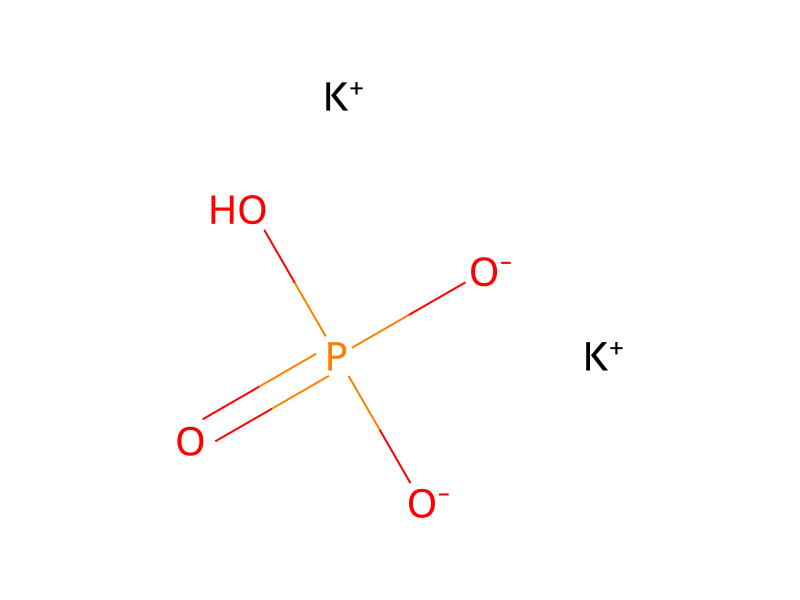
Grundinformationen
- Standard-SMILES
O=P([O-])([O-])O.[K+].[K+]- InChIKey
ZPWVASYFFYYZEW-UHFFFAOYSA-L- Summenformel
- K2HPO4
- Durchschnittliche Molmasse
- 174,176 g/mol
- Monoisotopische Masse
- 173,8886585
Überblick
Dipotassium hydrogen phosphate is a potassium salt that is the dipotassium salt of phosphoric acid. It has a role as a buffer. It is an inorganic phosphate and a potassium salt.
Namen und Bezeichner
- Bevorzugter Name
- Potassium Phosphate, Dibasic
- IUPAC
- dipotassium;hydrogen phosphate
- Lokaler Name
- Dikaliumhydrogenorthophosphat
- Englischer Name
- Potassium Phosphate Dibasic
- Summenformel
- K2HPO4
- Molmasse
- 174.18
Namen und Synonyme
7758-11-4Dipotassium hydrogen phosphateDIPOTASSIUM PHOSPHATEPotassium phosphate dibasicDipotassium hydrogenphosphatePotassium phosphate, dibasicDibasic potassium phosphatePhosphoric acid, dipotassium saltPotassium dibasic phosphateDipotassium monophosphatePotassium monophosphateDipotassium orthophosphate
Weitere Namen anzeigen
K2HPO4DKPPOTASSIUM HYDROGEN PHOSPHATEDipotassium phosphate anhydrousPOTASSIUM BIPHOSPHATE
Dipotassium monohydrogen phosphateHydrogen dipotassium phosphatePotassium phosphate (dibasic)Dipotassium hydrogenorthophosphatedi-potassium hydrogen phosphateCI71S98N1ZPhosphoric acid, potassium salt (1:2)Dipotassium acid phosphate
Datenbank-Bezeichner
- CAS
7758-11-4- PubChem CID
- 24450
- DTXSID
DTXSID8035506- ChEMBL
CHEMBL1200459- ChEBI
CHEBI:131527- UNII
- CI71S98N1Z
- EC Number
- 231-834-5
- Nikkaji
- J43.941J
Eigenschaften
Berechnete Struktureigenschaften
- Polarare Oberfläche (TPSA)
- 83,4 Ų
- H-Brücken-Donoren
- 1
- H-Brücken-Akzeptoren
- 4
- Frei drehbare Bindungen
- 0
- Schwere Atome
- 7
- Formalladung
- 0
- Komplexität
- 46,5
Experimentelle und physikochemische Eigenschaften
Chemical ClassesMetals -> Phosphates, Metallic Salts
Cosmetics
Cosmetic ingredients (Dipotassium Phosphate) -> CIR (Cosmetic Ingredient Review)
Buffering
pH
Between 8,7 and 9,4 (1 % solution)
PH= 8.8, DETERMINED IN A 1% SOLN
Food AdditivesEMULSIFIER OR EMULSIFIER SALT, NUTRIENT SUPPLEMENT, PH CONTROL AGENT, SEQUESTRANT, STABILIZER OR THICKENER -> FDA Substance added to food
Color/Form
White crystals
Colorless or white granules or powder
Solubility
Freely soluble in water. Insoluble in ethanol
Very sol in water; 100 g dissolves rapidly & completely in 67 g cold water
Slightly sol in alcohol
Human Drugs
FDA approved drugs -> Active ingredient
FDA approved drugs -> Active ingredient
Animal DrugsPharmaceuticals -> UK Veterinary Medicines Directorate List
Melting PointDecomp
Food Contact SubstancesFCS -> FDA Inventory of Food Contact Substances Listed in 21 CFR
Physical Description
Colourless or white granular powder, crystals or masses; deliquescent substance, hygroscopic
White partially hygroscopic solid; [Merck Index] Colorless or white odorless solid; Hygroscopic; [CHEMINFO] White odorless granules; [MSDSonline]
Other Experimental Properties
Converted into pyrophosphate by ignition; somewhat hygroscopic
Hygroscopic
Physikochemische Eigenschaften
- Schmelzpunkt
- 340 °C · 340 °C
- Dichte
- 2 · 2,44 g/cm3
- storage temp.
- 5 °C · Store at +5°C to +30°C.
- Löslichkeit
- 2 O: · H2O: 1 M at 20 °C, clear, colorless
- Aggregatzustand
- Solid
- Farbe
- White
- PH
- 8.5 · 8.5-9.6 (25℃, 50mg/mL in H2O)
- pka
- 1 · (1) 2.15, (2) 6.82, (3) 12.38 (at 25℃)
- Geruch (Odor)
- Odorless
- Biologische Quelle
- synthetic
- Wasserlöslichkeit
- 1600 g/L · 1600 g/L (20 ºC)
- Decomposition
- 465 °C · >465°C
- Merck
- 14 · 14,7658
- Stabilität
- Stable. Hygroscopic.
- Kosmetik-Inhaltsstoffe Funktionen
- ANTICORROSIVEBUFFERING
- InChI
- 1S/2K.H3O4P/c;;1-5(2,3)4/h;;(H3,1,2,3,4)/q2*+1;/p-2
- InChIKey
- ZPWVASYFFYYZEW-UHFFFAOYSA-L
- SMILES
- [K+].[K+].OP([O-])([O-])=O
- LogP
- -2.148 · -2.148 (est)
- CAS Datenbank
- 7758 · 7758-11-4(CAS DataBase Reference)
- EPA chemische Informationen
- Dipotassium phosphate (7758-11-4)
Sicherheit und Regulatorisches
GHS-Klassifizierung
GHS Classification
This chemical does not meet GHS hazard criteria for 48.2% (580 of 1203) of reports.
Danger
H315 (40.7%): Causes skin irritation [Warning Skin corrosion/irritation]
P264, P264+P265, P280, P302+P352, P305+P354+P338, P317, P321, P332+P317, and P362+P364 (click each P-code to see the statement)
Aggregated GHS information provided per 1203 reports by companies from 9 notifications to the ECHA C&L Inventory. Each notification may be associated with multiple companies.
Gefahrenhinweise
Regulatory Information
Chemical: Phosphoric acid, dipotassium salt
Status: Active Update: 14-03-2023 https://echa.europa.eu/registration-dossier/-/registered-dossier/14877
Dipotassium phosphate: Does not have an individual approval but may be used under an appropriate group standard
Other Safety InformationIMAP assessments - Phosphoric acid, dipotassium salt: Human health tier I assessment
Hazards SummaryEmergency treatment: Potassium; Potassium salts are usually not toxic after ingestion in patients with normal renal function. [HSDB] A probable irritant; [CHEMINFO] May cause irritation; [MSDSonline]
FDA Requirements
Dipotassium phosphate used as a sequestrant in food for human consumption is generally recognized as safe when used in accordance with good manufacturing practice.
Dipotassium phosphate used as a sequestrant in animal drugs, feeds, and related products is generally recognized as safe when used in accordance with good manufacturing or feeding practice.
Potassium phosphates (mono-, di-, and tribasic) are indirect food additives for use only as a component of adhesives. /Potassium phosphates (mono-, di-, and tribasic)/
Special ReportsWHO; Diseases Caused by Phosphorus and Its Toxic Compounds; Early Detection of Occupational Diseases pg 53-62 (1986). Review of diseases and health related effects resulting from exposure to phosphorus or phosphorus cmpd.
FIFRA Requirements
Dipotassium hydrogen phosphate is exempted from the requirement of a tolerance when used as a buffering agent in accordance with good agricultural practice as inert (or occasionally active) ingredients in pesticide formulations applied to growing crops only.
Residues of potassium phosphate are exempted from the requirement of a tolerance when used as a buffer in accordance with good agricultural practices as inert (or occasionally active) ingredients in pesticide formulations applied to growing crops or to raw agricultural commodities after harvest. /Potassium phosphate/
Hazard Classes and CategoriesSkin Irrit. 2 (40.7%)
Sicherheit und Schutzausrüstung
Storage ConditionsPotassium phosphates injection should be stored at controlled room temperature. /Potassium phosphates/
Disposal Methods
SRP: At the time of review, criteria for land treatment or burial (sanitary landfill) disposal practices are subject to significant revision. Prior to implementing land disposal of waste residue (including waste sludge), consult with environmental regulatory agencies for guidance on acceptable disposal practices.
Allowable Tolerances
Dipotassium hydrogen phosphate is exempted from the requirement of a tolerance when used as a buffering agent in accordance with good agricultural practice as inert (or occasionally active) ingredients in pesticide formulations applied to growing crops only.
Residues of potassium phosphate are exempted from the requirement of a tolerance when used as a buffer in accordance with good agricultural practices as inert (or occasionally active) ingredients in pesticide formulations applied to growing crops or to raw agricultural commodities after harvest. /Potassium phosphate/
Protective Action Criteria (PAC)
17 [mg/m3]
190 [mg/m3]
1100 [mg/m3]
Toxikologische Informationen
Toxicity Summary
The CIR Expert Panel concluded that the following 31 ingredients are safe in the present practices of use and concentration in cosmetics as described in this safety assessment, when formulated to be non-irritating...Dipotassium Phosphate...
Safe for use in cosmetics, with qualifications
Human Toxicity Excerpts
ACUTE POTASSIUM INTOXICATION BY MOUTH IS RARE BECAUSE LARGE SINGLE DOSES USUALLY INDUCE VOMITING & BECAUSE IN ABSENCE OF PREEXISTING KIDNEY DAMAGE, POTASSIUM IS RAPIDLY EXCRETED. /POTASSIUM SALTS/
SIDE EFFECTS OF /ORAL/ POTASSIUM SALTS MAY INCLUDE NAUSEA, VOMITING, DIARRHEA, AND ABDOMINAL DISCOMFORT. /POTASSIUM SALTS/
CLINICAL SIGNS AND SYMPTOMS OF /ORAL/ POTASSIUM OVERDOSAGE INCLUDE PARESTHESIAS OF THE EXTREMITIES, LISTLESSNESS, MENTAL CONFUSIONS, WEAKNESS OR HEAVINESS OF THE LEGS, FLACCID PARALYSIS, COLD SKIN, GRAY PALLOR, PERIPHERAL VASCULAR COLLAPSE WITH FALL IN BLOOD PRESSURE, CARDIAC ARRHYTHMIAS, AND HEART BLOCK. /POTASSIUM SALTS/
/IN POTASSIUM POISONING/ RESPIRATIONS ARE INITIALLY ACCELERATED BUT SKELETAL MUSCLE WEAKNESS MAY ADVANCE TO STAGE OF PARALYSIS. /POTASSIUM SALTS/
For more Human Toxicity Excerpts (Complete) data for DIPOTASSIUM PHOSPHATE (6 total), please visit the HSDB record page.
Non-Human Toxicity Excerpts
INVESTIGATED BY PLEDGET TECHNIQUE IN 1 ESOPHAGEAL STUDY WITH CATS, PRODUCED EXTENSIVE NECROSIS & ULCERATION. INGESTION MAY PRODUCE OROPHARYNGEAL BURNS, ESOPHAGITIS & GASTRITIS ACCOMPANIED BY ULCERATION, BLEEDING & DIARRHEA.
AFTER ORAL ADMIN OF 0.8 G/KG BODY WT FOR 14 OR 38 WK DOGS VOMITED, WERE CACHECTIC, & HAD ELEVATED CREATININE & BLOOD UREA NITROGEN. RENAL DAMAGE WAS MOST MARKED @ 38 WK, THERE WERE DISSEMINATED ATROPHY (USUALLY OF PROXIMAL TUBLES), FOCAL SCAR TISSUE & NEPHROCALCINOSIS.
ORALLY POISONED ANIMALS DIED FROM RESP FAILURE SOMETIMES FOLLOWING CONVULSIONS & ... GASTROENTERITIS, DEHYDRATION OF ORGANS & EARLY RENAL TUBULAR NECROSIS. /POTASSIUM SALTS/
/ORALLY POISONED ANIMALS/ SURVIVORS HAD ANOREXIA, POLYDIPSIA, POLYURIA, FEVER, CONVULSIVE MOVEMENTS & GI DISTURBANCES DURING FIRST 24 HR, BUT RAPIDLY RECOVERED ... . /POTASSIUM SALTS/
For more Non-Human Toxicity Excerpts (Complete) data for DIPOTASSIUM PHOSPHATE (8 total), please visit the HSDB record page.
Antidote and Emergency Treatment
Basic treatment: Establish a patent airway. Suction if necessary. Watch for signs of respiratory insufficiency and assist ventilations if necessary. Administer oxygen by nonrebreather mask at 6 to 12 L/min. Monitor for pulmonary edema and treat if necessary ... . Monitor for shock and treat if necessary ... . For eye contamination, flush eyes immediately with water. Irrigate each eye continuously with normal saline during transport ... . Do not use emetics. For ingestion, rinse mouth and administer 5 mL/kg up to 200 mL of water for dilution if the patient can swallow, has a strong gag reflex, and does not drool ... . Do not attempt to neutralize. Cover the skin burns with dry sterile dressings after decontamination ... . /Inorganic Bases/Alkaline Corrosives and Related Compounds/
Advanced treatment: Consider orotracheal or nasotracheal intubation for airway control in the patient who is unconscious or in respiratory arrest. Early intubation, at the first signs of upper airway obstruction, may be necessary. Positive-pressure ventilation techniques with a bag-valve-mask device may be beneficial. Monitor cardiac rhythm and treat arrhythmias as necessary ... . Start an IV of D5W TKO /SRP: "To keep open", minimal flow rate/. Use lactated Ringer's if signs of hypovolemia are present. Watch for signs of pulmonary edema. For hypotension with signs of hypovolemia, administer fluid cautiously. Watch for signs of fluid overload ... . Consider drug therapy for pulmonary edema ... . Use proparacaine hydrochloride to assist eye irrigation ... . /Inorganic Bases/Alkaline Corrosives and Related compounds/
RAIS Toxicity Values
1
PPRTV Current
4
PPRTV Current
Acceptable Daily Intakes
FAO/WHO EXPERT COMMITTEE ON FOOD ADDITIVES...RECOMMENDED.../LEVELS/ FOR TOTAL DIETARY PHOSPHORUS...UNCONDITIONAL ACCEPTANCE LEVEL /OF LESS THAN 30 MG/KG BODY WT/ IS CONSIDERED SAFE IN ANY TYPE OF DIET...CONDITIONAL ACCEPTANCE LEVEL /OF 30-70 MG/KG BODY WT/ IS ACCEPTABLE ONLY WHEN DIETARY CALCIUM LEVEL IS HIGH /PHOSPHATES/
Hazard Quotient Level 0.1 or Cancer Risk Level 1E-06
7.80e+04
1.20e+06
2.00e+04
1.5E+01(G)
1.00e+00
Volatile
Hazard Quotient Level 3 or Cancer Risk Level 1E-04
2.30e+05
3.50e+06
6.00e+04
1.5E+01 (G)
1.00e+00
Volatile
Regulatorische Informationen
FDA Requirements
Dipotassium phosphate used as a sequestrant in food for human consumption is generally recognized as safe when used in accordance with good manufacturing practice.
Dipotassium phosphate used as a sequestrant in animal drugs, feeds, and related products is generally recognized as safe when used in accordance with good manufacturing or feeding practice.
Potassium phosphates (mono-, di-, and tribasic) are indirect food additives for use only as a component of adhesives. /Potassium phosphates (mono-, di-, and tribasic)/
FIFRA Requirements
Dipotassium hydrogen phosphate is exempted from the requirement of a tolerance when used as a buffering agent in accordance with good agricultural practice as inert (or occasionally active) ingredients in pesticide formulations applied to growing crops only.
Residues of potassium phosphate are exempted from the requirement of a tolerance when used as a buffer in accordance with good agricultural practices as inert (or occasionally active) ingredients in pesticide formulations applied to growing crops or to raw agricultural commodities after harvest. /Potassium phosphate/
Sicherheitsdaten
- F
- 3
- wgk
- 3
- tsca
- TSCA listed
- hs_code
- 28352400
- RTECS-Nr.
- TC8450000
- risk_code
- 36-35-22
- Toxizität
- LD50 orally in Rabbit: 8000 mg/kg
- hazard_code
- Xi,C,T,F
- safety_code
- 22-24/25-36-26-45-36/37/39
- Speicherklasse
- 13 - Non Combustible Solids
- Giftige Stoffe Daten
- 7758-11-4(Hazardous Substances Data)
Chemie und Industrie
Pharmakologische Informationen
Bionecessity
Phosphate is a major intracellular anion which participates in providing energy for metabolism of substances and contributes to important metabolic and enzymatic reactions in almost all organs and tissues. Phosphate exerts a modifying influence on calcium concentrations, a buffering effect on acid-base equilibrium, and has a major role in the renal excretion of hydrogen ions. /Phosphate/
Phosphate as nutrient is a limiting factor to plant growth. /Phosphate/
Protein BindingPhosphate is minimally protein bound, and highly concentrated in cells (intracellular concentrations are 100-fold higher than serum concentrations). Concentrations of phosphate in plasma are higher in children than in adults.
Pharmacodynamics
Phosphate is a major intracellular anion which participates in providing energy for metabolism of substances and contributes to important metabolic and enzymatic reactions in almost all organs and tissues. Phosphate exerts a modifying influence on calcium concentrations, a buffering effect on acid-base equilibrium, and has a major role in the renal excretion of hydrogen ions.
Mechanism of Action
Once phosphate gains access to the body fluids and tissues, it exerts little pharmacological effect. If the ion is introduced into the intestine, the absorbed phosphate is rapidly excreted. If large amounts are given by this route, much of it may escape absorption. Because this property leads to a cathartic action, phosphate salts are employed as mild laxatives.
Once phosphate gains access to the body fluids and tissues, it exerts little pharmacological effect. If the ion is introduced into the intestine, the absorbed phosphate is rapidly excreted. If large amounts are given by this route, much of it may escape absorption. Because this property leads to a cathartic action, phosphate salts are employed as mild laxatives. Inorganic phosphate poisoning following ingestion of laxatives that contain phosphate salts has been reported in adults and children. Ingestion of large amounts of sodium dihydrogen phosphate lowers urinary pH. If excessive phosphate salts are introduced intravenously or orally, they may prove toxic by reducing the concentration of Ca 2+ in the circulation and from the precipitation of calcium phosphate in soft tissues. /Phosphates/
Biological Half-LifeIn healthy children with phosphate overdose, half-life was 4.8 to 10.6 hours, and was prolonged to 17 hours in a child with renal insufficiency.
Metabolism/MetabolitesPhosphate is a major intracellular anion which participates in providing energy for metabolism of substances and contributes to important metabolic and enzymatic reactions in almost all organs and tissues.
FDA Pharmacological Classification
KALI PHOSPHORICUM
Inhibition Large Intestine Fluid/Electrolyte Absorption [PE]; Osmotic Activity [MoA]; Potassium Compounds [CS]; Osmotic Laxative [EPC]; Increased Large Intestinal Motility [PE]; Potassium Salt [EPC]
POTASSIUM PHOSPHATE, DIBASIC
Osmotic Activity [MoA]; Inhibition Large Intestine Fluid/Electrolyte Absorption [PE]; Osmotic Laxative [EPC]; Potassium Compounds [CS]; Potassium Salt [EPC]; Increased Large Intestinal Motility [PE]
Absorption, Distribution and Excretion
Potassium salts are well absorbed from gastro intestinal tract. Net phosphorus absorption may occur in the small intestine in some species but is primarily a function of the colon in horses.
Potassium is excreted primarily by kidney.
Distribution is largely intracellular, but it is the intravascular concentration that is primarily responsible for toxicity.
Phosphates are rapidly cleared by dialysis.
POTASSIUM SALTS ARE WELL ABSORBED FROM THE GASTROINTESTINAL TRACT. ... POTASSIUM IS EXCRETED PRIMARILY BY THE KIDNEY. /POTASSIUM SALTS/
Net phosphorus absorption may occur in the small intestine in some species but is primarily a function of the colon in horses. /SRP: Phosphates/
Verwendung und Herstellung
Uses
CIR ingredient: Dipotassium Phosphate
Used as a buffering agent and corrosion inhibitor in anti-freeze, a culture nutrient for the production of antibiotics, a sequestrant, an emulsifier in cheeses, and a buffer in coffee creamers; Also used in specialty fertilizers, paper-processing aids, and saline cathartics; [HSDB] Used as yeast nutrient, humectant, and laboratory reagent; [CHEMINFO]
Pulp and Paper Processing [Category: Industry]
Buffering agent in anti-freeze; nutrient in the culturing of antibiotics
Sequestrant; emulsifier in specified cheeses
Most of the commercial output of dipotassium phosphate is used in conjunction with borates, nitrites, nitrates, and/or silicates as corrosion inhibitor systems in ethylene glycol antifreeze formulations. Its second largest use is as a buffer in coffee creamers to prevent casein protein precipitation by coffee acids. Other uses include specialty fertilizers, paper-processing aids, and saline cathartics.
U.S. Production
(1973) PROBABLY GREATER THAN 5X10+9 G (USE)
(1975) 4.54-6.36X10+9 GRAMS (SUPPLY)
Consumption Patterns68-70% AS A CORROSION INHIBITOR FOR ANTIFREEZE; 29-30% AS A BUFFERING AGENT FOR COFFEE CREAMERS; MINOR AMOUNTS USED IN PAPER PROCESSING, AS FERTILIZER, AS YEAST NUTRIENT, IN PHARMACEUTICALS, & AS CHEMICAL REAGENTS (1973)
Methods of ManufacturingBY REACTING POTASSIUM CARBONATE OR POTASSIUM HYDROXIDE WITH PHOSPHORIC ACID.
Formulations/Preparations
INJECTION, 2 MEQ OF POTASSIUM ION AND 1 MEQ OF HYDROGEN PHOSPHATE ION PER ML WITH BENZYL ALCOHOL 0.9%; 30 ML VIALS; POWDER NATIONAL FORMULARY.
Grades: commercial; pure; highest purity; NF /National Formulary/; FCC /Food Chemicals Codex/
Solid and 50% active solution
Household ProductsInformation on 6 consumer products that contain Dipotassium phosphate in the following categories is provided:
Use Classification
Food additives
Food Additives -> ACIDITY_REGULATOR; SEQUESTRANT; YEAST_FOOD -> JECFA Functional Classes
Food Additives -> ACIDITY_REGULATOR; SEQUESTRANT; YEAST_FOOD -> JECFA Functional Classes
Food Additives -> ACIDITY_REGULATOR; SEQUESTRANT; YEAST_FOOD -> JECFA Functional Classes
Food Additives -> ACIDITY_REGULATOR; SEQUESTRANT; YEAST_FOOD -> JECFA Functional Classes
Food Additives -> ACIDITY_REGULATOR; SEQUESTRANT; YEAST_FOOD -> JECFA Functional Classes
General Manufacturing Information
Phosphoric acid, potassium salt (1:2): ACTIVE
THE PROPERTIES OF /POTASSIUM PHOSPHATE/ ... DI-SALTS GIVE THEM EXCELLENT POTENTIAL AS FERTILIZERS, BUT HERETOFORE THEY HAVE RECEIVED SCANT ATTENTION BY THE INDUSTRY BECAUSE OF HIGH COSTS OF PRODUCTION.
... CAN INACTIVATE METALLIC IONS, WHICH ARE CAPABLE OF INTERFERING WITH NECESSARY FOOD-PROCESSING REACTIONS ... /INACTIVATION IS/ EITHER BY PPTN & REMOVING THEM FROM INTERFERENCE WITH DESIRED FOOD-PROCESSING REACTIONS OR BY COMPLEXING & MAINTAINING THEM IN SOL, BOUND STATE. /PHOSPHATES/
Anwendungen
BeschreibungPotassium Phosphate Dibasic is a common source of phosphorus and potassium, which is often used as a fertilizer. It is also widely applied in the food industry, such as food additive and electrolyte replenisher for workout supplement. Another usage of Potassium Phosphate Dibasic is as a medicine, who serves as a diuretic or laxative. Besides, it is employed in the production of imitation dairy creamers to prevent coagulation and used in certain powders to prepare beverages. In addition, it is commonly seen in chemical laboratories for producing buffer solutions and trypticase soy agar which is used to make agar plates for culturing bacteria.
VerwendenPotassium Phosphate Dibasic is the dipotassium salt of phosphoric acid which functions as a stabilizing salt, buffer, and sequestrant. It is mildly alkaline with a ph of 9 and is soluble in water with a solubility of 170 g/100 ml of water at 25°c. It improves the colloidal solubility of proteins. It acts as a buffer against variation in ph. For example, it is used in coffee whiteners as a buffer against ph variation in hot coffee and to prevent feathering. It also functions as an emulsifier in specified cheeses and as a buffering agent for processed foods. It is also termed dipotassium monohydrogen orthophosphate and dipotassium monophosphate.
Darstellung
synthetischeDipotassium phosphate is prepared by partial neutralization of phosphoric acid with potassium hydroxide, followed by crystallization:H3PO4+ 2KOH →K2HPO4+ 2H2O.
Vor- und nachgelagerte Produkte
Vorgelagerte Rohstoffe
Anbieter50 Anbieter
国药集团化学试剂有限公司86-21-63210123 · [email protected]
北京华美互利生物化工010-56205725 · [email protected]
上海阿拉丁生化科技股份有限公司400-6206333 13167063860 · [email protected]
上海炎泽化工有限公司15345144255 19975051755 · [email protected]
河北创海生物科技有限公司+86-86-13131129325 · [email protected]
Baoji Guokang Healthchem co.,ltd+8615604608665 15604608665 · [email protected]
Dayang Chem (Hangzhou) Co.,Ltd.+86-0571-88938639 17705817739 · [email protected]
Hebei Yanxi Chemical Co., Ltd.+86-17531190177 · [email protected]
上海迈瑞尔生化科技有限公司4006356688 18621169109 · [email protected]
大连美仑生物技术有限公司0411-62910999 13889544652 · [email protected]
阿法埃莎(中国)化学有限公司400-6106006 · [email protected]
安耐吉化学&3A(安徽泽升科技股份有限公司)400-0056266 · [email protected]
广东云星生物技术有限公司0751-18902340975/189023400307 18902340307 · [email protected]
北京绿百草科技发展有限公司010-61136123 · [email protected]
上海瀚鸿科技股份有限公司021-54306202 13764082696 · [email protected]
上海泰坦科技股份有限公司400-6009262 15618770481 · [email protected]
合肥天健化工有限公司551-65418679 15856988503;15837135945 · [email protected]
天津金汇太亚化学试剂有限公司022-59582624 18622766592 · [email protected]
孝感深远化工有限公司15527621225; 15527621225 · [email protected]
玛雅试剂+86 (573) 82222445 (0)18006601000 452520369 · [email protected]
四川库利南科技有限公司400-1166-196 18981987031 · [email protected]
天津希恩思生化科技有限公司400 638 7771 · [email protected]
湖南汇百侍生物科技有限公司0731-85526065 13308475853 · [email protected]
河南多贝化工有限公司0370-2785118 17550508557 · [email protected]
斯百全化学(上海)有限公司021-021-021-67601398-809-809-809 15221380277 · [email protected]
上海源叶生物科技有限公司13636370518 · [email protected]
艾科试剂4008-755-333 18080918076 · [email protected]
赛默飞世尔科技(中国)有限公司800-810-5118 · [email protected]
北京伊诺凯科技有限公司400-810-7969 010-59572699 · [email protected]
上海特伯化学科技有限公司+86-21-60341587 · [email protected]
上海遐瑞医药科技有限公司+86 21 61551611
上海将来实业股份有限公司400-0066400 13621662912 · [email protected]
上海将来实业股份有限公司021-61552785 · [email protected]
大连瑞闻科技有限公司86-0411-62789512 · [email protected]
上海爱蝶实业有限公司021-58957966 18930537195 · [email protected]
安倍医疗器械贸易(上海)有限公司400-1500-680 021-62402299 · [email protected]
成都零六生物科技有限公司400-1166-196 13458535857 · [email protected]
上海麦克林生化科技股份有限公司15221275939 15221275939 · [email protected]
杭州杰恒化工有限公司0571-87396432 · [email protected]
成都润泽本土化工有限公司13096311329 028-88469284 616445927 · [email protected]
湖北巨胜科技有限公司027-59599241 18871490274 · [email protected]
池州凯隆进出口贸易有限公司[email protected]
Sigma-Aldrich西格玛奥德里奇(上海)贸易有限公司021-61415566 800-8193336 · [email protected]
ALB Technology Limited702-983-3769 · [email protected]
TargetMol中国(陶术生物)021-021-33632979 15002134094 · [email protected]
上海波以尔化工有限公司021-50182298 021-50180596 · [email protected]
九鼎化学(上海)科技有限公司4009209199 · [email protected]
尤尼威尔化学品(上海)有限公司021-61932772 13012862996 · [email protected]
杭州鼎燕化工有限公司0571-87157530-8003 18267553885 · [email protected]
Alfa Chemistry+1-5166625404 · [email protected]
Ergänzende Hinweise
DefinitionChEBI: A potassium salt that is the dipotassium salt of phosphoric acid.
Zugehörige Reaktionen
567





Verknüpfte Notizen
Wird geladen…