StartseiteMCPWorkbenchSkills
StartseiteWorkbenchBenachrichtigungenMein Bereich
llms.txt · MCP-AnleitungDatenschutz · Nutzungsbedingungen · Supportv1.8.3
  1. Startseite
  2. /Verbindung

Broxyquinolin

Broxyquinoline

HCID 2453
Neue Reaktion
Drucken
GrundinformationenÜberblickNamen und BezeichnerEigenschaftenSicherheit und RegulatorischesChemie und IndustrieZugehörige ReaktionenNotizen zur Verbindung
TeilstruktursucheÄhnliche Strukturen suchen

Grundinformationen

CAS
521-74-4
Standard-SMILES
Oc1c(Br)cc(Br)c2cccnc12
InChIKey
ZDASUJMDVPTNTF-UHFFFAOYSA-N
Summenformel
C9H5Br2NO
Durchschnittliche Molmasse
302,95 g/mol
Monoisotopische Masse
300,87379

Überblick

5,7-dibromo-8-quinolinol is an organohalogen compound and a member of quinolines.

Namen und Bezeichner

Bevorzugter Name
Broxyquinoline
IUPAC
5,7-dibromoquinolin-8-ol
Lokaler Name
Broxyquinolin
Englischer Name
5,7-Dibromo-8-hydroxyquinoline
Summenformel
C9H5Br2NO
Molmasse
302.95

Namen und Synonyme

broxyquinoline5,7-Dibromoquinolin-8-ol521-74-45,7-Dibromo-8-hydroxyquinoline5,7-Dibromo-8-quinolinolDibromoxinBroxyquinolinDibromoxineFenilorDibromoxyquinolineBroxiquinolineBroxykinolin
Weitere Namen anzeigen
PavamibeBromoxinBROMOXINE
DibromoquinBrodiarColepurColipar5,7-DibromooxineDibromoksinParamibaParamibe

Datenbank-Bezeichner

CAS
521-74-4
PubChem CID
2453
DTXSID
DTXSID9045849
ChEMBL
CHEMBL223448
ChEBI
CHEBI:109543
UNII
UK4C618C8T
EC Number
208-317-8
Nikkaji
J6.615J

Eigenschaften

Berechnete Struktureigenschaften

XLogP
3,2
Polarare Oberfläche (TPSA)
33,1 Ų
H-Brücken-Donoren
1
H-Brücken-Akzeptoren
2
Frei drehbare Bindungen
0
Schwere Atome
13
Formalladung
0
Komplexität
190

Experimentelle und physikochemische Eigenschaften

SpringerMaterials PropertiesBoiling point
Collision Cross Section · 2 Einträge

137.7 Ų [M+H]+ [CCS Type: TW; Method: calibrated with polyalanine and drug standards]

136.76 Ų [M+H]+ [CCS Type: TW; Method: calibrated with polyalanine and drug standards]

Physikochemische Eigenschaften

Schmelzpunkt
198 · 198-200 °C(lit.)
Siedepunkt
363.74 °C · 363.74°C (rough estimate)
Dichte
2.189 · 2.189
Brechungsindex
1.64 · 1.6400 (estimate)
storage temp.
Keep in dark place,Sealed in dry,Room Temperature
Löslichkeit
DMSO (Slightly, Sonicated), Methanol (Slightly, Sonicated)
Aggregatzustand
Solid
pka
2.23 · 2.23±0.30(Predicted)
Farbe
Off-White to Pale Beige
Merck
14 · 14,1453
BRN
153624 · 153624
CAS Datenbank
521 · 521-74-4(CAS DataBase Reference)
EPA chemische Informationen
Broxyquinoline (521-74-4)

Sicherheit und Regulatorisches

Sicherheitsangaben dienen nur zur Orientierung und ersetzen weder das Sicherheitsdatenblatt (SDB) des Lieferanten noch geltende Vorschriften oder eine fachliche Bewertung.

GHS-Klassifizierung

GHS Classification · 4 Einträge

Warning

H315 (100%): Causes skin irritation [Warning Skin corrosion/irritation]

P261, P264, P264+P265, P271, P280, P302+P352, P304+P340, P305+P351+P338, P319, P321, P332+P317, P337+P317, P362+P364, P403+P233, P405, and P501 (click each P-code to see the statement)

Aggregated GHS information provided per 45 reports by companies from 5 notifications to the ECHA C&L Inventory. Each notification may be associated with multiple companies.

Gefahrenhinweise

Hazard Classes and CategoriesSkin Irrit. 2 (100%)

Toxikologische Informationen

Treatment · 1 Eintrag

EYES: irrigate opened eyes for several minutes under running water. INGESTION: do not induce vomiting. Rinse mouth with water (never give anything by mouth to an unconscious person). Seek immediate medical advice. SKIN: should be treated immediately by rinsing the affected parts in cold running water for at least 15 minutes, followed by thorough washing with soap and water. If necessary, the person should shower and change contaminated clothing and shoes, and then must seek medical attention. INHALATION: supply fresh air. If required provide artificial respiration.

Health Effects · 1 Eintrag

Bromine vapour causes irritation and direct damage to the mucous membranes. Elemental bromine also burns the skin. The bromide ion is a central nervous system depressant and chronic exposure produces neuronal effects. This is called bromism and can result in central reactions reaching from somnolence to coma, cachexia, exicosis, loss of reflexes or pathologic reflexes, clonic seizures, tremor, ataxia, loss of neural sensitivity, paresis, papillar edema of the eyes, abnormal speech, cerebral edema, delirium, aggressiveness, and psychoses. (L625, L626, L627)

Exposure RoutesOral (L626) ; inhalation (L626) ; dermal (L626)
Toxicity Summary · 1 Eintrag

Bromine is a powerful oxidizing agent and is able to release oxygen free radicals from the water in mucous membranes. These free radicals are also potent oxidizers and produce tissue damage. In additon, the formation of hydrobromic and bromic acids will result in secondary irritation. The bromide ion is also known to affect the central nervous system, causing bromism. This is believed to be a result of bromide ions substituting for chloride ions in the in actions of neurotransmitters and transport systems, thus affecting numerous synaptic processes. (L626, L627, A543)

Signs and Symptoms · 1 Eintrag

Bromine vapour causes irritation and direct damage to the mucous membranes. Symptoms include lacrimation, rhinorrhoea, eye irritation with mucous secretions from the oropharyngeal and upper airways, coughing, dyspnoea, choking, wheezing, epistaxis, and headache. The bromide ion is a central nervous system depressant producing ataxia, slurred speech, tremor, nausea, vomiting, lethargy, dizziness, visual disturbances, unsteadiness, headaches, impaired memory and concentration, disorientation and hallucinations. This is called bromism. (L626, L627)

Carcinogen ClassificationNo indication of carcinogenicity to humans (not listed by IARC).

Sicherheitsdaten

F
8
wgk
2
tsca
TSCA listed
hs_code
2933490090
RTECS-Nr.
VC5300000
risk_code
36/37/38
hazard_code
Xi
safety_code
26-36

Chemie und Industrie

Pharmakologische Informationen

ATC Code · 5 Einträge

P - Antiparasitic products, insecticides and repellents

G - Genito urinary system and sex hormones

A - Alimentary tract and metabolism

QA - Alimentary tract and metabolism

QG - Genito urinary system and sex hormones

Metabolism/Metabolites · 1 Eintrag

Bromine is mainly absorbed via inhalation, but may also enter the body through dermal contact. Bromine salts can be ingested. Due to its reactivity, bromine quickly forms bromide and may be deposited in the tissues, displacing other halogens. (L626)

Verwendung und Herstellung

UsesIt is used as an anti-infective. Diatomic bromine does not occur naturally, but bromine salts can be found in crustal rock.
General Manufacturing Information8-Quinolinol, 5,7-dibromo-: INACTIVE

Anwendungen

Verwendenantiinfectant, disinfectant

Vor- und nachgelagerte Produkte

Vorgelagerte Rohstoffe

8-HydroxychinolinHydrogenbromid7-Bromoquinolin-8-ol

Nachgelagerte Produkte

5-Bromchinolin-8-ol5,7-dibromo-8-benzyloxyquinoline

Zugehörige Reaktionen

9
Reaktionsaufzeichnung erstellen
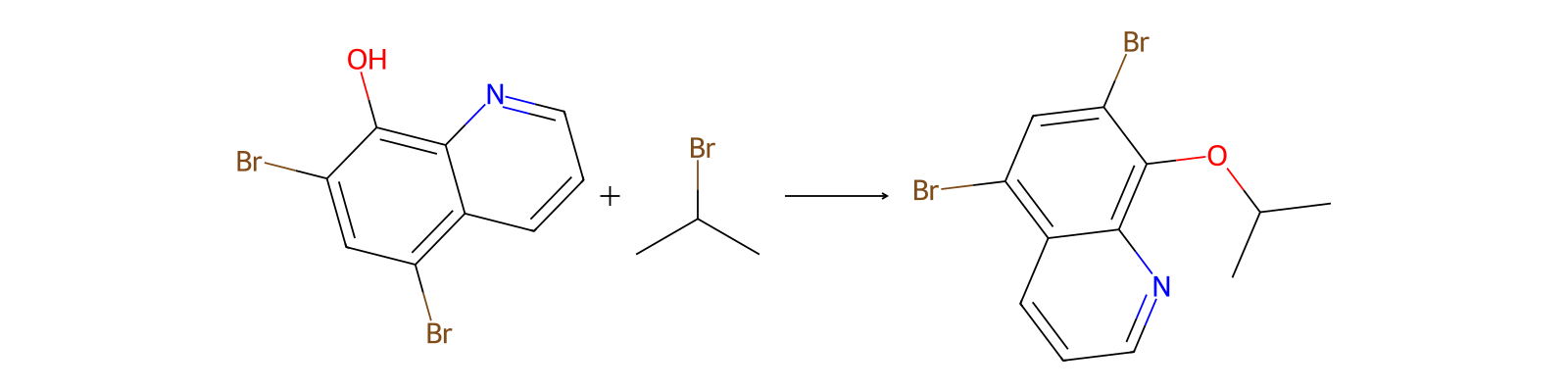
Reaktionsgleichung von HRID 281040
HRID 281040als Edukt
Reaktionsgleichung von HRID 623404
HRID 623404als Edukt
Reaktionsgleichung von HRID 872227
HRID 872227als Edukt
Reaktionsgleichung von HRID 1137945
HRID 1137945als Edukt
Reaktionsgleichung von HRID 1371256
HRID 1371256als Edukt
Reaktionsgleichung von HRID 1436952
HRID 1436952als Edukt
Reaktionsgleichung von HRID 1556578
HRID 1556578als Edukt
Reaktionsgleichung von HRID 1754089
HRID 1754089als Edukt
ZurückSeite 1 von 2

Notizen zur Verbindung

Auf dieser SeiteGrundinformationenÜberblickNamen und BezeichnerEigenschaftenSicherheit und RegulatorischesChemie und IndustrieZugehörige ReaktionenNotizen zur Verbindung