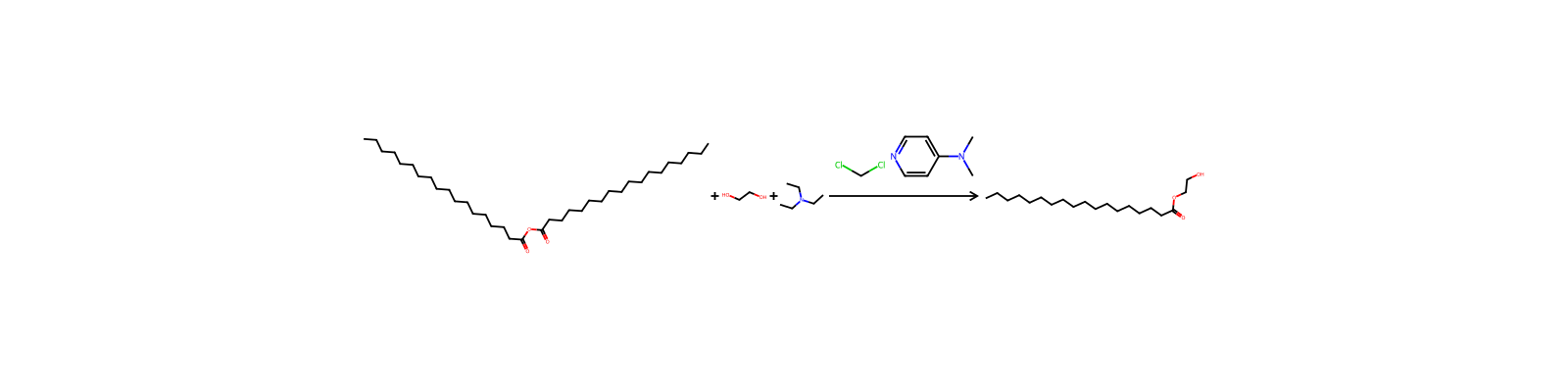
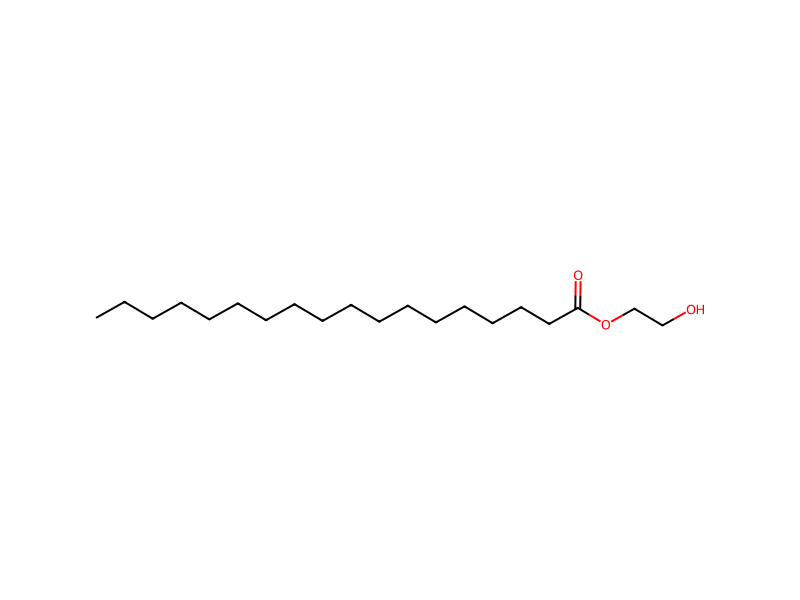
Grundinformationen
- Standard-SMILES
CCCCCCCCCCCCCCCCCC(=O)OCCO- InChIKey
RFVNOJDQRGSOEL-UHFFFAOYSA-N- Summenformel
- C20H40O3
- Durchschnittliche Molmasse
- 328,5 g/mol
Überblick
Polyoxyl 40 stearate is an octadecanoate ester composed of repeating 8-40 ethyleneoxy units. It is an ingredient used in cosmetics and beauty products primarily as a surfactant and emulsifier. It has a role as a nonionic surfactant, an emulsifier and a food emulsifier. It is a hydroxypolyether and an octadecanoate ester.
Namen und Bezeichner
- Bevorzugter Name
- Glycol monostearate
- IUPAC
- 2-hydroxyethyl octadecanoate
- Lokaler Name
- 2-Hydroxyethylstearat
- Englischer Name
- ETHYLENE GLYCOL MONOSTEARATE
- Summenformel
- C20H40O3
- Molmasse
- 328.53
Namen und Synonyme
Ethylene glycol monostearateGlycol stearate111-60-42-Hydroxyethyl octadecanoateMonthybaseMonthyleParastarinIvoritSedetolGlycol monostearateProdhybase ethylProdhybas N
Weitere Namen anzeigen
s151FGMSS 151lipoegms
Clindrol SEGEmerest 2350Ethylene glycol stearateLipo EGMSEmpilan 2848OCTADECANOIC ACID, 2-HYDROXYETHYL ESTERUSAF KE-11STEARIC ACID, 2-HYDROXYETHYL ESTER
Datenbank-Bezeichner
- CAS
111-60-4、86418-55-5、9004-99-3- PubChem CID
- 24762
- DTXSID
DTXSID5026881- ChEMBL
CHEMBL2355383- ChEBI
CHEBI:32027- UNII
- 0324G66D0E
- EC Number
- 203-886-9、617-851-4、618-405-1、926-608-4
- Nikkaji
- J110.879D
Eigenschaften
Berechnete Struktureigenschaften
- XLogP
- 7,8
- Polarare Oberfläche (TPSA)
- 46,5 Ų
- H-Brücken-Donoren
- 1
- H-Brücken-Akzeptoren
- 3
- Frei drehbare Bindungen
- 19
- Schwere Atome
- 23
- Formalladung
- 0
- Komplexität
- 241
Experimentelle und physikochemische Eigenschaften
PolymersOther Classes -> Polyoxyethylenes
Cosmetics
Cosmetic ingredients (Glycol Stearate) -> CIR (Cosmetic Ingredient Review)
Cosmetic ingredients (Glycol Stearate SE) -> CIR (Cosmetic Ingredient Review)
Emollient; Opacifying; Surfactant; Humectant; Emulsifying
OdorFAINT FATTY ODOR
TasteSLIGHTLY BITTER, FATTY TASTE
Color/FormCREAM-COLORED SOFT, WAXY OR PASTY SOLID @ 25 °C
Solubility
POLYETHYLENE GLYCOL ESTERS AND ETHERS INCR THE WATER SOLUBILITY OF TYROTHRICIN.
SOL IN CARBON TETRACHLORIDE, PETROLEUM BENZIN, CHLOROFORM, ETHER; SLIGHTLY SOL IN ALCOHOL; INSOL IN WATER /POLYETHYLENE GLYCOL 400 MONOSTEARATE USP XVI/
GENERALLY SOL OR DISPERSIBLE IN WATER
SOL IN TOLUENE, ACETONE, ETHER AND ETHANOL
Flash PointMYRJ 45: 500 °F OC
Melting Point
MP: 30-34 °C /POLYETHYLENE GLYCOL 400 MONOSTEARATE USP XVI/
60.00 to 61.00 °C. @ 760.00 mm Hg
Physical Description
Dry Powder; Other Solid; Large Crystals; Liquid; Liquid
Light tan solid; [Hawley]
Other Experimental Properties
NONIONIC SURFACTANT
NEARLY ODORLESS /POLYETHYLENE GLYCOL 400 MONOSTEARATE USP XVI/
Physikochemische Eigenschaften
- Schmelzpunkt
- 55 · 55-60 °C
- Siedepunkt
- 149 °C · 149 °C
- Dichte
- 0.878 · 0.8780
- Brechungsindex
- 1.431 · 1.4310 (estimate)
- Flammpunkt
- 425 · 425
- storage temp.
- 2 · 2-8°C
- Löslichkeit
- Chloroform (Slightly), Methanol (Slightly, Heated)
- pka
- 13.9 · 13.90±0.10(Predicted)
- Aggregatzustand
- Flakes
- Farbe
- White to pale yellow
- Geruch (Odor)
- 100 % · at 100.00%. mild waxy
- Stabilität
- Stable under normal conditions., Stable Under Normal Conditions.
- Kosmetik-Inhaltsstoffe Funktionen
- SURFACTANT - EMULSIFYINGSURFACTANT - CLEANSINGOPACIFYINGSKIN CONDITIONING - EMOLLIENT
- LogP
- 7.629 · 7.629 (est)
- CAS Datenbank
- 111 · 111-60-4(CAS DataBase Reference)
- EPA chemische Informationen
- Ethylene glycol monostearate (111-60-4)
Sicherheit und Regulatorisches
GHS-Klassifizierung
GHS Classification
This chemical does not meet GHS hazard criteria for 75.2% (357 of 475) of all reports.
Warning
H315 (18.9%): Causes skin irritation [Warning Skin corrosion/irritation]
P261, P264, P264+P265, P271, P280, P302+P352, P304+P340, P305+P351+P338, P319, P321, P332+P317, P337+P317, P362+P364, P403+P233, P405, and P501 (click each P-code to see the statement)
Aggregated GHS information provided per 475 reports by companies from 12 notifications to the ECHA C&L Inventory. Each notification may be associated with multiple companies.
This chemical does not meet GHS hazard criteria for 87% (267 of 307) of all reports.
Gefahrenhinweise
Regulatory Information
Chemical: Poly(oxy-1,2-ethanediyl), .alpha.-(1-oxooctadecyl)-.omega.-hydroxy-
Chemical: Octadecanoic acid, 2-hydroxyethyl ester
Octadecanoic acid, 2-hydroxyethyl ester is listed on the EPA's Chemical Data Reporting (CDR) system. Manufacturers and importers of Octadecanoic acid, 2-hydroxyethyl ester are required to report information about their production and use of this chemical to the EPA under the Toxic Substances Control Act (TSCA). (40 eCFR Part 711)
FRI - indicates a polymeric substance containing no free-radical initiator in its Inventory name but is considered to cover the designated polymer made with any free-radical initiator regardless of the amount used.
Octadecanoic acid, 2-hydroxyethyl ester: Does not have an individual approval but may be used under an appropriate group standard
Tegin G: Does not have an individual approval but may be used under an appropriate group standard
Hazards Summary
Caused bladder stones in rats when fed at >20% of diet; [JECFA] Mild irritant effect in eye of rabbit; [RTECS] Hydrolyzed in the intestines--fatty acids metabolized and the polyoxyethylene residues excreted unchanged in the urine; [HSDB] An irritant; [MSDSonline] See STEARATES.
EPA Safer Chemical
Chemical: Ethylene glycol monostearate
Chemical: Polyethylene glycol stearate
Hazard Classes and Categories
Skin Irrit. 2 (18.9%)
Eye Irrit. 2 (13%)
Sicherheit und Schutzausrüstung
Threshold Limit Values (TLV)
8 hr Time Weighted Avg (TWA): 10 mg/cu m. /Stearates; does not include stearates of toxic metals/
Excursion Limit Recommendation: Excursions in worker exposure levels may exceed 3 times the TLV-TWA for no more than a total of 30 minutes during a work day, and under no circumstances should they exceed 5 times the TLV-TWA, provided that the TLV-TWA is not exceeded. /Stearates; does not include stearates of toxic metals/
A4; Not classifiable as a human carcinogen. /Stearates; does not include stearates of toxic metals/
Toxikologische Informationen
Interactions
MYRI 32 INCREASED GI ABSORPTION OF ORAL GENTAMICIN IN RATS.
SENSITIVITY OF FEEDING TESTS IN DETECTING CARCINOGENICITY OF SMALL DOSE OF 7,12-DIMETHYLBENZ[A]ANTHRACENE IN FEMALE RATS INCR WHEN IT WAS GIVEN AT AN EARLIER AGE AND WHEN A HIGH FAT DIET CONTAINING 1% POLYOXYETHYLENE MONOSTEARATE WAS ADMIN.
Toxicity Summary
Safe in the present practices of use and concentration. Ingredient, concentration, and use information are available in documents discoverable at https://cir-reports.cir-safety.org
Safe in the present practices of use and concentration. Ingredient, concentration, and use information are available in documents discoverable at https://cir-reports.cir-safety.org
Non-Human Toxicity Excerpts
MALE & FEMALE RATS WERE FED HIGH DOSES OF MYRJ 45 FOR MORE THAN 12 WK, THEN REPRODUCTION & LACTATION WERE MEASURED. A SOMEWHAT GREATER PROP OF INFANT DEATHS NOTED AT 10% LEVEL THAN AT 5% LEVEL, WHEREAS AT 20% LEVEL SIGNIFICANT DIMINUTION OF SURVIVAL OF NEWBORN WAS OBSERVED.
Evidence for CarcinogenicityA4; Not classifiable as a human carcinogen. /Stearates; does not include stearates of toxic metals/
Sicherheitsdaten
- tsca
- TSCA listed
- hs_code
- 29189900
- RTECS-Nr.
- WI4100000
- risk_code
- 60-22-36/37/38-63
- hazard_code
- T
- safety_code
- 24/25-45-36/37/39-28-27-26-53
Chemie und Industrie
Pharmakologische Informationen
Absorption, Distribution and Excretion
THESE ESTERS ARE HYDROLYZED IN THE BOWEL. THE FATTY ACID IS ABSORBED & METABOLIZED; AT LEAST THE SHORTER POLYOXYETHYLENE RESIDUES ARE ALSO ABSORBED, BUT THEY ARE EXCRETED UNCHANGED IN THE URINE (NO DETECTABLE METABOLISM TO OXALIC ACID IN MAN).
Cellular LocationsExtracellular
Verwendung und Herstellung
Uses
CIR ingredient: Glycol Stearate
CIR ingredient: Glycol Stearate SE
Used as a surfactant, emulsifier (cosmetics, pharmaceuticals, textile finishes, defoamers, and baked goods), dye assistant, lubricant, and antistatic agent; Also used in dentifrice compositions and to make creams, lotions, ointments, and pharmaceutical preparations; [HSDB]
Textiles (Printing, Dyeing, or Finishing) [Category: Industry]
SURFACTANT
PEG 400 MONOSTEARATE USP XVI: IN PREPN OF CREAMS, LOTIONS, OINTMENTS & PHARMACEUTICAL PREPN WHICH ARE SOL IN WATER
U.S. Production
2023: 1,000,000 - <2,500,000 lb
(1972) 2.4X10+9 GRAMS (MONOSTEARATE)
(1975) 3.13X10+9 GRAMS (MONOSTEARATES)
(1984) 2.91X10+9 g
Consumer UsesSurfactant (surface active agent)
Industry UsesSurfactant (surface active agent)
Methods of ManufacturingREACTION OF ETHYLENE OXIDE WITH STEARIC ACID
Formulations/PreparationsPOLYOXYETHYLENE (8) STEARATE: MIXTURE OF MONO- & DIESTERS OF STEARIC ACID & MIXED POLYOXYETHYLENE DIOLS HAVING AN AVG POLYMER LENGTH OF 7.5 OXYETHYLENE UNITS.
Household Products
Information on 150 consumer products that contain Glycol stearate in the following categories is provided:
Information on 169 consumer products that contain PEG- 100 Stearate in the following categories is provided:
Use Classification
EPA Safer Chemical Functional Use Classes -> Surfactants
Safer Chemical Classes -> Green circle - The chemical has been verified to be of low concern
EPA Safer Chemical Functional Use Classes -> Defoamers;Surfactants
Safer Chemical Classes -> Green circle - The chemical has been verified to be of low concern
Cosmetics -> Emollient; Opacifying; Surfactant; Humectant; Emulsifying
General Manufacturing Information
Soap, Cleaning Compound, and Toilet Preparation Manufacturing
Octadecanoic acid, 2-hydroxyethyl ester: ACTIVE
Poly(oxy-1,2-ethanediyl), .alpha.-(1-oxooctadecyl)-.omega.-hydroxy-: ACTIVE
POLYETHYLENE GLYCOL 400 MONOSTEARATE USP XVI: IT IS AN ETHER, ALCOHOL & ESTER.
Anwendungen
Verwendenethylene glycol monostearate (glycol stearate) is a non-comedogenic raw material that provides a pearly look and consistency to clear preparations.
Vor- und nachgelagerte Produkte
Vorgelagerte Rohstoffe
Anbieter50 Anbieter
国药集团化学试剂有限公司86-21-63210123 · [email protected]
北京华美互利生物化工010-56205725 · [email protected]
梯希爱(上海)化成工业发展有限公司021-67121386 · [email protected]
上海阿拉丁生化科技股份有限公司400-6206333 13167063860 · [email protected]
Shandong chuangyingchemical Co., Ltd.18853181302 · [email protected]
南通鲁尔化工有限公司18012215199 · [email protected]
武汉欣扬瑞和化学科技有限公司153-07155313 15307155313 · [email protected]
河北展药生物科技有限公司15369953316 +8615369953316 · [email protected]
Baoji Guokang Healthchem co.,ltd+8615604608665 15604608665 · [email protected]
Dayang Chem (Hangzhou) Co.,Ltd.+86-0571-88938639 17705817739 · [email protected]
Hebei Yanxi Chemical Co., Ltd.+86-17531190177 · [email protected]
上海迈瑞尔生化科技有限公司4006356688 18621169109 · [email protected]
上海晶抗生物工程有限公司021-54721350 13524668266 · [email protected]
安耐吉化学&3A(安徽泽升科技股份有限公司)400-0056266 · [email protected]
武汉卡诺斯科技有限公司027-83238443 15327105076 · [email protected]
山东瑞生药用辅料有限公司0635-5018008 15240035289
山东洛克化工有限公司17653113209 13065062079 · [email protected]
上海景颜化工科技有限公司13817811078 · [email protected]
上海泰坦科技股份有限公司400-6009262 15618770481 · [email protected]
合肥天健化工有限公司551-65418679 15856988503;15837135945 · [email protected]
山东西亚化学有限公司13355009207 13355009207 · [email protected]
四川库利南科技有限公司400-1166-196 18981987031 · [email protected]
天津希恩思生化科技有限公司400 638 7771 · [email protected]
斯百全化学(上海)有限公司021-021-021-67601398-809-809-809 15221380277 · [email protected]
上海源叶生物科技有限公司13636370518 · [email protected]
艾科试剂4008-755-333 18080918076 · [email protected]
上海思域化工科技有限公司86-21-34053660 · [email protected]
TCI AMERICA800-4238616 · [email protected]
TOKYO CHEMICAL INDUSTRY CO., LTD.03-36680489 · [email protected]
TCI Europe320-37350700 · [email protected]
南京杜莱生物技术有限公司025-84699383-8003;025-846993838003-8003 18013301590 · [email protected]
北京环宇世纪化学科技有限公司hysj_bj.com
上海将来实业股份有限公司400-0066400 13621662912 · [email protected]
湖南华腾制药有限公司400-8592883 · [email protected]
上海麦克林生化科技股份有限公司15221275939 15221275939 · [email protected]
上海永叶生物科技有限公司86-021-61559134 15921386130 · [email protected]
上海有朋化工有限公司021-69005955 13701776567 · [email protected]
北京海力扬化学科技有限公司13718199399 · [email protected]
北京欣赛维化学科技有限公司010-56218822 13717722232 · [email protected]
四川海诺威科技有限公司13708085536 13708085536 · [email protected]
上海凯赛化工有限公司021-33516722 13701817765 · [email protected]
上海彤源化工有限公司021-021-69182866 13701855675 · [email protected]
北京华扬致成科技有限公司13716033033 · [email protected]
上海蓝润化学有限公司021-69515658 ; 69515628 13701998368 · [email protected]
上海容立化学科技有限公司021-69992220 13701886816 · [email protected]
上海康拓化工有限公司021-69185552 13701777608 · [email protected]
湖北巨胜科技有限公司027-59599241 18871490274 · [email protected]
池州凯隆进出口贸易有限公司[email protected]
Sigma-Aldrich西格玛奥德里奇(上海)贸易有限公司021-61415566 800-8193336 · [email protected]
TargetMol中国(陶术生物)021-021-33632979 15002134094 · [email protected]
Zugehörige Reaktionen
1
Verknüpfte Notizen
Wird geladen…