
HRID 1701109als Edukt
Sulfur monochloride
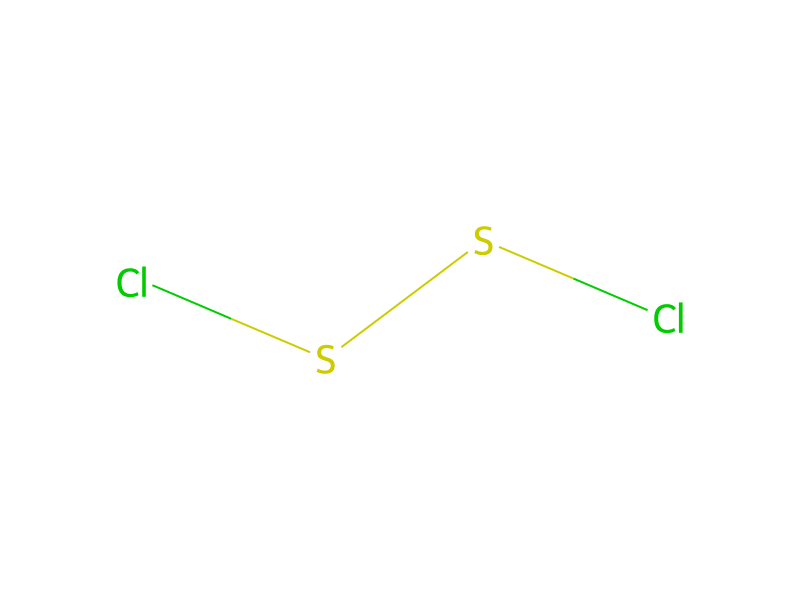
10025-67-9ClSSClPXJJSXABGXMUSU-UHFFFAOYSA-NSulfur monochloride appears as a yellow-red, oily, fuming liquid with a sharp odor. Contact or ingestion causes irritation or chemical burns to skin, eyes, and mucous membranes. Also poisonous by inhalation of vapors.
10025-67-9、12771-08-3DTXSID3042427Toxic Gases & Vapors -> Other Toxic Gases & Vapors
Corrosives
Suffocating odor
Pungent, nauseating, irritating odor.
1.68 at 68 °F (USCG, 1999) - Denser than water; will sink
1.6885 at 15.5 °C/15.5 °C
Saturated liquid density= 104.599 lb/cu ft @ 70 °F
Relative density (water = 1): 1.7
1.68
1.6885 @ 15.5°C
Decomposes (NIOSH, 2024)
Sol in alc, benzene, ether, carbon disulfide, carbon tetrachloride, oils
Soluble in amyl acetate
Insoluble in water
Solubility in water: reaction
Decomposes
Sulfur monochloride is minimally corrosive to carbon steel and iron when dry. When wet, it behaves like hydrochloric acid and attacks steel, cast iron, aluminum, stainless steels, copper and copper alloys, and many nickel-based materials.
Sicherheitsangaben dienen nur zur Orientierung und ersetzen weder das Sicherheitsdatenblatt (SDB) des Lieferanten noch geltende Vorschriften oder eine fachliche Bewertung.
Danger
H301: Toxic if swallowed [Danger Acute toxicity, oral]
P260, P261, P264, P270, P271, P273, P280, P301+P316, P301+P330+P331, P302+P361+P354, P304+P340, P305+P354+P338, P316, P317, P321, P330, P363, P391, P405, and P501 (click each P-code to see the statement)
Danger
H301+H331 (28.9%): Toxic if swallowed or if inhaled [Danger Acute toxicity, oral; acute toxicity, inhalation]
P260, P261, P264, P264+P265, P270, P271, P273, P280, P301+P316, P301+P330+P331, P302+P361+P354, P304+P340, P305+P354+P338, P316, P317, P321, P330, P363, P391, P403+P233, P405, and P501 (click each P-code to see the statement)
Chemical: Sulfur chloride (S2Cl2)
Sulfur chloride (S2Cl2) is listed on the EPA's Chemical Data Reporting (CDR) system. Manufacturers and importers of Sulfur chloride (S2Cl2) are required to report information about their production and use of this chemical to the EPA under the Toxic Substances Control Act (TSCA). (40 eCFR Part 711)
REACH registered substance: Disulphur dichloride (EC: 233-036-2)
Disulphur dichloride: HSNO Approval: HSR003082 Approved with controls
The New Jersey Worker and Community Right to Know Act requires public and private employers to provide information about hazardous substances at their workplaces. (N.J.S.A. 34:5A-1 et. seq.)
Excerpt from ERG Guide 137 [Substances - Water-Reactive - Corrosive]:
Combustible. Gives off irritating or toxic fumes (or gases) in a fire.
. . . used in vulcanizing rubber, chemical synthesis, wood hardening, textile finishing, and gold extraction. [ACGIH]
Textiles (Printing, Dyeing, or Finishing) [Category: Industry]
Precursor to mustard gas, lewisite 1, arsenic trichloride, and thionyl chloride.
Use for production of white vulcanized oils used for coating and impregnating textiles; use as natural and synthetic rubber extenders and modifying agents in erasers, and extruded rubber goods; use with unsaturated fatty acids in production of additives to extreme pressure lubricants and cutting oils; use as a cross-linking catalyst in polymer technology; use for treatment of drying oils for production of varnishes, inks, paints, and cements; use as a solvent for sulfur and sulfur cmpd.
Intermediate and chlorinating agent in the manufacture of organic chemicals, sulfur dyes, insecticides; synthetic rubbers;in cold vulcanization of rubber; as polymerization catalyst for vegetable oils; for hardening soft woods.
Chemicals (sulfur solvent, acetic anhydride, thionyl chloride, carbon tetrachloride from carbon disulfide, various chlorohydrins from glycerol, glycol, etc), analytical reagent, rubber vulcanizing, vulcanized oils, purifying sugar juices, military poison, insecticide, hardening soft woods (by treatment with sulfur chloride dissolved in carbon disulfide), pharmacueticals, sulfur dyes, extraction of gold from its ores.
... /Commercial disulfur dichloride/ can contain SCl2, SO2, SOCl2, chlorosulfanes, and dissolved sulfur as impurities.
Commercial material may contain 0-5% free sulfur.
2023: 25,000,000 - <40,000,000 lb
Production volumes for non-confidential chemicals reported under the Inventory Update Rule. [Table#2244]
Prepared by passing chlorine into molten sulfur, can be purified by fractional distillation.
Disulfur dichloride is generally produced from the elements. In the batch process, chlorine is passed into a solution of sulfur in S2Cl2 with cooling at about 50 - 70 °C until the correct chlorine content is reached. In the continuous process, gaseous chlorine is passed into molten sulfur at 220 - 260 °C, and the gaseous S2Cl2 leaving the reactor is then condensed.
Sulfur monochloride will attack some forms of plastics, rubber, and coatings.
245 °F (USCG, 1999)
245 °F
266 °F (open cup); 245 °F (closed cup)
118.5 °C c.c.
245 °F
245 °F
280 °F at 760 mmHg (USCG, 1999)
137 °C
When distilled at its atmospheric boiling point, it undergoes some decomposition to the dichloride, but decomposition is avoided with distillation at about 6.7 kPa (50 mmHg).
138 °C
280 °F
138 °C @760 [mm Hg]
SULFUR CHLORIDE /WHEN HEATED IS/ ... ASSOCIATED WITH EVOLUTION OF DANGEROUS DECOMP PRODUCTS, SULFUR DIOXIDE & HYDROGEN CHLORIDE.
Decomposes on contact with water to produce heat & toxic & corrosive fumes.
Decomposition by water yielding sulfur, hydrogen chloride, sulfur dioxide, hydrogen sulfide, sulfite, thiosulfate
-112 °F (USCG, 1999)
-77 °C
-77 °C
-112 °F
-77 °C
-107 °F
4.66 (Air = 1)
Relative vapor density (air = 1): 4.7
Highly corrosive to skin; [Quick CPC] Liquid causes second or third degree burns after short contact; [CHRIS] Sulfur monochloride is a respiratory irritant with a nauseating odor; it hydrolyzes into HCl and SO2. [ACGIH] Tear drawing. A corrosive substance that can cause pulmonary edema; [ICSC] Sulfur chlorides release HCl, SO2, and H2S when spilled in water; [ERG 2016]
The major hazards encountered in the use and handling of sulfur monochloride stem from its toxicologic properties. Toxic by all routes (ie, inhalation, ingestion, and dermal contact), exposure to this yellowish-red, strong smelling, oily liquid may occur from its use as an intermediate and chlorinating agent in the manufacture of high pressure lubricants and cutting oils, sulfur dyes, and insecticides, as a cross-linking catalyst in polymer technology, as a solvent for sulfur compounds, as a rubber extender, and in the purification of sugar juices. Effects from exposure may include headache, dizziness, nausea, burns to the skin and eyes, shortness of breath, respiratory irritation, pulmonary edema, respiratory distress and failure. OSHA has established a Ceiling limit of 1 ppm as a final standard to become effective December 31, 1992. In activities and situations where over-exposure may occur, wear a self-contained breathing apparatus with a full facepiece, and chemical resistant protective clothing specifically recommended by the shipper or producer. If contact should occur, immediately irrigate exposed eyes with copious amounts of tepid water for at least 15 minutes, and wash exposed skin thoroughly with soap and water. Facilities for quick drenching of the body should be provided in sulfur monochloride work areas. Contaminated clothing should be removed and left at the worksite for cleaning. While sulfur monochloride does not ignite easily, it may ignite other combustible materials (eg, wood, paper, oil). Also, it may create an explosion hazard if its heavier-than-air vapor is allowed to accumulate in confined spaces such as sewers. For fires involving sulfur monochloride, extinguish with dry chemical, CO2, or Halon. Because sulfur monochloride may react with water, use water only if large quantities of combustibles are involved. If water is used, apply it in flooding quantities as spray or fog, from as far a distance as possible. Sulfur monochloride should be stored in a cool, well ventilated area, away from moisture, sources of ignition, combustibles, and oxidizers. This material is readily hydrolyzed by water, becoming highly corrosive to metals. Sulfur monochloride may be shipped via air, rail, road, and water, in stainless steel containers bearing the label, "Corrosive." Transport on passenger carrying aircraft or railcars is forbidden. Spills of sulfur monochloride on land should first be diked with soil, sand bags, foamed polyurethane, or foamed concrete; the bulk liquid absorbed with fly ash or cement powder (water spray or mist may need to be applied to knock down vapor); and soda ash or slaked lime applied for neutralization. Spills in bodies of water should be neutralized with agricultural lime, crushed limestone, or sodium bicarbonate, then mechanical dredges or lifts used to remove the immobilized masses of pollutants and precipitates. Before implementing land disposal of sulfur monochloride waste, consult with environmental regulatory agencies for guidance.
Organization for the Prohibition of Chemical Weapons; Convention on the Prohibition of the Development, Production, Stockpiling and Use of Chemical Weapons and Their Destruction. Available from http://www.opcw.org as of November 12, 2008. The Chemical Weapons Convention (CWC) is an international treaty which bans the development, production, stockpiling, and transfer or use of chemical weapons. The Convention mandates the destruction and prohibition of chemical weapons and related facilities and provides for restrictions on international trade in toxic chemicals and precursors.
Excerpt from ERG Guide 137 [Substances - Water-Reactive - Corrosive]:
Use powder, carbon dioxide. NO hydrous agents. NO water. In case of fire: keep drums, etc., cool by spraying with water. NO direct contact with water.
Fresh air, rest. Half-upright position. Artificial respiration may be needed. Refer for medical attention.
Remove contaminated clothes. Rinse skin with plenty of water or shower. Refer for medical attention .
First rinse with plenty of water for several minutes (remove contact lenses if easily possible), then refer for medical attention.
Rinse mouth. Do NOT induce vomiting. Refer for medical attention .
Excerpt from NIOSH Pocket Guide for Sulfur monochloride:
(General first aid procedures)
Confined fires with high fuel loads of polyvinyl chloride, such as a fire in a vault with a high load of polyvinyl chloride-coated electrical wiring, may generate sufficient hydrogen chloride to cause irritation in fire fighters. Rapid combustion of relatively large amt of polymer may yield ... hydrogen chloride ... . /Hydrochloric acid/
TIH (Toxic Inhalation Hazard) - Term used to describe gases and volatile liquids that are toxic when inhaled. Some are TIH materials themselves, e.g., chlorine, and some release TIH gases when spilled in water, e.g., chlorosilanes. [ERG 2016].
Use dry chemical or carbon dioxide. Use water spray to keep fire-exposed containers cool. Approach fire from upwind to avoid hazardous vapors & toxic decomposition products.
/In fire/ wear goggles, self-contained breathing apparatus, & rubber overclothing (including gloves).
Use ... dry sand. Do not use water on material itself. If large quantities of combustibles are involved, use water in flooding quantities as spray and fog. Use water spray to knock-down vapors. Cool all affected containers with flooding quantities of water. Apply water from as far a distance as possible.
Extinguish fire using agent suitable for type of surrounding fire. (Material itself does not burn or burns with difficulty). Use water in flooding quantities as fog. Cool all affected containers with flooding quantities of water. Apply water from as far a distance as possible. /Hydrochloric acid/
Store in a cool, dry, well-ventilated location. Isolate from water & oxidizing materials.
Sulfur chlorides are noncorrosive to carbon steel and iron when dry. If it is necessary to avoid discoloration caused by iron sulfide formation, stainless steel should be used. ... When wet, they behave like hydrochloric acid and attack steel, cast iron, aluminum, stainless steels, copper and copper alloys, and many nickel-based materials. Alloys of 62 Ni-28 Mo and 54 Ni-15 Cr-16 are useful under these conditions. /Sulfur chlorides/
Storage temp: ambient
THE ACID SHOULD NOT BE STORED IN THE VICINITY OF FLAMMABLE OR OXIDIZING SUBSTANCES, EG NITRIC ACID OR CHLORATES, OR NEAR METALS AND METAL HYDRIDES THAT MAY BE ATTACKED BY THE ACID ... ELECTRICAL EQUIPMENT SHOULD BE FLAMEPROOF AND PROTECTED AGAINST CORROSIVE ACTION. ... /HYDROCHLORIC ACID/
Aldehydes and epoxides in the presence of hydrochloric acid cause violent polymerization. Alcohol and glycols in the presence of hydrochloric acid lead to dehydration reactions. /Hydrochloric acid/
1) Ventilate area of spill. 2) Spray on a thick layer of a (1:1) mixture of dry soda ash & slaked lime. Mix & spray on water slowly, then add large amounts of water.
Land spill: Dig a pit, pond, lagoon, holding area to contain liquid or solid material. /SRP: If time permits, pits, ponds, lagoons, soak holes, or holding areas should be sealed with an impermeable flexible membrane liner./ Dike surface flow using soil, sand bags, foamed polyurethane, or foamed concrete. Absorb bulk liquid with fly ash or cement powder. Neutralize with agricultural lime (CaO), crushed limestone (CaCO3) or sodium bicarbonate (NaHCO3).
Water spill: Neutralize with agricultural lime (CaO), crushed limestone (CaCO3), or sodium bicarbonate (NaHCO3). Use mechanical dredges or lifts to remove immobilized masses of pollutants and precipitates.
Air spill: Apply water spray or mist to knock down vapors. Vapor knockdown water is corrosive or toxic and should be diked for containment.
For more Cleanup Methods (Complete) data for SULFUR MONOCHLORIDE (9 total), please visit the HSDB record page.
SRP: The most favorable course of action is to use an alternative chemical product with less inherent propensity for occupational exposure or environmental contamination. Recycle any unused portion of the material for its approved use or return it to the manufacturer or supplier. Ultimate disposal of the chemical must consider: the material's impact on air quality; potential migration in soil or water; effects on animal, aquatic, and plant life; and conformance with environmental and public health regulations.
Neutralize with limestone, soda ash or slaked lime. /Hydrochloric acid/
The acid should never be disposed of into the sewage system until the pH is /adjusted/ to 5.5-8.5. /Hydrochloric acid/
Principles and methods for destruction of chemical weapons: ... "Destruction of chemical weapons" means a process by which chemicals are converted in an essentially irreversible way to a form unsuitable for production of chemical weapons, and which in an irreversible manner renders munitions and other devices unusable as such. ... Each ... /nation/ shall determine how it shall destroy chemical weapons, except that the following processes may not be used: dumping in any body of water, land burial or open-pit burning. It shall destroy chemical weapons only at specifically designated and appropriately designed and equipped facilities. ... Each ... /nation/ shall ensure that its chemical weapons destruction facilities are constructed and operated in a manner to ensure the destruction of the chemical weapons; and that the destruction process can be verified under the provisions of this Convention.
The substance can be absorbed into the body by inhalation of its vapour and by ingestion.
inhalation, ingestion, skin and/or eye contact
Sore throat. Cough. Burning sensation. Shortness of breath. Laboured breathing. Symptoms may be delayed.
Pain. Redness. Blisters. Skin burns.
Pain. Redness. Severe deep burns. Loss of vision.
Burning sensation. Abdominal pain. Shock or collapse.
irritation eyes, skin, mucous membrane; lacrimation (discharge of tears); cough; eye, skin burns; pulmonary edema
Preemployment and periodic examinations should give special emphasis to the skin, eyes, and respiratory system. Pulmonary function tests may be useful. /SRP: for baseline purposes/
The following medical procedures should be made available to each employee who is exposed to hydrogen chloride at potentially hazardous levels: 1. Initial medical examination: A complete history and physical examination: the purpose is to detect existing conditions that might place the exposed employee at increased risk, and to establish a baseline for future health monitoring. Examination of the respiratory system, skin, and eyes should be stressed. -- 14" x 17" chest roentgenogram: Hydrogen chloride causes lung damage. Surveillance of the lung is indicated. -- FVC and FEV (1 sec): Hydrogen chloride is a respiratory irritant. Persons with impaired pulmonary function may be at increased risk from exposure. Periodic surveillance is indicated. 2. Periodic Medical Examination: The aforementioned medical examinations should be repeated on an annual basis, except that an X-ray is necessary only when indicated by the results of pulmonary function testing or by signs and symptoms of respiratory disease. /Hydrochloric acid/
/SIGNS AND SYMPTOMS/ Sulfur monochloride vapors are corrosive and irritating to eyes, nose, and throat, inducing tearing and affecting breathing. Even 2 to 9 ppm in air are irritating to eyes.
/SIGNS AND SYMPTOMS/ It is a fuming, corrosive liquid ... The vapor is irritating to the lung and mucous membrane. In contact with skin, liquid can cause chemical burns.
/SIGNS AND SYMPTOMS/ Symptomatology (after ingestion or skin contact): 1. Corrosion of mucous membranes of mouth, throat, and esophagus, with immediate pain and dysphagia. The necrotic areas are at first grayish white but soon acquire a blackish discoloration and sometimes a shrunken or wrinkled texture; the process is described as a "coagulation necrosis." 2. Epigastric pain, which may be associated with nausea and the vomiting of mucoid and "coffee-ground" material. At times, gastric hemorrhage may be intense, and the vomitus then contains fresh blood. Profound thirst. 3. Ulceration of all membranes and tissues with which the acid comes in contact. After the ingestion of concentrated mineral acid, this corrosion may lead within a few hr or a few days to gastric perforation and peritonitis. 4. Circulatory collapse with clammy skin, weak and rapid pulse, shallow respirations, and scanty urine. Circulatory shock is often the immediate cause of death. 5. Asphyxial death due to glottic edema. 6. Late esophageal, gastric and pyloric strictures and stenoses, which may require major surgical repair, should be anticipated. Signs of obstruction commonly appear within a few weeks but may be delayed for months and even years. Permanent scars may also appear in the cornea, skin and oropharynx. 7. Uncorrected circulatory collapse of several hours' duration may lead to renal failure and ischemic lesions in the liver and heart. /Acids/
/SIGNS AND SYMPTOMS/ As result of its ability to release hydrochloric acid on contact with moisture, this compound is considered to be an upper respiratory tract irritant ... Under some conditions, however, the undecomposed vapor might reach the lungs, in which case it would be more toxic than an equivalent quantity of hydrogen chloride. The above data indicate a considerably greater acute toxicity than that of hydrogen chloride.
For more Human Toxicity Excerpts (Complete) data for SULFUR MONOCHLORIDE (15 total), please visit the HSDB record page.
/LABORATORY ANIMALS: Acute Exposure/ ... Exposure for 1 min at a concentration of 150 ppm was fatal to mice. A concentration of 12 ppm for 15 min was tolerated by cats, but 4 times that concentration, also for 15 min, could lead to death after few days.
NIOSH has statistically estimated that 28,181 workers (2,203 of these were female) were potentially exposed to sulfur monochloride in the US(1). Occupational exposure to sulfur monochloride may occur through inhalation and dermal contact with this compound at workplaces where sulfur monochloride is produced or used(SRC).
Sulfur monochloride can affect the body if it is inhaled or if it comes in contact with the eyes or skin. It can also affect the body if it is swallowed.
... IN SOME /OVEN "CURING" ATMOSPHERES SULFUR CHLORIDE/ ... HAS BEEN POURED INTO OPEN CONTAINERS & PLACED ON STEAM COILS ON FLOOR OF CURING OVEN, HAVING LITTLE OR NO VENTILATION. LEAKAGE ... CAUSES PRONOUNCED IRRITATION TO EYES & NOSE OF ANYONE WORKING IN ROOM. DISTRIBUTION & COLLECTION OF OPEN CONTAINERS INVOLVE BRIEF EXPOSURES TO RELATIVELY HIGH CONCN. MEN WHO DO THIS SOMETIMES INADVISEDLY RELY UPON HOLDING THEIR BREATH DURING PERIOD OF EXPOSURE TO HIGH VAPOR CONCN, RATHER THAN WEARING GAS MASK.
Exposure may ... occur during extraction of gold, purification of sugar juice ... processing vegetable oils, hardening of wood ...
The following list include some common operations in which exposure to sulfur monochloride may occur ... Use for production of white vulcanized oils used for coating and impregnating textiles; use as natural and synthetic rubber extenders and modifying agents in erasers, and extruded rubber goods; use with unsaturated fatty acids in production of additives to extreme pressure lubricants and cutting oils; use as a cross linking catalyst in polymer technology; use in chemical synthesis for production of intermediates for dyes, pharmaceuticals, insecticides, and war gases; use for treatment of drying oils for production of varnishes, inks, paints, and cements; use for cold vulcanizing of thin rubber articles; use as a solvent for sulfur and sulfur cmpd.
/SRP:/ Immediate first aid: Ensure that adequate decontamination has been carried out. If patient is not breathing, start artificial respiration, preferably with a demand-valve resuscitator, bag-valve-mask device, or pocket mask, as trained. Perform CPR as necessary. Immediately flush contaminated eyes with gently flowing water. Do not induce vomiting. If vomiting occurs, lean patient forward or place on left side (head-down position, if possible) to maintain an open airway and prevent aspiration. Keep patient quiet and maintain normal body temperature. Obtain medical attention. /Inorganic acids and related compounds/
/SRP:/ Basic treatment: Establish a patent airway (oropharyngeal or nasopharyngeal airway, if needed). Suction if necessary. Watch for signs of respiratory insufficiency and assist respirations if needed. Administer oxygen by nonrebreather mask at 10 to 15 L/min. Monitor for pulmonary edema and treat if necessary ... . Monitor for shock and treat if necessary ... . For eye contamination, flush eyes immediately with water. Irrigate each eye continuously with 0.9% saline (NS) during transport ... . Do not use emetics. Activated charcoal is not effective. For ingestion, rinse mouth and administer 5 ml/kg up to 200 ml of water for dilution if the patient can swallow, has a strong gag reflex, and does not drool ... . Do not attempt to neutralize because of exothermic reaction. Cover skin burns with dry, sterile dressings after decontamination ... . /Inorganic acids and related compounds/
/SRP:/ Advanced treatment: Consider orotracheal or nasotracheal intubation for airway control in the patient who is unconscious, has severe pulmonary edema, or is in severe respiratory distress. Early intubation, at the first sign of upper airway obstruction, may be necessary. Positive-pressure ventilation techniques with a bag valve mask device may be beneficial. Consider drug therapy for pulmonary edema ... . Consider administering a beta agonist such as albuterol for severe bronchospasm ... . Monitor cardiac rhythm and treat arrhythmias as necessary ... . Start IV administration of D5W /SRP: "To keep open", minimal flow rate/. Use 0.9% saline (NS) or lactated Ringer's(LR) if signs of hypovolemia are present. For hypotension with signs of hypovolemia, administer fluid cautiously. Consider vasopressors if patient is hypotensive with a normal fluid volume. Watch for signs of fluid overload ... . Use proparacaine hydrochloride to assist eye irrigation ... . /Inorganic acids and related compounds/
/SRP:/ Immediate first aid: Ensure that adequate decontamination has been carried out. If patient is not breathing, start artificial respiration, preferably with a demand-valve resuscitator, bag-valve-mask device, or pocket mask, as trained. Perform CPR as necessary. Immediately flush contaminated eyes with gently flowing water. Do not induce vomiting. If vomiting occurs, lean patient forward or place on left side (head-down position, if possible) to maintain an open airway and prevent aspiration. Keep patient quiet and maintain normal body temperature. Obtain medical attention. /Sulfur and related compounds/
Persons in charge of vessels or facilities are required to notify the National Response Center (NRC) immediately, when there is a release of this designated hazardous substance, in an amount equal to or greater than its reportable quantity of 1000 lb or 454 kg. The toll free number of the NRC is (800) 424-8802. The rule for determining when notification is required is stated in 40 CFR 302.4 (section IV. D.3.b). /CAS number: 12771-08-3/
Designated as a hazardous substance under section 311(b)(2)(A) of the Federal Water Pollution Control Act and further regulated by the Clean Water Act Amendments of 1977 and 1978. These regulations apply to discharges of this substance. /CAS number: 12771-08-3/
Disulfur dichloride is an intermediate in the production of carbon tetrachloride ... and trichloromethylsulfenyl chloride ... from CS2 and can be obtained from the process as a byproduct.
Sulfur monochloride is made commercially by direct chlorination of sulfur, usually in a heel of sulfur chloride from a previous batch. The chlorination appears to proceed stepwise through higher sulfur chlorides ... If conducted too quickly, the chlorination may yield products containing SCl2 and SxCl2 as well as S2Cl2. A catalyst, eg, iron, iodine, or a trace of ferric chloride, facilitates the reaction. The manufacture in the absence of Fe and Fe salts at 32-100 °C has also been reported.
For more Methods of Manufacturing (Complete) data for SULFUR MONOCHLORIDE (6 total), please visit the HSDB record page.
CBI
Sulfur chloride (S2Cl2): ACTIVE
Sulfur chlorides, carbon disulfide and carbon tetrachloride are removed from gases in 2 stages by sorption in disulfur dichloride, with the temp of the first stage maintained at 10-30 deg and that of the second stage at -10 deg to -20 deg.
/The Chemical Weapons Convention (CWC) is an international treaty which bans the development, production, stockpiling, and transfer or use of chemical weapons. The Convention mandates the destruction and prohibition of chemical weapons and related facilities and provides for restrictions on international trade in toxic chemicals and precursors./ The Convention's monitoring and verification measures involve submission of declarations regarding ... /Schedule 1, 2, and 3 chemicals/ and inspections by the Organization for the Prohibition of Chemical Weapons of the facilities where these chemicals are produced. ... Schedule 3 chemicals ... /may/ have been stockpiled or used as weapons, but ... are produced /and used/ in large quantities for purposes not prohibited by the Convention (2). Sulfur monochloride is listed in the CWC Annex on Chemicals under Schedule 3 (1).
VerwendenDisulfur dichloride is used as Intermediate and chlorinating agent in the manufacture of organic chemicals, sulfur dyes, insecticides, synthetic rubbers; in cold vulcanization of rubber; as polymerization catalyst for vegetable oils; for hardening soft woods. The chemical fiber industry is used as a finishing agent for the manufacture of fabrics. The metallurgical industry is used as an extraction agent for precious and rare metals such as gold and silver.
DefinitionDisulfur dichloride is a red fuming liquid with a strong smell. It is prepared by passing chlorine over molten sulfur and is used to harden rubber.
For more Antidote and Emergency Treatment (Complete) data for SULFUR MONOCHLORIDE (6 total), please visit the HSDB record page.