
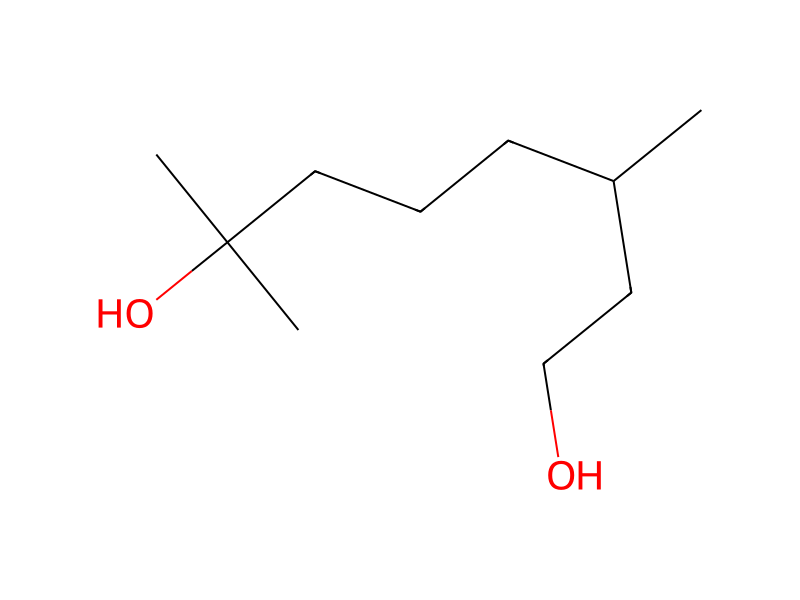
Grundinformationen
- Standard-SMILES
CC(CCO)CCCC(C)(C)O- InChIKey
FPCCDPXRNNVUOM-UHFFFAOYSA-N- Summenformel
- C10H22O2
- Durchschnittliche Molmasse
- 174,28 g/mol
- Monoisotopische Masse
- 174,16197994
Namen und Bezeichner
- Bevorzugter Name
- 3,7-Dimethyl-1,7-octanediol
- IUPAC
- 3,7-dimethyloctane-1,7-diol
- Lokaler Name
- 3,7-Dimethyloctan-1,7-diol
- Englischer Name
- Hydroxycitronellol
- Summenformel
- C10H22O2
- Molmasse
- 174.28
Namen und Synonyme
Hydroxycitronellol3,7-Dimethyloctane-1,7-diol107-74-41,7-Octanediol, 3,7-dimethyl-3,7-Dimethyl-1,7-octanediolCitronellol, hydroxy-FEMA No. 2586HydroxydihydrocitronellolDTXSID6044513R0B4U2I48WNSC-406140DTXCID4024513
Weitere Namen anzeigen
FEMA 2586HYDROXYOLhydroxy-citronelloHvdroxycitronellol3,7-dimethyloctane-3,7-dimethyl-7-octanediolMethoxyprene impurities 6Methoxyprotene impurity 6
RefChem:147158203-517-1Citronellol hydrate7-Hydroxy-3,7-dimethyloctan-1-ol1,2-Octandiol, 3,7-dimethyl-2,8-Octanediol, 2,6-dimethyl-MFCD00046005(+/-)-Hydroxycitronellol
Datenbank-Bezeichner
- CAS
107-74-4- PubChem CID
- 249494
- DTXSID
DTXSID6044513- ChEMBL
CHEMBL3187980- ChEBI
CHEBI:179046- UNII
- R0B4U2I48W
- EC Number
- 203-517-1
- Nikkaji
- J26.180G
Eigenschaften
Berechnete Struktureigenschaften
- XLogP
- 1,9
- Polarare Oberfläche (TPSA)
- 40,5 Ų
- H-Brücken-Donoren
- 2
- H-Brücken-Akzeptoren
- 2
- Frei drehbare Bindungen
- 6
- Schwere Atome
- 12
- Formalladung
- 0
- Komplexität
- 110
Experimentelle und physikochemische Eigenschaften
Density0.922-0.930
Solubility
slightly soluble in water; soluble in alcohol and oils
1 ml in 1 ml 60% alcohol (in ethanol)
Boiling Point263 °C; 156 °C (15 mm Hg)
Refractive Index1.455-1.460
Physical Description
Colorless liquid with a mild floral odor; [Fleurchem MSDS]
colourless very viscous liquid; mild sweet odour
Physikochemische Eigenschaften
- Schmelzpunkt
- 47.36 °C · 47.36°C (estimate)
- Siedepunkt
- 252.5 °C · 252.5°C
- Dichte
- 0.918 · 0.9180
- Dampfdruck
- 0.01 · 0.01-0.36Pa at 20-50℃
- Brechungsindex
- 1.4599 · 1.4599
- FEMA
- 2586 · 2586 | HYDROXYCITRONELLOL
- pka
- 15.14 · 15.14±0.10(Predicted)
- Aggregatzustand
- Liquid:viscous
- Geruch (Odor)
- 100 % · at 100.00 %. mild clean floral lily green peony
- Geruchsart
- floral
- JECFA Number
- 610 · 610
- Kosmetik-Inhaltsstoffe Funktionen
- PERFUMING
- LogP
- 1.59 at · 1.59 at 25℃ and pH3.8-4.8
- CAS Datenbank
- 107 · 107-74-4(CAS DataBase Reference)
- EPA chemische Informationen
- 1 · 1,7-Octanediol, 3,7-dimethyl- (107-74-4)
Sicherheit und Regulatorisches
GHS-Klassifizierung
GHS Classification
This chemical does not meet GHS hazard criteria for 91.1% (1520 of 1669) of all reports.
Not Classified;Reported as not meeting GHS hazard criteria by 1520 of 1669 companies (only 8.9% companies provided GHS information). For more detailed information, please visit ECHA C&L website.
Aggregated GHS information provided per 1669 reports by companies from 4 notifications to the ECHA C&L Inventory.;Reported as not meeting GHS hazard criteria per 1520 of 1669 reports by companies.;There are 2 notifications provided by 149 of 1669 reports by companies with hazard statement code(s).;Information may vary between notifications depending on impurities, additives, and other factors. The percentage value in parenthesis indicates the notified classification ratio from companies that provide hazard codes. Only hazard codes with percentage values above 10% are shown. For more detailed information, please visit ECHA C&L website.
Gefahrenhinweise
Regulatory Information
Chemical: 1,7-Octanediol, 3,7-dimethyl-
Status: Active Update: 23-05-2018 https://echa.europa.eu/registration-dossier/-/registered-dossier/23805
1,7-Octanediol, 3,7-dimethyl-: Does not have an individual approval but may be used as a component in a product covered by a group standard. It is not approved for use as a chemical in its own right.
Hazards Summary
A mild skin irritant; [RTECS] Fragrance ingredient with positive human patch test results (6% in 218 patients), but insufficient data to classify as established contact allergen in humans; [EC: SCCS] Safe when used as a flavoring agent in food; [JECFA] An irritant; [Fleurchem MSDS] See Citronellol.
Hazard Classes and CategoriesNot Classified
Regulatorische Informationen
Regulatory Information
Chemical: 1,7-Octanediol, 3,7-dimethyl-
Status: Active Update: 23-05-2018 https://echa.europa.eu/registration-dossier/-/registered-dossier/23805
1,7-Octanediol, 3,7-dimethyl-: Does not have an individual approval but may be used as a component in a product covered by a group standard. It is not approved for use as a chemical in its own right.
Sicherheitsdaten
- tsca
- TSCA listed
- Toxizität
- Both the acute oral LD50 value in rats and the acute dermal LD50 valuein rabbits exceeded 5 g/kg(Levenstein, 1973).
- safety_code
- 24/25
Chemie und Industrie
Pharmakologische Informationen
Cellular LocationsCytoplasm;Extracellular;Membrane
Verwendung und Herstellung
UsesUsed as a flavoring agent; [FDA]
Household ProductsInformation on 5 consumer products that contain Hydroxycitronellol in the following categories is provided:;• Auto Products;• Inside the Home;• Personal Care
Use Classification
Fragrance Ingredients
Flavouring Agent -> FLAVOURING_AGENT -> JECFA Functional Classes
Flavoring Agents -> JECFA Flavorings Index
Flavouring Agent -> FLAVOURING_AGENT -> JECFA Functional Classes
General Manufacturing Information1,7-Octanediol, 3,7-dimethyl-: ACTIVE
Anwendungen
BeschreibungHydroxyeitronellol has an odor reminiscent of rose and grape hyacinth. May be prepared by hydrogenation (under pressure in presence of Raney Ni) of 3,7-dimethyl-7-hydroxy-octan-l-al; also in good yields by catalytic hydrogenation (using Raney Ni) of 1.2-epoxy-3,7-dimethyl-octan-7-ol.
OccurrenceReported found in high bush blueberry, grapes, skim milk powder and white wine.
Darstellung
synthetischeBy hydrogenation (under pressure in presence of Raney Ni) of 3,7-dimethyl-7-hydroxy-octan-1-al; also in good yields by catalytic hydrogenation (using Raney Ni) of 1,2-epoxy-3,7-dimethyl-octan-7-ol.
Vor- und nachgelagerte Produkte
Vorgelagerte Rohstoffe
Anbieter44 Anbieter
Hebei Zhuanglai Chemical Trading Co Ltd+86-16264648883 · [email protected]
Shaanxi LonierHerb Bio Technology Co Ltd+86-86-+86-86-029-87551862 15002946897 · [email protected]
上海麦克林生化科技股份有限公司021-50706066 15221275939 · [email protected]
成都健腾生物技术有限公司028-85159085 · [email protected]
Syntechem Co.,Ltd[email protected]
上海迈瑞尔生化科技有限公司4006356688 18621169109 · [email protected]
梯希爱(上海)化工贸易有限公司021-61109150 · [email protected]
Aceschem Inc.+1-817863-6948 +1-(817)863-6948 · [email protected]
扬州瑞宏生物科技有限公司15380367604; 15380367604 · [email protected]
康迪斯化工(湖北)有限公司13125172151 · [email protected]
深圳摩科生化科技有限公司18627923403 · [email protected]
普善实业(陕西)有限公司029-81310890 18165209495 · [email protected]
康迪斯化工(湖北)有限公司13343438265 · [email protected]
成都卡麦尔医药科技有限公司028-67136579 15828051124 · [email protected]
HANGZHOU LEAP CHEM CO., LTD.+86-571-87711850 +86-15355479329 · [email protected]
sgtlifesciences pvt ltd+91-8790379245 · [email protected]
上海阿拉丁生化科技股份有限公司6206333 13167063860 · [email protected]
武汉华翔科洁生物技术有限公司027-86638848 18627828293 · [email protected]
武汉市承天精细化工有限公司18164098996 · [email protected]
湖北齐飞医药化工有限公司027-59322506 18071128681 · [email protected]
河北贞佳新材料有限公司0319-5925599 13315915972
BOC Sciences[email protected]
武汉柔博医药化工有限公司027-027-87827088 18986164924 · [email protected]
湖北东曹化学科技有限公司027-83238443 13343438265 · [email protected]
江苏艾康生物医药研发有限公司025-66113011 19370895928 · [email protected]
厦门盈融达化工有限公司+86-0592-6210733 · [email protected]
天津丹骏国际贸易有限公司15822601686 · [email protected]
湖北摩科化学有限公司18627753421; 18627756402 · [email protected]
湖北达豪化工有限公司027-027-59106191 13986034860 · [email protected]
陕西缔都医药化工有限公司029-029-029-81148696 18161915376 · [email protected]
XIAMEN AMITY INDUSTRY AND TRADE CO., LTD.+8618950047208 · [email protected]
上海凯为化学科技有限公司021-58461859 15821823057 · [email protected]
湖北星耀生物医药技术有限责任公司17871673970 · [email protected]
DAYANG CHEM (HANGZHOU) CO.,LTD+86-88938639 +86-17705817739 · [email protected]
陕西缔都医药化工有限公司+86-29-87569266 +86-17392581500 · [email protected]
天门恒昌化工有限公司027-59322316 15172518801 · [email protected]
Hefei TNJ Chemical Industry Co.,Ltd.+86-0551-65418671 +86-189 4982 3763 · [email protected]
杭州药睿易成生物医药有限公司18072846723 · [email protected]
深圳利斯康医药科技有限公司+86-0755-89396905 +86-18025329037 · [email protected]
合肥钼凯医药科技有限公司18001872185; 18001872185 · [email protected]
武汉克米克生物医药技术有限公司027-87747081 18186681184 · [email protected]
湖北省汉卿生物医药科技有限公司15827479330 · [email protected]
上海皓鸿生物医药科技有限公司400-8210725 4008210725 · [email protected]
湖北实顺生物科技有限公司027-59223025 15107168801 · [email protected]
Zugehörige Reaktionen
4


Verknüpfte Notizen
Wird geladen…