HuagongsheHuagongshe Chemie-Druckbericht · Nur für Forschungszwecke
Bis(4-nitrophenyl)hydrogenphosphat
BNPP · di-p-nitrophenylphosphate · Di-p-nitrophenyl phosphate · Di-4-nitrophenyl phosphate · BIS(P-NITROPHENYL)PHOSPHATE · BIS(4-NITROPHENYL) PHOSPHATE · p-nitro-phenohydrogenphosphate · DI-P-NITROPHENYLPHOSPHORIC ACID
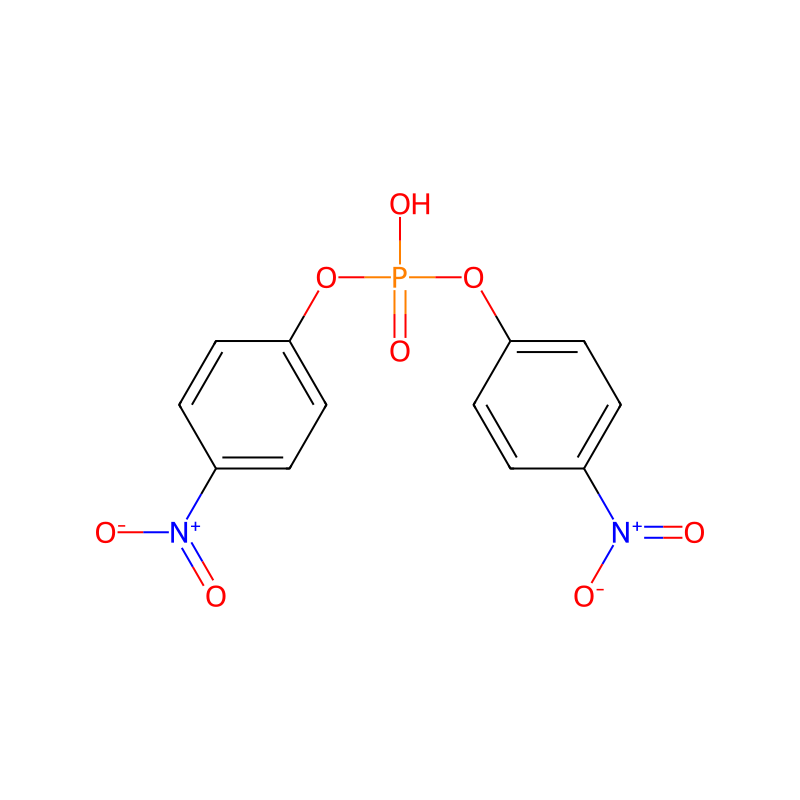
Identifikatoren & physikalische Daten
| CAS No. | 645-15-8 |
|---|---|
| Summenformel | C12H9N2O8P |
| Durchschnittliche Molmasse | 340,18 g/mol |
| Monoisotopische Masse | 340,00965188 g/mol |
| SMILES | O=[N+]([O-])c1ccc(OP(=O)(O)Oc2ccc([N+](=O)[O-])cc2)cc1 |
| InChIKey | MHSVUSZEHNVFKW-UHFFFAOYSA-N |
| PubChem CID | 255 |
| ChEMBL | CHEMBL1231178 |
| ChEBI | CHEBI:3122 |
| EC No. | 211-434-7 |
| DTXSID | DTXSID20870742 |
| Lokaler Name | Bis(4-nitrophenyl)hydrogenphosphat |
Chemische & physikalische Eigenschaften
| XLogP | 1 |
|---|---|
| Polarare Oberfläche (TPSA) | 147 |
| H-Brücken-Donoren | 1 |
| H-Brücken-Akzeptoren | 8 |
| Frei drehbare Bindungen | 4 |
| Schwere Atome | 23 |
| Formalladung | 0 |
| Komplexität | 434 |
| Schmelzpunkt | 172-175 °C(lit.) |
| Siedepunkt | 545.7±60.0 °C(Predicted) |
| Dichte | 1.614±0.06 g/cm3(Predicted) |
| Lagerbedingungen | Sealed in dry,Room Temperature |
| Löslichkeit | DMSO (Slightly), Isopropanol (Slightly), Methanolalmost transparency |
| pKa (Säurekonstante) | 1.04±0.50(Predicted) |
| Aggregatzustand | powder to crystal |
| Farbe | White to Almost white |
| InChI | InChI=1S/C12H9N2O8P/c15-13(16)9-1-5-11(6-2-9)21-23(19,20)22-12-7-3-10(4-8-12)14(17)18/h1-8H,(H,19,20) |
| InChIKey | MHSVUSZEHNVFKW-UHFFFAOYSA-N |
| SMILES | P(O)(OC1=CC=C([N+]([O-])=O)C=C1)(OC1=CC=C([N+]([O-])=O)C=C1)=O |
| CAS Datenbank | 645-15-8(CAS DataBase Reference) |
| NIST chemische Informationen | Phosphoric acid, bis(p-nitrophenyl) ester(645-15-8) |
| EPA chemische Informationen | Bis(p-nitrophenyl) phosphate (645-15-8) |
Sicherheit & Vorschriften
| GHS-Einstufung | DangerH300 (95.2%): Fatal if swallowed [Danger Acute toxicity, oral]P264, P270, P301+P316, P321, P330, P405, and P501 (click each P-code to see the statement)Aggregated GHS information provided per 42 reports by companies from 3 notifications to the ECHA C&L Inventory. |
|---|---|
| Hazard Classes and Categories | Acute Tox. 2 (95.2%) |
| Wassergefährdungsklasse (WGK) | 3 |
| TSCA-Inventar-Status | TSCA listed |
| UN-Transportnummer | UN 2811 6.1/PG 3 |
| Zollcode | 29199000 |
| RTECS-Nr. | TB8260000 |
| R-Sätze (R) | 25 |
| Gefahrensymbole | T |
| Sicherheitshinweise (S) | 45 |
| Gefahrenklasse | 6.1Acute Tox. 2 Oral |
| Lagerklasse | 6.1A - Combustible acute toxic Cat. 1 and 2very toxic hazardous materials |
Anwendungen & Verwendung
Verwenden
Bis(4-nitrophenyl) phosphate(BNPP) has been used as substrate to determine the enzyme activity of root phosphodiesterases of wetland plants. BNPP has been used to study the mechanism of cleavage of BNPP using oxamido-bridged dinuclear copper(II) complexes as catalysts.