Ammoniumchlorid
NH4CL · ammonium chloride solution · ammonia chloride · AMMONIUM STANDARD SOLUTION · Saturated Ammonium Chloride Solution · Amchlor · Ammoniumchlorid · Chlorid amonny
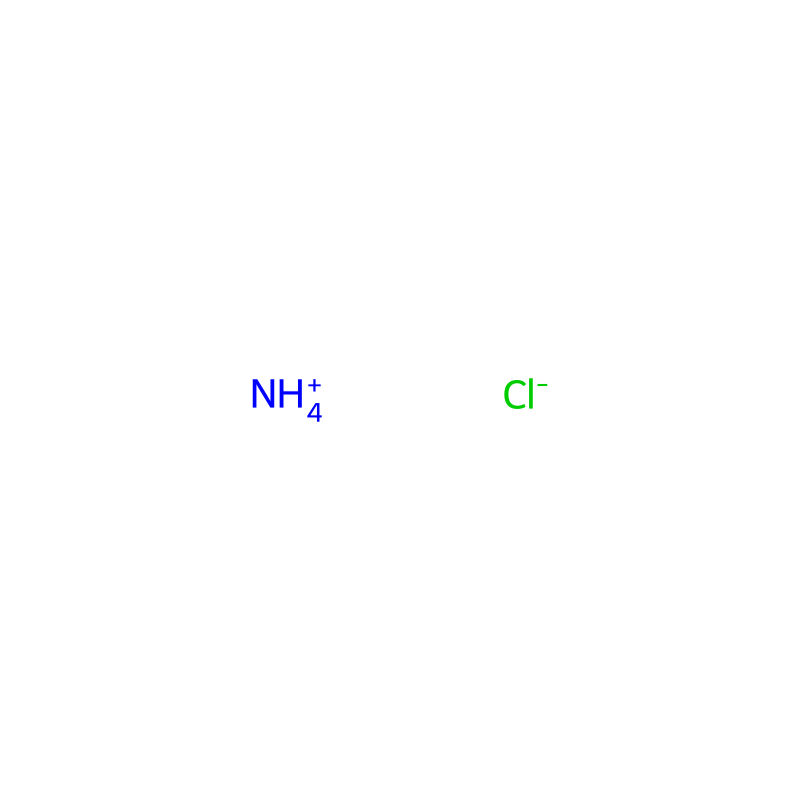
Identifikatoren & physikalische Daten
| CAS No. | 12125-02-9 |
|---|---|
| Summenformel | ClH4N |
| Durchschnittliche Molmasse | 53,49 g/mol |
| Monoisotopische Masse | 53,0032268 g/mol |
| SMILES | [Cl-].[NH4+] |
| InChIKey | NLXLAEXVIDQMFP-UHFFFAOYSA-N |
| PubChem CID | 25517 |
| ChEMBL | CHEMBL1200939 |
| ChEBI | CHEBI:31206 |
| EC No. | 235-186-4 |
| Lokaler Name | Ammoniumchlorid |
Chemische & physikalische Eigenschaften
| Polarare Oberfläche (TPSA) | 1 |
|---|---|
| H-Brücken-Donoren | 1 |
| H-Brücken-Akzeptoren | 1 |
| Frei drehbare Bindungen | 0 |
| Schwere Atome | 2 |
| Formalladung | 0 |
| Komplexität | 0 |
| pH | pH of aqueous solution (25 °C): 1% 5.53% 5.110% 5.04.7 (200g/l, H2O, 25℃)(External MSDS) |
| Geruch | Odorless |
| Geschmack | Cooling, saline |
| Dichte | 1.53 at 68 °F (USCG, 1999) - Denser than waterwill sink1.519 g/cu cm1.5 g/cm³1.53 @25 °C1.52 |
| Color/Form | Colorless crystals or crystalline masses, or white, granular powderColorless cubic crystalsA white, fine or coarse, crystalline powderFinely divided, ... white particulate dispersed in air. /Ammonium chloride fume/ |
| Löslichkeit | 37 % (NIOSH, 2024)Strongly endothermicsublimes without meltingsomewhat hygroscopictendency to cakehydrochloric acid and sodium chloride decrease solubility in waterIn water, 39.5 g/100 g water at 25 °CAlmost insoluble in acetone, ether, ethyl acetatesoluble in alcohol28.3% (wt/wt) in water at 25 °CSoluble in liquid ammoniaH2O: 1 M at 20 °C, clear, colorless |
| Corrosivity | At fire temp corrodes metals |
| Siedepunkt | Sublimes (NIOSH, 2024)338 °C (sublimes)520 °C100 °C750 mm Hg |
| Decomposition | Melting point: 338 °C (sublimes) |
| Schmelzpunkt | 662 °F (Sublimes) (NIOSH, 2024)350520.1 (triple pointdecomposes)662 °F (sublimes)338 °C340 °C (subl.) (lit.) |
| Dampfdruck | 1 mmHg at 321 °F (NIOSH, 2024)1 Pa at 91 °C (solid)10 Pa at 121 °C (solid)100 Pa at 159 °C (solid)1kPa at 204.7 °C (solid)10 kPa at 263.1 °C (solid)100 kPa at 339.5 °C (solid)Vapor pressure, kPa at 160 °C: 0.13(321 °F): 1 mmHg1 mm Hg ( 160.4 °C) |
| Brechungsindex | Index of refraction: 1.642 |
| Dampfdichte | 1.9 (vs air) |
| FEMA | 4494 | AMMONIA (ALSO INCLUDES AMMONIUM CHLORIDE) |
| Lagerbedingungen | Store at +5°C to +30°C. |
| Aggregatzustand | Solid |
| pKa (Säurekonstante) | 9.25[at 20 ℃] |
| Wichte | 1.53 |
| Farbe | White |
| Geruch | odorless |
| Geruchsart | ammoniacal |
| Spezifische Wärmekapazität | Cp(crystal): 1.57 J/(g·K), at 25℃ |
| Merck | 14,509 |
| BRN | 4371014 |
| Dielektrizitätskonstante | 7(0.0℃) |
| Stabilität | Stable. Incompatible with strong acids, strong bases. |
| Kosmetik-Inhaltsstoffe Funktionen | BUFFERINGVISCOSITY CONTROLLINGFRAGRANCE |
| InChI | 1S/ClH.H3N/h1H1H3 |
| InChIKey | NLXLAEXVIDQMFP-UHFFFAOYSA-N |
| SMILES | N.Cl |
| CAS Datenbank | 12125-02-9(CAS DataBase Reference) |
| NIST chemische Informationen | Ammonium chloride(12125-02-9) |
| EPA chemische Informationen | Ammonium chloride (12125-02-9) |
Sicherheit & Vorschriften
| GHS-Einstufung | WarningH302: Harmful if swallowed [Warning Acute toxicity, oral]H319: Causes serious eye irritation [Warning Serious eye damage/eye irritation]P264, P264+P265, P270, P280, P301+P317, P305+P351+P338, P330, P337+P317, and P501 (click each P-code to see the statement)This chemical does not meet GHS hazard criteria for < 0.1% (2 of 3391) of reports. |
|---|---|
| Regulatorische Informationen | Chemical: Ammonium chloride ((NH4)Cl)Regulation (EC) No 1831/2003 (amended)Ammonium chloride ((NH4)Cl) is listed on the EPA's Chemical Data Reporting (CDR) system. Manufacturers and importers of Ammonium chloride ((NH4)Cl) are required to report information about their production and use of this chemical to the EPA under the Toxic Substances Control Act (TSCA). (40 eCFR Part 711)Status: Active Update: 03-11-2022 https://echa.europa.eu/registration-dossier/-/registered-dossier/15492Ammonium chloride: Does not have an individual approval but may be used under an appropriate group standardThe New Jersey Worker and Community Right to Know Act requires public and private employers to provide information about hazardous substances at their workplaces. (N.J.S.A. 34:5A-1 et. seq.) |
| Weitere Sicherheitsinformationen | IMAP assessments - Ammonium chloride ((NH4)Cl): Environment tier I assessmentIMAP assessments - Ammonium chloride ((NH4)Cl): Human health tier II assessment |
| Brandgefahren | Special Hazards of Combustion Products: Toxic and irritating ammonia and hydrogen chloride gases may form in fire.Behavior in Fire: May volatilize and condense on cool surfaces. (USCG, 1999)Not combustible. Gives off irritating or toxic fumes (or gases) in a fire. |
| Gesundheitsgefahren | Inhalation of fumes irritates respiratory passages. Ingestion irritates mouth and stomach. Fumes are irritating to eyes. Contact with skin may cause irritation. (USCG, 1999) |
| Gefahrenübersicht | The substance decomposes on heating or on burning, producing toxic and irritating fumes (nitrogen oxides, ammonia and hydrogen chloride). A skin, eye, and respiratory tract irritant[ICSC] |
Anwendungen & Verwendung
Occurrence
Ammonium chloride occurs in nature in crevices near volcanoes. Also, it is found in smoke when burning dry camel or donkey dung as fuel. Important applications of this compound include the manufacture of dry cells for batteries; as a metal cleaner in soldering; as a flux in tin coating and galvanizing; in fertilizers; in pharmaceutical applications as a diuretic, or diaphoretic expectorant; and as an analytical standard in ammonia analysis. Also, it is used in freezing mixtures; washing powders; lustering cotton; in safety explosives and in dyeing and tanning.
Herstellung & Synthese
synthetische
Ammonium chloride is prepared commercially by reacting ammonia with hydrochloric acid. It may be prepared by fractional crystallization from a solution containing ammonium sulphate and sodium chloride or ammonium carbonate and calcium chloride. Because of it sease of preparation it can be manufacture dindustrially along side any plant that uses or produces ammonia. Ammonium chloride is used in dry cells, metal finishing, and in the preparation of cotton for dyeing and printing.