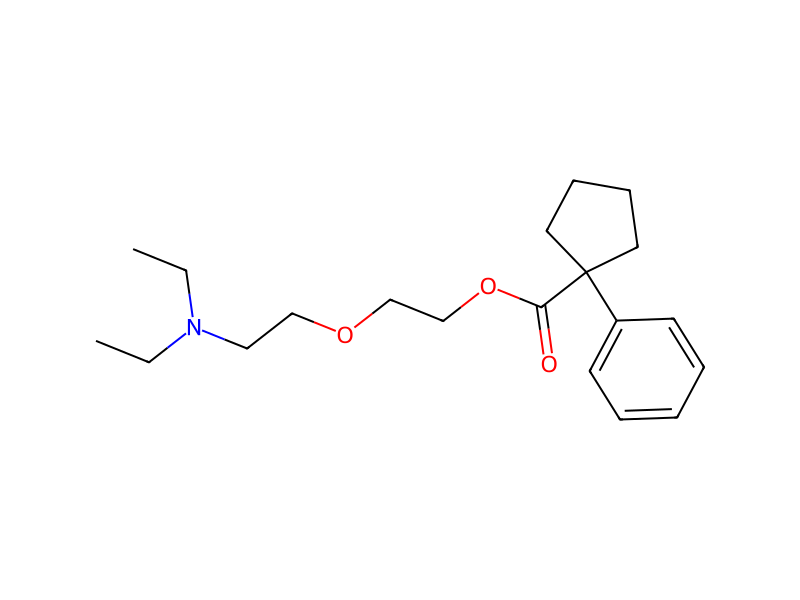
Grundinformationen
- Standard-SMILES
CCN(CC)CCOCCOC(=O)C1(c2ccccc2)CCCC1- InChIKey
CFJMRBQWBDQYMK-UHFFFAOYSA-N- Summenformel
- C20H31NO3
- Durchschnittliche Molmasse
- 333,5 g/mol
- Monoisotopische Masse
- 333,23039385
Überblick
1-phenyl-1-cyclopentanecarboxylic acid 2-[2-(diethylamino)ethoxy]ethyl ester is a member of benzenes.
Namen und Bezeichner
- Bevorzugter Name
- Carbetapentane
- IUPAC
- 2-[2-(diethylamino)ethoxy]ethyl 1-phenylcyclopentane-1-carboxylate
- Lokaler Name
- Pentoxyverin
- Englischer Name
- Pentoxyverine
- Summenformel
- C20H31NO3
- Molmasse
- 333.46
Namen und Synonyme
Weitere Namen anzeigen
Datenbank-Bezeichner
- CAS
77-23-6- PubChem CID
- 2562
- DTXSID
DTXSID9022734- ChEMBL
CHEMBL73234- ChEBI
CHEBI:94484- UNII
- 32C726X12W
- EC Number
- 201-014-1
- Nikkaji
- J4.198J
Eigenschaften
Berechnete Struktureigenschaften
- XLogP
- 3,8
- Polarare Oberfläche (TPSA)
- 38,8 Ų
- H-Brücken-Donoren
- 0
- H-Brücken-Akzeptoren
- 4
- Frei drehbare Bindungen
- 11
- Schwere Atome
- 24
- Formalladung
- 0
- Komplexität
- 356
Experimentelle und physikochemische Eigenschaften
Drugs
Pharmaceuticals
Pharmaceuticals -> Listed in ZINC15
Physikochemische Eigenschaften
- Siedepunkt
- 165 · 165-170 °C (1.33Pa)
- Dichte
- 1.048 · 1.048±0.06 g/cm3(Predicted)
- Brechungsindex
- 1.499 · 1.4990-1.5010
- storage temp.
- Refrigerator
- Löslichkeit
- Dichloromethane (Slightly), Methanol (Slightly)
- pka
- 9.69 · 9.69±0.25(Predicted)
- Aggregatzustand
- Oil
- Farbe
- Clear Very Dark Red to Brown
- CAS Datenbank
- 77 · 77-23-6(CAS DataBase Reference)
- NIST chemische Informationen
- 1 · 1-Cyclopentanecarboxylate, 2-(diethylaminoethoxy)ethyl-1-phenyl-(77-23-6)
Sicherheit und Regulatorisches
Gefahrenhinweise
Toxikologische Informationen
Sicherheitsdaten
- Toxizität
- LD50 oral in rat: 150mg/kg
- Giftige Stoffe Daten
- 77-23-6(Hazardous Substances Data)
Chemie und Industrie
Pharmakologische Informationen
ATC Code
R - Respiratory system
QR - Respiratory system
Pharmacodynamics
Pentoxyverine induces an antitussive action. In animal studies, intraperitoneal administration of pentoxyverine inhibited citric-acid-induced cough in guinea-pigs _in vivo_. Some mice and rat studies suggest that pentoxyverine may also exert anticonvulsant activities without inducing a protective effect from NMDA-induced lethality. Protective effects against maximal electroshock-induced seizures in a dose-related fashion was also observed following either intraperitoneal or oral administration. In hERG-transfected cells, pentoxyverine inhibited the outward current of the hERG ion channel with half-maximal inhibition concentrations (IC50) of 3.0 µM. In rats receiving intrathecal administration, pentoxyverine exhibited dose-dependent spinal blockade with a more sensory-selective action over motor blockade. It induced a spinal blockade with a more sensory/nociceptive-selective action over motor blockade compared to lidocaine.
Mechanism of Action
While the mechanism of antitussive action of pentoxyverine is not fully understood, it is thought to be mediated via sigma-1 receptors expressed in the central nervous system. Pentoxyverine acts as an agonist at sigma receptors with the Ki of 75±28 nM, as demonstrated in a competitive binding assay. The function of sigma receptors on cough suppressant activities is unclear, however these receptors are highly expressed in the nucleus tractus solitarius (NTS) of the brainstem where the afferent fibres first synapse. NTS is located very close to the cough centre in the brainstem thus may function as a ‘gate' for the cough reflex and allow sigma-1 receptor agonists to modulate afferent activity prior to reaching the cough center. It is suggested that highly lipophilic sigma-1 agonists may penetrate the CNS following systemic administration. When administered as aerosols, sigma-1 receptor agonists may temporarily act in the periphery to modulate cough by acting activate sigma receptors expressed in the lungs. However there is limited evidence of peripheral localization of the sigma agonists following aerosol administration and the ruling out of systemic exposure. The local anesthesia action of pentoxyverine may occur through inhibition of voltage-gated Na(+) currents.
NUMBER OF DRUGS ARE KNOWN TO REDUCE COUGH AS RESULT OF THEIR CENTRAL ACTIONS, ALTHOUGH EXACT MECHANISMS ARE STILL NOT ENTIRELY CLEAR. /NONOPIOID ANTITUSSIVES/
Absorption, Distribution and Excretion
In humans, maximum plasma concentrations are achieved 1.2 hours after oral dosing.
No pharmacokinetic data available.
No pharmacokinetic data available.
No pharmacokinetic data available.
Verwendung und Herstellung
Uses
MEDICATION
Use (kg; approx.) in Germany (2009): >1000
Anwendungen
VerwendenCarbetapentane is an antitussive anticonvulsant sigma site agonist.
Vor- und nachgelagerte Produkte
Vorgelagerte Rohstoffe
Anbieter50 Anbieter
Zugehörige Reaktionen
Keine Reaktionsaufzeichnungen unter den aktuellen Filterkriterien.
Verknüpfte Notizen
Wird geladen…