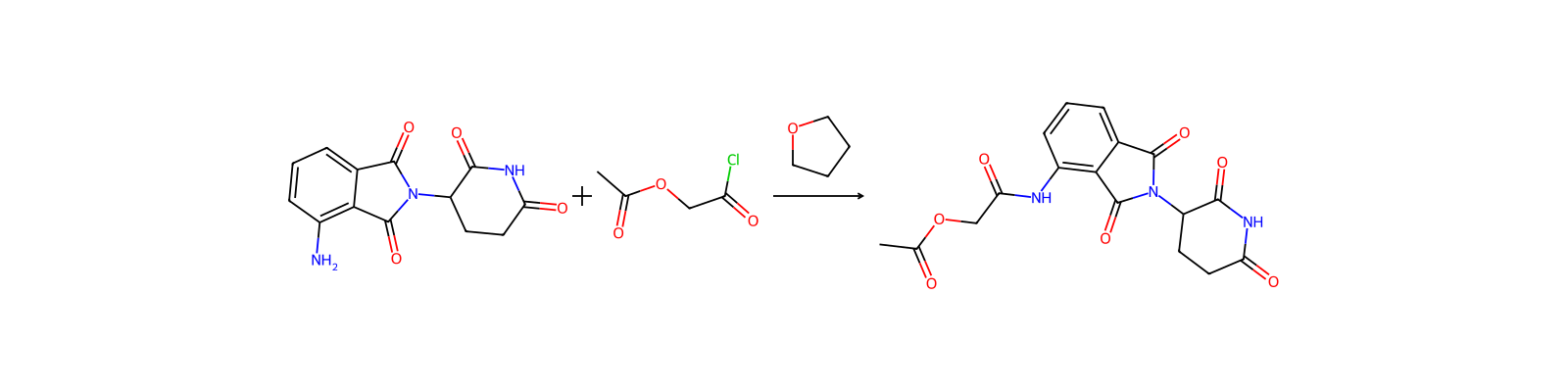
HRID 8800als Edukt
Acetoxyacetyl chloride

13831-31-7CC(=O)OCC(=O)ClHZDNNJABYXNPPV-UHFFFAOYSA-N13831-31-7DTXSID20160579Sicherheitsangaben dienen nur zur Orientierung und ersetzen weder das Sicherheitsdatenblatt (SDB) des Lieferanten noch geltende Vorschriften oder eine fachliche Bewertung.
Danger
H314 (100%): Causes severe skin burns and eye damage [Danger Skin corrosion/irritation]
P260, P261, P264, P271, P280, P301+P330+P331, P302+P361+P354, P304+P340, P305+P354+P338, P316, P319, P321, P363, P403+P233, P405, and P501 (click each P-code to see the statement)
Aggregated GHS information provided per 53 reports by companies from 11 notifications to the ECHA C&L Inventory. Each notification may be associated with multiple companies.
BeschreibungAcetoxyacetyl chloride acylates 2-aminofluorene in benzene/pyridine to give N-(acetoxyacetyl)-2-aminofluorene, and reacts with N-hydroxy-2-aminofluorene in ether/water in the presence of NaHCO3 at 0 °C to give N-hydroxy-N-(acetoxyacetyl)-2-aminofluorene[1]. It also acylates the amine released by zinc/acetic acid cleavage of the Troc groups in a tetrasaccharide intermediate, giving the acetoxyacetamide in 77% yield over two steps[2].
VerwendenAcetoxyacetyl chloride was used in synthesis of stabilized axial and equatorial conformers of spiro-β-lactamsand glycolylhydroxamic acids.