
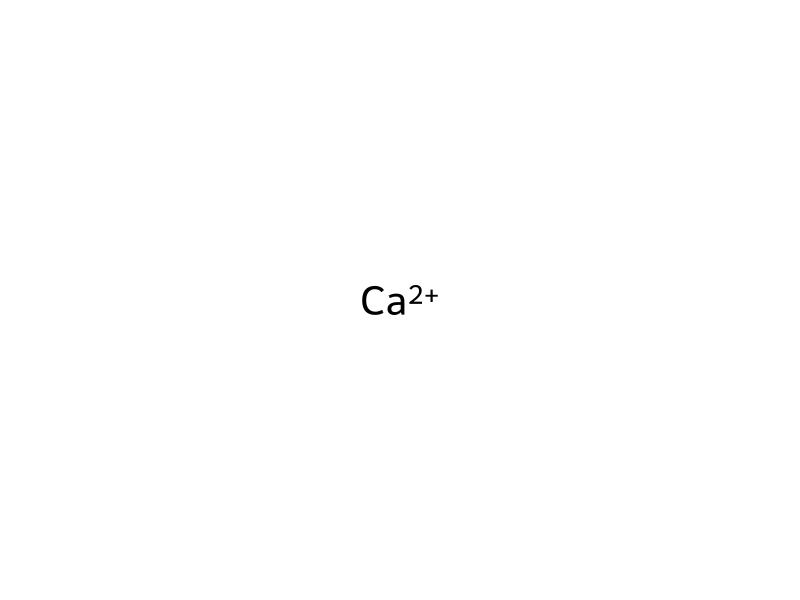
Grundinformationen
- Standard-SMILES
[Ca+2]- InChIKey
BHPQYMZQTOCNFJ-UHFFFAOYSA-N- Summenformel
- Ca+2
- Durchschnittliche Molmasse
- 40,08 g/mol
- Monoisotopische Masse
- 39,96149382
Überblick
Calcium(2+) is a monoatomic dication, a calcium cation and a divalent metal cation. It has a role as a cofactor and a human metabolite.
Namen und Bezeichner
- Bevorzugter Name
- Calcium Cation
- IUPAC
- calcium(2+)
- Englischer Name
- CALCIUM ION CHROMATOGRAPHY STANDARD
- Summenformel
- Ca+2
- Molmasse
- 40.08
Namen und Synonyme
calcium ionCalcium(2+)Calcium cation14127-61-8Calcium(2+) ionCalcium ionsCalcium(2+)ionsCa2+Calcium (2+)Ca++Calcium (II) ionCalcium, ion (Ca2+)
Weitere Namen anzeigen
CALCIUM ION STANDARDCalcium standard for ICCalcium standard for ICPCALCIUM ION CHROMATOGRAPHY STANDARD
CaIIUNII-2M83C4R6ZB2M83C4R6ZBCALCIUM ION(2+)CALCIUM, ION(CA2+)DTXSID7037638Ca(2+)CHEBI:29108
Datenbank-Bezeichner
- CAS
14127-61-8、17787-72-3、7440-70-2- PubChem CID
- 271
- DTXSID
DTXSID7037638- ChEBI
CHEBI:29108- UNII
- 2M83C4R6ZB
- Nikkaji
- J3.736B、J643.972A
Eigenschaften
Berechnete Struktureigenschaften
- Polarare Oberfläche (TPSA)
- 0 Ų
- H-Brücken-Donoren
- 0
- H-Brücken-Akzeptoren
- 0
- Frei drehbare Bindungen
- 0
- Schwere Atome
- 1
- Formalladung
- 2
- Komplexität
- 0
Experimentelle und physikochemische Eigenschaften
Melting Point850 °C
Physical DescriptionSolid
Physikochemische Eigenschaften
- Dichte
- 1.04 g/mL · 1.04 g/mL at 20 °C
- Aggregatzustand
- Liquid
- Merck
- 13 · 13,1687
- Major Application
- environmentalfood and beverages
Sicherheit und Regulatorisches
Toxikologische Informationen
Toxicity Summary
Calcium plays a vital role in the anatomy, physiology and biochemistry of organisms and of the cell, particularly in signal transduction pathways. More than 500 human proteins are known to bind or transport calcium. The skeleton acts as a major mineral storage site for the element and releases Ca2+ ions into the bloodstream under controlled conditions. Circulating calcium is either in the free, ionized form or bound to blood proteins such as serum albumin. Parathyroid hormone (secreted from the parathyroid gland) regulates the resorption of Ca2+ from bone. Calcitonin stimulates incorporation of calcium in bone, although this process is largely independent of calcitonin. Although calcium flow to and from the bone is neutral, about 5 mmol is turned over a day. Bone serves as an important storage point for calcium, as it contains 99% of the total body calcium. Low calcium intake may also be a risk factor in the development of osteoporosis. The best-absorbed form of calcium from a pill is a calcium salt like carbonate or phosphate. Calcium gluconate and calcium lactate are absorbed well by pregnant women. Seniors absorb calcium lactate, gluconate and citrate better unless they take their calcium supplement with a full breakfast. The currently recommended calcium intake is 1,500 milligrams per day for women not taking estrogen and 800 milligrams per day for women on estrogen. There is close to 300 milligrams of calcium in one cup of fluid milk. Calcium carbonate is currently the best and least expensive form of calcium supplement available.
Carcinogen ClassificationNo indication of carcinogenicity to humans (not listed by IARC).
Sicherheitsdaten
- wgk
- 1
- ridadr
- UN 3264 8/PG 3
- risk_code
- 36/38-36/37/38-34
- hazard_code
- Xi,C
- safety_code
- 26-36-24/25-36/37-45-36/37/39
- hazard_class
- 8
- packing_group
- III
- Speicherklasse
- 12 - Non Combustible Liquids
Chemie und Industrie
Pharmakologische Informationen
Metabolism/MetabolitesRoute of Elimination: The kidney excretes 250 mmol a day in urine, and resorbs 245 mmol, leading to a net loss in the urine of 5 mmol/d.
FDA Pharmacological Classification
2M83C4R6ZB
CALCIUM CATION
Established Pharmacologic Class [EPC] - Blood Coagulation Factor
Physiologic Effects [PE] - Increased Coagulation Factor Activity
Chemical Structure [CS] - Calcium
Chemical Structure [CS] - Cations, Divalent
Cellular LocationsExtracellular
Metabolite Pathways17-Beta Hydroxysteroid Dehydrogenase III Deficiency
Verwendung und Herstellung
UsesCalcium plays a vital role in the anatomy, physiology and biochemistry of organisms and of the cell, particularly in signal transduction pathways. It is vital in cell signaling, muscular contractions, bone health, and signalling cascades.
Anbieter4 Anbieter
山东晟腾化工有限公司13688633386 15866781319 · [email protected]
济南巨鑫邦仕新材料有限公司15154159039 15154159039 · [email protected]
同蓝新能源科技发展(山东)集团有限公司15154159039 15154159039 · [email protected]
DAYANG CHEM (HANGZHOU) CO.,LTD+86-88938639 +86-17705817739 · [email protected]
Zugehörige Reaktionen
574







Verknüpfte Notizen
Wird geladen…