
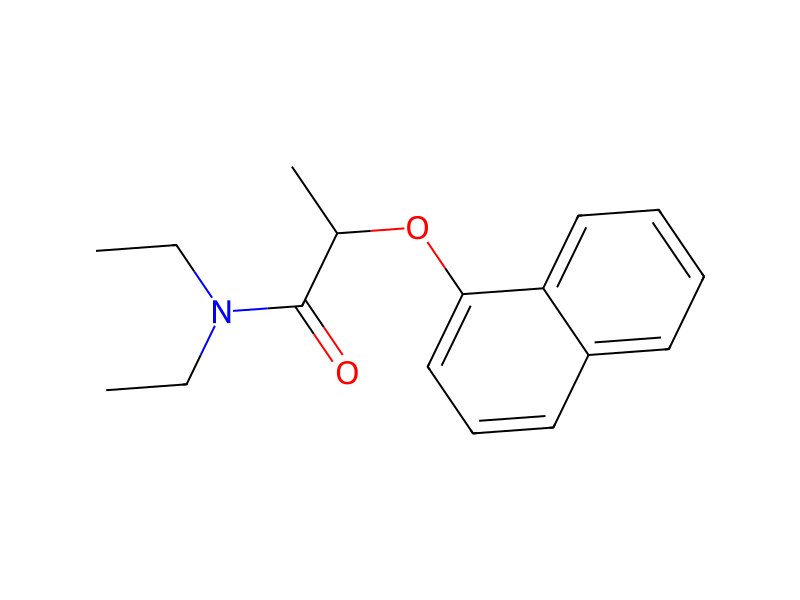
Grundinformationen
- Standard-SMILES
CCN(CC)C(=O)C(C)Oc1cccc2ccccc12- InChIKey
WXZVAROIGSFCFJ-UHFFFAOYSA-N- Summenformel
- C17H21NO2
- Durchschnittliche Molmasse
- 271,35 g/mol
- Monoisotopische Masse
- 271,15722891
Überblick
N,N-diethyl-2-(naphthalen-1-yloxy)propanamide is a monocarboxylic acid amide that is propanamide substituted by two ethyl groups at the nitrogen atom and a naphthalen-1-yloxy group at position 2. It is a member of naphthalenes, a monocarboxylic acid amide and an aromatic ether.
Namen und Bezeichner
- Bevorzugter Name
- Napropamide
- IUPAC
- N,N-diethyl-2-naphthalen-1-yloxypropanamide
- Lokaler Name
- Napropamid
- Englischer Name
- Napropamide
- Summenformel
- C17H21NO2
- Molmasse
- 271.35
Namen und Synonyme
Napropamide15299-99-7NapropamidDevrinolRacemic devrinolWaylayN,N-Diethyl-2-(1-naphthyloxy)propionamideDTXSID5024211Propionamide, N,N-diethyl-2-(1-naphthyloxy)-N,N-Diethyl-2-(1-naphthalenyloxy)propionamide2-(1-Naphthoxy)-N,N-diethylpropionamidePropanamide, N,N-diethyl-2-(1-naphthalenyloxy)-
Weitere Namen anzeigen
NAPROAMIDEr-7475WAYLAY(R)NapromideDevrinol T
2-(alpha-Naphthoxy)-N,N-diethylpropionamideR 7465R-7465N,N-DIETHYL-2-(1-NAPHTHALENYLOXY)PROPANAMIDEB56M9401K6DTXCID504211RefChem:832052CHEBI:82025
Datenbank-Bezeichner
- CAS
15299-99-7- PubChem CID
- 27189
- DTXSID
DTXSID5024211- ChEMBL
CHEMBL1877460- ChEBI
CHEBI:83771- UNII
- B56M9401K6
- EC Number
- 239-333-3
- Nikkaji
- J1.863E
Eigenschaften
Berechnete Struktureigenschaften
- XLogP
- 3,4
- Polarare Oberfläche (TPSA)
- 29,5 Ų
- H-Brücken-Donoren
- 0
- H-Brücken-Akzeptoren
- 2
- Frei drehbare Bindungen
- 5
- Schwere Atome
- 20
- Formalladung
- 0
- Komplexität
- 314
Experimentelle und physikochemische Eigenschaften
Pesticides
Pesticide -> EPA IRIS
Herbicides
Active substance -> EU Pesticides database: Approved
Pesticides -> Herbicides, Other
Herbicides
Environmental transformation -> Pesticides (parent, predecessor)
LogP
log Kow= 3.36
3.3
Color/Form
Colorless crystals; (tech., brown solid)
Brown solid
Light brown solid from n-pentane.
White crystals when pure
Solubility
/Solubility/ in acetone, ethanol >1000, xylene 505, kerosene 62, hexane 15 (all in g/l, 20 °C); miscible with acetone, ethanol, methyl isobutyl ketone.
Acetone: >100; ethanol: >100; n-hexane: 1.5; 4-methylpentan-2- one: soluble; kerossene: 6.2; xylene: 50.5 g/100 ml @ 20 °C
In water, 73 mg/l @ 20 °C
Endocrine DisruptorsPotential endocrine disrupting compound
Melting Point
75 °C
Melting point: 74.8-75.5 °C when pure (technical is 68-70 °C)
Vapor Density5.8X10-5 mg/l @ 25 °C
Vapor Pressure
0.00000017 [mmHg]
1.72X10⁻⁷ mm Hg @ 25 °C
Physical DescriptionLight brown solid; [Merck Index] Colorless, white, or brown solid; [HSDB]
Collision Cross Section172.0 Ų [M+Na]+ [CCS Type: DT; Buffer gas: N2; Ionization: ESI+; Dataset: TOXCAST; Source Identifier: DTXSID5024211]
Other Experimental PropertiesNo decomposition occurs over 16 h at 100 °C. Decomposed by sunlight. Stable to hydrolysis between pH 4 and 10 at 40 °C.
Physikochemische Eigenschaften
- Schmelzpunkt
- 73 · 73-78 °C (lit.)
- Siedepunkt
- 414.44 °C · 414.44°C (rough estimate)
- Dichte
- 1.0288 · 1.0288 (rough estimate)
- Brechungsindex
- 1.5675 · 1.5675 (estimate)
- storage temp.
- Sealed in dry,Room Temperature
- Löslichkeit
- Chloroform (Slightly), Methanol (Sparingly)
- pka
- -0.82 · -0.82±0.70(Predicted)
- Aggregatzustand
- Solid
- Farbe
- Brown
- Wasserlöslichkeit
- 73 mg/L · 73mg/L(20 ºC)
- Merck
- 13 · 13,6442
- BRN
- 6809160 · 6809160
- Henry's Law Constant
- 1.2 · 1.2×104 mol/(m3Pa) at 25℃, HSDB (2015)
- InChI
- 1S/C17H21NO2/c1-4-18(5-2)17(19)13(3)20-16-12-8-10-14-9-6-7-11-15(14)16/h6-13H,4-5H2,1-3H3
- InChIKey
- WXZVAROIGSFCFJ-UHFFFAOYSA-N
- SMILES
- CCN(CC)C(=O)C(C)Oc1cccc2ccccc12
- LogP
- 3.36 · 3.360
- CAS Datenbank
- 15299 · 15299-99-7(CAS DataBase Reference)
- NIST chemische Informationen
- Napropamide(15299-99-7)
- EPA chemische Informationen
- Napropamide (15299-99-7)
Sicherheit und Regulatorisches
GHS-Klassifizierung
GHS Classification
This chemical does not meet GHS hazard criteria for 9.5% (4 of 42) of reports.
Warning
H319 (83.3%): Causes serious eye irritation [Warning Serious eye damage/eye irritation]
P264+P265, P273, P280, P305+P351+P338, P337+P317, P391, and P501 (click each P-code to see the statement)
Aggregated GHS information provided per 42 reports by companies from 8 notifications to the ECHA C&L Inventory. Each notification may be associated with multiple companies.
Gefahrenhinweise
Regulatory Information
Commission Regulation (EC) No 1490/2002
Napropamide is listed in the dataset of EPA Human Health Benchmarks for Pesticides under the Safe Drinking Water Act (40 eCFR 141)
2010/83/EU, Reg. (EU) 2018/670, Reg. (EU) 2023/2592, Reg. (EU) No 540/2011
Propanamide, N,N-diethyl-2-(1-naphthalenyloxy)-: Does not have an individual approval but may be used as a component in a product covered by a group standard. It is not approved for use as a chemical in its own right.
Other Safety InformationIMAP assessments - Propanamide, N,N-diethyl-2-(1-naphthalenyloxy)-: Environment tier I assessment
Hazards SummaryMay cause irritation; [MSDSonline]
FIFRA Requirements
As the federal pesticide law FIFRA directs, EPA is conducting a comprehensive review of older pesticides to consider their health and environmental effects and make decisions about their future use. Under this pesticide reregistration program, EPA examines health and safety data for pesticide active ingredients initially registered before November 1, 1984, and determines whether they are eligible for reregistration. In addition, all pesticides must meet the new safety standard of the Food Quality Protection Act of 1996. Pesticides for which EPA had not issued Registration Standards prior to the effective date of FIFRA '88 were divided into three lists based upon their potential for human exposure and other factors, with List B containing pesticides of greater concern and List D pesticides of less concern. Napropamide is found on List B. Case No: 2450; Pesticide type: herbicide; Case Status: PreRED - OPP is reviewing data from the pesticide's producers regarding its human health and/or environmental effects, or OPP is determining the pesticide's eligibility for reregistration and developing the RED document.; Active ingredient (AI): n,n-diethyl-2-(1-naphthalenyloxy)propionamide; Data Call-in (DCI) Date(s): 2/13/1991, 2/28/1994, and 10/13/1995; AI Status: Supported - The producers of the pesticide have made commitments to conduct the studies and pay the fees required for reregistration, and are meeting those commitments in a timely manner.
Tolerances are established for negligible residues (N) of the herbicide N,N-Diethyl-2-(1-napthalenyloxy)propionamide in or on the following raw agricultural commodities: almond, hulls; artichokes; asparagus; avocados; basil; brassica (cole) leafy vegetables; coffee beans; cucurbits vegetables; figs; fruits, citrus; fruits, pome; fruits, small; fruits, stone; kiwifruit; marjoram; mint; nuts; olives; persimmons; pistachio nuts; rhubarb; rosemary; savory, summer; savory, winter; sweet potato, and vegetables, fruiting.
Tolerances with regional registration are established for residues of the herbicide N,N-Diethyl-2-(1-napthalenyloxy)propionamide in or on the following raw agricultural commodities: pomegranates.
Hazard Classes and CategoriesEye Irrit. 2 (83.3%)
State Drinking Water Guidelines
(FL) FLORIDA 700 ug/l
(ME) MAINE 840 ug/L
Sicherheit und Schutzausrüstung
Disposal Methods
SRP: At the time of review, criteria for land treatment or burial (sanitary landfill) disposal practices are subject to significant revision. Prior to implementing land disposal of waste residue (including waste sludge), consult with environmental regulatory agencies for guidance on acceptable disposal practices.
Allowable Tolerances
Tolerances are established for negligible residues (N) of the herbicide N,N-Diethyl-2-(1-napthalenyloxy)propionamide in or on the following raw agricultural commodities: almond, hulls, 0.1(N) ppm; artichokes, 0.1 ppm; asparagus, 0.1 ppm; avocados, 0.1 ppm; basil, 0.1 ppm; brassica (cole) leafy vegetables, 0.1 ppm; coffee beans, 0.1(N) ppm; cucurbits vegetables, 0.1 ppm; figs, 0.1(N) ppm; fruits, citrus, 0.1(N) ppm; fruits, pome, 0.1(N) ppm; fruits, small, 0.1(N) ppm; fruits, stone, 0.1(N) ppm; kiwifruit, 0.1 ppm; marjoram, 0.1 ppm; mint, 0.1 ppm; nuts, 0.1(N) ppm; olives, 0.1 ppm; persimmons, 0.1 ppm; pistachio nuts, 0.1 ppm; rhubarb, 0.1 ppm; rosemary, 0.1 ppm; savory, summer, 0.1 ppm; savory, winter, 0.1 ppm; sweet potato, 0.1 ppm and vegetables, fruiting, 0.1(N) ppm.
Tolerances with regional registration are established for residues of the herbicide N,N-Diethyl-2-(1-napthalenyloxy)propionamide in or on the following raw agricultural commodities: pomegranates, 0.1 ppm.
Toxikologische Informationen
Target OrgansReproductive
Ecotoxicity ValuesLC50 Bluegill sunfish 30 mg/l/96 hr, goldfish >10 mg/l/96 hr and rainbow trout 16.6 mg/l/96 hr
Environmental Fate
TERRESTRIAL FATE: Based on a classification scheme(1), Koc values for napropamide ranging from 218 to 700(2,3,6) indicate that napropamide is expected to have low to moderate mobility in soil(SRC). Volatilization of napropamide from moist soil surfaces is not expected to be an important fate process(SRC) given an estimated Henry's Law constant of 8.4X10⁻¹⁰ atm-cu m/mole(SRC), calculated from its vapor pressue, 1.72X10⁻⁷(4), and water solubility, 73 mg/l(5). Napropamide is not expected to volatilize from dry soil surfaces(SRC) based upon a its vapor pressure(4). Field studies have shown that the half-life of napropamide ranges from 34 days to over 2 yrs depending on the field conditions, with biodegadation and photolysis as the primary processes(7).
AQUATIC FATE: Based on a classification scheme(1), Koc values for napropamide ranging from 218 to 700(2,3,8) indicate that napropamide is expected to adsorb to suspended solids and sediment(SRC). Volatilization from water surfaces is not expected(3) based upon a Henry's Law constant of 8.4X10⁻¹⁰ atm-cu m/mole(SRC), calculated from its vapor pressure, 1.72X10⁻⁷ mm Hg(4), and water solubility, 73 mg/l(7). According to a classification scheme(5), an estimated BCF of 77(SRC), from an estimated log Kow of 3.36(9) and a regression-derived equation(6), suggests the potential for bioconcentration in aquatic organisms is moderate(SRC). Direct photolysis in sunlit surface waters may be an important environmental fate process based on a photolysis half-life of 5.7 minutes using a buffered solution in laboratory experiments(10).
ATMOSPHERIC FATE: According to a model of gas/particle partitioning of semivolatile organic compounds in the atmosphere(1), napropamide, which has a vapor pressure of 1.72X10⁻⁷ mm Hg at 25 °C(2), will exist in both the vapor and particulate phases in the ambient atmosphere. Vapor-phase napropamide is degraded in the atmosphere by reaction with photochemically-produced hydroxyl radicals(SRC); the half-life for this reaction in air is estimated to be 2 hrs(SRC), calculated from its rate constant of 2.3X10⁻¹⁰ cu cm/molecule-sec at 25 °C(SRC) determined using a structure estimation method(3). Particulate-phase napropamide may be removed from the air by wet and dry deposition(SRC).
Food Survey Values
In a 1993-94 US FDA monitoring program of domestic and imported apples and rice, napropamide was detected in 2 of 796 domestic apple samples at a concentration of 0.09 ppm and in 1 of 1062 imported apple samples at a concentration of 0.06 ppm(1).
EPA IRIS Information
Napropamide
Reproductive
1 x 10 ^-1 mg/kg-day
Soil Adsorption/Mobility
Koc values for napropamide have been reported to range from 218 to 700(1,2). Kocs for napropamide on several Israeli soils ranged from 249 to 450(3). A Koc of 500 ml/g was calculated from measured Freundlich isotherm parameters in a sorption study using Casa Grande sandy loam from the Maricopa Agricultural Center in central Arizona(4). According to a classification scheme(5), these estimated Koc values suggest that napropamide is expected to have low to moderate mobility in soil.
No observed leaching was noted in field studies using Ockley silt loam nor Bloomsfield loamy sand samples from Lafayette, IN and Johnson, IN, respectively(1). Using the A horizon of 2 Brazilian latosols, napropamide presented high adsorption and low leaching(2). Napropamide did not travel appreciably in 24 hrs from a point source in field studies using Israeli Gilat and Neve Yaar soils(3). Following 2 weeks of leaching with 23 cm net applied water, 73% of the applied napropamide was found in the top 0-19 cm layer in a field study using Tujunga loamy sand in Etiwanda, CA; however, over 1% was found to a depth of 150 cm(4).
Dissolved organic matter has been shown to form a stable complex with this compound(1-3). Napropamide in a 3.5 ml solution with dissolved organic matter at 25 °C for 48 hrs(1) showed a negative linear correlation between the log of the solubility and the log of the association coefficient with dissolved humic acid extracted from Texas peat, fulvic acid obtained from Greenfield sandy loam, Suwannee stream reference fulvic acid, Tujunga loamy sand, and Bermeo clay(1). Using a sludge-amended silt loam soil, it was observed that the water-soluble dissolved organic matter in the soil facilitated napropamide movement, exhibiting a strong positive relationship(4). In laboratory and soil column studies, napropamide was found to bind strongly to dissolved organic matter in sewage sludge and thus migrate through the column(1).
Atmospheric Concentrations
URBAN/SUBURBAN: Napropamide was detected in ambient air samples from Kitakyushu City, Japan at a concentration of 0.17 ng/cu m in July, 1991, and 0.12 ng/cu m in April, 1992(1), the slightly higher summer level being attributed to use of pesticides in rice field water(1).
RURAL/REMOTE: Air samples collected over the Mississippi River from New Orleans, LA to St. Paul, MN during the first 10 days in June, 1994 were not found to contain napropamide, detection limit equaling 0.15 ng/cu m, which is used on cropland within 40 km of the river(1).
Artificial Pollution SourcesNapropamide's production and use as a herbicide(1) will result in its direct release to the environment(SRC).
Environmental Biodegradation
AEROBIC: Napropamide degradation may be dependent on concentration(1). Following acclimation at 25 °C, napropamide half-lives in soil were observed to range from 34 to 217 days at 4 ug/g and from 156 to 436 days at 16 ug/g in Gilat soil; half-lives ranged from 108 to 507 days at 4 ug/g and 150-923 days at 16 ug/g in Neve Yaar soil, both samples from Israel(1). The rate generally decreased as soil moisture content decreased(1). Similar results were obtained using soil samples from Great Britain(2). These results indicate that this compound biodegrades slowly(1). These rates were positively correlated with the extent of napropamide adsorption and soil clay content and negatively correlated with soil pH(3). Napropamide applied at 1.12 and 2.24 kg/ha in the spring adversely affected fall growth of rye, the latter by 84%, in a field study using sandy loam soil, indicating slow degradation in the environment(4). 50% loss times of 25, 45, and 75 days at 25, 15, and 5 °C were noted in soil; when treated a second time, 50% loss times decreased to 4, 7, and 15 days at the same temperatures, irrespective of the temperature of the first incubation(5).
Carcinogen ClassificationNo indication of carcinogenicity to humans (not listed by IARC).
Environmental Bioconcentration
An estimated BCF of 77 was calculated for napropamide(SRC), using a log Kow of 3.36(1) and a regression-derived equation(2). According to a classification scheme(3), this BCF suggests the potential for bioconcentration in aquatic organisms is moderate(SRC). However, due to rapid aqueous photolysis(4), bioconcentration is not likely to be an important environmental process(SRC).
Volatilization from Water/Soil
The Henry's Law constant for napropamide is estimated as 8.41X10⁻¹⁰ atm-cu m/mole(SRC) calculated from its vapor pressure, 1.72X10⁻⁷ mm Hg(1), and water solubility, 73 mg/l(2). This Henry's Law constant indicates that napropamide is expected to be essentially nonvolatile from water surfaces(3). Napropamide is not expected to volatilize from dry soil surfaces(SRC) based upon it's vapor pressure(1).
Regulatorische Informationen
FIFRA Requirements
As the federal pesticide law FIFRA directs, EPA is conducting a comprehensive review of older pesticides to consider their health and environmental effects and make decisions about their future use. Under this pesticide reregistration program, EPA examines health and safety data for pesticide active ingredients initially registered before November 1, 1984, and determines whether they are eligible for reregistration. In addition, all pesticides must meet the new safety standard of the Food Quality Protection Act of 1996. Pesticides for which EPA had not issued Registration Standards prior to the effective date of FIFRA '88 were divided into three lists based upon their potential for human exposure and other factors, with List B containing pesticides of greater concern and List D pesticides of less concern. Napropamide is found on List B. Case No: 2450; Pesticide type: herbicide; Case Status: PreRED - OPP is reviewing data from the pesticide's producers regarding its human health and/or environmental effects, or OPP is determining the pesticide's eligibility for reregistration and developing the RED document.; Active ingredient (AI): n,n-diethyl-2-(1-naphthalenyloxy)propionamide; Data Call-in (DCI) Date(s): 2/13/1991, 2/28/1994, and 10/13/1995; AI Status: Supported - The producers of the pesticide have made commitments to conduct the studies and pay the fees required for reregistration, and are meeting those commitments in a timely manner.
Tolerances are established for negligible residues (N) of the herbicide N,N-Diethyl-2-(1-napthalenyloxy)propionamide in or on the following raw agricultural commodities: almond, hulls; artichokes; asparagus; avocados; basil; brassica (cole) leafy vegetables; coffee beans; cucurbits vegetables; figs; fruits, citrus; fruits, pome; fruits, small; fruits, stone; kiwifruit; marjoram; mint; nuts; olives; persimmons; pistachio nuts; rhubarb; rosemary; savory, summer; savory, winter; sweet potato, and vegetables, fruiting.
Tolerances with regional registration are established for residues of the herbicide N,N-Diethyl-2-(1-napthalenyloxy)propionamide in or on the following raw agricultural commodities: pomegranates.
State Drinking Water Guidelines
(FL) FLORIDA 700 ug/l
(ME) MAINE 840 ug/L
Sicherheitsdaten
- wgk
- 2
- ridadr
- UN3082 (liquid)
- hs_code
- 29242990
- RTECS-Nr.
- UE3600000
- Toxizität
- LD50 in mice (g/kg): >5 orally, >1 i.p., >1 s.c. (Kawada)
- Speicherklasse
- 11 - Combustible Solids
- Giftige Stoffe Daten
- 15299-99-7(Hazardous Substances Data)
Chemie und Industrie
Verwendung und Herstellung
Uses
Used as herbicide; [Merck Index]
Farming (Pesticides) [Category: Industry]
For napropamide (USEPA/OPP Pesticide Code: 103001) ACTIVE products with label matches. /SRP: Registered for use in the U.S. but approved pesticide uses may change periodically and so federal, state and local authorities must be consulted for currently approved uses./
Selective herbicide
This is a man-made compound that is used as a pesticide.
Consumption Patterns(1989) 699,000 lbs active ingredient; (1982) 147,000 lbs active ingredient
Methods of Manufacturing
Prepn: H. Files et al., U.S. pat 3,480,671 (1969 to Stauffer).
/Napropamide/ ... is obtained by the reaction of 1-naphthol and N,N-diethyl-alpha-bromopropionamide in MeOH-NaOMe at reflux.
alpha-naphthol + alpha-chloropropionic acid + diethylamine (ether formation/amide formation)
Formulations/Preparations
USEPA/OPP Pesticide Code 103001; Trade Names: Devrinol; Waylay; R-7165; Napromide; Napropamid; R 7465; R-7475.
Technical grade is 92-96% pure
Emulsifiable concentrate, granules, wettable powder
Use Classification
Herbicides
Environmental transformation -> Pesticides (parent, predecessor)
Anwendungen
VerwendenHerbicide.
Vor- und nachgelagerte Produkte
Vorgelagerte Rohstoffe
Anbieter50 Anbieter
上海阿拉丁生化科技股份有限公司400-6206333 13167063860 · [email protected]
湖北威德利化学试剂有限公司181-6332-1995 18062128043 · [email protected]
盐城通铭生物科技有限公司15195160625 · [email protected]
山东海舟生物工程有限公司130-0567-0367 13006570367 · [email protected]
上海哲研生物科技有限公司021-18017610038 18017610038 · [email protected]
广州佳途科技股份有限公司81960175 18933936954 · [email protected]
上海毕得医药科技股份有限公司400-1647117 13681763483 · [email protected]
陕西缔都新材料有限公司029-63373950 17392216152 · [email protected]
Dayang Chem (Hangzhou) Co.,Ltd.+86-0571-88938639 17705817739 · [email protected]
湖北威德利化学试剂有限公司17771473825 13385289472 · [email protected]
安耐吉化学&3A(安徽泽升科技股份有限公司)400-0056266 · [email protected]
梯希爱(上海)化工贸易有限公司021-61109150 · [email protected]
成都添福瑞生物科技有限公司18030648795 18030648795 · [email protected]
湖北长耀生物科技有限公司17683887209 17683887209 · [email protected]
上海瀚鸿科技股份有限公司021-54306202 13764082696 · [email protected]
湖北魏氏化学试剂股份有限公司027-59102966 18717199209 · [email protected]
上海泰坦科技股份有限公司400-6009262 15618770481 · [email protected]
BOC Sciences1-631-485-4226; 16314854226 · [email protected]
武汉贝乐叶生物医药科技有限公司15871353653 18086118076 · [email protected]
上海毕楷科技有限公司18516304666
ChemeGen 中国18818260767 · [email protected]
四川库利南科技有限公司400-1166-196 18981987031 · [email protected]
天津希恩思生化科技有限公司400 638 7771 · [email protected]
艾科试剂4008-755-333 18080918076 · [email protected]
成都思天德生物科技有限公司028-83243028 19136088901 · [email protected]
武汉普洛夫生物科技有限公司17612776928 · [email protected]
南京生利德生物科技有限公司025-57798810 18652991625 · [email protected]
苏州亚科科技股份有限公司0512-87182055 13451648594 · [email protected]
上海将来实业股份有限公司400-0066400 13621662912 · [email protected]
上海将来实业股份有限公司021-61552785 · [email protected]
天津阿尔塔科技有限公司022-65378550-8551 · [email protected]
天津普西唐生物医药科技有限公司010-60605840 · [email protected]
青岛海智微元生物科技有限公司18317699790 18317699790 · [email protected]
凯试(上海)科技有限公司021-50135380 · [email protected]
湖北巨胜科技有限公司027-59599241 18871490274 · [email protected]
Sigma-Aldrich西格玛奥德里奇(上海)贸易有限公司021-61415566 800-8193336 · [email protected]
天津阿尔塔科技有限公司022-6537-8550 15522853686 · [email protected]
TargetMol中国(陶术生物)021-021-33632979 15002134094 · [email protected]
南兴化工(江苏)有限公司0512-66387035 18662433356 · [email protected]
上海陶术生物科技股份有限公司+1-781-999-5354; +1-00000000000 · [email protected]
湖北威德利化学试剂有限公司18327179646 · [email protected]
广州和为医药科技有限公司17612033329 17612033329
湖北川合化工有限公司187-7130-7593 18672969259 · [email protected]
泰安市江舟生物科技有限公司1385-13854830759 13854830759 · [email protected]
湖北辰心化工有限公司17362916295
湖北万业众诚化学试剂有限责任公司18671296875 · [email protected]
湖北美钡新材料有限公司18271819653 · [email protected]
南京择优新材料科技有限公司173-40521416 17340521416 · [email protected]
上海西陇生化科技有限公司021-52907766-8042
广州市齐云生物技术有限公司020-61288194 61288195 · [email protected]
Zugehörige Reaktionen
3


Verknüpfte Notizen
Wird geladen…