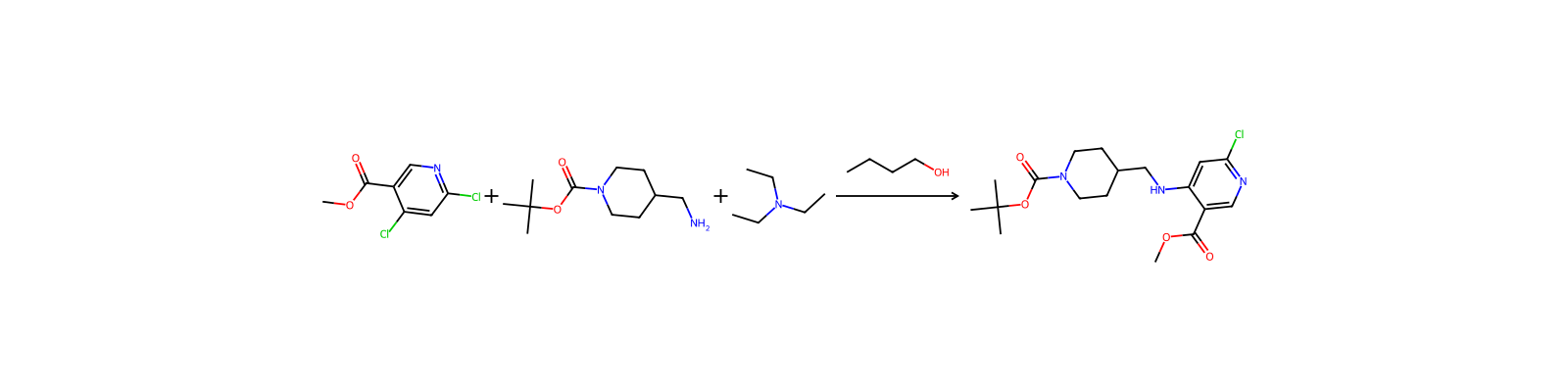
HRID 251574als Edukt
Daten werden ergänzt – lade die Seite später neu, um den aktuellen Stand zu sehen

65973-52-6COC(=O)c1cnc(Cl)cc1ClJEJMDUMJSZTJTI-UHFFFAOYSA-N65973-52-6DTXSID30377292Sicherheitsangaben dienen nur zur Orientierung und ersetzen weder das Sicherheitsdatenblatt (SDB) des Lieferanten noch geltende Vorschriften oder eine fachliche Bewertung.
Warning
H302 (40%): Harmful if swallowed [Warning Acute toxicity, oral]
P261, P264, P264+P265, P270, P271, P280, P301+P317, P302+P352, P304+P340, P305+P351+P338, P319, P321, P330, P332+P317, P337+P317, P362+P364, P403+P233, P405, and P501 (click each P-code to see the statement)
Aggregated GHS information provided per 5 reports by companies from 5 notifications to the ECHA C&L Inventory. Each notification may be associated with multiple companies.
VerwendenMethyl 4,6-dichloronicotinate could be used to synthesize 4,6-dichloronicotinic acid. Specifically, to a solution of methyl 4,6-dichloronicotinate in a mixture of THF (400 mL), MeOH (100 mL), and H2O (100 mL), a solution of NaOH (10 g) in 40 mL H2O was added. The mixture was stirred for 40 min at room temperature. Then, the solvents were reduced and acidified with concentrated HCl to a pH of about 2. It was extracted using a mixture of Et2O/EtOAc, and the organic layer was dried with Na2SO4. The solvents were removed, and the residue was dried in vacuo to obtain 4,6-dichloronicotinic acid as a white solid (12.3 g, 69% yield).