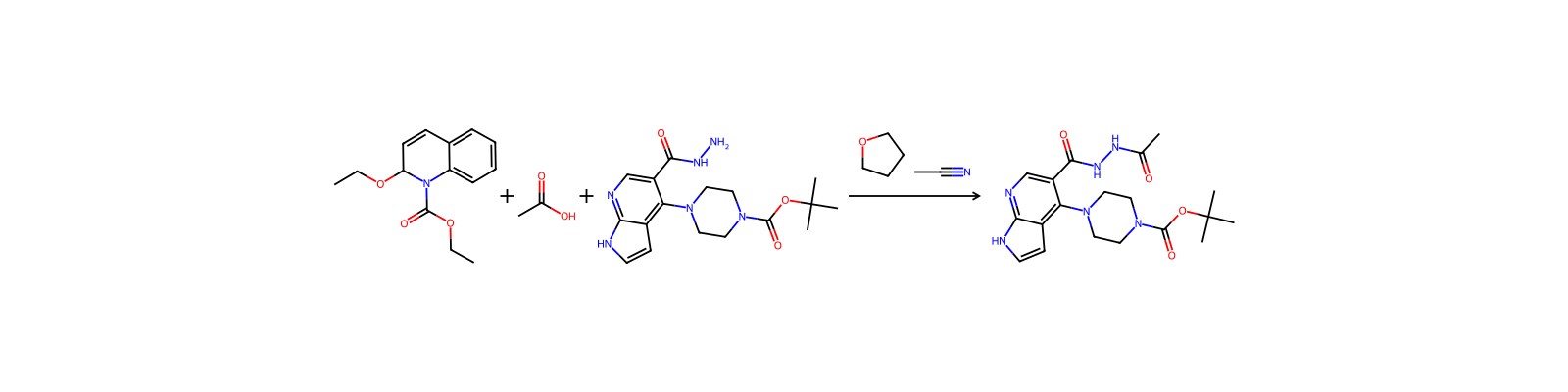
Ethyl-N-(2-ethoxy-1,2-dihydrochinolin)carboxylat
2-Ethoxy-1-(ethoxycarbonyl)-1,2-dihydroquinoline

Grundinformationen
- CAS
16357-59-8- Standard-SMILES
CCOC(=O)N1c2ccccc2C=CC1OCC- InChIKey
GKQLYSROISKDLL-UHFFFAOYSA-N- Summenformel
- C14H17NO3
- Durchschnittliche Molmasse
- 247,29 g/mol
- Monoisotopische Masse
- 247,1208434
Überblick
peptide coupling reagent
Namen und Bezeichner
- Bevorzugter Name
- 2-Ethoxy-1-(ethoxycarbonyl)-1,2-dihydroquinoline
- IUPAC
- ethyl 2-ethoxy-2H-quinoline-1-carboxylate
- Lokaler Name
- Ethyl-N-(2-ethoxy-1,2-dihydrochinolin)carboxylat
- Englischer Name
- N-Ethoxycarbonyl-2-ethoxy-1,2-dihydroquinoline
- Summenformel
- C14H17NO3
- Molmasse
- 247.29
Namen und Synonyme
16357-59-8EEDQ1(2H)-QUINOLINECARBOXYLIC ACID, 2-ETHOXY-, ETHYL ESTER2-Ethoxy-1(2H)-quinolinecarboxylic acid, ethyl esterN-carbethoxy-2-ethoxy-1,2-dihydroquinolineDTXSID5087196960O971AN192-ethoxy-1-(ethoxycarbonyl)-1,2-dihydroquinolineRefChem:471395DTXCID408195772-Ethoxy-1-ethoxycarbonyl-1,2-dihydroquinolineN-Ethoxycarbonyl-2-ethoxy-1,2-dihydroquinoline
Weitere Namen anzeigen
ETHYL 1,2-DIHYDRO-2-ETHOXY-1-QUINOLINECARBOXYLATEETHYL 2-ETHOXY-1,2-DIHYDRO-1-QUINOLINECARBOXYLATE2-Ethoxy-2H-quinoline-1-carboxylic acid ethyl esterEEDQ extrapure
ethyl 2-ethoxyquinoline-1(2H)-carboxylateethyl 2-ethoxy-2H-quinoline-1-carboxylateethyl 2-ethoxy-1,2-dihydroquinoline-1-carboxylate1-Ethoxycarbonyl-2-ethoxy-1,2-dihydroquinolineMFCD00006703MLS000069601BC 681NSC 147831
Eigenschaften
Berechnete Struktureigenschaften
- XLogP
- 2,8
- Polarare Oberfläche (TPSA)
- 38,8 Ų
- H-Brücken-Donoren
- 0
- H-Brücken-Akzeptoren
- 3
- Frei drehbare Bindungen
- 4
- Schwere Atome
- 18
- Formalladung
- 0
- Komplexität
- 316
Experimentelle und physikochemische Eigenschaften
Chemical ClassesOther Uses -> Biochemical Research
Solubility8 [ug/mL] (The mean of the results at pH 7.4)
Endocrine DisruptorsPotential endocrine disrupting compound
Physical DescriptionOff-white powder; [Alfa Aesar MSDS]
Physikochemische Eigenschaften
- Schmelzpunkt
- 62 · 62-67 °C(lit.)
- Siedepunkt
- 125 · 125-128 °C (0.1 mmHg)
- Dichte
- 1.1173 · 1.1173 (rough estimate)
- Brechungsindex
- 1.53 · 1.5300 (estimate)
- Flammpunkt
- 125 · 125-128°C/0.1mm
- storage temp.
- 2 · 2-8°C
- Löslichkeit
- Chlorofrom (Slightly), Ethyl Acetate (Slightly), Methanol (Slightly)
- pka
- -1.27 · -1.27±0.40(Predicted)
Sicherheit und Regulatorisches
Sicherheitsangaben dienen nur zur Orientierung und ersetzen weder das Sicherheitsdatenblatt (SDB) des Lieferanten noch geltende Vorschriften oder eine fachliche Bewertung.
GHS-Klassifizierung
GHS Classification
This chemical does not meet GHS hazard criteria for 1.1% (1 of 87) of reports.
Warning
H302 (90.8%): Harmful if swallowed [Warning Acute toxicity, oral]
P261, P264, P264+P265, P270, P271, P280, P301+P317, P302+P352, P304+P340, P305+P351+P338, P319, P321, P330, P332+P317, P337+P317, P362+P364, P403+P233, P405, and P501 (click each P-code to see the statement)
Aggregated GHS information provided per 87 reports by companies from 10 notifications to the ECHA C&L Inventory. Each notification may be associated with multiple companies.
Gefahrenhinweise
Regulatory Information1(2H)-Quinolinecarboxylic acid, 2-ethoxy-, ethyl ester: Does not have an individual approval but may be used under an appropriate group standard
Hazards SummaryCauses other degenerative changes to brain and effects on proteins in acute intraperitoneal studies of rats; Intraperitoneal LD50 (mouse) = 32 mg/kg; [RTECS] A skin and strong eye irritant; [Alfa Aesar MSDS]
Hazard Classes and CategoriesAcute Tox. 4 (90.8%)
Sicherheitsdaten
- F
- 9-21
- wgk
- 3
- tsca
- TSCA listed
- hs_code
- 29334990
- RTECS-Nr.
- VB2010000
- risk_code
- 38-36/37/38-20/21/22
- Toxizität
- mouse,LD50,intraperitoneal,32mg/kg (32mg/kg),Journal of Medicinal Chemistry. Vol. 14, Pg. 49, 1971.
Chemie und Industrie
Pharmakologische Informationen
MeSH Pharmacological Classification
Drugs that bind to but do not activate alpha-adrenergic receptors thereby blocking the actions of endogenous or exogenous adrenergic agonists. Adrenergic alpha-antagonists are used in the treatment of hypertension, vasospasm, peripheral vascular disease, shock, and pheochromocytoma.
Highly reactive chemicals that introduce alkyl radicals into biologically active molecules and thereby prevent their proper functioning. Many are used as antineoplastic agents, but most are very toxic, with carcinogenic, mutagenic, teratogenic, and immunosuppressant actions. They have also been used as components in poison gases.
Drugs that bind to but do not activate serotonin receptors, thereby blocking the actions of serotonin or SEROTONIN RECEPTOR AGONISTS.
Drugs that bind to but do not activate DOPAMINE RECEPTORS, thereby blocking the actions of dopamine or exogenous agonists. Many drugs used in the treatment of psychotic disorders (ANTIPSYCHOTIC AGENTS) are dopamine antagonists, although their therapeutic effects may be due to long-term adjustments of the brain rather than to the acute effects of blocking dopamine receptors. Dopamine antagonists have been used for several other clinical purposes including as ANTIEMETICS, in the treatment of Tourette syndrome, and for hiccup. Dopamine receptor blockade is associated with NEUROLEPTIC MALIGNANT SYNDROME.
Verwendung und Herstellung
UsesUsed as a coupling agent in peptide synthesis; [Merck Index]
General Manufacturing Information1(2H)-Quinolinecarboxylic acid, 2-ethoxy-, ethyl ester: ACTIVE
Anwendungen
VerwendenPeptide condensing agent with little or no racemization. Amidation coupling reagent.
Vor- und nachgelagerte Produkte
Vorgelagerte Rohstoffe
Zugehörige Reaktionen
776






Notizen zur Verbindung
Wird geladen…