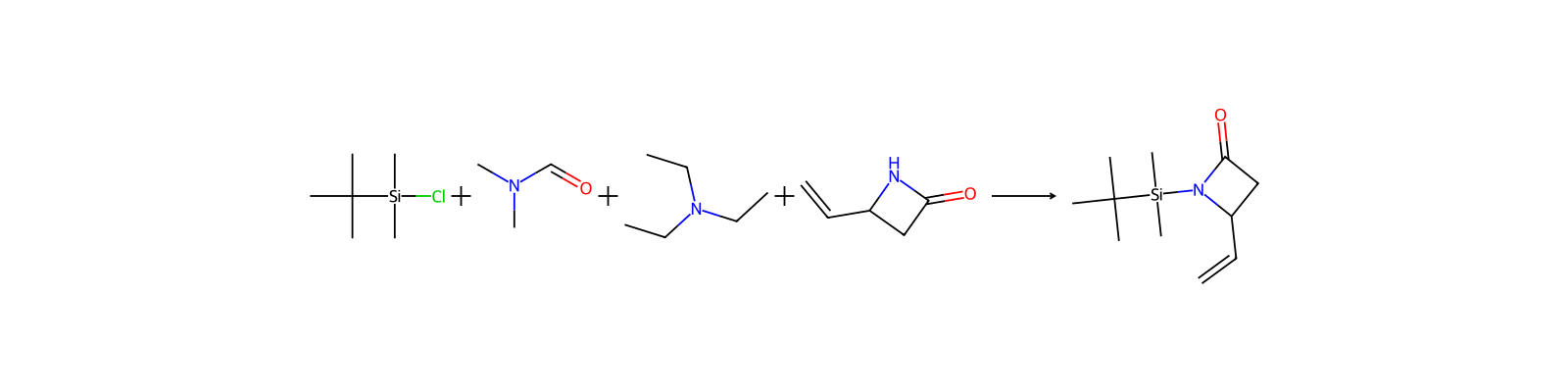
4-Ethenylazetidin-2-one
Daten werden ergänzt – lade die Seite später neu, um den aktuellen Stand zu sehen

Grundinformationen
- CAS
7486-94-4- Standard-SMILES
C=CC1CC(=O)N1- InChIKey
ZEWHMWFASYXCAO-UHFFFAOYSA-N- Summenformel
- C5H7NO
- Durchschnittliche Molmasse
- 97,12 g/mol
- Monoisotopische Masse
- 97,05276385
Namen und Bezeichner
- Bevorzugter Name
- 4-Ethenylazetidin-2-one
- IUPAC
- 4-ethenylazetidin-2-one
Namen und Synonyme
4-ethenylazetidin-2-oneDTXSID40300798RefChem:522565DTXCID40251933984-990-87486-94-44-vinylazetidin-2-one(+/-)-4-Vinylazetidin-2-oneMFCD00055493NSC 1390202-Azetidinone, 4-ethenyl-NSC139020
Weitere Namen anzeigen
4-vinyl-azetidin-2-oneSCHEMBL6687753AKOS006352082AT19037NSC-139020TS-7320SY575785DB-367731
Datenbank-Bezeichner
- CAS
7486-94-4- PubChem CID
- 283813
- DTXSID
DTXSID40300798- EC Number
- 984-990-8
- Nikkaji
- J533.376H
Eigenschaften
Berechnete StruktureigenschaftenWird ergänzt
- XLogP
- -0,1
- Polarare Oberfläche (TPSA)
- 29,1 Ų
- H-Brücken-Donoren
- 1
- H-Brücken-Akzeptoren
- 1
- Frei drehbare Bindungen
- 1
- Schwere Atome
- 7
- Formalladung
- 0
- Komplexität
- 109
Sicherheit und Regulatorisches
Sicherheitsangaben dienen nur zur Orientierung und ersetzen weder das Sicherheitsdatenblatt (SDB) des Lieferanten noch geltende Vorschriften oder eine fachliche Bewertung.
GHS-Klassifizierung
GHS Classification
Danger
H302 (100%): Harmful if swallowed [Warning Acute toxicity, oral];H312 (100%): Harmful in contact with skin [Warning Acute toxicity, dermal];H315 (100%): Causes skin irritation [Warning Skin corrosion/irritation];H319 (100%): Causes serious eye irritation [Warning Serious eye damage/eye irritation];H332 (100%): Harmful if inhaled [Warning Acute toxicity, inhalation];H334 (100%): May cause allergy or asthma symptoms or breathing difficulties if inhaled [Danger Sensitization, respiratory];H335 (100%): May cause respiratory irritation [Warning Specific target organ toxicity, single exposure; Respiratory tract irritation]
P233, P260, P261, P264, P264+P265, P270, P271, P280, P284, P301+P317, P302+P352, P304+P340, P305+P351+P338, P317, P319, P321, P330, P332+P317, P337+P317, P342+P316, P362+P364, P403, P403+P233, P405, and P501 (click each P-code to see the statement)
Aggregated GHS information provided per 2 reports by companies from 1 notifications to the ECHA C&L Inventory. Each notification may be associated with multiple companies.;Information may vary between notifications depending on impurities, additives, and other factors. The percentage value in parenthesis indicates the notified classification ratio from companies that provide hazard codes. Only hazard codes with percentage values above 10% are shown. For more detailed information, please visit ECHA C&L website.
Gefahrenhinweise
Hazard Classes and CategoriesAcute Tox. 4 (100%);Acute Tox. 4 (100%);Skin Irrit. 2 (100%);Eye Irrit. 2A (100%);Acute Tox. 4 (100%);Resp. Sens. 1 (100%);STOT SE 3 (100%)
Zugehörige Reaktionen
1
Notizen zur Verbindung
Wird geladen…