StartseiteMCPWorkbenchSkills
StartseiteWorkbenchBenachrichtigungenMein Bereich
llms.txt · MCP-AnleitungDatenschutz · Nutzungsbedingungen · Supportv1.8.3
  1. Startseite
  2. /Verbindung

Levofloxacin Hydrate

HCID 3033924
Neue Reaktion
Drucken
GrundinformationenÜberblickNamen und BezeichnerEigenschaftenSicherheit und RegulatorischesChemie und IndustrieZugehörige ReaktionenNotizen zur Verbindung
TeilstruktursucheÄhnliche Strukturen suchen

Grundinformationen

CAS
138199-71-0
Standard-SMILES
C[C@H]1COc2c(N3CCN(C)CC3)c(F)cc3c(=O)c(C(=O)O)cn1c23.C[C@H]1COc2c(N3CCN(C)CC3)c(F)cc3c(=O)c(C(=O)O)cn1c23.O
InChIKey
SUIQUYDRLGGZOL-RCWTXCDDSA-N
Summenformel
C36H42F2N6O9
Durchschnittliche Molmasse
740,7 g/mol
Monoisotopische Masse
740,29813326

Überblick

Levofloxacin is a synthetic fluoroquinolone antibacterial agent that inhibits the supercoiling activity of bacterial DNA gyrase, halting DNA replication. Levofloxacin is marketed by Ortho-McNeil under the trade name Levaquin. Chemically, levofloxacin is the S-enantiomer (L-isomer) of ofloxacin.

Namen und Bezeichner

Bevorzugter Name
Levofloxacin Hydrate
IUPAC
bis((2S)-7-fluoro-2-methyl-6-(4-methylpiperazin-1-yl)-10-oxo-4-oxa-1-azatricyclo[7.3.1.05,13]trideca-5(13),6,8,11-tetraene-11-carboxylic acid);hydrate
Englischer Name
Levofloxacin heMihydrate
Summenformel
C18H22FN3O5
Molmasse
379.39

Namen und Synonyme

Levofloxacin hydrateDTXSID60160533RefChem:1088440DTXCID2083024(3S)-9-Fluoro-3-methyl-10-(4-methylpiperazin-1-yl)-7-oxo-2,3-dihydro-7H-pyrido(1,2,3-de)(1,4)benzoxazine-6-carboxylic acid hemihydrate138199-71-0DynaquinMFCD07772024Levofloxacin (hydrate)(S)-9-Fluoro-3-methyl-10-(4-methylpiperazin-1-yl)-7-oxo-3,7-dihydro-2H-[1,4]oxazino[2,3,4-ij]quinoline-6-carboxylic acid hydrate(2:1)7H-Pyrido[1,2,3-de]-1,4-benzoxazine-6-carboxylic acid, 9-fluoro-2,3-dihydro-3-methyl-10-(4-methyl-1-piperazinyl)-7-oxo-, hydrate (2:1), (3S)-(S)-9-Fluoro-3-methyl-10-(4-methylpiperazin-1-yl)-7-oxo-2,3-dihydro-7H-[1,4]oxazino[2,3,4-ij]quinoline-6-carboxylic acid hemihydrate
Weitere Namen anzeigen
LevofloxacineLEVOFLOXACIN HCL(s)-9-fluoro-2,3-dihydro-3-methyl-10-(4-methyl-1-piperazinyl)-7-oxo-7h-pyrido(1,2,3-de)-1,4-benzoxazine-6-carboxylic acid hydrate (2:1)3-de)-1Iquix hydrate(S)-9-Fluoro-2Cravit hydrateQuixin hydrate
7H-Pyrido(1,2,3-de)-1,4-benzoxazine-6-carboxylic acid, 9-fluoro-2,3-dihydro-3-methyl-10-(4-methyl-1-piperazinyl)-7-oxo-hydrate (2:1), (S)-Levofloxacin [USAN]RWJ 25213Quixin (TN)Iquix (TN)(2S)-7-fluoro-2-methyl-6-(4-methylpiperazin-1-yl)-10-oxo-4-oxa-1-azatricyclo[7.3.1.05,13]trideca-5(13),6,8,11-tetraene-11-carboxylic acid;hydrateUNII-6GNT3Y5LMFLevofloxacin hemihydrate CRS

Eigenschaften

Berechnete Struktureigenschaften

Polarare Oberfläche (TPSA)
148 Ų
H-Brücken-Donoren
3
H-Brücken-Akzeptoren
17
Frei drehbare Bindungen
4
Schwere Atome
53
Formalladung
0
Komplexität
634

Experimentelle und physikochemische Eigenschaften

Dissociation Constants · 4 Einträge

8.12

6.1

6

8.6

Physikochemische Eigenschaften

Schmelzpunkt
214 · 214-216°C
storage temp.
2 · Sealed in dry,2-8°C
Löslichkeit
Aqueous Base (Slightly), DMSO (Sparingly), Methanol (Slightly)
Aggregatzustand
Solid
Farbe
Pale Yellow to Light Yellow
Major Application
pharmaceutical (small molecule)
InChI
1S/2C18H20FN3O4.H2O/c2*1-10-9-26-17-14-11(16(23)12(18(24)25)8-22(10)14)7-13(19)15(17)21-5-3-20(2)4-6-21;/h2*7-8,10H,3-6,9H2,1-2H3,(H,24,25);1H2/t2*10-;/m00./s1
InChIKey
SUIQUYDRLGGZOL-RCWTXCDDSA-N
SMILES
O.C[C@H]1COc2c(N3CCN(C)CC3)c(F)cc4C(=O)C(=CN1c24)C(O)=O.C[C@H]5COc6c(N7CCN(C)CC7)c(F)cc8C(=O)C(=CN5c68)C(O)=O
CAS Datenbank
138199 · 138199-71-0(CAS DataBase Reference)

Sicherheit und Regulatorisches

Sicherheitsangaben dienen nur zur Orientierung und ersetzen weder das Sicherheitsdatenblatt (SDB) des Lieferanten noch geltende Vorschriften oder eine fachliche Bewertung.

GHS-Klassifizierung

GHS Classification · 4 Einträge

Danger

H302 (99.1%): Harmful if swallowed [Warning Acute toxicity, oral]

P203, P233, P260, P261, P263, P264, P270, P271, P272, P280, P284, P301+P317, P302+P352, P304+P340, P318, P321, P330, P333+P317, P342+P316, P362+P364, P403, P405, and P501 (click each P-code to see the statement)

Aggregated GHS information provided per 114 reports by companies from 14 notifications to the ECHA C&L Inventory. Each notification may be associated with multiple companies.

Gefahrenhinweise

Hazard Classes and CategoriesAcute Tox. 4 (99.1%)

Toxikologische Informationen

TreatmentIn the event of an acute overdosage, the stomach should be emptied. The patient should be observed and appropriate hydration maintained. Levofloxacin is not efficiently removed by hemodialysis or peritoneal dialysis. (L1009)
Health Effects · 1 Eintrag

Irreversible peripheral neuropathy, central nervous system toxicity, cardiovascular toxicity, tendon / articular toxicity, and hepatic toxicity. Toxic epidermal necrolysis, coagulation abnormalities and pancytopenia are other possible adverse effect of levofloxacin. Administration of commercial levofloxin (Levaquin), increased risk of tendinitis and tendon rupture in all ages. This adverse reaction most frequently involves the Achilles tendon (L1009, L1017).

Exposure RoutesIngestion; injection; skin contact (L1017). Absorption of ofloxacin after single or multiple doses of 200 to 400 mg is predictable, and the amount of drug absorbed increases proportionately with the dose.

Chemie und Industrie

Pharmakologische Informationen

Metabolism/Metabolites · 1 Eintrag

Mainly excreted as unchanged drug (87%); undergoes limited metabolism in humans. Levofloxacin is rapidly and essentially completely absorbed after oral administration. It is distributed into body tissues, especially in the skin and lung tissues. Levofloxacin is stereochemically stable in plasma and urine and does not invert metabolically to its enantiomer, D-ofloxacin. Levofloxacin undergoes limited metabolism in humans and is primarily excreted as unchanged drug in the urine. Following oral administration, approximately 87% of an administered dose was recovered as unchanged drug in urine within 48 hours, whereas less than 4% of the dose was recovered in feces in 72 hours. Less than 5% of an administered dose was recovered in the urine as the desmethyl and N-oxide metabolites, the only metabolites identified in humans. These metabolites have little relevant pharmacological activity. Levofloxacin is excreted largely as unchanged drug in the urine (L1009). Route of Elimination: Mainly excreted as unchanged drug in the urine. Half Life: 6-8 hours

Verwendung und Herstellung

Uses · 1 Eintrag

For the treatment of bacterial conjunctivitis caused by susceptible strains of the following organisms: <i>Corynebacterium</i> species, <i>Staphylococus aureus</i>, <i>Staphylococcus epidermidis</i>, <i>Streptococcus pneumoniae</i>, <i>Streptococcus</i> (Groups C/F/G), Viridans group streptococci, <i>Acinetobacter lwoffii</i>, <i>Haemophilus influenzae</i>, <i>Serratia marcescens</i>. Levofloxacin is a synthetic chemotherapeutic agent used to treat severe and life threatening bacterial infection (L1009).

Anwendungen

VerwendenLevofloxacin heMihydrate is an antibiotic used against gram-negative organisms.

Vor- und nachgelagerte Produkte

Vorgelagerte Rohstoffe

Mandelsure

Zugehörige Reaktionen

12
Reaktionsaufzeichnung erstellen
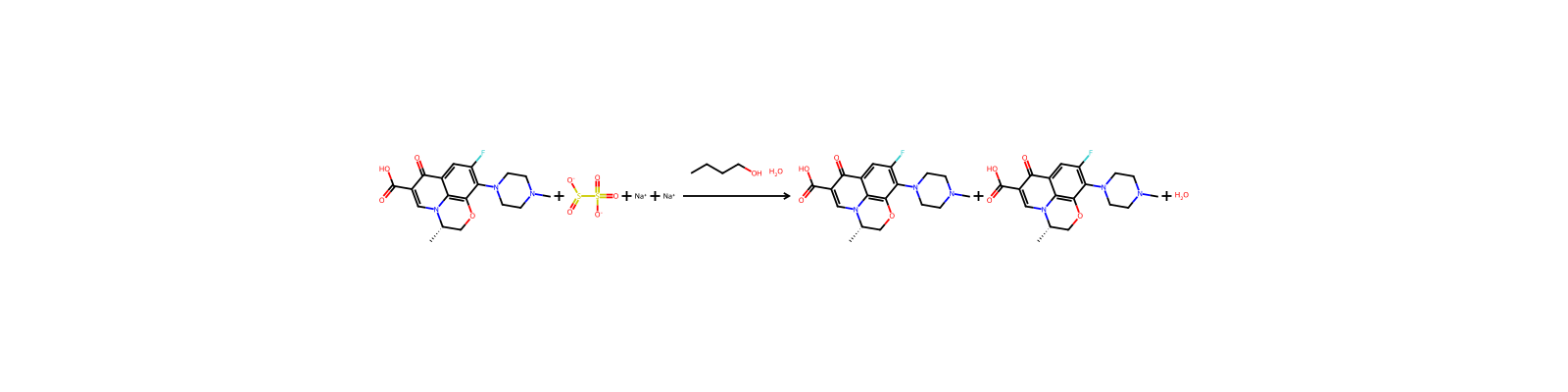
Reaktionsgleichung von HRID 31371
HRID 31371als Produkt
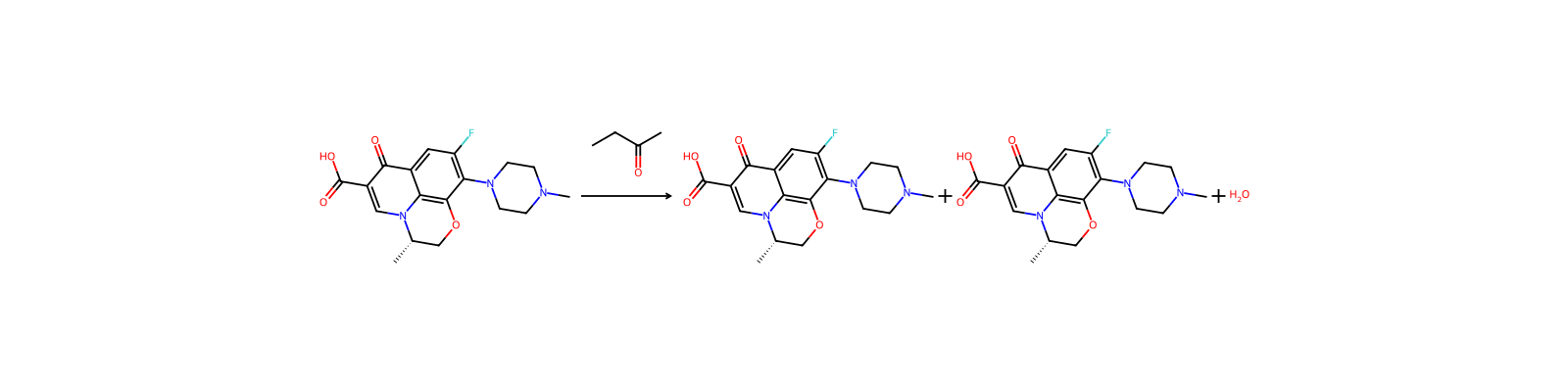
Reaktionsgleichung von HRID 31372
HRID 31372als Produkt
Reaktionsgleichung von HRID 31373
HRID 31373als Produkt
Reaktionsgleichung von HRID 31374
HRID 31374als Produkt
Reaktionsgleichung von HRID 31375
HRID 31375als Produkt
Reaktionsgleichung von HRID 31376
HRID 31376als Produkt
Reaktionsgleichung von HRID 1866748
HRID 1866748als Produkt
Reaktionsgleichung von HRID 1866749
HRID 1866749als Produkt
ZurückSeite 1 von 2

Notizen zur Verbindung

Auf dieser SeiteGrundinformationenÜberblickNamen und BezeichnerEigenschaftenSicherheit und RegulatorischesChemie und IndustrieZugehörige ReaktionenNotizen zur Verbindung

Datenbank-Bezeichner

CAS
138199-71-0
PubChem CID
3033924
DTXSID
DTXSID60160533
ChEMBL
CHEMBL5315124
UNII
6GNT3Y5LMF
EC Number
604-067-2
Toxicity Summary · 1 Eintrag

Levofloxacin inhibits bacterial type II topoisomerases, topoisomerase IV and DNA gyrase. Levofloxacin, like other fluoroquinolones, inhibits the A subunits of DNA gyrase, two subunits encoded by the gyrA gene. This results in strand breakage on a bacterial chromosome, supercoiling, and resealing; DNA replication and transcription is inhibited.

Signs and SymptomsSide effects include disorientation, dizziness, drowsiness, hot and cold flashes, nausea, slurring of speech, swelling and numbness in the face.
Carcinogen ClassificationNo indication of carcinogenicity to humans (not listed by IARC).
Toxicity DataLD50: 640 mg/kg (Oral, Rat)

Sicherheitsdaten

wgk
3
hs_code
2934990002
risk_code
50/53
hazard_code
N
safety_code
24/25-61-60
Speicherklasse
11 - Combustible Solids
Hazard Classifications
Acute Tox. 4 OralResp. Sens. 1Skin Sens. 1