
Diethyl-pyrocarbonat
Diethyl Pyrocarbonate
Daten werden ergänzt – lade die Seite später neu, um den aktuellen Stand zu sehen

Grundinformationen
- CAS
1609-47-8- Standard-SMILES
CCOC(=O)OC(=O)OCC- InChIKey
FFYPMLJYZAEMQB-UHFFFAOYSA-N- Summenformel
- C6H10O5
- Durchschnittliche Molmasse
- 162,14 g/mol
- Monoisotopische Masse
- 162,05282342
Überblick
Diethyl pyrocarbonate is the diethyl ester of dicarbonic acid. It is functionally related to a dicarbonic acid.
Namen und Bezeichner
- Bevorzugter Name
- Diethyl Pyrocarbonate
- IUPAC
- ethoxycarbonyl ethyl carbonate
- Lokaler Name
- Diethyl-pyrocarbonat
- Englischer Name
- Diethyl pyrocarbonate
- Summenformel
- C6H10O5
- Molmasse
- 162.14
Namen und Synonyme
diethyl pyrocarbonate1609-47-8Diethyl dicarbonateDEPCDiethyl oxydiformateDiethylpyrocarbonateBaycovinEthyl pyrocarbonatePirefDicarbonic acid, diethyl esterDicarbonic acid diethyl esterDiethyl pyrocarbonic acid
Weitere Namen anzeigen
ethoxycarbonyl ethyl carbonateDKDDEP/DEPCDEPC/DEPethylpyrocarbonate
Oxydiformic acid diethyl esterPyrocarbonic acid diethyl esterDiethylpyrokarbonatEthoxyformic acid anhydridePyrocarbonate d'ethylePyrokohlensaeure diaethyl esterDiethyl ester of pyrocarbonic acidDiethylester kyseliny diuhlicite
Datenbank-Bezeichner
- CAS
1609-47-8- PubChem CID
- 3051
- DTXSID
DTXSID2051764- ChEMBL
CHEMBL55517- ChEBI
CHEBI:59051- UNII
- LMR3LZG146
- EC Number
- 216-542-8
Eigenschaften
Berechnete StruktureigenschaftenWird ergänzt
- XLogP
- 1,4
- Polarare Oberfläche (TPSA)
- 61,8 Ų
- H-Brücken-Donoren
- 0
- H-Brücken-Akzeptoren
- 5
- Frei drehbare Bindungen
- 6
- Schwere Atome
- 11
- Formalladung
- 0
- Komplexität
- 126
Experimentelle und physikochemische Eigenschaften
Chemical ClassesOther Classes -> Esters, Other
Food AdditivesDOUGH STRENGTHENER -> FDA Substance added to food
Density1.12 @25 °C
Melting Point< 25 °C
Physical Description
Viscous liquid with a fruity odor. [Merck Index] Clear colorless liquid; [Sigma-Aldrich MSDS]
Solid
Physikochemische Eigenschaften
- Schmelzpunkt
- 69 ℃ · 69℃
- Siedepunkt
- 93 · 93-94 °C18 mm Hg(lit.)
- Dichte
- 1.12 g/mL · 1.12 g/mL at 20 °C
- Brechungsindex
- 20 · n20/D 1.398(lit.)
- Flammpunkt
- 157 °F · 157 °F
- storage temp.
- 2 · 2-8°C
Sicherheit und Regulatorisches
Sicherheitsangaben dienen nur zur Orientierung und ersetzen weder das Sicherheitsdatenblatt (SDB) des Lieferanten noch geltende Vorschriften oder eine fachliche Bewertung.
GHS-Klassifizierung
GHS Classification
Warning
H302 (93.5%): Harmful if swallowed [Warning Acute toxicity, oral]
P261, P264, P264+P265, P270, P271, P280, P301+P317, P302+P352, P304+P340, P305+P351+P338, P319, P321, P330, P332+P317, P337+P317, P362+P364, P403+P233, P405, and P501 (click each P-code to see the statement)
Aggregated GHS information provided per 93 reports by companies from 14 notifications to the ECHA C&L Inventory. Each notification may be associated with multiple companies.
Gefahrenhinweise
Regulatory Information
Chemical: Dicarbonic acid, diethyl ester
Diethyl dicarbonate: Does not have an individual approval but may be used under an appropriate group standard
Hazards Summary
Causes dyspnea in inhalation lethal-concentration studies of guinea pigs, mice, and rabbits (LCLo = 10 ppm/1hr); [RTECS] Slowly decomposed by water forming ethanol and carbon dioxide; A skin, eye, and mucous membrane irritant; [Merck Index] A skin and strong eye irritant; Harmful by ingestion; [Sigma-Aldrich MSDS]
Hazard Classes and CategoriesAcute Tox. 4 (93.5%)
Sicherheit und Schutzausrüstung
Protective Action Criteria (PAC)
4.1 [mg/m3]
45 [mg/m3]
270 [mg/m3]
Toxikologische Informationen
Chemie und Industrie
Pharmakologische Informationen
Cellular LocationsCytoplasm
Verwendung und Herstellung
Uses
Used as a preservative in wines, soft drinks, and fruit juices; [Merck Index] Used as a laboratory reagent; [REPROTOX]
Banned for use as a food additive; [FDA]
Use ClassificationFood Additives -> PRESERVATIVE -> JECFA Functional Classes
General Manufacturing InformationDicarbonic acid, 1,3-diethyl ester: ACTIVE
Anwendungen
VerwendenDiethyl pyrocarbonate may be used in the following studies:For the modification of histidyl residues in proteins.As a nuclease inhibitor, for the extraction of undegraded nucleic acids from etiolated and green plant tissues.For the modification of linear and supercoiled plasmid DNAs.As a chemical probe to investigate the secondary structure in negatively supercoiled DNA.For cabethoxylation of histidine residues of actin.
Vor- und nachgelagerte Produkte
Nachgelagerte Produkte
Ergänzende Hinweise
DefinitionChEBI: The diethyl ester of dicarbonic acid.
Zugehörige Reaktionen
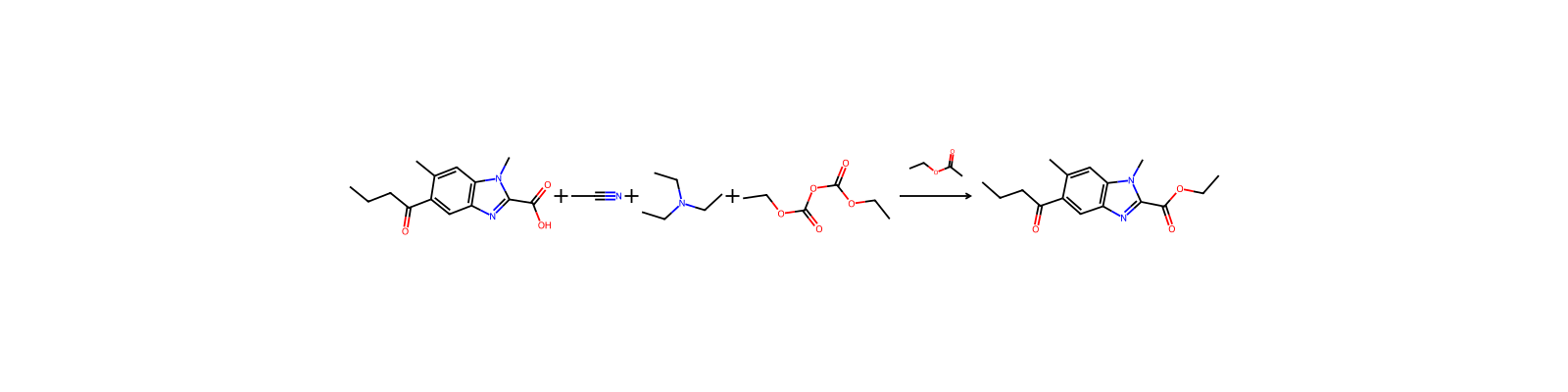
130


Notizen zur Verbindung
Wird geladen…