N-[(1-Ethyl-2-pyrrolidinyl)methyl]-5-(ethylsulfonyl)-2-methoxybenzamidmonohydrochlorid
Benzamide, N-((1-ethyl-2-pyrrolidinyl)methyl)-5-(ethylsulfonyl)-2-methoxy-, hydrochloride (1:1)
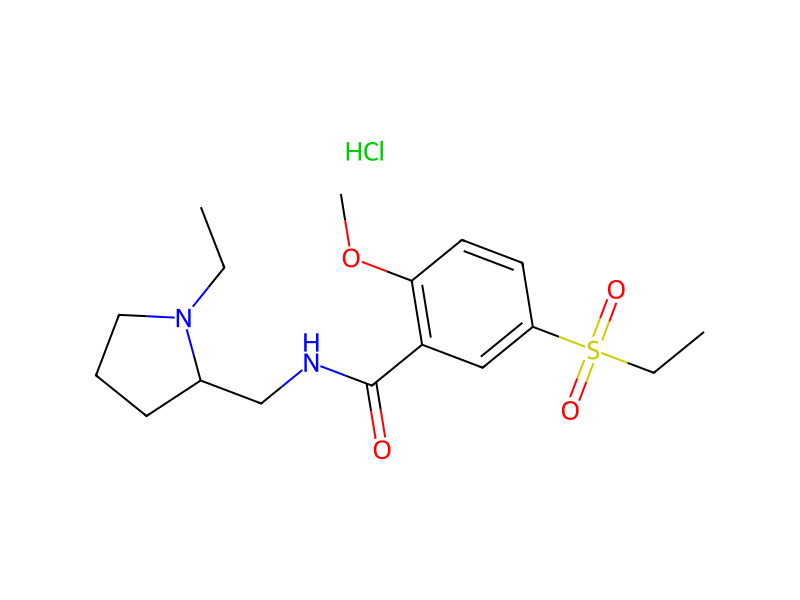
Grundinformationen
- CAS
23694-17-9- Standard-SMILES
CCN1CCCC1CNC(=O)c1cc(S(=O)(=O)CC)ccc1OC.Cl- InChIKey
IGOWMQPOGQYFFM-UHFFFAOYSA-N- Summenformel
- C17H27ClN2O4S
- Durchschnittliche Molmasse
- 390,9 g/mol
- Monoisotopische Masse
- 390,1380062
Namen und Bezeichner
- Bevorzugter Name
- Benzamide, N-((1-ethyl-2-pyrrolidinyl)methyl)-5-(ethylsulfonyl)-2-methoxy-, hydrochloride (1:1)
- IUPAC
- N-[(1-ethylpyrrolidin-2-yl)methyl]-5-ethylsulfonyl-2-methoxybenzamide;hydrochloride
- Lokaler Name
- N-[(1-Ethyl-2-pyrrolidinyl)methyl]-5-(ethylsulfonyl)-2-methoxybenzamidmonohydrochlorid
- Englischer Name
- Sultopride hydrochloride
- Summenformel
- C17H27ClN2O4S
- Molmasse
- 390.93
Namen und Synonyme
sultopride hydrochloride23694-17-9BarnotilDTXSID00490708Q6926T32J55619-22-2DTXCID1028996Benzamide, N-[(1-ethyl-2-pyrrolidinyl)methyl]-5-(ethylsulfonyl)-2-methoxy-, hydrochloride (1:1)BENZAMIDE, N-((1-ETHYL-2-PYRROLIDINYL)METHYL)-5-(ETHYLSULFONYL)-2-METHOXY-, HYDROCHLORIDE (1:1)RefChem:186764245-829-0259-726-3
Weitere Namen anzeigen
BatilStadorfMS-5024BamotilEinecs 245-829-0Barnetil HydrochlorideBarnotil HydrochlorideLIN 1418 Hydrochloridesultropridechlorhydrate
N-((1-Ethylpyrrolidin-2-yl)methyl)-5-(ethylsulfonyl)-2-methoxybenzamide hydrochlorideSultopride HClSultopride hydrochloride [JAN]UNII-8Q6926T32JLIN-1418 hydrochlorideSultopride monohydrochlorideSultopride hydrochloride (JAN)SultoprideHCl
Eigenschaften
Berechnete Struktureigenschaften
- Polarare Oberfläche (TPSA)
- 84,1 Ų
- H-Brücken-Donoren
- 2
- H-Brücken-Akzeptoren
- 5
- Frei drehbare Bindungen
- 7
- Schwere Atome
- 25
- Formalladung
- 0
- Komplexität
- 517
Physikochemische Eigenschaften
- Schmelzpunkt
- 181 · 181-182°C
- storage temp.
- Sealed in dry,Room Temperature
- Löslichkeit
- Acetonitrile (Slightly), Methanol (Slightly)
- Aggregatzustand
- Solid
- Farbe
- White to Off-White
Sicherheit und Regulatorisches
Sicherheitsangaben dienen nur zur Orientierung und ersetzen weder das Sicherheitsdatenblatt (SDB) des Lieferanten noch geltende Vorschriften oder eine fachliche Bewertung.
GHS-Klassifizierung
GHS Classification
Warning
H302 (100%): Harmful if swallowed [Warning Acute toxicity, oral]
P264, P270, P301+P317, P330, and P501 (click each P-code to see the statement)
Aggregated GHS information provided per 2 reports by companies from 1 notifications to the ECHA C&L Inventory.
Gefahrenhinweise
Hazard Classes and CategoriesAcute Tox. 4 (100%)
Sicherheitsdaten
- Alarmwort
- Warnung
- Gefahrenhinweise
- Code Gefahrenhinweise Gefahrenklasse Abteilung Alarmwort Symbol P-Code H317
Chemie und Industrie
Pharmakologische Informationen
MeSH Pharmacological Classification
Agents that control agitated psychotic behavior, alleviate acute psychotic states, reduce psychotic symptoms, and exert a quieting effect. They are used in SCHIZOPHRENIA; senile dementia; transient psychosis following surgery; or MYOCARDIAL INFARCTION; etc. These drugs are often referred to as neuroleptics alluding to the tendency to produce neurological side effects, but not all antipsychotics are likely to produce such effects. Many of these drugs may also be effective against nausea, emesis, and pruritus.
Drugs that bind to but do not activate DOPAMINE RECEPTORS, thereby blocking the actions of dopamine or exogenous agonists. Many drugs used in the treatment of psychotic disorders (ANTIPSYCHOTIC AGENTS) are dopamine antagonists, although their therapeutic effects may be due to long-term adjustments of the brain rather than to the acute effects of blocking dopamine receptors. Dopamine antagonists have been used for several other clinical purposes including as ANTIEMETICS, in the treatment of Tourette syndrome, and for hiccup. Dopamine receptor blockade is associated with NEUROLEPTIC MALIGNANT SYNDROME.
A structurally and mechanistically diverse group of drugs that are not tricyclics or monoamine oxidase inhibitors. The most clinically important appear to act selectively on serotonergic systems, especially by inhibiting serotonin reuptake.
Vor- und nachgelagerte Produkte
Vorgelagerte Rohstoffe
Anbieter
Wird geladen…
Öffentliche Anfragen
Wird geladen…
Zugehörige Reaktionen
0
Keine Reaktionsaufzeichnungen unter den aktuellen Filterkriterien.
Notizen zur Verbindung
Wird geladen…