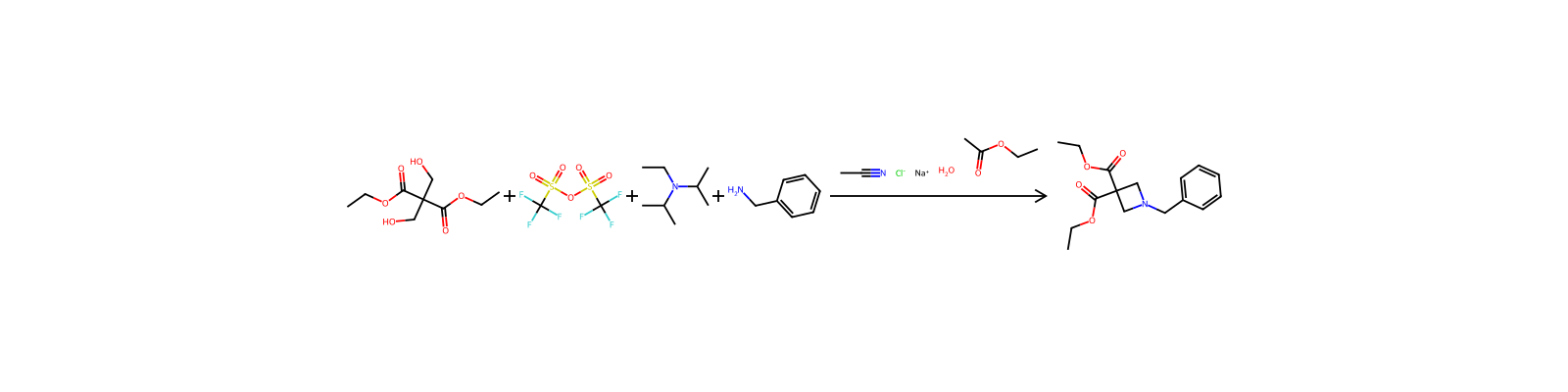
Diethylbis(hydroxymethyl)malonat
Propanedioic acid, 2,2-bis(hydroxymethyl)-, 1,3-diethyl ester

Grundinformationen
- CAS
20605-01-0- Standard-SMILES
CCOC(=O)C(CO)(CO)C(=O)OCC- InChIKey
WIOHBOKEUIHYIC-UHFFFAOYSA-N- Summenformel
- C9H16O6
- Durchschnittliche Molmasse
- 220,22 g/mol
- Monoisotopische Masse
- 220,09468823
Namen und Bezeichner
- Bevorzugter Name
- Propanedioic acid, 2,2-bis(hydroxymethyl)-, 1,3-diethyl ester
- IUPAC
- diethyl 2,2-bis(hydroxymethyl)propanedioate
- Lokaler Name
- Diethylbis(hydroxymethyl)malonat
- Englischer Name
- Diethyl bis(hydroxymethyl)malonate
- Summenformel
- C9H16O6
- Molmasse
- 220.22
Namen und Synonyme
Diethyl bis(hydroxymethyl)malonate20605-01-0Propanedioic acid, bis(hydroxymethyl)-, diethyl esterPropanedioic acid, 2,2-bis(hydroxymethyl)-, 1,3-diethyl esterEINECS 243-916-8DTXSID10885143RefChem:868937DTXCID601024542243-916-8NSC 218327Diethyl 2,2-bis(hydroxymethyl)malonatediethyl 2,2-bis(hydroxymethyl)propanedioate
Weitere Namen anzeigen
TIMTEC-BB SBB007847Ethyl Dimethylol Malonatebis(hydroxyMethyl)MalonateDiethyl bis(hydroxyMethyl)Malonbis-(Hydroxymethyl)diethylesterDiethyl bis(hydroxymethyl)malotediethyl bis(hydroxymethyl)malonatDiethylebis(hydroxymethyl)malonate
1,3-diethyl 2,2-bis(hydroxymethyl)propanedioateMFCD00009130Diethyl bis(hydroxymethyl)malonate, 97%SCHEMBL371475diethyl 2,2-bis(hydroxymethyl)propane-1,3-dioatePropanedioic acid,NSC218327Diethyl2,2-bis(hydroxymethyl)malonate
Datenbank-Bezeichner
- CAS
20605-01-0- PubChem CID
- 311844
- DTXSID
DTXSID10885143- EC Number
- 243-916-8
- Nikkaji
- J149.877K
Eigenschaften
Berechnete Struktureigenschaften
- XLogP
- -0,6
- Polarare Oberfläche (TPSA)
- 93,1 Ų
- H-Brücken-Donoren
- 2
- H-Brücken-Akzeptoren
- 6
- Frei drehbare Bindungen
- 8
- Schwere Atome
- 15
- Formalladung
- 0
- Komplexität
- 201
Physikochemische Eigenschaften
- Schmelzpunkt
- 49 · 49-51 °C (lit.)
- Siedepunkt
- 281.15 °C · 281.15°C (rough estimate)
- Dichte
- 1.2286 · 1.2286 (rough estimate)
- Brechungsindex
- 1.439 · 1.4390 (estimate)
- Flammpunkt
- 230 °F · >230 °F
- storage temp.
- Sealed in dry,Room Temperature
- pka
- 12.59 · 12.59±0.10(Predicted)
- Aggregatzustand
- Crystalline Solid
- Farbe
- White to almost white
- Wasserlöslichkeit
- Slightly soluble in water.
- BRN
- 1788515 · 1788515
- InChI
- InChI=1S/C9H16O6/c1-3-14-7(12)9(5-10,6-11)8(13)15-4-2/h10-11H,3-6H2,1-2H3
- InChIKey
- WIOHBOKEUIHYIC-UHFFFAOYSA-N
- SMILES
- C(OCC)(=O)C(CO)(CO)C(OCC)=O
- CAS Datenbank
- 20605 · 20605-01-0(CAS DataBase Reference)
- NIST chemische Informationen
- Diethyl bis(hydroxymethyl)malonate(20605-01-0)
- EPA chemische Informationen
- Propanedioic acid, bis(hydroxymethyl)-, diethyl ester (20605-01-0)
Sicherheit und Regulatorisches
GHS-Klassifizierung
GHS Classification
Warning
H315 (100%): Causes skin irritation [Warning Skin corrosion/irritation]
P261, P264, P264+P265, P271, P280, P302+P352, P304+P340, P305+P351+P338, P319, P321, P332+P317, P337+P317, P362+P364, P403+P233, P405, and P501 (click each P-code to see the statement)
The GHS information provided by 1 company from 1 notification to the ECHA C&L Inventory.
Gefahrenhinweise
Regulatory InformationPMN - indicates a commenced PMN (Pre-Manufacture Notices) substance.
Hazard Classes and CategoriesSkin Irrit. 2 (100%)
Sicherheitsdaten
- wgk
- 3
- tsca
- TSCA listed
- hs_code
- 29181998
- risk_code
- 36/37/38
- hazard_code
- Xi
- safety_code
- 23-24/25-36-26
- hazard_class
- IRRITANT
- Speicherklasse
- 11 - Combustible Solids
Chemie und Industrie
Verwendung und Herstellung
General Manufacturing InformationPropanedioic acid, 2,2-bis(hydroxymethyl)-, 1,3-diethyl ester: ACTIVE
Anwendungen
VerwendenDiethyl bis(hydroxymethyl)malonate is used as a reagent for preparing 1,3-dioxanes from acetals, aldehydes and ketones. It is also used as an intermediate for the preparation of substituted malonic, acrylic and isobutyric esters, for conversion to the useful dienophiles, -bromomethylacrylic acid and its ethyl ester and to bis(bromomethyl)acetic acid and its methyl ester.
Vor- und nachgelagerte Produkte
Vorgelagerte Rohstoffe
Nachgelagerte Produkte
Anbieter101 Anbieter
国药集团化学试剂有限公司86-21-63210123 · [email protected]
上海阿拉丁生化科技股份有限公司400-6206333 13167063860 · [email protected]
T&W GROUP021-61551611 13296011611 · [email protected]
Baoji Guokang Healthchem co.,ltd+8615604608665 15604608665 · [email protected]
Dayang Chem (Hangzhou) Co.,Ltd.+86-0571-88938639 17705817739 · [email protected]
重庆茂环科技有限公司13996103726 · [email protected]
Syntechem Co.,Ltd[email protected]
韶远科技(上海)有限公司021-50795510 4000665055 · [email protected]
上海迈瑞尔生化科技有限公司4006356688 18621169109 · [email protected]
北京华威锐科化工有限公司0757-86329057 18934348241 · [email protected]
阿法埃莎(中国)化学有限公司400-6106006 · [email protected]
安耐吉化学&3A(安徽泽升科技股份有限公司)400-0056266 · [email protected]
嘉兴市艾森化工有限公司0573-85285100 18627885956 · [email protected]
武汉丰泰威远科技有限公司+86-27-8746-5837 +86-18627785180 · [email protected]
武汉丰泰威远科技有限公司027-87465837 19945049750 · [email protected]
宁波奕睿生物科技有限公司15221000252 · [email protected]
天津诺康医药科技有限公司022-23989838 13810451150 · [email protected]
山东西亚化学有限公司13355009207 13355009207 · [email protected]
玛雅试剂+86 (573) 82222445 (0)18006601000 452520369 · [email protected]
上海耐士化工科技有限公司400-188-0725 +86 21 34310725 13611771617
南京维奥化工有限公司Please Send Email 18652950785 · [email protected]
上海昊锐医药生物科技有限公司021-58388037;21-58388037 13472507714 · [email protected]
赛默飞世尔科技(中国)有限公司800-810-5118 · [email protected]
北京伊诺凯科技有限公司400-810-7969 010-59572699 · [email protected]
上海遐瑞医药科技有限公司+86 21 61551611
上海贤鼎生物科技有限公司4009209199 · [email protected]
深圳康特腾科技有限公司86-0755-86635001 · [email protected]
苏州亚科科技股份有限公司0512-87182055 13451648594 · [email protected]
上海将来实业股份有限公司400-0066400 13621662912 · [email protected]
上海将来实业股份有限公司021-61552785 · [email protected]
HBCChem, Inc.+1-510-219-6317 · [email protected]
上海毕得医药科技股份有限公司400-164-7117 18317119277 · [email protected]
上海笛柏生物科技有限公司400-008-9730,021-54359730 400-008-9730 · [email protected]
成都零六生物科技有限公司400-1166-196 13458535857 · [email protected]
雷丁试剂0510-85629785 18013409632 · [email protected]
湖南华腾制药有限公司400-8592883 · [email protected]
上海创赛科技有限公司400-6087598 15021221957 · [email protected]
杭州杰恒化工有限公司0571-87396432 · [email protected]
上海嵩爰化工科技有限公司010-1234567 18521000990 · [email protected]
上海拓目化工有限公司13391076197 · [email protected]
上海孚一生物科技有限公司+86 (21) 61124340
Sigma-Aldrich西格玛奥德里奇(上海)贸易有限公司021-61415566 800-8193336 · [email protected]
山东中瀚医药科技有限公司15315818580 18562151612
江苏倍达医药科技有限公司0512-63009836 18994340901 · [email protected]
上海波以尔化工有限公司021-50182298 021-50180596 · [email protected]
BOC Sciences16314854226; +8616314854226 · [email protected]
厦门志信化学有限公司+86-5922680277 +86-13806087780 · [email protected]
Alfa Chemistry+1-5166625404 · [email protected]
上海珈得尔化学技术有限公司021-4007787-550 400-7787-550 · [email protected]
南京世洲生物科技有限公司025-85563444 18351873721 · [email protected]
Zugehörige Reaktionen
11


Notizen zur Verbindung
Wird geladen…