
Benzyldimethyl(octadecyl)ammonium-chlorid
Benzyldimethylstearylammonium chloride
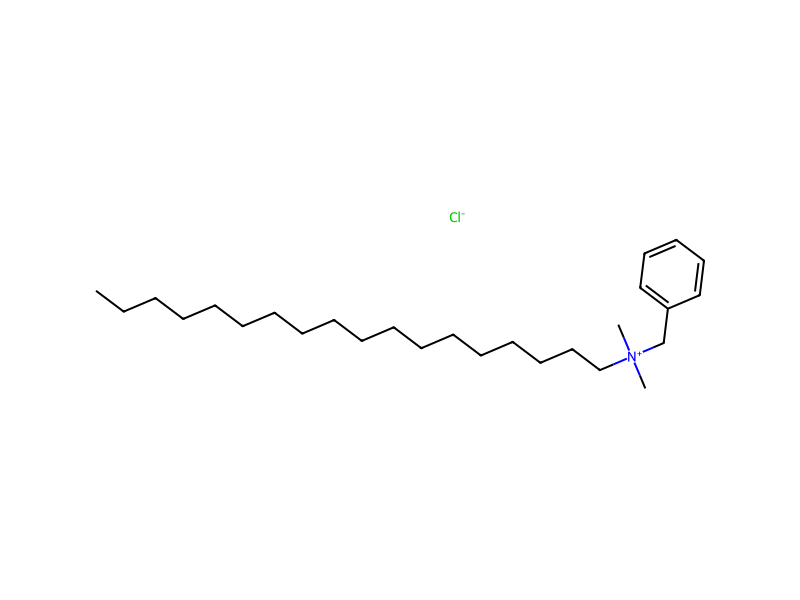
Grundinformationen
- CAS
122-19-0- Standard-SMILES
CCCCCCCCCCCCCCCCCC[N+](C)(C)Cc1ccccc1.[Cl-]- InChIKey
SFVFIFLLYFPGHH-UHFFFAOYSA-M- Summenformel
- C27H50N.Cl
- Durchschnittliche Molmasse
- 424,1 g/mol
- Monoisotopische Masse
- 423,3631783
Überblick
Benzyldimethyloctadecylammonium chloride appears as white solid or thick liquid with a mild odor. (USCG, 1999)
Namen und Bezeichner
- Bevorzugter Name
- Benzyldimethylstearylammonium chloride
- IUPAC
- benzyl-dimethyl-octadecylazanium chloride
- Lokaler Name
- Benzyldimethyl(octadecyl)ammonium-chlorid
- Englischer Name
- Benzyldimethylstearylammonium Chloride
- Summenformel
- C27H50ClN
- Molmasse
- 424.15
Namen und Synonyme
122-19-0Stearyldimethylbenzylammonium chlorideStearalkonium chlorideBENZYLDIMETHYLSTEARYLAMMONIUM CHLORIDEStebacStedbacOrthosan MBCarsoquat sdq-25Quaternol 1Ammonyx 4Carsoquat sdq-85Benzyldimethyloctadecylammonium chloride
Weitere Namen anzeigen
18272bOCTADECYLDIMETHYL BENZYL AMMONIUM CHLORIDESKCjsoftc4ammonyx4
Ammonyx CA specialIntexsan SB-85Ammonyx 490Barquat SB-25Intexan SB-85Algene SC 25Triton X-40Ammonyx 4002
Datenbank-Bezeichner
- CAS
122-19-0- PubChem CID
- 31204
- DTXSID
DTXSID2025139- ChEMBL
CHEMBL118663- UNII
- 0OUO26BB88
- EC Number
- 204-527-9
Eigenschaften
Berechnete Struktureigenschaften
- Polarare Oberfläche (TPSA)
- 0 Ų
- H-Brücken-Donoren
- 0
- H-Brücken-Akzeptoren
- 1
- Frei drehbare Bindungen
- 19
- Schwere Atome
- 29
- Formalladung
- 0
- Komplexität
- 316
Experimentelle und physikochemische Eigenschaften
Chemical ClassesNitrogen Compounds -> Quaternary Amines
Cosmetics
Cosmetic ingredients (Stearalkonium Chloride) -> CIR (Cosmetic Ingredient Review)
Surfactant; Antistatic; Preservative
PesticidesBiocide
LogPlog Kow= 3.23
Density
greater than 1.1 at 68 °F (USCG, 1999)
GREATER THAN 1.1 @ 20 °C (SOLID)
Color/Form
WHITE, CRYSTALLINE POWDER
SOLID OR VISCOUS LIQ, WHITE
Solubility
less than 1 mg/mL at 70 °F (NTP, 1992)
SOL IN WATER, CHLOROFORM, BENZENE, ACETONE, XYLENE
Boiling PointDECOMP @ 120 °C
DecompositionWhen heated to decomposition it emits very toxic fumes of /nitrogen oxides and hydrogen chloride/.
Physical Description
Benzyldimethyloctadecylammonium chloride appears as white solid or thick liquid with a mild odor. (USCG, 1999)
Other Solid; CBI
White solid or viscous liquid; [HSDB] White crystalline powder; [MSDSonline]
Other Experimental PropertiesA QUATERNARY AMMONIUM SALT
Physikochemische Eigenschaften
- Schmelzpunkt
- 54 · 54-56°C
- Dichte
- 0.98 · 0.98
- Dampfdruck
- 0 Pa · 0Pa at 25℃
- storage temp.
- Inert atmosphere,Room Temperature
- Löslichkeit
- Chloroform (Slightly), DMSO (Slightly), Methanol (Slightly)
- Aggregatzustand
- Solid
- Farbe
- White to Off-White
- Geruch (Odor)
- 100 % · at 100.00%. bland
- Wasserlöslichkeit
- 4000 G/L · 4000 G/L (20 ºC)
- Henry's Law Constant
- 2.3 · 2.3×105 mol/(m3Pa) at 25℃, HSDB (2015)
- Kosmetik-Inhaltsstoffe Funktionen
- ANTISTATICSURFACTANT - CLEANSINGPRESERVATIVE
- InChI
- InChI=1S/C27H50N.ClH/c1-4-5-6-7-8-9-10-11-12-13-14-15-16-17-18-22-25-28(2,3)26-27-23-20-19-21-24-27;/h19-21,23-24H,4-18,22,25-26H2,1-3H3;1H/q+1;/p-1
- InChIKey
- SFVFIFLLYFPGHH-UHFFFAOYSA-M
- SMILES
- C1(=CC=CC=C1)C[N+](C)(C)CCCCCCCCCCCCCCCCCC.[Cl-]
- LogP
- 3.89 at · 3.89 at 20℃
- CAS Datenbank
- 122 · 122-19-0(CAS DataBase Reference)
- EPA chemische Informationen
- Dimethyl octadecyl benzyl ammonium chloride (122-19-0)
Sicherheit und Regulatorisches
Sicherheitsangaben dienen nur zur Orientierung und ersetzen weder das Sicherheitsdatenblatt (SDB) des Lieferanten noch geltende Vorschriften oder eine fachliche Bewertung.
GHS-Klassifizierung
GHS Classification
This chemical does not meet GHS hazard criteria for 5.4% (32 of 591) of reports.
Danger
H302 (86.5%): Harmful if swallowed [Warning Acute toxicity, oral]
P260, P264, P264+P265, P270, P280, P301+P317, P301+P330+P331, P302+P361+P354, P304+P340, P305+P354+P338, P316, P317, P321, P330, P363, P405, and P501 (click each P-code to see the statement)
Aggregated GHS information provided per 591 reports by companies from 21 notifications to the ECHA C&L Inventory. Each notification may be associated with multiple companies.
Danger
Gefahrenhinweise
Regulatory Information
Chemical: Benzenemethanaminium, N,N-dimethyl-N-octadecyl-, chloride
Benzenemethanaminium, N,N-dimethyl-N-octadecyl-, chloride (1:1) is listed on the EPA's Chemical Data Reporting (CDR) system. Manufacturers and importers of Benzenemethanaminium, N,N-dimethyl-N-octadecyl-, chloride (1:1) are required to report information about their production and use of this chemical to the EPA under the Toxic Substances Control Act (TSCA). (40 eCFR Part 711)
REACH registered substance: Benzyldimethyl(octadecyl)ammonium chloride (EC: 204-527-9)
Stearalkonium chloride: Does not have an individual approval but may be used under an appropriate group standard
Other Safety InformationEvaluation - Benzalkonium halides
DOT LabelPoison
Fire HazardsSpecial Hazards of Combustion Products: Toxic oxides of nitrogen and hydrochloric acid fumes may form in fires. (USCG, 1999)
Health HazardsIngestion causes gastrointestinal disturbances. Contact with chemical irritates eyes and skin and may damage eyes. (USCG, 1999)
Hazards Summary
A skin and eye irritant; May damage eyes; [HSDB] Allergic contact dermatitis is infrequently documented for quaternary ammonium compounds; [Marks, p. 266] Quaternary ammonium compounds have curare-like properties when concentrated solutions are ingested; Affected patients may have methemoglobinemia and hemolysis and die within 1-3 hours; Elevated liver function tests were reported; Concentrated solutions can cause burns; No data on carcinogenicity or teratogenicity; [IPCS-PIMs] A corrosive substance that can cause injury to the skin, eyes, and respiratory tract; [MSDSonline] See Benzalkonium chloride.
FDA Requirements
The food additive, quaternary ammonium chloride combination, may be safely used in food in accordance with the following conditions: (a) The additive contains the following compounds: ... n-octadecyl dimethyl benzyl ammonium chloride ... (b) The additive meets the following specifications: pH (5% active solution) 7.0-8.0; total amines, maximum 1% as combined free amines and amine hydrochlorides. (c) The additive is used as an antimicrobial agent, as defined in 170.3(o)(2) of this chapter, in raw sugar cane juice. It is added prior to clarification when further processing of the sugar cane must be delayed. (d) The additive is applied to the sugar juice in the following quantities, based on the weight of the raw sugar: ... n-octadecyl dimethyl benzyl ammonium chloride 0.25-1.0 ppm ... .
Reactive GroupNon-Redox-Active Inorganic Compounds
Special ReportsToxicity profile for Benzalkonium Chloride. The British Industrial Biological Research Association. (1989)
Reactivity ProfileBENZYLDIMETHYLOCTADECYLAMMONIUM CHLORIDE is a quaternary ammonium compound.
Air and Water ReactionsInsoluble in water.
Toxic Combustion ProductsTOXIC OXIDES OF NITROGEN & HYDROCHLORIC ACID FUMES MAY FORM IN FIRES.
Sicherheit und Schutzausrüstung
Fire FightingFires involving this material can be controlled with a dry chemical, carbon dioxide or Halon extinguisher. (NTP, 1992)
First Aid
EYES: First check the victim for contact lenses and remove if present. Flush victim's eyes with water or normal saline solution for 20 to 30 minutes while simultaneously calling a hospital or poison control center. Do not put any ointments, oils, or medication in the victim's eyes without specific instructions from a physician. IMMEDIATELY transport the victim after flushing eyes to a hospital even if no symptoms (such as redness or irritation) develop.
Nonfire Spill Response
SMALL SPILLS AND LEAKAGE: Should a spill occur while you are handling this chemical, FIRST REMOVE ALL SOURCES OF IGNITION, then you should dampen the solid spill material with 60-70% ethanol and transfer the dampened material to a suitable container. Use absorbent paper dampened with 60-70% ethanol to pick up any remaining material. Seal the absorbent paper, and any of your clothes, which may be contaminated, in a vapor-tight plastic bag for eventual disposal. Solvent wash all contaminated surfaces with 60-70% ethanol followed by washing with a soap and water solution. Do not reenter the contaminated area until the Safety Officer (or other responsible person) has verified that the area has been properly cleaned.
Disposal Methods
SRP: At the time of review, criteria for land treatment or burial (sanitary landfill) disposal practices are subject to significant revision. Prior to implementing land disposal of waste residue (including waste sludge), consult with environmental regulatory agencies for guidance on acceptable disposal practices.
Preventive Measures
SRP: The scientific literature for the use of contact lenses in industry is conflicting. The benefit or detrimental effects of wearing contact lenses depend not only upon the substance, but also on factors including the form of the substance, characteristics and duration of the exposure, the uses of other eye protection equipment, and the hygiene of the lenses. However, there may be individual substances whose irritating or corrosive properties are such that the wearing of contact lenses would be harmful to the eye. In those specific cases, contact lenses should not be worn. In any event, the usual eye protection equipment should be worn even when contact lenses are in place.
Isolation and EvacuationExcerpt from ERG Guide 154 [Substances - Toxic and/or Corrosive (Non-Combustible)]:
Protective Action Criteria (PAC)
3.8 [mg/m3]
41 [mg/m3]
250 [mg/m3]
Personal Protective Equipment (PPE)
Goggles or face shield; rubber gloves (USCG, 1999)
GOGGLES OR FACE SHIELD; RUBBER GLOVES.
Toxikologische Informationen
Environmental Fate
TERRESTRIAL FATE: Based on a classification scheme(1), an estimated Koc value of 3X10+7(SRC), determined from a structure estimation method(2), indicates that benzyldimethylstearylammonium chloride is expected to be immobile in soil(SRC). Volatilization of benzyldimethylstearylammonium chloride from moist soil surfaces is not expected to be an important fate process(SRC) given an estimated Henry's Law constant of 4.2X10⁻¹¹ atm-cu m/mole(SRC), using a fragment constant estimation method(3). Benzyldimethylstearylammonium chloride is not expected to volatilize from dry soil surfaces(SRC) based upon an estimated vapor pressure of 1.2X10⁻¹³ mm Hg(SRC), determined from a fragment constant method(4).
AQUATIC FATE: Based on a classification scheme(1), an estimated Koc value of 3X10+7(SRC), determined from an estimation method(2), indicates that benzyldimethylstearylammonium chloride is expected to adsorb to suspended solids and sediment in water(SRC). Volatilization from water surfaces is not expected(3) based upon an estimated Henry's Law constant of 4.2X10⁻¹¹ atm-cu m/mole(SRC), developed using a fragment constant estimation method(4). According to a classification scheme(5), an estimated BCF of 71(SRC), from its log Kow of 3.23(2) and a regression-derived equation(6), suggests the potential for bioconcentration in aquatic organisms is moderate. Using the SCAS method and the OECD Confirmatory test, 94 and 95% benzyldimethylstearylammonium chloride was degraded, respectively(8), suggesting that biodegradability in water is likely to be important(SRC).
ATMOSPHERIC FATE: According to a model of gas/particle partitioning of semivolatile organic compounds in the atmosphere(1), benzyldimethylstearylammonium chloride, which has an estimated vapor pressure of 1.2X10⁻¹³ mm Hg at 25 °C(SRC), using a fragment constant estimation method(2), is expected to exist in the particulate phase in the ambient atmosphere. Particulate-phase benzyldimethylstearylammonium chloride may be removed from the air by wet and dry deposition(SRC).
Adverse EffectsNeurotoxin - Other CNS neurotoxin
Toxicity SummarySafe in the present practices of use and concentration. Ingredient, concentration, and use information are available in documents discoverable at https://cir-reports.cir-safety.org
Soil Adsorption/Mobility
Using a structure estimation method based on molecular connectivity indices(1), the Koc for benzyldimethylstearylammonium chloride can be estimated to be 3X10+7(SRC). According to a classification scheme(2), this estimated Koc value suggests that benzyldimethylstearylammonium chloride is expected to be immobile in soil.
Human Toxicity Excerpts
SYMPTOMATOLOGY: 1. INGESTION OF CONCN SOLN LEADS TO IMMEDIATE BURNING PAIN IN MOUTH, THROAT, & ABDOMEN. PROFUSE SALIVATION. 2. HYPOTENSION...SIGNS & SYMPTOMS OF CIRCULATORY SHOCK. 3. ...APPREHENSION, RESTLESSNESS, CONFUSION, & WEAKNESS. /BENZALKONIUM CHLORIDE/
SYMPTOMATOLOGY /AFTER INGESTION OF CONCENTRATED SOLUTION/: 4. ...MUSCLE WEAKNESS...ASSOCIATED WITH...MUSCLE FASCICULATION... 5. CNS DEPRESSION...WEAK CONVULSIVE MOVEMENTS... MAY OR MAY NOT BE DUE TO CEREBRAL ISCHEMIA. 6. LABORED BREATHING & CYANOSIS DUE TO WEAKNESS OF RESP MUSCLES OR TO CIRCULATORY SHOCK. /BENZALKONIUM CHLORIDE/
SYMPTOMATOLOGY /AFTER INGESTION OF CONCENTRATED SOLUTION/: 7. ASPHYXIAL DEATH...TERMINAL CONVULSION, DUE TO PARALYSIS OF MUSCLES OF RESP OR TO CARDIOVASCULAR COLLAPSE. ...DEATH IS EXPECTED...WITHIN 1 OR 2 HR AFTER INGESTION. 8. IF PATIENT SURVIVES A PERIOD OF SEVERE HYPOTENSION, RENAL FAILURE MAY DEVELOP. /BENZALKONIUM CHLORIDE/
INGESTION CAUSES GASTROINTESTINAL DISTURBANCES. CONTACT WITH CHEM IRRITATES EYES & SKIN & MAY DAMAGE EYES.
Poison by intraperitoneal route. Moderately toxic by ingestion. A human skin irritant and severe experimental eye irritant.
Artificial Pollution Sources
Benzyldimethylstearylammonium chloride's production and use in contraceptive formulations(1), in industrial and institutional cleaners, various detergents, emulsion polymerization process, and paper and textile processing(2) may result in its release to the environment through various waste streams(SRC).
Environmental BiodegradationAEROBIC: Benzyldimethystearylammonium chloride did not degrade after 10 days using the MITI test(1). The SCAS method and the OECD Confirmatory test showed 94 and 95% degradation of benzyldimethylstearylammonium chloride, respectively(2).
Environmental Bioconcentration
An estimated BCF of 71 was calculated for benzyldimethylstearylammonium chloride(SRC), using a log Kow of 3.23(1) and a regression-derived equation(2). According to a classification scheme(3), this BCF suggests the potential for bioconcentration in aquatic organisms is moderate.
Volatilization from Water/Soil
The Henry's Law constant for benzyldimethylstearylammonium chloride is estimated as 4.2X10⁻¹¹ atm-cu m/mole(SRC) using a fragment constant estimation method(1). This Henry's Law constant indicates that benzyldimethylstearylammonium chloride is expected to be essentially nonvolatile from water surfaces(2). Benzyldimethylstearylammonium chloride's estimated Henry's Law constant(1) indicates that volatilization from moist soil surfaces will not occur(SRC). Benzyldimethylstearylammonium chloride is not expected to volatilize from dry soil surfaces(SRC) based upon a an estimated vapor pressure of 1.2X10⁻¹³ mm Hg(SRC), determined from a fragment constant method(3).
Non-Human Toxicity Excerpts
BENZYLDIMETHYLSTEARYLAMMONIUM CHLORIDE DID NOT EXERT ANY SELECTIVE EMBRYOPATHIC ACTIVITY WHEN APPLIED TOPICALLY TO PREGNANT RATS DURING THE ORGANOGENIC PERIOD (DAYS 6-15 OF GESTATION) AT DOSAGE REGIMENS ELICITING ADVERSE MATERNAL REACTIONS (LOCAL SKIN REACTIONS).
CAPILLARY PERMEABILITY IN RABBIT AND MOUSE WAS INCREASED WHEN DODECYLDIMETHYLBENZYLAMMONIUM CHLORIDE WAS INTRACUTANEOUSLY INJECTED. THE PERMEABILITY THRESHOLDS WERE 0.01% AND 0.005% WHEN INJECTED INTO RABBIT AND MOUSE, RESPECTIVELY. THE PERMEABILITY THRESHOLD INCREASED 100-200-FOLD IN THE PRESENCE OF A KERATINOUS LAYER.
Environmental Abiotic Degradation
Benzyldimethylstearylammonium chloride is not expected to undergo hydrolysis in the environment due to the lack of hydrolyzable functional groups(3) nor to directly photolyze due to the lack of absorption in the environmental UV spectrum (>290 nm).
Probable Routes of Human Exposure
NIOSH (NOES Survey 1981-1983) has statistically estimated that 25,059 workers (15,638 of these are female) are potentially exposed to benzyldimethylstearylammonium chloride in the US(1). Occupational exposure to benzyldimethylstearylammonium chloride may occur via dermal contact with this compound at workplaces where benzyldimethylstearylammonium chloride is produced or used(SRC). The general population may be exposed to benzyldimethylstearylammonium chloride by using consumer products containing benzyldimethylstearylammonium chloride(SRC).
Regulatorische Informationen
FDA Requirements
The food additive, quaternary ammonium chloride combination, may be safely used in food in accordance with the following conditions: (a) The additive contains the following compounds: ... n-octadecyl dimethyl benzyl ammonium chloride ... (b) The additive meets the following specifications: pH (5% active solution) 7.0-8.0; total amines, maximum 1% as combined free amines and amine hydrochlorides. (c) The additive is used as an antimicrobial agent, as defined in 170.3(o)(2) of this chapter, in raw sugar cane juice. It is added prior to clarification when further processing of the sugar cane must be delayed. (d) The additive is applied to the sugar juice in the following quantities, based on the weight of the raw sugar: ... n-octadecyl dimethyl benzyl ammonium chloride 0.25-1.0 ppm ... .
Sicherheitsdaten
- wgk
- WGK 2
- tsca
- TSCA listed
- hs_code
- 29239000
- RTECS-Nr.
- BO7000000
- risk_code
- 22-38-41-50-34-21/22
- Toxizität
- LD50 oral in rat: 1250mg/kg
- hazard_code
- C,N
- safety_code
- 26-36/37/39-61-45
- Speicherklasse
- 11 - Combustible Solids
- Giftige Stoffe Daten
- 122-19-0(Hazardous Substances Data)
- Hazard Classifications
- Acute Tox. 4 OralAquatic Acute 1Aquatic Chronic 1Eye Dam. 1
Chemie und Industrie
Verwendung und Herstellung
Uses
CIR ingredient: Stearalkonium Chloride
Used as a cationic surfactant, wetting agent, emulsifier, germicide, fungicide, disinfectant, and slimicide; Used in industrial cleaners, emulsion polymerization processes, paper and textile processing, hair colors and conditioners (softener), lipsticks and lotions (emollient), textiles (softener), hair sprays (antistatic agent), and contraceptive formulations; [HSDB] Quaternary ammonium compounds are also used as algaecides/slimicides (swimming pools, industrial water reservoirs, and farm ponds), antiseptics for cleaning wounds, antistatic agents for textiles, softeners for paper products, and pigment dispersers; [IPCS-PIMs]
Pulp and Paper Processing [Category: Industry]
CATIONIC SURFACTANT
SOFTENERS; WETTING AGENTS; EMULSIFIERS; SOME GRADES ARE GERMICIDES, FUNGICIDES, DISINFECTANTS, & SLIMICIDES. /AMMONYX/
Industrial and institutional cleaners, various detergents, emulsion polymerization processes, paper and textile processing.
U.S. Production
2023: <75,000 lb
(1979) PROBABLY GREATER THAN 1.59X10+7 GRAMS
(1981) 1.34X10+9 GRAMS
Consumer UsesSurfactant (surface active agent)
Industry UsesSurfactant (surface active agent)
Methods of ManufacturingREACTION OF DIMETHYL-N-OCTADECYLAMINE WITH BENZYL CHLORIDE
Formulations/Preparations
"AMMONYX" TRADEMARK FOR A SERIES OF QUATERNARY AMMONIUM CHLORIDE DERIVATIVES, IN WHICH THE SUBSTITUENTS ARE METHYL, ETHYL, BENZYL, STEARYL, LAURYL, PHENYL & CETYL GROUPS. /AMMONYX/
"TRITON" TRADEMARK FOR SURFACTANTS BASED ON ALKYLARYL POLYETHER ALC, SULFONATES & SULFATES; NONIONIC, CATIONIC & ANIONIC TYPES; OIL-SOL & WATER-SOL TYPES. SUPPLIED AS VISCOUS LIQ, PASTES, OR AQ SOLN. SURFACE ACTIVITY INCL DETERGENCY, EMULSIFICATION, WETTING, SPREADING, DISPERSING ACTION. /TRITON/
"STEDBAC" TRADEMARK FOR STEARYL DIMETHYL BENZYL AMMONIUM CHLORIDE, A HAIR CONDITIONER USED PRIMARILY IN AFTER-SHAMPOO HAIR RINSES.
Household ProductsInformation on 58 consumer products that contain Stearalkonium chloride in the following categories is provided:
Use ClassificationCosmetics -> Surfactant; Antistatic; Preservative
General Manufacturing Information
All Other Chemical Product and Preparation Manufacturing
Benzenemethanaminium, N,N-dimethyl-N-octadecyl-, chloride (1:1): ACTIVE
(Union Carbide). /Trade mark/ for specialty surfactants that are alcohol and ethoxylates, alkoxylates, sulfates, sulfonates, sulfosuccinates, or phosphate esters. /Triton/
Anwendungen
VerwendenStearyldimethylbenzylammonium chloride is a compound used in products for promoting skin cleanliness and health. It is used in hair care formulations, as a hair conditioner and cream rinse.
Darstellung
synthetischeSynthesis of benzyldimethylstearylammonium chloride: put 450kg of dimethyl octadecylamine into the reaction kettle, heat to 80~85℃, and slowly add 180kg of benzyl chloride under stirring in 1.5~2h. Keep warm at 80~90℃ during the drop addition. After the dosing is completed, increase the temperature to 100~105℃, hold the reaction for several hours and take samples to measure the pH value. When the pH value of 1% aqueous solution reaches 6~6.5, the reaction is completed. Cool down to 60℃ and discharge to get benzyldimethylstearylammonium chloride.
Vor- und nachgelagerte Produkte
Vorgelagerte Rohstoffe
Zugehörige Reaktionen
1
Notizen zur Verbindung
Wird geladen…