StartseiteMCPWorkbenchSkills
StartseiteWorkbenchBenachrichtigungenMein Bereich
llms.txt · MCP-AnleitungDatenschutz · Nutzungsbedingungen · Supportv1.8.0
  1. Startseite
  2. /Verbindung

N-Methylformamid

N-Methylformamide

HCID 31254
Neue NotizNeue ReaktionAnfrage stellen
Druckvorschau

Daten werden ergänzt – lade die Seite später neu, um den aktuellen Stand zu sehen

GrundinformationenNamen und BezeichnerEigenschaftenSicherheit und RegulatorischesChemie und IndustrieZugehörige ReaktionenNotizen zur Verbindung
TeilstruktursucheÄhnliche Strukturen suchen

Grundinformationen

CAS
123-39-7
Standard-SMILES
CNC=O
InChIKey
ATHHXGZTWNVVOU-UHFFFAOYSA-N
Summenformel
C2H5NO
Durchschnittliche Molmasse
59,07 g/mol
Monoisotopische Masse
59,03711378

Namen und Bezeichner

Bevorzugter Name
N-Methylformamide
IUPAC
N-methylformamide
Lokaler Name
N-Methylformamid
Englischer Name
N-Methylformamide
Summenformel
C2H5NO
Molmasse
59.07

Namen und Synonyme

N-METHYLFORMAMIDE123-39-7MethylformamideFormamide, N-methyl-MonomethylformamideN-Monomethylformamiden-methyl-FormamideNSC 3051EK 7011Formic acid amide, N-methyl-X 188XPE4G7Y986
Weitere Namen anzeigen
NMFN-MethylmethanamideN-FORMYLMETHYLAMINEx188ek7011
DTXSID0025608NSC3051NSC-3051CHEBI:7438formylmethylamineFormamide, N-methylRefChem:830717DTXCID905608

Datenbank-Bezeichner

CAS
123-39-7
PubChem CID
31254
DTXSID
DTXSID0025608
ChEMBL
CHEMBL9240
ChEBI
CHEBI:7438
UNII
XPE4G7Y986
EC Number
204-624-6
Nikkaji
J2.498H

Eigenschaften

Berechnete StruktureigenschaftenWird ergänzt

XLogP
-1
Polarare Oberfläche (TPSA)
29,1 Ų
H-Brücken-Donoren
1
H-Brücken-Akzeptoren
1
Frei drehbare Bindungen
0
Schwere Atome
4
Formalladung
0
Komplexität
20

Experimentelle und physikochemische Eigenschaften

LogP · 3 Einträge

log Kow = -0.97

-0.97

-0.0624

Density · 4 Einträge

1.011 at 66 °F (NTP, 1992) - Denser than water; will sink

0.9961 g/cu cm @ 25 °C

Density (at 20 °C): 1.003 g/cm³

0.9961 @25 °C

Viscosity1.99 mN/s/m @ 15 °C; 1.65 mN/s/m @ 25 °C
Solubility · 6 Einträge

greater than or equal to 100 mg/mL at 68 °F (NTP, 1992)

Very soluble in acetone, ethanol.

Miscible in water

1000 mg/mL at 25 °C

Solubility in water: good

Water miscible

Flash Point · 3 Einträge

208 °F (NTP, 1992)

98 °C

98 °C c.c.

Boiling Point · 3 Einträge

356 to 365 °F at 760 mmHg (NTP, 1992)

180-185 °C

182.5 °C

DecompositionWhen heated to decomposition it emits toxic fumes of /nitrogen oxides/.

Sicherheit und Regulatorisches

Sicherheitsangaben dienen nur zur Orientierung und ersetzen weder das Sicherheitsdatenblatt (SDB) des Lieferanten noch geltende Vorschriften oder eine fachliche Bewertung.

GHS-Klassifizierung

GHS Classification · 6 Einträge

Danger

H312: Harmful in contact with skin [Warning Acute toxicity, dermal];H360D ***: May damage the unborn child [Danger Reproductive toxicity]

P203, P280, P302+P352, P317, P318, P321, P362+P364, P405, and P501 (click each P-code to see the statement)

Danger

Gefahrenhinweise

Regulatory Information · 4 Einträge

Chemical: Formamide, N-methyl-

Hazard Traits - Reproductive Toxicity;Authoritative List - EC Annex VI CMRs - Cat. 1B;Report - if used as a fragrance or flavor ingredient

Status: Active Update: 29-10-2012 https://echa.europa.eu/registration-dossier/-/registered-dossier/6092;Status: Active Update: 24-02-2014 https://echa.europa.eu/registration-dossier/-/registered-dossier/12311;Status: Active Update: 11-11-2014 https://echa.europa.eu/registration-dossier/-/registered-dossier/7551

Methylformamide: Does not have an individual approval but may be used under an appropriate group standard

Other Safety InformationIMAP assessments - Formamide, N-methyl-: Environment tier I assessment;IMAP assessments - Formamide, N-methyl-: Human health tier I assessment
Fire Hazards · 2 Einträge

This chemical is combustible. (NTP, 1992)

Combustible.

Fire PotentialA very dangerous fire hazard when exposed to heat or flame.
Health Hazards · 1 Eintrag

SYMPTOMS: Symptoms of exposure to this compound include irritation of the mucous membranes and upper respiratory tract. Other symptoms include liver damage, eye irritation with discomfort, tearing or blurring of vision, skin irritation with discomfort or rash, abnormalities of liver function with jaundice, temporary nervous system depression with anesthetic effects such as dizziness, headache, confusion, incoordination and loss of consciousness.;ACUTE/CHRONIC HAZARDS: This compound may be absorbed through the skin and cause skin irritation. It may also irritate the eyes, mucous membranes and upper respiratory tract. When heated to decomposition it emits toxic fumes of carbon monoxide, carbon dioxide and nitrogen oxides. (NTP, 1992)

Chemie und Industrie

Pharmakologische Informationen

Mechanism of Action · 1 Eintrag

The mechanism by which NMF causes hepatotoxicity is currently under investigation. Evidence is accumulating which suggests that a reactive metabolite of NMF is involved. In vitro NMF was cytotoxic only at concns in the 0.1 M range whereas the maximum NMF concn in the plasma of animals which showed evidence of hepatotoxicity was below 0.01 M. The hypothesis that a reactive metabolite is formed which might be responsible for NMF-induced hepatotoxicity is supported by the following findings: 1) NMF caused the depletion of hepatic glutathione levels in vivo, & in hepatocytes in vitro; 2) an NMF metabolite (or metabolites) was covalently bound to liver microsomal protein; & 3) pretreatment of mice with cysteine or N-acetylcysteine protected against NMF-induced hepatotoxicity. Liver mitochondria may be a target for the reactive metab, as NMF has been shown to inhibit the ability of mouse liver mitochondria to sequester calcium ions when a hepatotoxic dose was admin ip.

Metabolism/Metabolites · 3 Einträge

It is known that dimethylformamide is metabolized in man by sequential N-demethylation to methylformamide & formamide, which are largely eliminated in the urine.

In mice, NMF is metabolized mainly to carbon dioxide, which is exhaled with the breath, & to methylamine, which is excreted with the urine. Of the radioactivity injected with [C14]formyl-NMF (400 mg/kg), 39% was exhaled as carbon dioxide. The amount of the drug excreted unchanged in the urine in mice was only 26% & 15% of the dose was metabolized to methylamine. A mercapturate, N-acetyl-S-(N-methylcarbamoyl)cysteine was identified as a major metabolite of NMF in the urine of mice, rats, & patients. Formation of the novel metabolite involves oxidation of the formyl moiety & subsequent conjugation with glutathione. On GLC analysis of the urine of mice which had received NMF, small amounts of formamide were also detected. Some evidence suggests that this metabolite was actually N-hydroxy-methylformamide, the immediate product of N-methyl-C-hydroxylation of NMF, & not formamide. N-Hydroxymethylformamide, like N-hydroxymethyl-N-methylformamide, the principal metabolite of dimethylformamide, is thermally labile & breaks down to give formamide & formaldehyde; but it is stable in aqueous soln. In alkaline soln N-hydroxymethylformamide undergoes facile hydrolysis. Only 14% of the radioactivity injected with [C14]methyl-NMF was exhaled as labeled carbon dioxide. Formate was not a urinary metabolite of NMF in mice.

Zugehörige Reaktionen

140
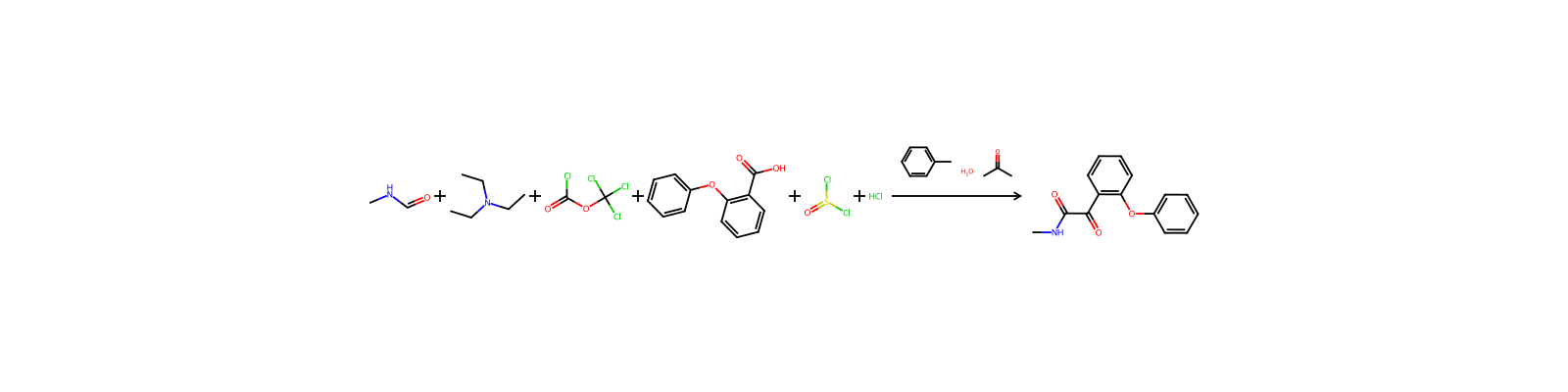
Reaktionsaufzeichnung erstellen
Reaktionsgleichung von HRID 13491
HRID 13491als Eduktuspto-grants-2010_06
Reaktionsgleichung von HRID 36431
HRID 36431als Eduktuspto-grants-1995_05
Reaktionsgleichung von HRID 78297
HRID 78297als Eduktuspto-grants-2014_09
Reaktionsgleichung von HRID 132087
HRID 132087als Eduktuspto-grants-2008_06
Reaktionsgleichung von HRID 137228
HRID 137228als EduktTraining data from https://doi.org/10.1039/C8SC04228D (9/10)
Reaktionsgleichung von HRID 166088
HRID 166088als EduktTraining data from https://doi.org/10.1039/C8SC04228D (9/10)
Reaktionsgleichung von HRID 196256
HRID 196256als EduktTraining data from https://doi.org/10.1039/C8SC04228D (6/10)
Reaktionsgleichung von HRID 199742
HRID 199742als EduktTraining data from https://doi.org/10.1039/C8SC04228D (6/10)
Seite 1 von 18

Notizen zur Verbindung

Wird geladen…

Auf dieser SeiteGrundinformationenNamen und BezeichnerEigenschaftenSicherheit und RegulatorischesChemie und IndustrieZugehörige ReaktionenNotizen zur Verbindung
Weitere Aktionen
Neue NotizNeue ReaktionAnfrage stellen
Melting Point · 4 Einträge

-40 °F (NTP, 1992)

-5.4 °C

-3.8 °C

-3 °C

Vapor DensityRelative vapor density (air = 1): 2.04
Vapor Pressure · 4 Einträge

0.2 mmHg at 77 °F (NTP, 1992)

0.25 [mmHg]

0.253 mm Hg @ 25 °C

0.253 [mm Hg] @25 °C

Surface Tension37.96 dynes/cm @ 30 °C; 35.02 dynes/cm @ 50 °C
Refractive IndexIndex of refraction: 1.4319 @ 20 °C/D

Physikochemische Eigenschaften

Schmelzpunkt
-4 °C · -4 °C (lit.)
Siedepunkt
198 · 198-199 °C (lit.)
Dichte
1.011 g/mL · 1.011 g/mL at 25 °C (lit.)
Dampfdruck
20 Pa · 20Pa at 20℃
Brechungsindex
20 · n20/D 1.432(lit.)
Flammpunkt
230 °F · >230 °F
storage temp.
Sealed in dry,Room Temperature
Löslichkeit
soluble in water, chloroform, alcohols, acetone, ethylacetate but not in diethyl ether and petroleum ether
pka
16.48 · 16.48±0.23(Predicted)
Aggregatzustand
Liquid
Farbe
Clear colorless
Geruch (Odor)
strong odor
Wasserlöslichkeit
miscible
Spezifische Wärmekapazität
2.1 J/ · Cp(liquid): 2.1 J/(g·K), at 25℃
Merck
14 · 14,6076
BRN
1098352 · 1098352
Henry's Law Constant
1.4 · 1.4×103 mol/(m3Pa) at 25℃, Burkholder et al. (2019)
Dielectric constant
171 · 171.0
InChI
1S/C2H5NO/c1-3-2-4/h2H,1H3,(H,3,4)
InChIKey
ATHHXGZTWNVVOU-UHFFFAOYSA-N
SMILES
[H]C(=O)NC
LogP
-0.97 · -0.97
CAS Datenbank
123 · 123-39-7(CAS DataBase Reference)
NIST chemische Informationen
Formamide, N-methyl-(123-39-7)
EPA chemische Informationen
N-Methylformamide (123-39-7)
Hazards Summary · 1 Eintrag

An eye irritant; May cause liver injury; [ICSC] TLV Basis: Embryo/fetal injury; teratogenic effects; liver injury; A more recent phase I study using oral administration of NMF found elevated hepatic enzymes, mild myelosuppression and worsening of preexistent toxic peripheral neuropathies at 700 mg/m2 (227 mg/kg); [ACGIH] An eye irritant; May cause liver injury; Peripheral neuropathy has been observed in patients during clinical trials; Teratogenic and embryotoxic; Emergency treatment: Dimethylformamide; [HSDB] An eye, mucous membrane, and upper respiratory tract irritant; Can be absorbed through skin; May cause temporary nervous system depression and liver damage; [CAMEO] Irritating to rabbit eyes; Dramatically reduced body weights and increased liver enzymes in 2-week inhalation study of rats at highest dose (970 mg/m3); In rats fed by gavage, over 50% of fetuses malformed at the highest dose tested (75 mg/kg/day), a maternally toxic dose; Similar results obtained in study of rabbits; [EPA HPV] Causes hepatitis in five-day, intermittent, intravenous study of dogs; [RTECS] Embryotoxic in animals at doses maternally toxic; [REPROTOX] An irritant; [Alfa Aesar MSDS] See Dimethylformamide.

Reactive GroupAmides and Imides
EC ClassificationSymbol: T; R: 61-21; S: 53-45; Note: E
Reactivity Profile · 1 Eintrag

N-METHYLFORMAMIDE is incompatible with benzene sulfonyl chloride. It is also incompatible with strong oxidizing agents, acids, bases and acid chlorides. It may react with chlorine, bromine, nitrates, nitric acid, triethylaluminum, potassium permanganate, chromic acid, chromic anhydride, chromium trioxide, borohydrides, hydrides, thionyl chloride, metallic sodium, phosphorus trioxide, diborane, (octafluoroisobutyrate + sodium nitrite) and (perchloryl fluoride + potassium methyl 4,4-dinitrobutyrate). (NTP, 1992)

Chemical DangersDecomposes on heating and on burning. This produces nitrogen oxides. Reacts with strong oxidants. Attacks some forms of plastic and rubber.
Air and Water ReactionsWater soluble.
Toxic Combustion ProductsWhen heated to decomposition it emits toxic fumes of /nitrogen oxides/.

Sicherheit und Schutzausrüstung

Fire Fighting · 2 Einträge

Fires involving this material can be controlled with a dry chemical, carbon dioxide or Halon extinguisher. A water spray may also be used. (NTP, 1992)

Use powder, carbon dioxide. In case of fire: keep drums, etc., cool by spraying with water.

First Aid Measures · 4 Einträge

Fresh air, rest. Refer for medical attention.

Rinse skin with plenty of water or shower.

First rinse with plenty of water for several minutes (remove contact lenses if easily possible), then refer for medical attention.

Rinse mouth. Rest. Refer for medical attention .

First Aid · 1 Eintrag

EYES: First check the victim for contact lenses and remove if present. Flush victim's eyes with water or normal saline solution for 20 to 30 minutes while simultaneously calling a hospital or poison control center. Do not put any ointments, oils, or medication in the victim's eyes without specific instructions from a physician. IMMEDIATELY transport the victim after flushing eyes to a hospital even if no symptoms (such as redness or irritation) develop.;SKIN: IMMEDIATELY flood affected skin with water while removing and isolating all contaminated clothing. Gently wash all affected skin areas thoroughly with soap and water. If symptoms such as redness or irritation develop, IMMEDIATELY call a physician and be prepared to transport the victim to a hospital for treatment.;INHALATION: IMMEDIATELY leave the contaminated area; take deep breaths of fresh air. If symptoms (such as wheezing, coughing, shortness of breath, or burning in the mouth, throat, or chest) develop, call a physician and be prepared to transport the victim to a hospital. Provide proper respiratory protection to rescuers entering an unknown atmosphere. Whenever possible, Self-Contained Breathing Apparatus (SCBA) should be used; if not available, use a level of protection greater than or equal to that advised under Protective Clothing.;INGESTION: DO NOT INDUCE VOMITING. If the victim is conscious and not convulsing, give 1 or 2 glasses of water to dilute the chemical and IMMEDIATELY call a hospital or poison control center. Be prepared to transport the victim to a hospital if advised by a physician. If the victim is convulsing or unconscious, do not give anything by mouth, ensure that the victim's airway is open and lay the victim on his/her side with the head lower than the body. DO NOT INDUCE VOMITING. IMMEDIATELY transport the victim to a hospital. (NTP, 1992)

Safe StorageSeparated from oxidants.
Nonfire Spill Response · 1 Eintrag

SMALL SPILLS AND LEAKAGE: If you should spill this chemical, use absorbent paper to pick up all liquid spill material. Seal the absorbent paper, as well as any of your clothing which may be contaminated, in a vapor-tight plastic bag for eventual disposal. Wash any surfaces you may have contaminated with a soap and water solution. Do not reenter the contaminated area until the Safety Officer (or other responsible person) has verified that the area has been properly cleaned.;STORAGE PRECAUTIONS: You should store this material under ambient temperatures and keep away from oxidizers. (NTP, 1992)

Disposal Methods · 1 Eintrag

SRP: At the time of review, criteria for land treatment or burial (sanitary landfill) disposal practices are subject to significant revision. Prior to implementing land disposal of waste residue (including waste sludge), consult with environmental regulatory agencies for guidance on acceptable disposal practices.

Spillage DisposalPersonal protection: chemical protection suit including self-contained breathing apparatus. Collect leaking liquid in covered containers.
Preventive Measures · 1 Eintrag

SRP: The scientific literature for the use of contact lenses in industry is conflicting. The benefit or detrimental effects of wearing contact lenses depend not only upon the substance, but also on factors including the form of the substance, characteristics and duration of the exposure, the uses of other eye protection equipment, and the hygiene of the lenses. However, there may be individual substances whose irritating or corrosive properties are such that the wearing of contact lenses would be harmful to the eye. In those specific cases, contact lenses should not be worn. In any event, the usual eye protection equipment should be worn even when contact lenses are in place.

Eye PreventionWear safety goggles.
Fire PreventionNO open flames.
Inhalation RiskNo indication can be given about the rate at which a harmful concentration of this substance in the air is reached on evaporation at 20 °C.
Skin PreventionProtective gloves.

Toxikologische Informationen

Body Burden · 1 Eintrag

The concn of N-methylformamide in urine was 7.7 mg/l and 23.3 mg/l before shift and after shift, respectively, for workers exposed to N,N-dimethylformamide at a synthetic leather factory(1). N-Methylformamide is a metabolite of N,N-dimethylformamide(1).

Interactions · 4 Einträge

SIMULTANEOUS TREATMENT OF PREGNANT RATS AND MICE WITH SODIUM NITRITE (0.5-0.75% IN DRINKING WATER ON DAYS 11-15 OF GESTATION) AND N-METHYLUREA, N,N'-DIMETHYLUREA OR N,N,N-TRIMETHYLUREA (1000, 1000 OR 500 MG/KG IP, RESPECTIVELY, ON DAY 11 OR 13 OF GESTATION) PRODUCED THE SAME TERATOGENIC EFFECTS AS TREATMENT WITH THE NITROSYLATED HOMOLOGS OF THESE METHYLUREAS. TREATMENT OF RATS WITH SODIUM NITRITE & N-METHYLFORMAMIDE PRODUCED GREATER TERATOGENIC EFFECTS THAN TREATMENT WITH N-ALKYL CARBOXYLIC ACID AMIDE ALONE.

N-METHYLFORMAMIDE (1.8 G/KG IV) DECR HYPERTENSION INDUCED BY INDIRECTLY ACTING AMINES TYRAMINE & EPHEDRINE.

Admin of NMF on 4 consecutive days enhanced the sleeping time caused by pentobarbital in male rats to 565% of controls & reduced to a moderate extent the activities of rat hepatic cytochrome P-450 & cytochrome c reductase.

Like dimethylformamide NMF or its metabolites appear to interact with the metab of ethanol. Admin of 2 or 20 mmol/kg NMF to rats 3 or 18 hr before ethanol (both orally) induced an elevation in blood acetaldehyde levels. In the case of high doses of NMF admin 18 hr before alcohol, the level of ethanol in the blood was also raised significantly over controls.

Environmental Fate · 3 Einträge

TERRESTRIAL FATE: Based on a classification scheme(1), an estimated Koc value of 7(SRC), determined from a log Kow of -0.97(2) and a regression-derived equation(3), indicates that N-methylformamide is expected to have very high mobility in soil(SRC). Volatilization of N-methylformamide from moist soil surfaces is not expected to be an important fate process(SRC) given an estimated Henry's Law constant of 2.0X10⁻⁸ atm-cu m/mole(SRC), derived from its vapor pressure, 0.25 mm Hg(4), and water solubility, 1.0X10+6 mg/l(5). N- Methylformamide is not expected to volatilize from dry soil surfaces(SRC) based upon a vapor pressure of 0.25 mm Hg(4). N-methylformamide has been shown to biodgrade by microorgansism obtained through soil enrichment(6), suggesting that N-methylformamide may biodegrade in soil(SRC).

AQUATIC FATE: Based on a classification scheme(1), an estimated Koc value of 7(SRC), determined from a log Kow of -0.97(2) and a regression-derived equation(3), indicates that N-methylformamide is not expected to adsorb to suspended solids and sediment(SRC). Volatilization from water surfaces is not expected(3) based upon an estimated Henry's Law constant of 2.0X10⁻⁸ atm-cu m/mole(SRC), derived from its vapor pressure, 0.25 mm Hg(4), and water solubility, 1.0X10+6 mg/l(5). According to a classification scheme(6), an estimated BCF of 3(SRC), from its log Kow(2) and a regression-derived equation(7), suggests the potential for bioconcentration in aquatic organisms is low(SRC). N-Methylformamide, present at 400 mg/l, reached 4%, 98%, and 100% of its theoretical BOD in 3 hrs, 3 days, and 7 days, respectively, using an industrial activated sludge inoculum and the Zahn-Wellens test(8). Using the BOD test, N-methylformamide achieved 2% of its theoretical BOD after 5 days(8), suggesting that N-methylformamide may biodegrade in the aquatic environment(SRC).

ATMOSPHERIC FATE: According to a model of gas/particle partitioning of semivolatile organic compounds in the atmosphere(1), N-methylformamide, which has a vapor pressure of 0.253 mm Hg at 25 °C(2), is expected to exist solely as a vapor in the ambient atmosphere(SRC). Vapor-phase N-methylformamide is degraded in the atmosphere by reaction with photochemically-produced hydroxyl radicals(SRC); the half-life for this reaction in air is estimated to be 57 hours(SRC), calculated from its rate constant of 6.8X10⁻¹² cu cm/molecule-sec at 25 °C(SRC) determined using a structure estimation method(3).

Adverse Effects · 1 Eintrag

Neurotoxin - Acute solvent syndrome;Occupational hepatotoxin - Secondary hepatotoxins: the potential for toxic effect in the occupational setting is based on cases of poisoning by human ingestion or animal experimentation.;Reproductive Toxin - A chemical that is toxic to the reproductive system, including defects in the progeny and injury to male or female reproductive function. Reproductive toxicity includes developmental effects. See Guidelines for Reproductive Toxicity Risk Assessment.

Exposure RoutesThe substance can be absorbed into the body by inhalation, through the skin and by ingestion.
Signs and Symptoms · 2 Einträge

Cough.

Redness. Pain.

Soil Adsorption/Mobility · 1 Eintrag

The Koc of N-methylformamide is estimated as 7(SRC), using a log Kow of -0.97(1) and a regression-derived equation(2). According to a classification scheme(3), this estimated Koc value suggests that N-methylformamide is expected to have very high mobility in soil(SRC).

Human Toxicity Excerpts · 4 Einträge

The major potential of NMF is its ability to cause liver damage. NMF is also teratogenic & embryotoxic. It appears to be more toxic than its methyl homologue, dimethylformamide, or its N-desmethyl analogue, formamide.

As NMF is an investigational anticancer drug, a number of clinical trials have been conducted with this chemical. The first clinical evaluation was initiated in 1956. Five patients were treated with NMF; all but one patient received the drug orally. The dose ranged from 0.1-4 g/day for 2-36 days. All patients showed symptoms of toxicity- chiefly anorexia, nausea, & vomiting. Hepatic damage as measured by liver function tests was seen in all patients at total doses between 80-870 mg/kg. The liver damage appeared to be reversible with cessation of treatment. Autopsy exam of the liver of one patient showed irregular lobular disorganization, some large hepatocytes & areas of liver regeneration.

... /NMF was administered/ iv & orally to 19 patients at a starting dose of 300 mg/sq m/day for 5 days. Treatment cycles were repeated every 2 wk & doses were escalated to 1200 mg/sq m/day for 5 days. /In another study/ 35 patients /were treated/ with NMF iv at doses ranging from 125-3125 mg/sq m weekly every 6 wk. The principal toxic effects of NMF were general malaise, nausea, vomiting & anorexia. Biochemical disturbances included reversible elevation of serum levels of transaminases in several patients. The occurrence of raised serum enzyme levels did not seem to be related to the dose. Other toxic symptoms were peripheral neuropathy & alcohol intolerance in a few patients.

/N-methylformamide/ is an eye irritant.

Fish/Seafood ConcentrationsN-Methylformamide has been detected at concns of 0.09 and 4.06 ug/g in two samples of mussel collected at the Oarai Coast in Ibaraki, Japan on July 31, 1985 and July 31, 1986, respectively(1).
Artificial Pollution Sources · 1 Eintrag

N-Methylformamide's production and use as an intermediate in the synthesis of pesticides; as an extraction solvent for aromatic hydrocarbons(1); and in the manufacture of methyl isocyanate(2); may result in its release to the environment through various waste streams(SRC). N-Methylformamide has been detected in cigarette smoke(3). N-Methylformamide may be also released to the atmosphere as a result of the photolysis of dimethylamine or trimethylamine(4), and may occur in water as a result of photolysis of the aquatic herbicide fluridone(5).

Environmental Biodegradation · 1 Eintrag

AEROBIC: N-Methylformamide, present at 400 mg/l, reached 4%, 98%, and 100% of its theoretical BOD in 3 hrs, 3 days, and 7 days, respectively, using an industrial activated sludge inoculum and the Zahn-Wellens test(1). Using the BOD test, N-methylformamide achieved 2% of its theoretical BOD after 5 days(1). N-Methylformamide has also been shown to biodegrade by microorgansism obtained through soil enrichment(2). Therefore, N-methylformamide may biodegrade in the environment(SRC).

Environmental Bioconcentration · 1 Eintrag

An estimated BCF of 3 was calculated for N-methylformamide(SRC), using a log Kow of -0.97(1) and a regression-derived equation(2). According to a classification scheme(3), this BCF suggests the potential for bioconcentration in aquatic organisms is low(SRC).

Regulatorische Informationen

Regulatory Information · 4 Einträge

Chemical: Formamide, N-methyl-

Hazard Traits - Reproductive Toxicity;Authoritative List - EC Annex VI CMRs - Cat. 1B;Report - if used as a fragrance or flavor ingredient

Status: Active Update: 29-10-2012 https://echa.europa.eu/registration-dossier/-/registered-dossier/6092;Status: Active Update: 24-02-2014 https://echa.europa.eu/registration-dossier/-/registered-dossier/12311;Status: Active Update: 11-11-2014 https://echa.europa.eu/registration-dossier/-/registered-dossier/7551

Methylformamide: Does not have an individual approval but may be used under an appropriate group standard

Sicherheitsdaten

wgk
1
tsca
TSCA listed
hs_code
29241990
RTECS-Nr.
LQ3000000
risk_code
61-21-R61-R21
Toxizität
LD50 in mice (mg/kg): 2300 i.p.; 2600 orally; 1580 i.v.; 2700 i.m. (Langdon)
hazard_code
T
safety_code
53-45-S53-S45
packing_group
II
Speicherklasse
6.1C - Combustible acute toxic Cat.3toxic compounds or compounds which causing chronic effects
Giftige Stoffe Daten
123-39-7(Hazardous Substances Data)
Hazard Classifications
Acute Tox. 4 DermalRepr. 1B

N-methylformamide has known human metabolites that include Methyl Isocyanate.

MeSH Pharmacological Classification · 2 Einträge

Substances that inhibit or prevent the proliferation of NEOPLASMS.

Drugs used to potentiate the effectiveness of radiation therapy in destroying unwanted cells.

Absorption, Distribution and Excretion · 2 Einträge

8 healthy male subjects were exposed to dimethylformamide vapor at a concn of 8.79 + or - 0.33 ppm for 6 hr/day for 5 consecutive days. All urine voided by the subjects was collected from the beginning of the first exposure to 24 hr past the end of the last exposure & each sample was analyzed for monomethylformamide. Monomethylformamide was rapidly eliminated from the body with urine values peaking within a few hr following the end of each exposure period. The mean for the 7 hr (end of exposure) sample was 4.74 ug/ml urine or 736.8 ug.

Dimethylformamide reached an average level of 2.8 mg/l in the blood of subjects exposed to 21 ppm of the vapor for 4 hr, & was undetectable at 4 hr after the exposure; the metabolite, methylformamide, averaged between 1 & 2 mg/l in the blood & this level was maintained for at least 4 hr after exposure. Maximal blood levels of about 14 & 8 mg/l were observed for dimethylformamide & methylformamide, respectively, at 0 & 3 hrs, after a 4 hr exposure to 87 ppm of the vapor. Repeated daily exposures to 21 ppm of dimethylformamide did not result in accumulation of the chemical or its metabolite in blood. /Dimethylformamide and methylformamide/

Verwendung und Herstellung

Uses · 4 Einträge

Used to make pesticides and methyl isocyanate and as an extraction solvent for aromatic hydrocarbons; [HSDB] Photodegradation product of Fluridone (herbicide) and metabolite of dimethylformamide (CAS# 68-12-2); [REPROTOX]

Farming (Pesticides) [Category: Industry]

The substance is used as an intermediate in the synthesis of pesticides; extraction solvent for aromatic hydrocarbons.

In the manufacture of methyl isocyanate.

Methods of Manufacturing · 2 Einträge

BY HEATING THE METHYLAMINE SALT; OR BY REACTION OF METHYLAMINE WITH METHYL OR ETHYL FORMATE

Methyl formate + methylamine (amide formation)

General Manufacturing InformationFormamide, N-methyl-: ACTIVE

Anwendungen

VerwendenN-Methylformamide is used in amidation or transamidation chemical reactions where formamide is insufficient.

Vor- und nachgelagerte Produkte

Vorgelagerte Rohstoffe

KohlenmonoxidAmeisensäure-ethylesterMethylamin, gasförmigAmeisensureMethylformiat1,1-Dimethyl-2-methylenehydrazineN,N-DimethylnitrosamindimethylnitramineN-Methylmethanamin, gasförmigcarbon monoxide

Nachgelagerte Produkte

2-(Methylamino)pyridinN-Methylbis(2,4-xylyliminomethyl)-aminN,alpha-dimethylcyclohexaneethylamineN-methylquinolin-2-amineCyclopentyl-methyl-amine5-broMo-N,3-diMethylpyridin-2-aMineN-desmethylchlorpheniramineFormamide, N-(2-phenylethyl)-Telatinib1,3-Oxazolidine

Ergänzende Hinweise

DefinitionChEBI: N-methylformamide is a member of the class of formamides having a N-methyl substituent. It is functionally related to a formamide.