StartseiteMCPWorkbenchSkills
StartseiteWorkbenchBenachrichtigungenMein Bereich
llms.txt · MCP-AnleitungDatenschutz · Nutzungsbedingungen · Supportv1.8.0
  1. Startseite
  2. /Verbindung

Diallylamine

HCID 31279
Neue NotizNeue ReaktionAnfrage stellen
Druckvorschau
GrundinformationenÜberblickNamen und BezeichnerEigenschaftenSicherheit und RegulatorischesChemie und IndustrieZugehörige ReaktionenNotizen zur Verbindung
TeilstruktursucheÄhnliche Strukturen suchen

Grundinformationen

CAS
124-02-7
Standard-SMILES
C=CCNCC=C
InChIKey
DYUWTXWIYMHBQS-UHFFFAOYSA-N
Summenformel
C6H11N
Durchschnittliche Molmasse
97,16 g/mol
Monoisotopische Masse
97,08914935

Überblick

Diallylamine appears as a liquid with a disagreeable odor. Less dense than water. May be toxic by inhalation and skin absorption. Irritates skin and eyes. Used to make other chemicals.

Namen und Bezeichner

Bevorzugter Name
Diallylamine
IUPAC
N-prop-2-enylprop-2-en-1-amine
Englischer Name
N,N-Diallylamine
Summenformel
C6H11N
Molmasse
97.15824

Namen und Synonyme

Diallylamine124-02-7CCRIS 4776DTXSID1024918HSDB 5471N-2-PROPENYL-2-PROPEN-1-AMINEUNII-N18EXB6V6PEINECS 204-671-2N18EXB6V6PNSC 20948UN2359BRN 0773718
Weitere Namen anzeigen
AI3-15324DIALLYLAMINE [MI]NSC-20948N,N-Di(2-propenyl)amine(CH2=CHCH2)2NHDTXCID7049184-04-00-01060 (Beilstein Handbook Reference)UN 2359

Datenbank-Bezeichner

CAS
124-02-7
PubChem CID
31279
DTXSID
DTXSID1024918
ChEMBL
CHEMBL3186706
UNII
N18EXB6V6P
EC Number
204-671-2
Nikkaji
J2.503H

Eigenschaften

Berechnete Struktureigenschaften

XLogP
1,1
Polarare Oberfläche (TPSA)
12 Ų
H-Brücken-Donoren
1
H-Brücken-Akzeptoren
1
Frei drehbare Bindungen
4
Schwere Atome
7
Formalladung
0
Komplexität
49,2

Experimentelle und physikochemische Eigenschaften

Chemical Classes · 2 Einträge

Nitrogen Compounds -> Amines, Aliphatic

Flammable agents - 3rd degree

SpringerMaterials PropertiesBoiling point
LogP · 3 Einträge

log Kow= 1.11

1.11

1.08

Odor · 2 Einträge

RECOGNIZABLE BUT REFRESHING ODOR @ 4-9 PPM

Unpleasant odor

TasteSWEETISH TASTE
Density · 3 Einträge

0.7627 at 50 °F (NTP, 1992) - Less dense than water; will float

0.7889 @ 20 °C

Relative density (water = 1): 0.8

Viscosity1.46X10-2 Pa.sec @ 184.75 K
Color/FormLiquid
Solubility · 4 Einträge

8.6 g/100mL (NTP, 1992)

Soluble in ethanol and ethyl ether

In water, 8.6X10+4 mg/l @ room temperature

Sicherheit und Regulatorisches

Sicherheitsangaben dienen nur zur Orientierung und ersetzen weder das Sicherheitsdatenblatt (SDB) des Lieferanten noch geltende Vorschriften oder eine fachliche Bewertung.

GHS-Klassifizierung

GHS Classification · 6 Einträge

Danger

H225 (100%): Highly Flammable liquid and vapor [Danger Flammable liquids]

P210, P233, P240, P241, P242, P243, P260, P261, P262, P264, P264+P265, P270, P271, P273, P280, P301+P317, P301+P330+P331, P302+P352, P302+P361+P354, P303+P361+P353, P304+P340, P305+P351+P338, P305+P354+P338, P316, P317, P319, P321, P330, P332+P317, P337+P317, P361+P364, P362+P364, P363, P370+P378, P403+P233, P403+P235, P405, and P501 (click each P-code to see the statement)

Aggregated GHS information provided per 174 reports by companies from 12 notifications to the ECHA C&L Inventory. Each notification may be associated with multiple companies.

Not Classified

Danger

Gefahrenhinweise

Regulatory Information · 5 Einträge

Chemical: 2-Propen-1-amine, N-2-propenyl-

2-Propen-1-amine, N-2-propen-1-yl- is listed on the EPA's Chemical Data Reporting (CDR) system. Manufacturers and importers of 2-Propen-1-amine, N-2-propen-1-yl- are required to report information about their production and use of this chemical to the EPA under the Toxic Substances Control Act (TSCA). (40 eCFR Part 711)

Status: Active Update: 21-01-2019 https://echa.europa.eu/registration-dossier/-/registered-dossier/20978

Diallylamine: Does not have an individual approval but may be used under an appropriate group standard

The New Jersey Worker and Community Right to Know Act requires public and private employers to provide information about hazardous substances at their workplaces. (N.J.S.A. 34:5A-1 et. seq.)

DOT LabelFlammable Liquid Poison Corrosive
Fire Hazards · 3 Einträge

Excerpt from ERG Guide 132 [Flammable Liquids - Corrosive]:

· Flammable/combustible material.

Highly flammable. Gives off irritating or toxic fumes (or gases) in a fire. Vapour/air mixtures are explosive.

Chemie und Industrie

Verwendung und Herstellung

Uses · 5 Einträge

Used in the production of pharmaceuticals, resins, and paper; Also used as a solvent and in crop protection; [HSDB] Used as a corrosion inhibitor, ore flotation agent, rubber processor, and solvent; [AIHA]

Pulp and Paper Processing [Category: Industry]

Intermediate in the production of pharmaceuticals and resins

Used in crop protection and as an auxiliary in paper making

Solvent and in organic syntheses

U.S. Production2023: 250,000 - <550,000 lb
Consumer UsesIntermediate
Industry UsesIntermediate
Methods of Manufacturing · 2 Einträge

Prepared from allylamine and allyl bromide: Ladenburg, Ber. 14, 1879 (1881); from allylamine and allyl chloride: Liebermann, Hagen, Ber. 16, 1641 (1883); from diallylcyanamide by refluxing with dil sulfuric acid: Vliet, J. Am. Chem. Soc. 46, 1307 (1924); Org. Syn. coll. vol. I (2nd ed., 1941) p 201.

Prepared from allyl chloride plus ammonia (amine formation; coproduced with allylamine/triallylamine)

General Manufacturing Information · 3 Einträge

All Other Basic Organic Chemical Manufacturing

2-Propen-1-amine, N-2-propen-1-yl-: ACTIVE

/PREPN OF THE CHLOROACETAMIDE HERBICIDE N,N-DIALLYL-2-CHLOROACETAMIDE (CDAA)/...BY THE REACTION OF CHLOROACETYL CHLORIDE WITH...DIALLYLAMINE...

Zugehörige Reaktionen

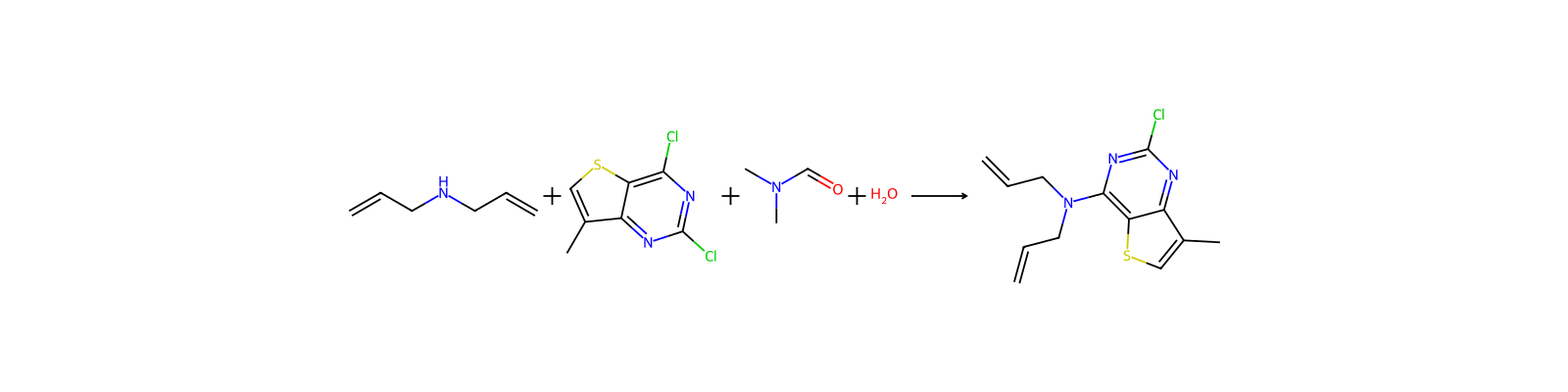
163
Reaktionsaufzeichnung erstellen
Reaktionsgleichung von HRID 1661
HRID 1661als Eduktuspto-grants-1998_03
Reaktionsgleichung von HRID 3914
HRID 3914als Eduktuspto-grants-1988_02
Reaktionsgleichung von HRID 66914
HRID 66914als Eduktuspto-grants-1982_08
Reaktionsgleichung von HRID 77563
HRID 77563als Eduktuspto-grants-2014_09
Reaktionsgleichung von HRID 85970
HRID 85970als EduktTraining data from https://doi.org/10.1039/C8SC04228D (2/10)
Reaktionsgleichung von HRID 87705
HRID 87705als EduktTraining data from https://doi.org/10.1039/C8SC04228D (2/10)
Reaktionsgleichung von HRID 102161
HRID 102161als EduktTraining data from https://doi.org/10.1039/C8SC04228D (2/10)
Reaktionsgleichung von HRID 124331
HRID 124331als EduktTraining data from https://doi.org/10.1039/C8SC04228D (2/10)
Seite 1 von 21

Notizen zur Verbindung

Wird geladen…

Auf dieser SeiteGrundinformationenÜberblickNamen und BezeichnerEigenschaftenSicherheit und RegulatorischesChemie und IndustrieZugehörige ReaktionenNotizen zur Verbindung
Weitere Aktionen
Neue NotizNeue ReaktionAnfrage stellen

Solubility in water, g/100ml at 20 °C: 9

Flash Point · 2 Einträge

21 °C

7 °C

Boiling Point · 3 Einträge

232 °F at 760 mmHg (NTP, 1992)

111 °C

111 °C

Melting Point · 3 Einträge

-127.1 °F (NTP, 1992)

-88.4 °C

-88.4 °C

Physikochemische Eigenschaften

Schmelzpunkt
-88.4 °C · -88.4 °C
Siedepunkt
111 °C · 111 °C
Dichte
0.7889 g/cm3 · 0.7889 g/cm3
pka
9.02 · 9.02±0.20(Predicted)
Health Hazards · 2 Einträge

Excerpt from ERG Guide 132 [Flammable Liquids - Corrosive]:

· May cause toxic effects if inhaled or ingested.

Hazards Summary · 1 Eintrag

A corrosive substance that causes lacrimation and may cause lung edema after inhalation of high concentrations; [CHEMINFO] A skin, eye, and respiratory tract irritant; [ICSC] Toxic by inhalation and skin absorption; [Hawley] A corrosive substance that can cause injury to the skin, eyes, and respiratory tract; Inhalation may cause chemical pneumonitis; Can be absorbed through skin; Effects in high-dose animal studies include lacrimation; [MSDSonline] Human volunteers experienced mucous membrane irritation at 22 ppm; At 70 ppm, irritating effects were considered severe but not intolerable; [AIHA]

DOT ID and Guide2359 132
Reactive GroupAmines, Phosphines, and Pyridines
UN ClassificationUN Hazard Class: 3; UN Subsidiary Risks: 6.1 and 8; UN Pack Group: II
Reactivity AlertsHighly Flammable
Reactivity Profile · 1 Eintrag

DIALLYLAMINE neutralizes acids in exothermic reactions to form salts plus water. May be incompatible with isocyanates, halogenated organics, peroxides, phenols (acidic), epoxides, anhydrides, and acid halides. Flammable gaseous hydrogen may be generated in combination with strong reducing agents, such as hydrides.

Chemical DangersDecomposes on burning. This produces toxic fumes including nitrogen oxides. The solution in water is a medium strong base. Reacts violently with strong acids, oxidants and chlorine. Attacks metals.
Physical DangersThe vapour mixes well with air, explosive mixtures are easily formed. As a result of flow, agitation, etc., electrostatic charges can be generated.

Sicherheit und Schutzausrüstung

Fire Fighting · 2 Einträge

Excerpt from ERG Guide 132 [Flammable Liquids - Corrosive]:

Use water spray, foam, powder, carbon dioxide. In case of fire: keep drums, etc., cool by spraying with water.

First Aid Measures · 4 Einträge

Fresh air, rest. Half-upright position. Refer immediately for medical attention.

First rinse with plenty of water for at least 15 minutes, then remove contaminated clothes and rinse again. Refer immediately for medical attention.

Rinse with plenty of water (remove contact lenses if easily possible). Refer immediately for medical attention.

Rinse mouth. Do NOT induce vomiting. Refer immediately for medical attention.

Accidental Release Measures · 2 Einträge

· CALL 911. Then call emergency response telephone number on shipping paper. If shipping paper not available or no answer, refer to appropriate telephone number listed on the inside back cover.

· ELIMINATE all ignition sources (no smoking, flares, sparks or flames) from immediate area.

First Aid · 2 Einträge

EYES: First check the victim for contact lenses and remove if present. Flush victim's eyes with water or normal saline solution for 20 to 30 minutes while simultaneously calling a hospital or poison control center. Do not put any ointments, oils, or medication in the victim's eyes without specific instructions from a physician. IMMEDIATELY transport the victim after flushing eyes to a hospital even if no symptoms (such as redness or irritation) develop.

General First Aid:

Safe StorageProvision to contain effluent from fire extinguishing. Fireproof. Separated from strong oxidants, strong acids and food and feedstuffs. Well closed. Store in an area without drain or sewer access.
Exposure Control and Personal Protection · 2 Einträge

· Wear positive pressure self-contained breathing apparatus (SCBA).

4.0 [ppm]

Nonfire Spill ResponseExcerpt from ERG Guide 132 [Flammable Liquids - Corrosive]:
Disposal Methods · 1 Eintrag

SRP: At the time of review, criteria for land treatment or burial (sanitary landfill) disposal practices are subject to significant revision. Prior to implementing land disposal of waste residue (including waste sludge), consult with environmental regulatory agencies for guidance on acceptable disposal practices.

Spillage Disposal · 1 Eintrag

Remove all ignition sources. Evacuate danger area! Consult an expert! Personal protection: gas-tight chemical protection suit including self-contained breathing apparatus. Do NOT let this chemical enter the environment. Collect leaking liquid in sealable containers. Absorb remaining liquid in sand or inert absorbent. Then store and dispose of according to local regulations.

Isolation and Evacuation · 2 Einträge

Excerpt from ERG Guide 132 [Flammable Liquids - Corrosive]:

Immediate precautionary measure

Eye PreventionWear face shield or eye protection in combination with breathing protection.
Fire Prevention · 1 Eintrag

NO open flames, NO sparks and NO smoking. Closed system, ventilation, explosion-proof electrical equipment and lighting. Do NOT use compressed air for filling, discharging, or handling. Prevent build-up of electrostatic charges (e.g., by grounding).

Toxikologische Informationen

Environmental Fate · 3 Einträge

TERRESTRIAL FATE: Based on a classification scheme(1), an estimated Koc value of 96(SRC), determined from a log Kow of 1.11(2) and a regression-derived equation(3), indicates that diallylamine is expected to have high mobility in soil(SRC). However, a pKa of 9.29(6), indicates that this compound will exist in the protonated form in the environment and cations generally adsorb to organic carbon and clay more strongly than their neutral counterparts, thus reducing mobility. Volatilization of diallylamine from moist soil surfaces is expected to be an important fate process(SRC) given an estimated Henry's Law constant of 3.0X10⁻⁵ atm-cu m/mole(SRC), derived from its vapor pressure, 20.2 mm Hg(5), and water solubility, 8.6X10+4 mg/l(4). The potential for volatilization of diallylamine from dry soil surfaces may exist(SRC) based upon a vapor pressure of 20.2 mm Hg(5). However, adsorption to soil is expected to attenuate volatilization when the compound is in the cation form(SRC).

AQUATIC FATE: Based on a classification scheme(1), an estimated Koc value of 96(SRC), determined from a log Kow of 1.11(2) and a regression-derived equation(3), indicates that diallylamine is not expected to adsorb to suspended solids and sediment in water(SRC). Volatilization from water surfaces is expected(3) based upon an estimated Henry's Law constant of 3.0X10⁻⁵ atm-cu m/mole(SRC), derived from its vapor pressure, 20.2 mm Hg(7), and water solubility, 8.6X10+4 mg/l(8). Using this Henry's Law constant and an estimation method(3), volatilization half-lives for a model river and model lake are 20 hrs and 13 days, respectively(SRC). A pKa of 9.29(4) indicates diallylamine will exist almost entirely in the protonated form in aqueous environments and the protonated form of diallylamine is not expected to volatilize from water surfaces. According to a classification scheme(5), an estimated BCF of 1.4(SRC), from its log Kow(2) and a regression-derived equation(6), suggests the potential for bioconcentration in aquatic organisms is low.

ATMOSPHERIC FATE: According to a model of gas/particle partitioning of semivolatile organic compounds in the atmosphere(1), diallylamine, which has a vapor pressure of 20.2 mm Hg at 25 °C(2), will exist solely in the vapor phase in the ambient atmosphere. Vapor-phase diallylamine is degraded in the atmosphere by reaction with photochemically-produced hydroxyl radicals(SRC); the half-life for this reaction in air is estimated to be 11 hrs(SRC), calculated from its rate constant of 1.33X10⁻¹⁰ cu cm/molecule-sec at 25 °C(3) determined using a structure estimation method(3).

Adverse EffectsDermatotoxin - Skin burns.
Exposure RoutesThe substance can be absorbed into the body by inhalation of its vapour, through the skin and by ingestion. Serious local effects by all routes of exposure.
Signs and Symptoms · 4 Einträge

Cough. Headache. Nausea. Sore throat. Laboured breathing. Shortness of breath. Symptoms may be delayed.

Redness. Pain. Serious skin burns.

Watering of the eyes. Redness. Pain. Blurred vision. Severe burns. Loss of vision.

Burns in mouth and throat. Burning sensation in the throat and chest. Abdominal pain. Vomiting. Diarrhoea. Shock or collapse.

ICSC Environmental DataThe substance is toxic to aquatic organisms. It is strongly advised not to let the chemical enter into the environment.
Soil Adsorption/Mobility · 1 Eintrag

The Koc of diallylamine is estimated as 96(SRC), using a log Kow of 1.11(1) and a regression-derived equation(2). According to a classification scheme(3), this estimated Koc value suggests that diallylamine is expected to have high mobility in soil. The pKa of diallylamine is 9.29(4), indicating that this compound will exist in the protonated form in the environment and cations generally adsorb to organic carbon and clay more strongly than their neutral counterparts.

TSCA Test Submissions · 4 Einträge

Diallylamine (CAS # 124-02-7) was evaluated for acute oral toxicity in fasted male Sprague-Dawley albino rats fed single undiluted doses of 215, 464, 1000, and 2150 mg/kg by oral gavage and observed for 14 days. Treatment was associated with increasing dose-related lethargy and mortality consistent with an oral LD50 for male rats of 316 (205-488) mg/kg. Fasted females fed undiluted doses of 215, 464, 1000, and 4640 mg/kg exhibited moderate lethargy from doses of 464 mg/kg and mortality (all within 20 hours of dosing) consistent with an oral LD50 of 501 (344-730) mg/kg. Female rats of 215 mg/kg suffered no apparent untoward effects of treatment. No additional comments regarding protocol, results, or pathology were provided.

Diallylamine (CAS # 124-02-7) was evaluated for acute dermal toxicity in New Zealand white albino rabbits (2/sex/group) administered topical occluded applications of 215, 464, 1,000, and 2,150 mg/kg upon clipped intact abdominal skin for 24 hours. Test sites were examined prior to cleansing and rewrap in a gauze binder for 14-day observation of systemic toxicity. Local effects included necrosis, erythema, and edema. Treatment was also associated with mortality primarily within 4 hours and consistent with a dermal LD50 of 563 (383-825) mg/kg.

Diallylamine (CAS # 124-02-7) was evaluated for acute inhalation toxicity in Sprague-Dawley albino rats (5/sex/group) exposed to a dynamically-generated atmosphere of 6.3 mg/l in a 32 liter, positive pressure environmental chamber for 1 hour. Treatment was associated with moderate eye irritation and depression which persisted to 24 hours post-exposure. Exposed animals exhibited no other signs of toxicity and no mortality throughout 14-day post-exposure observation.

Diallylamine (CAS # 124-02-7) was evaluated for eye irritation in 6 New Zealand rabbits each administered 0.1 ml instillations (concentration unspecified) into the conjunctival sac of one eye for 4 hours, the second eye serving as control. Treatment was associated with phonation upon contact with the eye, with severe corneal damage to obscure iritic examination, and conjunctival erythema, chemosis, and discharge at 24, 48, and 72 hours post-instillation. No apparent remission occurred throughout 7-day observation.

Human Toxicity Excerpts/IN EXPTL HUMAN EXPOSURES/...RECOGNIZABLE BUT NOT UNPLEASANT @ 2 TO 9 PPM, MUCOUS MEMBRANE IRRITATION & CHEST DISCOMFORT IN A FEW SUBJECTS @ 22 PPM, NOT INTOLERABLE @ 70 PPM.
Artificial Pollution Sources · 1 Eintrag

Diallylamine's production and use as an intermediate in the production of pharmaceuticals and resins(1) and in crop protection, as an auxiliary in paper making(2), and as a solvent(3) may result in its direct release to the environment through various waste streams(SRC).

Environmental Bioconcentration · 1 Eintrag

An estimated BCF of 1.4 was calculated for diallylamine(SRC), using a log Kow of 1.11(1) and a regression-derived equation(2). According to a classification scheme(3), this BCF suggests the potential for bioconcentration in aquatic organisms is low.

Volatilization from Water/Soil · 1 Eintrag

The Henry's Law constant for diallylamine is estimated as 3.0X10⁻⁵ atm-cu m/mole(SRC), derived from its vapor pressure, 20.2 mm Hg(1), and water solubility, 8.6X10+4 mg/l(2). This Henry's Law constant indicates that diallylamine is expected to volatilize from water surfaces(3). Based on this Henry's Law constant, the volatilization half-life from a model river (1 m deep, flowing 1 m/sec, wind velocity of 3 m/sec)(3) is estimated as 20 hours(SRC). The volatilization half-life from a model lake (1 m deep, flowing 0.05 m/sec, wind velocity of 0.5 m/sec)(3) is estimated as 13 days(SRC). Diallylamine's estimated Henry's Law constant(1,2) indicates that volatilization from moist soil surfaces may occur(SRC). The potential for volatilization of diallylamine from dry soil surfaces may exist(SRC) based upon a vapor pressure of 20.2 mm Hg(1). However, adsorption to soil is expected to attenuate volatilization when the compound is in the cation form(SRC).

Non-Human Toxicity Excerpts · 5 Einträge

...INHALATION STUDIES IN MICE USING HEAVY DOSES OF...DIALLYLAMINE; ALMOST ALL ANIMALS DIED WITHIN 10 MIN @ CONCN OF 0.88 MMOL (1.9%).

REPEATED INHALATIONS IN RATS, (7 HR X 50 EXPOSURES @ 200 PPM), PRODUCED CHANGES IN LIVER & KIDNEY WEIGHTS, REDUCED GROWTH, & DEATH. /FROM TABLE/

/IN ACUTE STUDIES WITH RATS, PERCUTANEOUS DIALLYLAMINE WAS/...SEVERELY IRRITATING TO SKIN... ACUTE EXPOSURES TO VAPORS PRODUCED...RESPIRATORY TRACT IRRITATION.

PATHOLOGICAL CHANGES OBSERVED IN RATS FOLLOWING REPEATED INHALATION INCLUDED CHEMICAL PNEUMONIAS & SOME LIVER & KIDNEY DAMAGE. THE MOST PROMINENT PATHOLOGICAL EFFECT...WAS MYOCARDITIS...WHICH OCCURRED AFTER REPEATED INHALATION OF ALL THREE ALLYLAMINES /MONOALLYLAMINE, DIALLYLAMINE, & TRIALLYLAMINE/.

For more Non-Human Toxicity Excerpts (Complete) data for DIALLYLAMINE (7 total), please visit the HSDB record page.

Sicherheitsdaten

ridadr
UN 2359
hazard_class
3
packing_group
II