
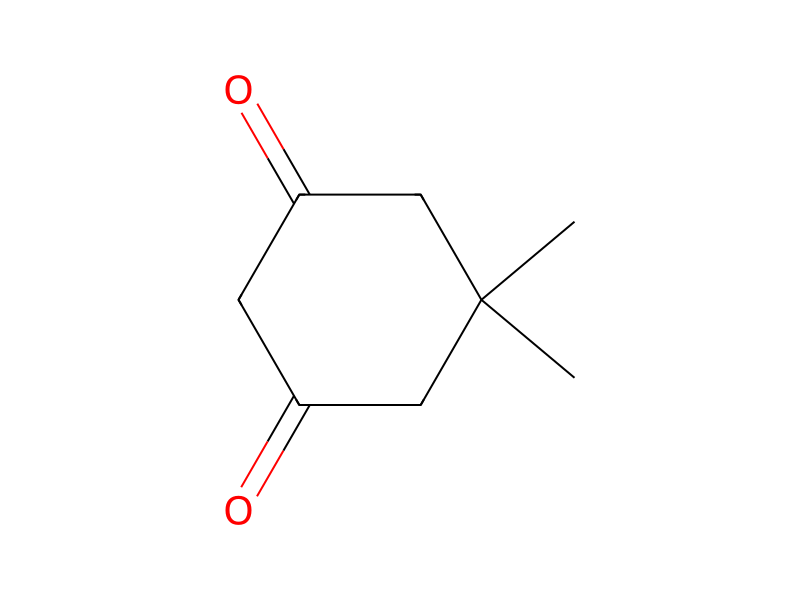
Grundinformationen
- Standard-SMILES
CC1(C)CC(=O)CC(=O)C1- InChIKey
BADXJIPKFRBFOT-UHFFFAOYSA-N- Summenformel
- C8H12O2
- Durchschnittliche Molmasse
- 140,18 g/mol
- Monoisotopische Masse
- 140,08372962
Namen und Bezeichner
- Bevorzugter Name
- Dimedone
- IUPAC
- 5,5-dimethylcyclohexane-1,3-dione
- Lokaler Name
- 5,5-Dimethylcyclohexan-1,3-dion
- Englischer Name
- Dimedone
- Summenformel
- C8H12O2
- Molmasse
- 140.18
Namen und Synonyme
Dimedone126-81-85,5-DIMETHYL-1,3-CYCLOHEXANEDIONEMethoneCyclomethoneMedonDimedon1,3-Cyclohexanedione, 5,5-dimethyl-Methon1,1-Dimethyl-3,5-diketocyclohexane1,1-Dimethyl-3,5-cyclohexanedioneLU 274
Weitere Namen anzeigen
5,5-DIMETHYL-CYCLOHEXANE-1,3-DIONE5,5-Dimethyl-1,3-cyclohexadionelu274
B2B5DSX2FCNSC-14984DTXSID8021987RefChem:134141DTXCID101987204-804-45,5-Dimethylcyclohexane-1,3-dione5,5-Dimethyldihydroresorcinol
Datenbank-Bezeichner
- CAS
126-81-8- PubChem CID
- 31358
- DTXSID
DTXSID8021987- UNII
- B2B5DSX2FC
- EC Number
- 204-804-4
- Nikkaji
- J2.014A
Eigenschaften
Berechnete Struktureigenschaften
- XLogP
- 0,8
- Polarare Oberfläche (TPSA)
- 34,1 Ų
- H-Brücken-Donoren
- 0
- H-Brücken-Akzeptoren
- 2
- Frei drehbare Bindungen
- 0
- Schwere Atome
- 10
- Formalladung
- 0
- Komplexität
- 162
Experimentelle und physikochemische Eigenschaften
Vapor Pressure0.06 [mmHg]
Physical DescriptionSolid; [Merck Index] White crystalline powder; [Alfa Aesar MSDS]
Kovats Retention Index
1101
1176
Physikochemische Eigenschaften
- Schmelzpunkt
- 146 · 146-148 °C (lit.)
- Siedepunkt
- 216.69 °C · 216.69°C (rough estimate)
- Dichte
- 1.0373 · 1.0373 (rough estimate)
- Brechungsindex
- 1.4787 · 1.4787 (estimate)
- storage temp.
- Keep in dark place,Inert atmosphere,Room temperature
- Löslichkeit
- 4.01 g/l · 4.01g/l
- pka
- 4.8 · 4.8(at 25℃)
- Aggregatzustand
- Liquid
- Farbe
- Clear colorless to yellow
- Wasserlöslichkeit
- 0.416 g/100 · 0.416 g/100 mL (25 ºC)
- Merck
- 14 · 14,3242
- BRN
- 471489 · 471489
- Stabilität
- Stable, but may be light sensitive. Incompatible with strong oxidizing agents.
- InChI
- 1S/C8H12O2/c1-8(2)4-6(9)3-7(10)5-8/h3-5H2,1-2H3
- InChIKey
- BADXJIPKFRBFOT-UHFFFAOYSA-N
- SMILES
- CC1(C)CC(=O)CC(=O)C1
- LogP
- 1.3 at · 1.3 at 20℃
- CAS Datenbank
- 126 · 126-81-8(CAS DataBase Reference)
- NIST chemische Informationen
- Dimedone(126-81-8)
- EPA chemische Informationen
- 1 · 1,3-Cyclohexanedione, 5,5-dimethyl- (126-81-8)
Sicherheit und Regulatorisches
GHS-Klassifizierung
GHS Classification
This chemical does not meet GHS hazard criteria for 70% (7 of 10) of all reports.
Warning
H315 (30%): Causes skin irritation [Warning Skin corrosion/irritation];H319 (30%): Causes serious eye irritation [Warning Serious eye damage/eye irritation];H335 (30%): May cause respiratory irritation [Warning Specific target organ toxicity, single exposure; Respiratory tract irritation]
P261, P264, P264+P265, P271, P280, P302+P352, P304+P340, P305+P351+P338, P319, P321, P332+P317, P337+P317, P362+P364, P403+P233, P405, and P501 (click each P-code to see the statement)
Aggregated GHS information provided per 10 reports by companies from 4 notifications to the ECHA C&L Inventory. Each notification may be associated with multiple companies.;Reported as not meeting GHS hazard criteria per 7 of 10 reports by companies.;There are 3 notifications provided by 3 of 10 reports by companies with hazard statement code(s).;Information may vary between notifications depending on impurities, additives, and other factors. The percentage value in parenthesis indicates the notified classification ratio from companies that provide hazard codes. Only hazard codes with percentage values above 10% are shown. For more detailed information, please visit ECHA C&L website.
Gefahrenhinweise
Regulatory Information
Chemical: 1,3-Cyclohexanedione, 5,5-dimethyl-
Status: Active Update: 21-11-2022 https://echa.europa.eu/registration-dossier/-/registered-dossier/5719
1,3-Cyclohexanedione, 5,5-dimethyl-: Does not have an individual approval but may be used under an appropriate group standard
Other Safety InformationEvaluation - Chemicals that are unlikely to require further regulation to manage risks to human health
Hazards SummaryMay cause irritation; [Sigma-Aldrich MSDS] See o-Methylcyclohexanone.
Hazard Classes and CategoriesSkin Irrit. 2 (30%);Eye Irrit. 2A (30%);STOT SE 3 (30%)
Regulatorische Informationen
Regulatory Information
Chemical: 1,3-Cyclohexanedione, 5,5-dimethyl-
Status: Active Update: 21-11-2022 https://echa.europa.eu/registration-dossier/-/registered-dossier/5719
1,3-Cyclohexanedione, 5,5-dimethyl-: Does not have an individual approval but may be used under an appropriate group standard
Sicherheitsdaten
- F
- 8-9
- wgk
- 2
- tsca
- TSCA listed
- hs_code
- 29142900
- RTECS-Nr.
- GV0345000
- risk_code
- 36/37/38
- hazard_code
- Xi
- safety_code
- 24/25-36-26
- Speicherklasse
- 11 - Combustible Solids
Chemie und Industrie
Verwendung und Herstellung
UsesUsed to identify aldehydes; [Merck Index]
General Manufacturing Information1,3-Cyclohexanedione, 5,5-dimethyl-: ACTIVE
Anwendungen
BeschreibungDimedon bildet farblose bis blassgelbe, wasserunlösliche Kristalle. Die Verbindung wird in der analytischen Chemie zur Identifizierung und Trennung Aldehyden, meist von Formaldehyd, verwendet.
VerwendenReagent used in synthesis of fused 3-methylfuransDimedone is used in organic chemistry to identify the presence of aldehyde group. It is also used as a catalyst in the formation of transition-metal complexes. Further, it is also employed in colorimetry, crystallography, luminescence and spectrophotometric analysis. In addition to this, it is used in the synthesis of naturally occurring fused 3-methylfurans.
Vor- und nachgelagerte Produkte
Vorgelagerte Rohstoffe
Nachgelagerte Produkte
Anbieter50 Anbieter
国药集团化学试剂有限公司86-21-63210123 · [email protected]
梯希爱(上海)化成工业发展有限公司021-67121386 · [email protected]
上海阿拉丁生化科技股份有限公司400-6206333 13167063860 · [email protected]
INTATRADE GmbH+49 3493/605464 · [email protected]
上海如吉生物科技发展有限公司+86-21-65211385-8001 36031160 · [email protected]
北京安司莫森技术有限公司010-82954736 13391601435 · [email protected]
韶远科技(上海)有限公司021-50795510 4000665055 · [email protected]
科瑞迪化学400-821-5857 021-64326257 · [email protected]
Ark Pharm, Inc.847-367-3680 · [email protected]
上海迈瑞尔生化科技有限公司4006356688 18621169109 · [email protected]
武汉易泰科技有限公司上海分公司18930552037 · [email protected]
阿法埃莎(中国)化学有限公司400-6106006 · [email protected]
太原市瑞和丰科贸有限公司+86 351 7031519 · [email protected]
安耐吉化学&3A(安徽泽升科技股份有限公司)400-0056266 · [email protected]
武汉凯威斯科技有限公司86-027-67849912 · [email protected]
上海瀚鸿科技股份有限公司021-54306202 13764082696 · [email protected]
上海相辉医药科技有限公司13761987713 · [email protected]
上海景颜化工科技有限公司13817811078 · [email protected]
嘉兴市艾森化工有限公司0573-85285100 18627885956 · [email protected]
Pure Chemistry Scientific Inc.001-857-928-2050 or 1-888-588-9418 · [email protected]
孝感深远化工有限公司15527621225; 15527621225 · [email protected]
玛雅试剂+86 (573) 82222445 (0)18006601000 452520369 · [email protected]
四川库利南科技有限公司400-1166-196 18981987031 · [email protected]
上海耐士化工科技有限公司400-188-0725 +86 21 34310725 13611771617
天津希恩思生化科技有限公司400 638 7771 · [email protected]
南京维奥化工有限公司Please Send Email 18652950785 · [email protected]
斯百全化学(上海)有限公司021-021-021-67601398-809-809-809 15221380277 · [email protected]
艾科试剂4008-755-333 18080918076 · [email protected]
上海思域化工科技有限公司86-21-34053660 · [email protected]
赛默飞世尔科技(中国)有限公司800-810-5118 · [email protected]
北京伊诺凯科技有限公司400-810-7969 010-59572699 · [email protected]
上海特伯化学科技有限公司+86-21-60341587 · [email protected]
TCI AMERICA800-4238616 · [email protected]
TOKYO CHEMICAL INDUSTRY CO., LTD.03-36680489 · [email protected]
TCI Europe320-37350700 · [email protected]
上海贤鼎生物科技有限公司4009209199 · [email protected]
越林试剂021-62960152 · [email protected]
上海睿升化工科技有限公司+86-021-50935922
上海倍卓生物科技有限公司021-61119791,13386096464 · [email protected]
上海湄水化工科技有限公司021-60549325 18616193163
上海将来实业股份有限公司021-61552785 · [email protected]
HBCChem, Inc.+1-510-219-6317 · [email protected]
日照力德士化工有限公司010-51268198 · [email protected]
郑州鸿晟医药科技有限公司0371-0371-13526885213 15637198702 · [email protected]
美岚实业(上海)有限公司021-58958189 · [email protected]
上海爱蝶实业有限公司021-58957966 18930537195 · [email protected]
成都零六生物科技有限公司400-1166-196 13458535857 · [email protected]
广拓化学(上海)有限公司021-60899189-8001 18918189673 · [email protected]
雷丁试剂0510-85629785 18013409632 · [email protected]
上海御略医药科技有限公司021-60345187 13671753212 · [email protected]
Zugehörige Reaktionen
187


Verknüpfte Notizen
Wird geladen…