
Doxazosin

Grundinformationen
- CAS
74191-85-8- Standard-SMILES
COc1cc2nc(N3CCN(C(=O)C4COc5ccccc5O4)CC3)nc(N)c2cc1OC- InChIKey
RUZYUOTYCVRMRZ-UHFFFAOYSA-N- Summenformel
- C23H25N5O5
- Durchschnittliche Molmasse
- 451,5 g/mol
- Monoisotopische Masse
- 451,1855689
Überblick
Doxazosin is a member of the class of quinazolines that is quinazoline substituted by an amino group at position 4, methoxy groups at positions 6 and 7 and a piperazin-1-yl group at position 2 which in turn is substituted by a 2,3-dihydro-1,4-benzodioxin-2-ylcarbonyl group at position 4. An antihypertensive agent, it is used in the treatment of high blood pressure. It has a role as an antineoplastic agent, a vasodilator agent, an antihypertensive agent, an alpha-adrenergic antagonist and an antihyperplasia drug. It is a monocarboxylic acid amide, an aromatic amine, a member of quinazolines, a N-acylpiperazine, a N-arylpiperazine and a benzodioxine.
Namen und Bezeichner
- Bevorzugter Name
- Doxazosin
- IUPAC
- [4-(4-amino-6,7-dimethoxyquinazolin-2-yl)piperazin-1-yl]-(2,3-dihydro-1,4-benzodioxin-3-yl)methanone
- Englischer Name
- Doxazosin
- Summenformel
- C23H25N5O5
- Molmasse
- 451.48
Namen und Synonyme
doxazosin74191-85-8DoxazosineDoxazosinumDoxazosinaUK-33274C02CA041-(4-Amino-6,7-Dimethoxy-2-quinazolinyl)-4-(1,4-benzodioxan-2-ylcarbonyl)piperazinCHEBI:4708UK 332741-(4-Amino-6,7-dimethoxy-2-chinazolinyl)-4-(2,3-dihydro-1,4-benzodioxixin-2-ylcarbonyl)piperazinDTXSID7022964
Weitere Namen anzeigen
UK 33,274Doxazosin baseDOXAZOSINMESYTLDOXAZOSIN(CARDULAR)Doxazosin USP/EP/BPDoxazosin (UK 33274)Doxazosin Mesylate USPDoxazosin, 10 mM in DMSO
NW1291F1W8Piperazine, 1-(4-amino-6,7-dimethoxy-2-quinazolinyl)-4-((2,3-dihydro-1,4-benzodioxin-2-yl)carbonyl)-2-{4-[(2,3-dihydro-1,4-benzodioxin-2-yl)carbonyl]piperazin-1-yl}-6,7-dimethoxyquinazolin-4-amine(4-(4-AMINO-6,7-DIMETHOXY-2-QUINAZOLINYL)-1-PIPERAZINYL)(2,3-DIHYDRO-1,4-BENZODIOXIN-2-YL)METHANONE(4-(4-Amino-6,7-dimethoxyquinazolin-2-yl)piperazin-1-yl)(2,3-dihydro-1,4-benzodioxin-2-yl)methanoneratio Doxazosinratio-DoxazosinDoxaUro
Eigenschaften
Berechnete Struktureigenschaften
- XLogP
- 2,5
- Polarare Oberfläche (TPSA)
- 112 Ų
- H-Brücken-Donoren
- 1
- H-Brücken-Akzeptoren
- 9
- Frei drehbare Bindungen
- 4
- Schwere Atome
- 33
- Formalladung
- 0
- Komplexität
- 678
Experimentelle und physikochemische Eigenschaften
Drugs
Pharmaceuticals -> Antihypertensives
Pharmaceuticals
LogP
2.1
3.38
Solubility
0.8%
7.90e-01 g/L
Human DrugsBreast Feeding; Lactation; Milk, Human; Adrenergic alpha-Antagonists; Antihypertensive Agents
Melting Point
275-277
289 - 290 °C
Physical DescriptionSolid
Dissociation Constants6.52
Collision Cross Section
202.9 Ų [M+H]+ [CCS Type: TW; Method: Major Mix IMS/Tof Calibration Kit (Waters)]
196.92 Ų [M+Na]+ [CCS Type: TW; Method: calibrated with polyalanine and drug standards]
Physikochemische Eigenschaften
Sicherheit und Regulatorisches
Sicherheitsangaben dienen nur zur Orientierung und ersetzen weder das Sicherheitsdatenblatt (SDB) des Lieferanten noch geltende Vorschriften oder eine fachliche Bewertung.
GHS-Klassifizierung
GHS Classification
Danger
H302 (20%): Harmful if swallowed [Warning Acute toxicity, oral]
P260, P264, P270, P273, P280, P301+P317, P301+P330+P331, P302+P361+P354, P304+P340, P305+P354+P338, P316, P319, P321, P330, P363, P391, P405, and P501 (click each P-code to see the statement)
Aggregated GHS information provided per 5 reports by companies from 2 notifications to the ECHA C&L Inventory. Each notification may be associated with multiple companies.
Gefahrenhinweise
Regulatory InformationStatus: Active Update: 01-07-2020 https://echa.europa.eu/registration-dossier/-/registered-dossier/31210
Hazard Classes and CategoriesSkin Corr. 1B (80%)
Toxikologische Informationen
Hepatotoxicity
Doxazosin has been associated with a low rate of serum aminotransferase elevations that in controlled trials was no higher than with placebo therapy. These elevations were transient and did not require dose modification. No instances of clinically apparent acute liver injury due to doxazosin have been published in the literature, but reports of cholestatic hepatitis have been received by the sponsor. Among the alpha adrenergic receptor antagonists, the most frequently implicated agent in causing liver injury has been alfuzosin with only single, and not well documented cases linked to other alpha blockers. Thus, acute symptomatic liver injury due to doxazosin is quite rare, and severe hepatotoxicity must be exceeding rare, if it occurs at all.
Adverse EffectsDose-related Adverse Effects
Chemie und Industrie
Pharmakologische Informationen
ATC Code
C - Cardiovascular system
QC - Cardiovascular system
Protein BindingThe plasma protein binding of doxazosin is estimated at 98%.. It has also been shown to be bound to the alpha-1 acid glycoprotein.
Pharmacodynamics
Doxazosin decreases standing and supine blood pressure and relieves the symptoms of benign prostatic hypertrophy through the inhibition of alpha-1 receptors. Doxazosin may cause hypotension due to its pharmacological actions. This frequently occurs in the upright position, leading to a feeling of dizziness or lightheadedness. The first dose of doxazosin may lead to such effects, however, subsequent doses may also cause them. The risk of these effects is particularly high when dose adjustments occur or there are long intervals between doxazosin doses. Treatment should be started with the 1 mg dose of doxazosin, followed by slow titration to the appropriate dose. Patients must be advised of this risk and to avoid situations in which syncope and dizziness could be hazardous following the ingestion of doxazosin. Interestingly doxazosin exerts beneficial effects on plasma lipids. It reduces LDL (low-density lipoprotein) cholesterol and triglyceride levels and increases HDL (high-density lipoprotein) cholesterol levels. A note on priapism risk In rare cases, doxazosin and other alpha-1 blockers may cause priapism, a painful occurrence of persistent and unrelievable penile erection that can lead to impotence if medical attention is not sought as soon as possible. Patients must be advised of the priapism risk associated with doxazosin and to seek medical attention immediately if it is suspected.
Mechanism of Action
Doxazosin selectively inhibits the postsynaptic alpha-1 receptors on vascular smooth muscle by nonselectively blocking the alpha-1a, alpha-1b, and alpha-1d subtypes. This action on blood vessels decreases systemic peripheral vascular resistance, reducing blood pressure, exerting minimal effects on the heart rate due to its receptor selectivity. Norepinephrine-activated alpha-1 receptors located on the prostate gland and bladder neck normally cause contraction of regional muscular tissue, obstructing urinary flow and contributing to the symptoms of benign prostatic hypertrophy. Alpha-1 antagonism causes smooth muscle relaxation in the prostate and bladder, effectively relieving urinary frequency, urgency, weak urinary stream, and other unpleasant effects of BPH. Recently, doxazosin was found to cause apoptosis of hERG potassium channels in an in vitro setting, possibly contributing to a risk of heart failure with doxazosin use.
Zugehörige Reaktionen
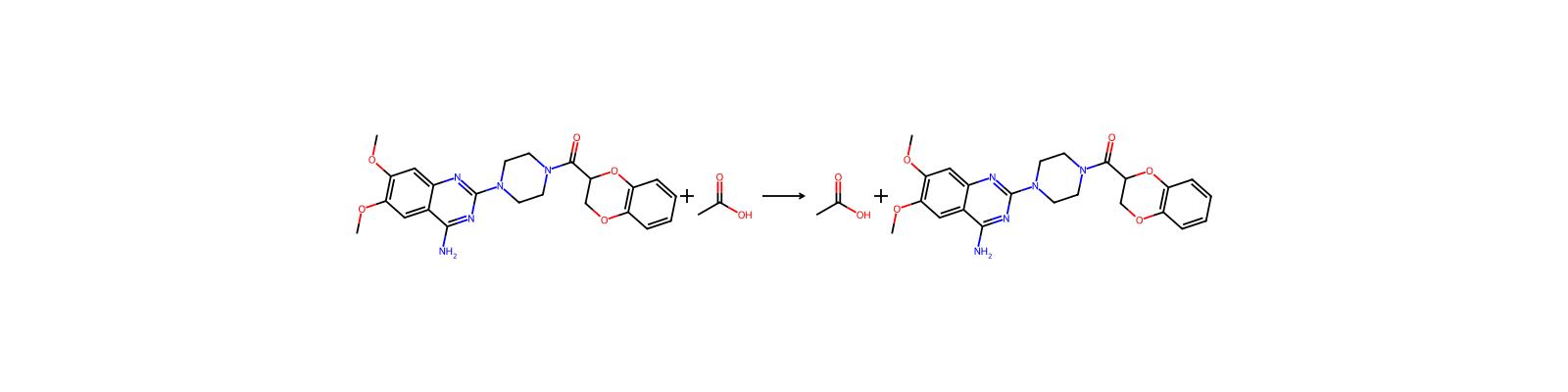
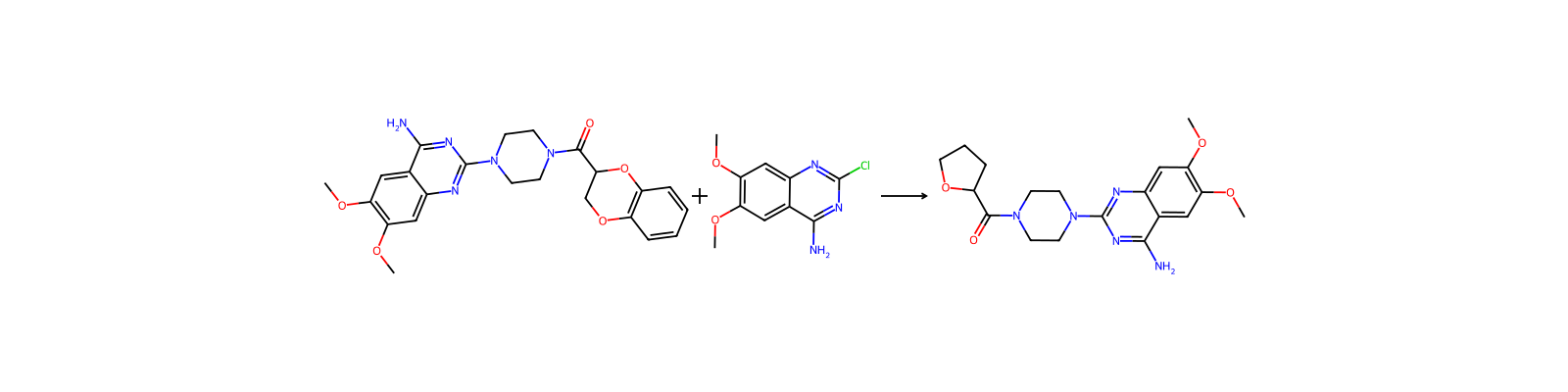
19




Notizen zur Verbindung
Wird geladen…