
HRID 319328als Edukt
Ethoprophos
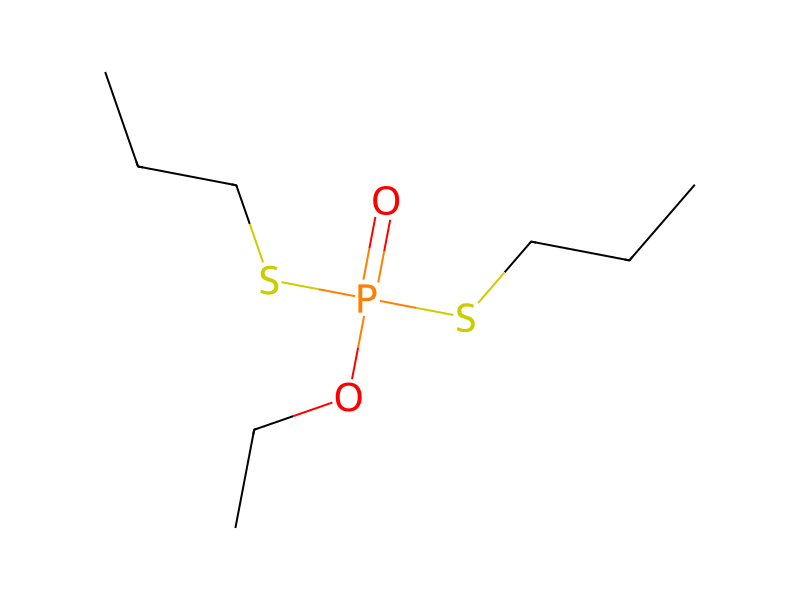
13194-48-4CCCSP(=O)(OCC)SCCCVJYFKVYYMZPMAB-UHFFFAOYSA-NEthoprop can cause cancer according to The Environmental Protection Agency (EPA).
13194-48-4DTXSID4032611CHEMBL1894994CHEBI:38665Insecticides, Nematicides
Active substance -> EU Pesticides database: Not approved
Pesticides -> Organophosphate Insecticides
Pesticide
Environmental transformation -> Pesticides (parent, predecessor)
Pesticide (Ethoprop) -> USDA PDB
log Kow = 3.59 @ 21 °C
3.6
3.59
1.094 at 68 °F (EPA, 1998) - Denser than water; will sink
1.094 g/cu cm @ 20 °C
Relative density (water = 1): 1.09
1.09 @ 20°C
Pale yellow liquid
Pale yellow oil
Readily sol in most organic solvents
SOLUBLE IN KEROSENE
Solubility >300 g/kg @ 20 °C in acetone, ethanol, xylene, 1,2-dichloroethane, diethyl ether, ethyl acetate, petroleum spirit, cyclohexane
In water, 750 mg/l @ 20-25 °C
Solubility in water, g/100ml at 20 °C: 0.075
Sicherheitsangaben dienen nur zur Orientierung und ersetzen weder das Sicherheitsdatenblatt (SDB) des Lieferanten noch geltende Vorschriften oder eine fachliche Bewertung.
Danger
H301: Toxic if swallowed [Danger Acute toxicity, oral]
P260, P261, P262, P264, P270, P271, P272, P273, P280, P284, P301+P316, P302+P352, P304+P340, P316, P320, P321, P330, P333+P317, P361+P364, P362+P364, P391, P403+P233, P405, and P501 (click each P-code to see the statement)
Danger
H301 (100%): Toxic if swallowed [Danger Acute toxicity, oral]
P260, P261, P262, P264, P270, P271, P272, P273, P280, P284, P301+P316, P302+P352, P304+P340, P316, P320, P321, P330, P333+P317, P361+P364, P362+P364, P391, P403+P233, P405, and P501 (click each P-code to see the statement)
Hazard Traits - Carcinogenicity; Environmental tox
Regulation (EC) No 1107/2009 (amended)
Ethoprop is listed in the dataset of EPA Human Health Benchmarks for Pesticides under the Safe Drinking Water Act (40 eCFR 141)
07/52/EC, Reg. (EU) 2018/917, Reg. (EU) 2019/344, Reg. (EU) No 1178/2013, Reg. (EU) No 540/2011
REACH registered substance: Ethoprophos (EC: 236-152-1)
The New Jersey Worker and Community Right to Know Act requires public and private employers to provide information about hazardous substances at their workplaces. (N.J.S.A. 34:5A-1 et. seq.)
(Non-Specific -- Organophosphorus Pesticide, Liquid, n.o.s.) Container may explode in heat of fire. Fire and runoff from fire control water may produce irritating or poisonous gases. Stable in water. Hydrolyzed in alkali. (EPA, 1998)
Organophosphorus insecticides exert their acute effects in both insects and mammals by inhibiting acetylcholinesterase (AChE) in the nervous system with subsequent accumulation of toxic levels of acetylcholine (ACh), which is a neurotransmitter. In many cases, the organophosphorylated enzyme is fairly stable, so that recovery from intoxication may be slow. /Organophosphorus Pesticides/
The first essential step in the initiation of the delayed neuropathic effect of an organophosphate is phosphorylation of a target protein in the nervous system. The protein has esteratic enzyme activity. The phosphorylation, which was originally studied radiochemically, can be monitored conveniently as progressive inhibition of the activity of this enzyme, which is now referred to as Neuropathy Target Esterase (NTE or Neurotoxic Esterase)... . The second, and equally essential, step is the transformation of the phosphorylated NTE to a modified form: one of the remaining ester bonds of the inhibitor molecule attached to the NTE active site undergoes a biochemical cleavage leaving an ionized acidic residue bound to the protein: this residue is negatively charged and the reaction is referred to as "aging". Both inhibition and aging of inhibited NTE are essential to initiate neuropathy, but the role of the negative charge in the initiation of axonal degeneration is not known. The process of "aging" of inhibited NTE has some analogy with the better-known "aging" of inhibited AChE. However, the analogy does not last above the level of enzyme inhibition. Acute toxicity arises directly from the loss of catalytic activity of AChE, leading to accumulation of excess physiological substrate. Mere loss of catalytic activity of NTE (without aging) does not initiate neuropathy. There is no evidence of a deleterious accumulation of a physiological substrate for NTE or lack of hydrolysis products after inhibition in vivo, and the effect of the negative charge may be focused on some quite separate process. /Organophosphorus Pesticides/
In a metabolism study, ethoprop was administered to Crl:CD(SD)BR rats as a single IV bolus (males and females); single oral bolus (females, metabolism and pharmacokinetic studies; males, metabolism only); or by multiple oral doses. ...Terminal elimination t1/2 in blood was 92-135 hours.
187 to 196 °F at 0.2 mmHg (EPA, 1998)
86-91 °C @ 0.2 mm Hg
at 0.03kPa: 86-91 °C
When heated to decomposition it emits very toxic fumes of /phosphorus oxides and sulfur oxides/.
room temperature. This produces flammable n-propylmercaptan (see ICSC 1492). Decomposes on heating. This produces toxic fumes including phosphorus oxides and sulfur oxides.
-13 °C
-13 °C
-13 °C
0.00035 mmHg at 78.8 °F (EPA, 1998)
0.00035 [mmHg]
3.8X10⁻⁴ mm Hg @ 20-25 °C
Vapor pressure, Pa at 20-25 °C: 0.05
0.00038 [mm Hg] @25 °C
Ethorop is one of a family of organophosphorus pesticides. It is combustible though it may require some effort to ignite. It is very toxic by skin absorption and inhalation. It may or may not be water soluble.
Pale yellow liquid; [Merck Index] Colorless to yellow liquid with a strong odor of mercaptans; [Reference #1]
PALE YELLOW LIQUID WITH CHARACTERISTIC ODOUR.
Combustible. Gives off irritating or toxic fumes (or gases) in a fire. Heating will cause rise in pressure with risk of bursting.
Decomposes at room temperature evolving n-Propylmercaptan (flammable); A cholinesterase inhibitor that may have effects on the nervous system causing convulsions and respiratory depression; Can be absorbed through skin and eyes; [ICSC] No significant adverse effects besides cholinesterase inhibition observed in sub-chronic animal feeding studies; [HSDB] The average of two baseline respective cholinesterase activity determinations three days apart, with no exposures to enzyme inhibiting pesticides for at least 30 days, is recommended for each worker prior to exposure to cholinesterase inhibitors because of large inter-individual differences in published baseline values. To be established at least once a year. Removal from workplace exposures is recommended until the cholinesterase activity returns to within 20% of baseline. [TLVs and BEIs] See 1-Propanethiol.
USEPA/Office of Pesticide Programs; Interim Reregistration Eligibility Decision (IRED) for Ethoprop. EPA issues an IRED for a pesticide that is undergoing reregistration, requires a reregistration eligibility decision, and also needs a cumulative assessment under FQPA. The IRED, issued after EPA completes the individual pesticide\'s aggregate risk assessment, may include taking risk reduction measures -- for example, reducing risks to workers or eliminating uses that the registrant no longer wishes to maintain -- to gain the benefits of these changes before the final RED can be issued following the Agency\'s consideration of cumulative risks.[Available from, as of July 24, 2003: http://www.epa.gov/pesticides/reregistration/status.htm]
Tolerances are established for residues of the nematocide and insecticide (O-ethyl S,S-Dipropyl phosphorodithioate) in or on the following raw agricultural commodities: banana; bean, lima; bean, snap; cabbage; corn, fodder; corn, forage; corn, fresh (including sweet K=CWHR); corn, grain; cucumber; peanut; peanut, hay; pineapple; potato; sugarcane; and sweet potato.
As the federal pesticide law FIFRA directs, EPA is conducting a comprehensive review of older pesticides to consider their health and environmental effects and make decisions about their future use. Under this pesticide reregistration program, EPA examines health and safety data for pesticide active ingredients initially registered before November 1, 1984, and determines whether they are eligible for reregistration. In addition, all pesticides must meet the new safety standard of the Food Quality Protection Act of 1996. Ethoprop is found on List A, which contains most food use pesticides and consists of the 194 chemical cases (or 350 individual active ingredients) for which EPA issued registration standards prior to FIFRA, as amended in 1988. Case No: 0106; Pesticide type: insecticide, fungicide, (nematicide); Registration Standard Date: 06/01/88; Case Status: OPP is reviewing data from the pesticide's producers regarding its human health and/or environmental effects, or OPP is determining the pesticide's eligibility for reregistration and developing the Reregistration Eligibility Decision (RED) document.; Active ingredient (AI): Ethoprop; Data Call-in (DCI) Date(s): 09/15/92, 06/08/94, 10/13/95; AI Status: The producers of the pesticide has made commitments to conduct the studies and pay the fees required for reregistration, and are meeting those commitments in a timely manner.
Classified for restricted use and limited to use by or under the direct supervision of a certified applicator. Formulation: emulsifiable concentrates 40% and greater; Use Pattern: aquatic uses; Classification: restricted; Criteria Influencing Restriction: acute dermal toxicity.
Classified for restricted use and limited to use by or under the direct supervision of a certified applicator. Formulation: all granular and fertilizer formulations; Use Pattern: all uses; Classification: under evaluation.
Based on its review, EPA has identified risk mitigation measures that the Agency believes are necessary to address the human health and environmental risks associated with the current use of ethoprop, and various types of additional data that are necessary to confirm these risk mitigation measures. The Agency is now publishing its interim decision on the reregistration eligibility of and risk management decision for the current uses of ethoprop and its associated human health and environmental risks. The reregistration eligibility and tolerance reassessment decisions for ethoprop will be issued once the cumulative risks for all of the OP pesticides are considered. The Agency may need to pursue further risk management measures for ethoprop once cumulative risks are considered. The ...Interim Reregistration Eligibility Decision for Ethoprop, which was approved on September 28, 2001, contains the Agencys decision on the individual chemical ethoprop.
Organothiophosphates, such as ETHOPROPHOS, are susceptible to formation of highly toxic and flammable phosphine gas in the presence of strong reducing agents such as hydrides. Partial oxidation by oxidizing agents may result in the release of toxic phosphorus oxides.
(Non-Specific -- Organophosphorus Pesticide, Liquid, n.o.s.) Stay upwind; keep out of low areas. Move containers from fire area if you can do it without risk. Fight fire from maximum distance. Dike fire control water for later disposal; do not scatter the material. Wear positive pressure breathing apparatus and special protective clothing.
Use water spray, dry powder, carbon dioxide, alcohol-resistant foam. In case of fire: keep drums, etc., cool by spraying with water. NO direct contact with water.
Fresh air, rest. Artificial respiration may be needed. Refer immediately for medical attention.
Remove contaminated clothes. Rinse and then wash skin with water and soap. Refer immediately for medical attention. Wear protective gloves when administering first aid.
First rinse with plenty of water for several minutes (remove contact lenses if easily possible), then refer for medical attention.
Rinse mouth. Give a slurry of activated charcoal in water to drink. Refer immediately for medical attention.
Biological Exposure Indices (BEI) [ACGIH] - Acetylcholinesterase activity in red blood cells = 70% of individual's baseline; Butylcholinesterase activity in serum or plasma = 60% of individual's baseline; Sample at end of shift; [TLVs and BEIs]
If material on fire or involved in fire: Do not extinguish fire unless flow can be stopped. Use water in flooding quantities as fog. Solid streams of water may be ineffective. Cool all affected containers with flooding quantities of water. Apply water from as far a distance as possible. Use "alcohol" foam, dry chemical or carbon dioxide. /Organophosphorus pesticides, liquid, flammable, toxic; Organophosphorus pesticides, liquid, toxic/
If material on fire or involved in fire: Use water in flooding quantities as fog. Extinguish fire using agent suitable for type of surrounding fire. (Material itself does not burn or burns with difficulty.) /Organophosphorus pesticides, solid, toxic/
Environmental considerations: Air spill: Apply water spray or mist to knock down vapors. /Organophosphorus pesticides, liquid, flammable, toxic; Organophosphorus pesticides, liquid, toxic; Organophosphorus pesticides, solid, toxic/
Environmental considerations: Water spill: Use natural barriers or oil spill control booms to limit spill travel. Remove trapped material with suction hoses. /Organophosphorus pesticides, liquid, flammable, toxic; Organophosphorus pesticides, liquid, toxic; Organophosphorus pesticides, solid, toxic/
Environmental considerations: Land spill: Dig a pit, pond, lagoon, holding area to contain liquid or solid material. /SRP: If time permits, pits, ponds, lagoons, soak holes, or holding areas should be sealed with an impermeable flexible membrane liner./ Dike surface flow using soil, sand bags, foamed polyurethane, or foamed concrete. Absorb bulk liquid with fly ash, cement powder, or commercial sorbents. /Organophosphorus pesticides, liquid, flammable, toxic; Organophosphorus pesticides, liquid, toxic; Organophosphorus pesticides, solid, toxic/
SRP: The most favorable course of action is to use an alternative chemical product with less inherent propensity for occupational exposure or environmental contamination. Recycle any unused portion of the material for its approved use or return it to the manufacturer or supplier. Ultimate disposal of the chemical must consider: the material's impact on air quality; potential migration in soil or water; effects on animal, aquatic, and plant life; and conformance with environmental and public health regulations.
Personal protection: complete protective clothing including self-contained breathing apparatus. Collect leaking and spilled liquid in sealable containers as far as possible. Absorb remaining liquid in sand or inert absorbent. Then store and dispose of according to local regulations. Do NOT let this chemical enter the environment.
Do not contaminate water, food, feed by storage or disposal.
Avoid contact with skin and eyes and inhalation of fumes and dust.
If material not on fire and not involved in fire: Keep sparks, flames, and other sources of ignition away. Keep material out of water sources and sewers. /Organophosphorus pesticides, solid, toxic
If material not on fire and not involved in fire: Keep sparks, flames, and other sources of ignition away. Keep material out of water sources and sewers. Build dikes to contain flow as necessary. Attempt to stop leak if without undue personnel hazard. Use water spray to knock-down vapors. /Organophosphorus pesticides, liquid, toxic/
For more Preventive Measures (Complete) data for ETHOPROP (10 total), please visit the HSDB record page.
If the compound has been ingested, rapid gastric lavage should be performed using 5% sodium bicarbonate. For skin contact, the skin should be washed with soap and water. If the compound has entered the eyes, they should be washed with large quantities of isotonic saline or water. In serious cases, atropine and/or pralidoxime should be administered. Anti-cholinergic drugs work to counteract the effects of excess acetylcholine and reactivate AChE. Atropine can be used as an antidote in conjunction with pralidoxime or other pyridinium oximes (such as trimedoxime or obidoxime), though the use of '-oximes' has been found to be of no benefit, or possibly harmful, in at least two meta-analyses. Atropine is a muscarinic antagonist, and thus blocks the action of acetylcholine peripherally.
Because different classes of enzymes may be inhibited, the effects of organophosphorus pesticide poisoning may be complex and potentially at least could involve interactions with drugs as well as with other pesticides or chemicals. Potentiation may also involve solvents or other components of formulated pesticides. Certain drugs such a phenothiazines, antihistamines, CNS depressants, barbiturates, xanthines (theophylline), aminoglycosides and parasympathomimetic agents are to be avoided because of increased toxicity. /Organophosphorus pesticides/
Acute exposure to cholinesterase inhibitors can cause a cholinergic crisis characterized by severe nausea/vomiting, salivation, sweating, bradycardia, hypotension, collapse, and convulsions. Increasing muscle weakness is a possibility and may result in death if respiratory muscles are involved. Accumulation of ACh at motor nerves causes overstimulation of nicotinic expression at the neuromuscular junction. When this occurs symptoms such as muscle weakness, fatigue, muscle cramps, fasciculation, and paralysis can be seen. When there is an accumulation of ACh at autonomic ganglia this causes overstimulation of nicotinic expression in the sympathetic system. Symptoms associated with this are hypertension, and hypoglycemia. Overstimulation of nicotinic acetylcholine receptors in the central nervous system, due to accumulation of ACh, results in anxiety, headache, convulsions, ataxia, depression of respiration and circulation, tremor, general weakness, and potentially coma. When there is expression of muscarinic overstimulation due to excess acetylcholine at muscarinic acetylcholine receptors symptoms of visual disturbances, tightness in chest, wheezing due to bronchoconstriction, increased bronchial secretions, increased salivation, lacrimation, sweating, peristalsis, and urination can occur. Certain reproductive effects in fertility, growth, and development for males and females have been linked specifically to organophosphate pesticide exposure. Most of the research on reproductive effects has been conducted on farmers working with pesticides and insecticdes in rural areas. In females menstrual cycle disturbances, longer pregnancies, spontaneous abortions, stillbirths, and some developmental effects in offspring have been linked to organophosphate pesticide exposure. Prenatal exposure has been linked to impaired fetal growth and development. Neurotoxic effects have also been linked to poisoning with OP pesticides causing four neurotoxic effects in humans: cholinergic syndrome, intermediate syndrome, organophosphate-induced delayed polyneuropathy (OPIDP), and chronic organophosphate-induced neuropsychiatric disorder (COPIND). These syndromes result after acute and chronic exposure to OP pesticides.
LC50 Colinis virginianus (Bobwhite) 33 ppm in 5 day diet (95% confidence limit 27-40 ppm), age 14 days /technical material, 95.8%/
LC50 Coturnix japonica (Japanese quail) 100 ppm in 5 day diet (95% confidence limit 85-117 ppm), age 14 days /technical material, 95.8%/
LC50 Phasianus colchicus (Ring-necked pheasant) 118 ppm in 5 day diet (95% confidence limit 103-134 ppm), age 10 days /technical material, 95.8%/
LC50 Anas platyrhynchos (Mallard duck, /5 day old/) 287 ppm in 5 day diet (95% confidence limit 215-382 ppm), age 5 days /technical material, 95.8%/
For more Ecotoxicity Values (Complete) data for ETHOPROP (27 total), please visit the HSDB record page.
TERRESTRIAL FATE: Based on a classification scheme(1), Koc values in the range of 70-120(2-4), indicate that ethoprop is expected to have high mobility in soil(SRC). Volatilization of ethoprop from moist soil surfaces is not expected to be an important fate process(SRC), given a Henry's Law constant of 1.62X10⁻⁷ atm-cu m/mole(SRC), derived from ethoprop's vapor pressure, 0.00038 mm Hg(2) and water solubility, 750 mg/l(2). Ethoprop is not expected to volatilize from dry soil surfaces(SRC) based upon its vapor pressure(2). However, under laboratory conditions, volatilization of ethoprop residue after 12 hours was reported as 1.4-3.6, 2.3-4.5, and 6.5-20.2% from sandy loam soil with 1, 10 and 20 % moisture levels, respectively(7). The US Department of Agriculture's Pesticide Properties Database lists a soil half-life of 25 days for ethoprop(2), but half-lives may range from 3-56 days(4). Due to microbial adaptation, ethoprop degrades more rapidly in soils that have had prior exposure to ethoprop(5,6). Half-lives for photolysis of ethoprop in soil in the sunlight and shade were 4.7 and 12.3 days, respectively(7).
AQUATIC FATE: Based on a classification scheme(1), Koc values ranging from 70-120(2-3), indicate that ethoprop is not expected to adsorb to suspended solids and sediment(SRC). Volatilization from water surfaces is not expected(4) based upon a Henry's Law constant of 1.62X10⁻⁷ atm-cu m/mole(SRC), derived from a vapor pressure of 0.00038 mm Hg(2) and water solubility 750 mg/l(2). According to a classification scheme(5), BCFs ranging from 4-17(6) suggest the potential for bioconcentration in aquatic organisms is low(SRC). Ethoprop is very stable in neutral and weakly acidic media, but is rapidly hydrolyzed in alkaline media(7). The major degradation pathway for ethoprop under both aerobic and anaerobic conditions is hydrolysis to O-ethyl-S-propyl-phosphorothioic acid(8). The hydrolytic half-lives of ethoprop in distilled, river, brackish and open sea water were 25, 133, 65, and 81 days, respectively(9). Half-lives of 75 and 90 days have been found in sand sediment/water and silt loam sediment/water systems(10).
ATMOSPHERIC FATE: According to a model of gas/particle partitioning of semivolatile organic compounds in the atmosphere(1), ethoprop, which has a vapor pressure of 0.00038 mm Hg at 20-25 °C(2), is expected to exist solely as a vapor in the ambient atmosphere. Vapor-phase ethoprop is degraded in the atmosphere by reaction with photochemically-produced hydroxyl radicals(SRC); the half-life for this reaction in air is estimated to be 5.6 hours(SRC), calculated from its rate constant of 6.9X10⁻¹¹ cu cm/molecule-sec at 25 °C(SRC), that was derived using a structure estimation method(3). While ethoprop was found to undergo photolysis on soil(4), no data were found regarding photolysis by sunlight in air(SRC).
In a summary of pesticide residue findings of the US Food and Drug Admin's regulatory monitoring of domestic foods which may be eaten by infants/children for fiscal years 1985-1991, ethoprop was detected (concn of 0.14 ppm) in 1 of 2464 apple samples(1). In a US monitoring survey of 6970 produce samples (fruits and vegetables) collected between 1989 and 1991, ethoprop was not detected in any sample at a detection limit of 0.05 ppm(2). In 1989 monitoring conducted by the California Dept of Food and Agric, ethoprop was not detected (detection limit not reported) in any cabbage (1 sample) or potato (10 samples) samples(3). Ethoprop was detected in the ethyl acetate and dichloromethane extracts of brown rice, potato, cabbage, lettuce, carrot, cucumber, apple, strawberry, and banana obtain from a local retail store in Japan(4). Ethoprop was found in foods in an 1994 US regulatory monitoring study(5).
The substance can be absorbed into the body in hazardous amounts by inhalation, through the skin, through the eyes and by ingestion.
Oral (L1655) ; inhalation (L1655) ; dermal (L1655)
Ethoprop is a cholinesterase or acetylcholinesterase (AChE) inhibitor. A cholinesterase inhibitor (or 'anticholinesterase') suppresses the action of acetylcholinesterase. Because of its essential function, chemicals that interfere with the action of acetylcholinesterase are potent neurotoxins, causing excessive salivation and eye-watering in low doses, followed by muscle spasms and ultimately death. Nerve gases and many substances used in insecticides have been shown to act by binding a serine in the active site of acetylcholine esterase, inhibiting the enzyme completely. Acetylcholine esterase breaks down the neurotransmitter acetylcholine, which is released at nerve and muscle junctions, in order to allow the muscle or organ to relax. The result of acetylcholine esterase inhibition is that acetylcholine builds up and continues to act so that any nerve impulses are continually transmitted and muscle contractions do not stop. Among the most common acetylcholinesterase inhibitors are phosphorus-based compounds, which are designed to bind to the active site of the enzyme. The structural requirements are a phosphorus atom bearing two lipophilic groups, a leaving group (such as a halide or thiocyanate), and a terminal oxygen.
/BIRDS and MAMMALS/ In a reproduction study, the LOEC for Northern bobwhite quail (Colinus virginianus) was 7.5 ppm based on reductions in viable and live embryos, eggs set of eggs laid, and female body weights. /96.8% ai/ /from table/
/BIRDS and MAMMALS/ In a reproduction study, the LOEC for Mallard duck (Anas platyrhynchos) was 40 ppm based on reductions in eggs laid, eggs set, viable and live 3 wk embryos. /96.8% ai/ /from table/
/AQUATIC SPECIES/ In a freshwater fish early life-stage toxicity study using Fathead minnow (Pimephales promelus) under flow-through conditions, the NOEC was 0.024 ppm, and the LOEC was 0.054 ppm based on affected larval growth. /Technical ethoprop/ /from table/
/AQUATIC SPECIES/ The data indicate that ethoprop /(96.5-96.8% ai)/ significantly reduced growth and reproduction /of Waterflea (Daphnia magna), a freshwater invertebrate,/ at concentrations greater than 0.8 and 2.4 ppb, respectively.
For more Ecotoxicity Excerpts (Complete) data for ETHOPROP (7 total), please visit the HSDB record page.
BEAN & CORN PLANTS WERE GROWN IN SOIL TREATED WITH LABELED MOCAP. ONLY SMALL FRACTION OF LABELED MOCAP WAS TAKEN UP FROM SOIL... MOST OF THE RADIOACTIVITY REMAINED IN THE SOIL.
Ethoprop has been detected in a variety of plants that were seeded in soil treated with ethoprop several days to several weeks before seeding(1-3); residues in plants were generally higher with higher rates of ethoprop application(1-3); residues of ethoprop in various plants were as follows: whole onion (0.12-1.34 ppm)(1), radishes (0.12-0.66 ppm)(1), carrots (0.14-0.81 ppm)(1); eggplant (0.027-0.086 ppm)(1); carrots (0.06-0.78 ppm)(2); peas (0.01-2.12 ppm)(2); lima beans (0.02-4.16 ppm)(2); radishes (0.01-0.14 ppm)(2); string beans (0.01-0.11 ppm)(2); turnips (0.01-0.15 ppm)(2); turnip roots (<0.005-0.018 ppm)(3); onions (<0.005-0.068 ppm)(3); radishes (0.005-0.345ppm)(3).
Tolerances are established for residues of the nematocide and insecticide (O-ethyl S,S-Dipropyl phosphorodithioate) in or on the following raw agricultural commodities: banana; bean, lima; bean, snap; cabbage; corn, fodder; corn, forage; corn, fresh (including sweet K=CWHR); corn, grain; cucumber; peanut; peanut, hay; pineapple; potato; sugarcane; and sweet potato.
As the federal pesticide law FIFRA directs, EPA is conducting a comprehensive review of older pesticides to consider their health and environmental effects and make decisions about their future use. Under this pesticide reregistration program, EPA examines health and safety data for pesticide active ingredients initially registered before November 1, 1984, and determines whether they are eligible for reregistration. In addition, all pesticides must meet the new safety standard of the Food Quality Protection Act of 1996. Ethoprop is found on List A, which contains most food use pesticides and consists of the 194 chemical cases (or 350 individual active ingredients) for which EPA issued registration standards prior to FIFRA, as amended in 1988. Case No: 0106; Pesticide type: insecticide, fungicide, (nematicide); Registration Standard Date: 06/01/88; Case Status: OPP is reviewing data from the pesticide's producers regarding its human health and/or environmental effects, or OPP is determining the pesticide's eligibility for reregistration and developing the Reregistration Eligibility Decision (RED) document.; Active ingredient (AI): Ethoprop; Data Call-in (DCI) Date(s): 09/15/92, 06/08/94, 10/13/95; AI Status: The producers of the pesticide has made commitments to conduct the studies and pay the fees required for reregistration, and are meeting those commitments in a timely manner.
Classified for restricted use and limited to use by or under the direct supervision of a certified applicator. Formulation: emulsifiable concentrates 40% and greater; Use Pattern: aquatic uses; Classification: restricted; Criteria Influencing Restriction: acute dermal toxicity.
Classified for restricted use and limited to use by or under the direct supervision of a certified applicator. Formulation: all granular and fertilizer formulations; Use Pattern: all uses; Classification: under evaluation.
Based on its review, EPA has identified risk mitigation measures that the Agency believes are necessary to address the human health and environmental risks associated with the current use of ethoprop, and various types of additional data that are necessary to confirm these risk mitigation measures. The Agency is now publishing its interim decision on the reregistration eligibility of and risk management decision for the current uses of ethoprop and its associated human health and environmental risks. The reregistration eligibility and tolerance reassessment decisions for ethoprop will be issued once the cumulative risks for all of the OP pesticides are considered. The Agency may need to pursue further risk management measures for ethoprop once cumulative risks are considered. The ...Interim Reregistration Eligibility Decision for Ethoprop, which was approved on September 28, 2001, contains the Agencys decision on the individual chemical ethoprop.
Releases of CERCLA hazardous substances are subject to the release reporting requirement of CERCLA section 103, codified at 40 CFR part 302, in addition to the requirements of 40 CFR part 355. Ethoprophos is an extremely hazardous substance (EHS) subject to reporting requirements when stored in amounts in excess of its threshold planning quantity (TPQ) of 1,000 lbs.
After admin of labeled Mocap by stomach tube to rats, urine contained traces of methyl propyl sulfide, methyl propyl sulfoxide and methyl propyl sulfone... Major water-sol metabolite was o-ethyl-s-propyl phosphorothioic acid. This was also obtained with liver microsomes and supernatant. Rat urine also contained o-ethyl phosphoric acid, s-propyl phosphorothiolic acid and s,s-dipropyl phosphorodithioic acid. Rat and rabbit liver supernatant enzymes de-ethylated Mocap in the presence of glutathione and formed s-ethylglutathione.
In a metabolism study, ethoprop was administered to Crl:CD(SD)BR rats as a single IV bolus (males and females); single oral bolus (females, metabolism and pharmacokinetic studies; males, metabolism only); or by multiple oral doses. Following oral administration, ethoprop was completely absorbed and completely metabolized. ...Metabolism was by dealkylation of one or both S-propyl groups, followed by hydroxylation and probably conjugation. Two urinary metabolites were identified by HPLC while 3 others were believed to be possible conjugates of those metabolites. The TLC profiles of fecal metabolites were similar to the profiles for urinary metabolites.
Metabolism of organophosphates occurs principally by oxidation, by hydrolysis via esterases and by reaction with glutathione. Demethylation and glucuronidation may also occur. Oxidation of organophosphorus pesticides may result in moderately toxic products. In general, phosphorothioates are not directly toxic but require oxidative metabolism to the proximal toxin. The glutathione transferase reactions produce products that are, in most cases, of low toxicity. Paraoxonase (PON1) is a key enzyme in the metabolism of organophosphates. PON1 can inactivate some organophosphates through hydrolysis. PON1 hydrolyzes the active metabolites in several organophosphates insecticides as well as, nerve agents such as soman, sarin, and VX. The presence of PON1 polymorphisms causes there to be different enzyme levels and catalytic efficiency of this esterase, which in turn suggests that different individuals may be more susceptible to the toxic effect of organophosphate exposure.
In a metabolism study, ethoprop was administered to Crl:CD(SD)BR rats as a single IV bolus (males and females); single oral bolus (females, metabolism and pharmacokinetic studies; males, metabolism only); or by multiple oral doses. Following oral administration, ethoprop was completely absorbed and completely metabolized. Excretion was by urinary (>50% administered dose), fecal (7-16%), and respiratory (11-19%) routes and was essentially complete by 48 hours.
Used as non-systemic nematicide and soil insecticide for use on ornamentals, potatoes, fruits, nuts, and other crops; [HSDB]
Use is restricted due to acute dermal toxicity (formulations containing 10% or greater); [Reference #1]
Farming (Pesticides) [Category: Industry]
For ethoprop (USEPA/OPP Pesticide Code: 041101) ACTIVE products with label matches. /SRP: Registered for use in the U.S. but approved pesticide uses may change periodically and so federal, state and local authorities must be consulted for currently approved uses./
/SRP: FORMER USE/ ... WIREWORM AND FLEABEETLE LARVAE CONTROL. ... IT IS RECOMMENDED FOR CORN ROOTWORM, CUTWORM & WIREWORM CONTROL ON CORN; WIREWORM CONTROL ON WHITE POTATO; & CORN ROOTWORM CONTROL ON PEANUTS AT PEGGING AND ROOT BORER CONTROL ON BANANA AND PLAINTAIN.
Non-systemic nematicide and soil insecticide with contact action. /For/ control of plant-parasitic nematodes and soil insects in ornamentals, potatoes, sweet potatoes, tomatoes, vegetables, maize, soya beans, peanuts, cucurbits, strawberries, citrus, tobacco, bananas, pineapples, sugar cane, turf, and other crops, at 1.6-6.6 kg/ha.
AVAILABLE AS AN EMULSIFIABLE CONCENTRATE AT 4 LB/US GAL (US) & 10% GRANULAR FORMULATION.
'MOCAP', GRANULES (100 G AI/KG); EMULSIFIABLE CONCENTRATE (700 G/L).
MOCAP PLUS 4-2 EC (WITH DISYSTON).
Aventis CropScience has registrations for technical grades (95.9% and 94.4% active ingredient (ai)), emulsifiable concentrates (EC) (one product is solely ethoprop at 69.6% ai and the other is 46% ethoprop and 23% disulfoton), granulars (3% [one product, which is a multiple ai with 10% pentachloronitrobenzene (PCNB)], 10% [one product is solely ethoprop and other products are multiple ai, one with 8.8% phorate and the other 5.6% disulfoton], 15%, and 20% ai), and a gel in water-soluble packaging (68.2% ai). Micro- Flo Co. has a registration for a granular (3% ai as a multiple ai with 10% PCNB). Note that Aventis has indicated that their gel formulation and multiple ai products (with disulfoton, phorate, and PCNB) are not currently marketed, and has requested voluntary cancellation of these products.
'Rhocap' (Aventis); 'Vimoca' (Vipesco) mixtures: 'Holdem' (+ phorate) (Aventis); ...Discontinued names: 'Prophos' * (Rhone-Poulenc).
The WHO Recommended Classification of Pesticides by Hazard identifies Ethoprophos (technical grade) as Class IA: extremely hazardous; Main Use: insecticide-applied to soil: not used with herbicides or plant growth regulators.
.../IT/ MAY BE USED AT PLANTING TIME WITH NO WAITING PERIOD.
Must be mixed with soil or carried by water into soil.
Ethoprop is a restricted use chemical for most products containing 10% or more of the active ingredient, due to acute dermal toxicity.
BeschreibungIntroduced in the 1960s, ethoprop is a nonsystemic insecticide/nematicide. The mobility of ethoprop in soil and its half-life are strongly dependent on soil organic matter (21). It is not known to be carcinogenic and is available as granules or emulsifiable concentrates.
VerwendenEthoprophos is an organophosphate non-systemic nematicide and soil insecticide. Ethoprophos is an acetylcholinesterase (AChE) inhibitor.