
Flutamid
Flutamide
Daten werden ergänzt – lade die Seite später neu, um den aktuellen Stand zu sehen
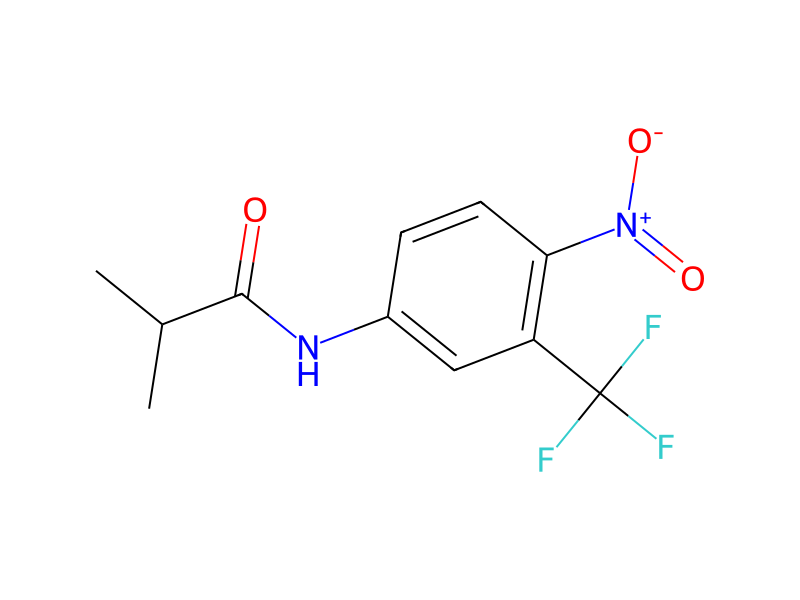
Grundinformationen
- CAS
13311-84-7- Standard-SMILES
CC(C)C(=O)Nc1ccc([N+](=O)[O-])c(C(F)(F)F)c1- InChIKey
MKXKFYHWDHIYRV-UHFFFAOYSA-N- Summenformel
- C11H11F3N2O3
- Durchschnittliche Molmasse
- 276,21 g/mol
- Monoisotopische Masse
- 276,0721767
Überblick
Flutamide can cause developmental toxicity according to state or federal government labeling requirements.
Namen und Bezeichner
- Bevorzugter Name
- Flutamide
- IUPAC
- 2-methyl-N-[4-nitro-3-(trifluoromethyl)phenyl]propanamide
- Lokaler Name
- Flutamid
- Englischer Name
- Flutamide
- Summenformel
- C11H11F3N2O3
- Molmasse
- 276.21
Namen und Synonyme
flutamide13311-84-7EulexinNiftolide2-Methyl-N-[4-nitro-3-(trifluoromethyl)phenyl]propanamideNFBASch 13521niftolidDrogenilFlutamidaFlutamidumSch-13521
Weitere Namen anzeigen
EunexOdyneEuflexDrognilFugerelEu.1eximFlucinom
4'-Nitro-3'-trifluoromethylisobutyranilide2-Methyl-N-(4-nitro-3-[trifluoromethyl]phenyl)propanamideEulexinePropanamide, 2-methyl-N-[4-nitro-3-(trifluoromethyl)phenyl]-SCH13521DTXSID7032004alpha,alpha,alpha-Trifluoro-2-methyl-4'-nitro-m-propionotoluidideNSC-215876
Datenbank-Bezeichner
- CAS
13311-84-7- PubChem CID
- 3397
- DTXSID
DTXSID7032004- ChEMBL
CHEMBL4759307、CHEMBL806- ChEBI
CHEBI:5132- UNII
- 76W6J0943E
- EC Number
- 236-341-9
- Nikkaji
- J8.099C
Eigenschaften
Berechnete StruktureigenschaftenWird ergänzt
- XLogP
- 3,3
- Polarare Oberfläche (TPSA)
- 74,9 Ų
- H-Brücken-Donoren
- 1
- H-Brücken-Akzeptoren
- 6
- Frei drehbare Bindungen
- 2
- Schwere Atome
- 19
- Formalladung
- 0
- Komplexität
- 352
Experimentelle und physikochemische Eigenschaften
Drugs
Pharmaceutical
Pharmaceuticals -> Antineoplastic and immunomodulating agents -> Antineoplastic agents
Pharmaceuticals -> Listed in ZINC15
Pharmaceuticals
LogP
2.6
3.35
Solubility
5.66e-03 g/L
>41.4 [ug/mL] (The mean of the results at pH 7.4)
Human Drugs
FDA approved drugs -> Active ingredient
FDA approved drugs -> Active ingredient
Hormones and antihormones
Endocrine DisruptorsPotential endocrine disrupting compound
Melting Point
111.5-112.5
111 - 113 °C
Physical DescriptionSolid
Collision Cross Section
Sicherheit und Regulatorisches
Sicherheitsangaben dienen nur zur Orientierung und ersetzen weder das Sicherheitsdatenblatt (SDB) des Lieferanten noch geltende Vorschriften oder eine fachliche Bewertung.
GHS-Klassifizierung
GHS Classification
Danger
H302+H312+H332 (29.8%): Harmful if swallowed, in contact with skin or if inhaled [Warning Acute toxicity, oral; acute toxicity, dermal; acute toxicity, inhalation]
P203, P260, P261, P264, P270, P271, P273, P280, P301+P317, P302+P352, P304+P340, P317, P318, P319, P321, P330, P362+P364, P405, and P501 (click each P-code to see the statement)
Aggregated GHS information provided per 94 reports by companies from 15 notifications to the ECHA C&L Inventory. Each notification may be associated with multiple companies.
Danger
H361: Suspected of damaging fertility or the unborn child [Warning Reproductive toxicity]
Gefahrenhinweise
Regulatory InformationHazard Traits - Developmental Toxicity
Hazard Classes and Categories
Acute Tox. 4 (88.3%)
Reproductive toxicity - Category 2
Toxikologische Informationen
Hepatotoxicity
Chronic therapy with flutamide is associated with elevations in serum aminotransferase levels in up to 62% of patients, but marked elevations (above 5 times ULN) in only 3% to 5%. Most of these abnormalities are transient, asymptomatic and do not require dose adjustment or drug discontinuation. However, in 0.1% to 1% of patients, acute liver injury with symptoms and jaundice arises which can be prolonged, severe and even fatal. The latency of onset ranges widely from 1 to 10 months (Cases 2 and 3), averaging 3 months. Allergic manifestations are rare as are autoantibodies. The pattern of liver enzyme elevations is most commonly hepatocellular, but many cases with cholestatic and mixed patterns have been described. Liver failure with a requirement for emergency liver transplantation or fatality has been described in many publications with 20 fatal cases reported from the FDA MedWatch program during the first 5 years of its availability. Fatal cases have been reported in children and young women being treated for hirsutism or acne (Case 1).
Chemie und Industrie
Pharmakologische Informationen
ATC Code
L02BB01
L - Antineoplastic and immunomodulating agents
QL - Antineoplastic and immunomodulating agents
Protein Binding94-96%
Pharmacodynamics
Flutamide is a nonsteroidal antiandrogen. In animal studies, flutamide demonstrates potent antiandrogenic effects. It exerts its antiandrogenic action by inhibiting androgen uptake and/or by inhibiting nuclear binding of androgen in target tissues or both. Prostatic carcinoma is known to be androgen-sensitive and responds to treatment that counteracts the effect of androgen and/or removes the source of androgen, e.g. castration. Elevations of plasma testosterone and estradiol levels have been noted following flutamide administration.
Mechanism of Action
Flutamide is a nonsteroidal antiandrogen that blocks the action of both endogenous and exogenous testosterone by binding to the androgen receptor. In addition Flutamide is a potent inhibitor of testosterone-stimulated prostatic DNA synthesis. Moreover, it is capable of inhibiting prostatic nuclear uptake of androgen.
Biological Half-LifeThe plasma half-life for the alpha-hydroxylated metabolite of flutamide (an active metabolite) is approximately 6 hours.
Metabolism/Metabolites
Flutamide is rapidly and extensively metabolized, with flutamide comprising only 2.5% of plasma radioactivity 1 hour after administration.
Flutamide has known human metabolites that include 2-hydroxy-flutamide.
Flutamide is rapidly and extensively metabolized, with flutamide comprising only 2.5% of plasma radioactivity 1 hour after administration. Route of Elimination: Flutamide and its metabolites are excreted mainly in the urine with only 4.2% of a single dose excreted in the feces over 72 hours. Half Life: The plasma half-life for the alpha-hydroxylated metabolite of flutamide (an active metabolite) is approximately 6 hours.
FDA Pharmacological Classification
Zugehörige Reaktionen
11


Notizen zur Verbindung
Wird geladen…