Grundinformationen
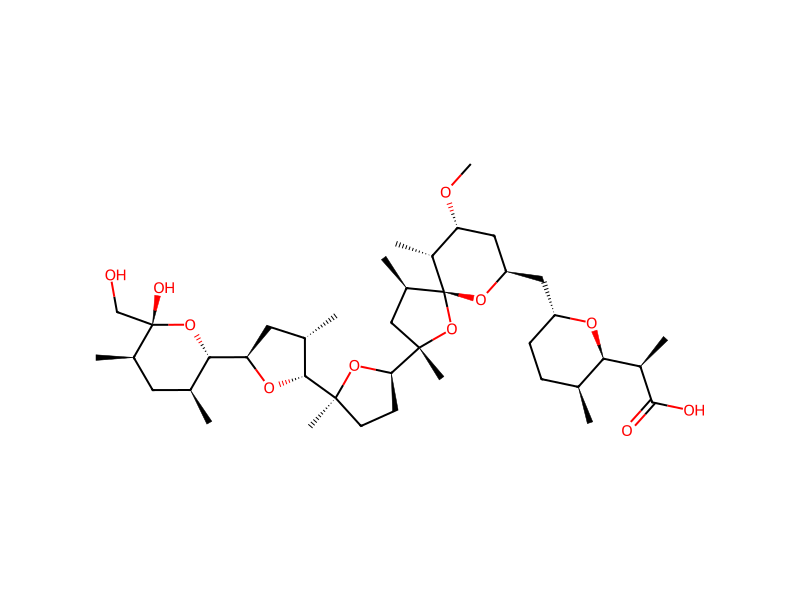
- Standard-SMILES
CO[C@@H]1C[C@@H](C[C@H]2CC[C@H](C)[C@H]([C@@H](C)C(=O)O)O2)O[C@]2(O[C@](C)([C@H]3CC[C@@](C)([C@@H]4O[C@@H]([C@H]5O[C@@](O)(CO)[C@H](C)C[C@@H]5C)C[C@@H]4C)O3)C[C@H]2C)[C@@H]1C- InChIKey
DANUORFCFTYTSZ-SJSJOXFOSA-N- Summenformel
- C40H68O11
- Durchschnittliche Molmasse
- 725 g/mol
- Monoisotopische Masse
- 724,476163
Überblick
Nigericin is a polyether antibiotic which affects ion transport and ATPase activity in mitochondria. It is produced by Streptomyces hygroscopicus. It has a role as an antimicrobial agent, an antibacterial agent, a bacterial metabolite and a potassium ionophore.
Namen und Bezeichner
- Bevorzugter Name
- Nigericin
- IUPAC
- (2R)-2-[(2R,3S,6R)-6-[[(2S,4R,5R,6R,7R,9R)-2-[(2R,5S)-5-[(2R,3S,5R)-5-[(2S,3S,5R,6R)-6-hydroxy-6-(hydroxymethyl)-3,5-dimethyloxan-2-yl]-3-methyloxolan-2-yl]-5-methyloxolan-2-yl]-7-methoxy-2,4,6-trimethyl-1,10-dioxaspiro[4.5]decan-9-yl]methyl]-3-methyloxan-2-yl]propanoic acid
- Englischer Name
- NIGERICIN SODIUM SALT
- Summenformel
- C40H68O11
- Molmasse
- 724.96
Namen und Synonyme
Weitere Namen anzeigen
Datenbank-Bezeichner
- CAS
28380-24-7- PubChem CID
- 34230
- DTXSID
DTXSID9041079- ChEMBL
CHEMBL405862- ChEBI
CHEBI:7569- UNII
- RRU6GY95IS
- EC Number
- 686-881-8
- Nikkaji
- J19.064K
Eigenschaften
Berechnete Struktureigenschaften
- XLogP
- 5,5
- Polarare Oberfläche (TPSA)
- 142 Ų
- H-Brücken-Donoren
- 3
- H-Brücken-Akzeptoren
- 11
- Frei drehbare Bindungen
- 9
- Schwere Atome
- 51
- Formalladung
- 0
- Komplexität
- 1.230
Experimentelle und physikochemische Eigenschaften
Physikochemische Eigenschaften
- Schmelzpunkt
- 183.5 · 183.5-185°
- Siedepunkt
- 779.9 · 779.9±60.0 °C(Predicted)
- Dichte
- 1.19 · 1.19±0.1 g/cm3(Predicted)
- storage temp.
- 2 · 2-8°C
- Löslichkeit
- 10 mg/mL, · chloroform: 10 mg/mL, clear, colorless
- Aggregatzustand
- Solid
- pka
- 4.39 · 4.39±0.10(Predicted)
- Farbe
- White to off-white
- InChIKey
- DANUORFCFTYTSZ-ANZYULKNSA-N
Sicherheit und Regulatorisches
GHS-Klassifizierung
GHS Classification
Danger
H301 (100%): Toxic if swallowed [Danger Acute toxicity, oral]
P261, P264, P264+P265, P270, P271, P280, P301+P316, P302+P352, P304+P340, P305+P351+P338, P319, P321, P330, P332+P317, P337+P317, P362+P364, P403+P233, P405, and P501 (click each P-code to see the statement)
Aggregated GHS information provided per 146 reports by companies from 3 notifications to the ECHA C&L Inventory. Each notification may be associated with multiple companies.
Gefahrenhinweise
Sicherheitsdaten
- F
- 10
- wgk
- 3
- ridadr
- UN 3462 6.1/PG 3
- hs_code
- 29419090
- RTECS-Nr.
- QT6840000
- risk_code
- 25-36/37/38
- Toxizität
- LD50 in mice (mg/kg): 10-15 i.p. (Shoji); also reported as 2.5 i.p. (Harned)
- hazard_code
- T,Xi
- safety_code
- 26-36/37/39-45-36
- hazard_class
- 6.1(b)
- packing_group
- III
Chemie und Industrie
Pharmakologische Informationen
MeSH Pharmacological Classification
Chemical agents that increase the permeability of biological or artificial lipid membranes to specific ions. Most ionophores are relatively small organic molecules that act as mobile carriers within membranes or coalesce to form ion permeable channels across membranes. Many are antibiotics, and many act as uncoupling agents by short-circuiting the proton gradient across mitochondrial membranes.
Substances that inhibit the growth or reproduction of BACTERIA.
Anwendungen
VerwendenNigericin is a polyether antibiotic produced by Streptomyces, notably S. hygroscopicus, isolated in the 1950s. Its complex structure was finally elucidated in 1968. Nigericin is an ionophore, possessing very high affinity for monovalent cations such as Na+ and K+. Nigericin disrupts membrane potential and Golgi apparatus in mitochondria. Although nigericin can be isolated as the free acid (under acidic conditions), like most ionophores it is extracted into organic solvents and is most conveniently isolated as a salt. In vitro, nigericin has broad biological activity against Gram positive bacteria, fungi, tumour cell lines and some viruses, including HIV. Nigericin is the most common member of the polyether class which are common false positives in in vitro screening bioassays using crude microbial extracts. They are thus important standards for dereplication.
Anbieter50 Anbieter
Ergänzende Hinweise
DefinitionChEBI: A polyether antibiotic which affects ion transport and ATPase activity in mitochondria. It is produced by Streptomyces hygroscopicus.
Zugehörige Reaktionen
Keine Reaktionsaufzeichnungen unter den aktuellen Filterkriterien.
Verknüpfte Notizen
Wird geladen…