Nylon-66
HCID 36070
Grundinformationen
- CAS
32131-17-2- Standard-SMILES
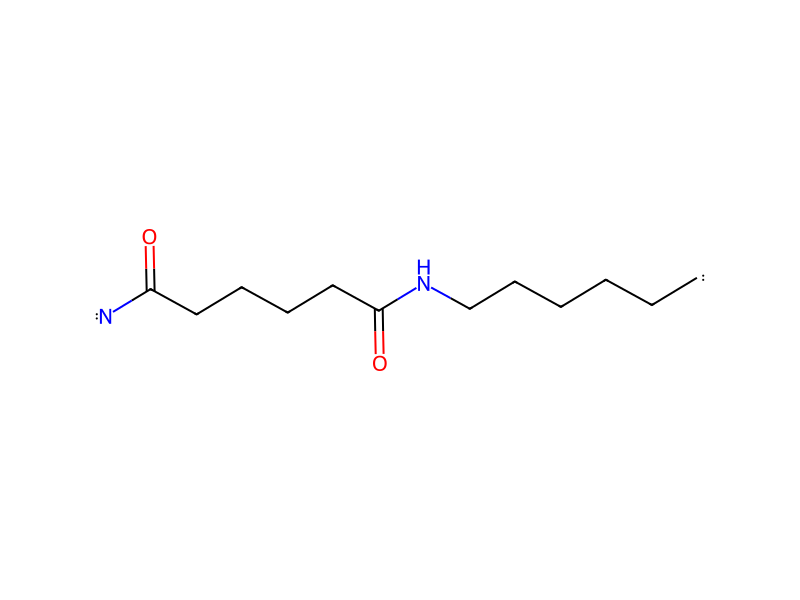
[CH]CCCCCNC(=O)CCCCC([N])=O- InChIKey
LOCYSVHOSYQGOV-UHFFFAOYSA-N- Summenformel
- C12H20N2O2
- Durchschnittliche Molmasse
- 224,3 g/mol
- Monoisotopische Masse
- 224,15247789
Namen und Bezeichner
- Bevorzugter Name
- Nylon-66
- Englischer Name
- Nylon 6/6
- Summenformel
- C36H66N6O6X2
- Molmasse
- 678.95
Namen und Synonyme
Nylon-66RefChem:1093341608-706-6NYLON 6Poly[imino(1,6-dioxo-1,6-hexanediyl)imino-1,6-hexanediyl]Nylon 6/6 pelletsPOLY(HEXAMETHYLENE ADIPAMIDE)Nylon 6/6,Poly(N,N′-hexamethyleneadipinediamide, Poly(hexamethylene adipamide)Nylon 66 powderNYLON 6,6 POLYMERS[-CO(CH2)4CONH(CH2)6NH-]nPOLY(HEXAMETHYLENE DODECANEDIAMIDE)
Weitere Namen anzeigen
PA-66
Datenbank-Bezeichner
- CAS
32131-17-2- PubChem CID
- 36070
- EC Number
- 608-706-6
Eigenschaften
Berechnete Struktureigenschaften
- XLogP
- 1,4
- Polarare Oberfläche (TPSA)
- 47,2 Ų
- H-Brücken-Donoren
- 1
- H-Brücken-Akzeptoren
- 2
- Frei drehbare Bindungen
- 10
- Schwere Atome
- 16
- Formalladung
- 0
- Komplexität
- 205
Experimentelle und physikochemische Eigenschaften
Cosmetics
Cosmetic ingredients (Nylon-66) -> CIR (Cosmetic Ingredient Review)
Bulking; Viscosity controlling; Opacifying
Physikochemische Eigenschaften
- Schmelzpunkt
- 250 · 250-260 °C(lit.)
- Dichte
- 1.47 g/mL · 1.47 g/mL at 25 °C
- Brechungsindex
- 20 · n20/D 1.565
- Löslichkeit
- strong proton donor solvents, acetic acid and phenols: soluble
- Aggregatzustand
- pellets
- Stabilität
- Stable. Incompatible with strong oxidizing agents, strong bases.
- Kosmetik-Inhaltsstoffe Funktionen
- BULKINGOPACIFYINGVISCOSITY CONTROLLING
- InChI
- 1S/C12H24N2O2/c1-2-3-4-7-10-14-12(16)9-6-5-8-11(13)15/h2-10H2,1H3,(H2,13,15)(H,14,16)
- InChIKey
- QDBQXOAICGSACD-UHFFFAOYSA-N
- SMILES
- C(CC(=O)NCCCCCCNC(=O)CCCCC(=O)NCCCCCCN*)CCC(=O)NCCCCCCNC(=O)CCCCC(*)=O |$;;;;;;;;;;;;;;;;;;;;;;;;;;;;*;;;;;;;;;;;;;;;;;;;;*;$|
Sicherheit und Regulatorisches
Sicherheitsangaben dienen nur zur Orientierung und ersetzen weder das Sicherheitsdatenblatt (SDB) des Lieferanten noch geltende Vorschriften oder eine fachliche Bewertung.
GHS-Klassifizierung
GHS Classification
This chemical does not meet GHS hazard criteria for 88.5% (177 of 200) of all reports.
Warning
H315 (11.5%): Causes skin irritation [Warning Skin corrosion/irritation]
P264, P280, P302+P352, P321, P332+P317, and P362+P364 (click each P-code to see the statement)
Aggregated GHS information provided per 200 reports by companies from 2 notifications to the ECHA C&L Inventory.
Gefahrenhinweise
Hazard Classes and CategoriesSkin Irrit. 2 (11.5%)
Toxikologische Informationen
Toxicity SummarySafe in the present practices of use and concentration. Ingredient, concentration, and use information are available in documents discoverable at https://cir-reports.cir-safety.org
Sicherheitsdaten
- wgk
- 3
- tsca
- TSCA listed
- safety_code
- 24/25
- Speicherklasse
- 11 - Combustible Solids
- Selbstentzündungstemperatur
- 752 °F
Chemie und Industrie
Verwendung und Herstellung
UsesCIR ingredient: Nylon-66
Use ClassificationCosmetics -> Bulking; Viscosity controlling; Opacifying
Anwendungen
BeschreibungNylon 6,6 was first developed in 1935 by W.H. Carothers at DuPont and patented in 1938 for use as a textile fiber. It was originally given the name Fiber #66. The fibers are known to be strong, tough, and elastic. Importantly, as opposed to traditional fibers such as cotton, wool, and rayon, nylon fibers are glossy. They are extruded through a spinneret with a circular or trilobal cross section shape. Nylon 6,6 fibers can be used individually, i.e., as monofilaments, for brushes, surgical sutures, tennis strings, and fishing lines. Nylon 6,6 fibers are used for clothing, carpets, tire cords, conveyor belts, and brushes. Nylon 6,6 exhibits excellent dyeability and are twice as durable as Cotton (see Canvasetc.com). Nylon is sometimes coated with plastic, such as vinyl, to produce thin, lightweight waterproof fabrics.
VerwendenNylon 6/6 can be used as nanofibers for the fabrication of support materials for osmosis membranes. It can also be used in the formation of the nanofibrous membranes as separators in lithium-ion batteries.
Darstellung
synthetischeNylon 6/6 is synthesized by polycondensation of hexamethylenediamine and adipic acid with the removal of water.
Vor- und nachgelagerte Produkte
Vorgelagerte Rohstoffe
Zugehörige Reaktionen
0
Noch keine zugehörigen Reaktionen