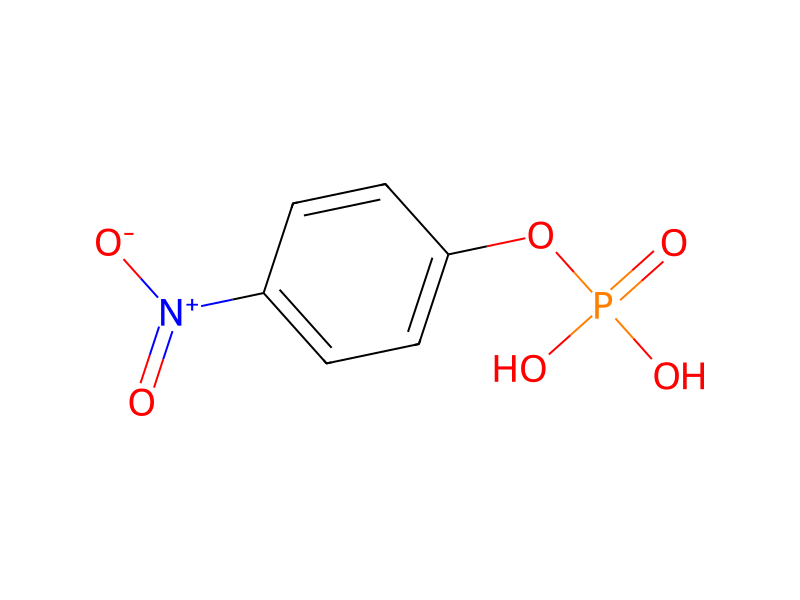
4-Nitrophenyldihydrogenphosphat
4-Nitrophenyl Phosphate
Grundinformationen
- CAS
12778-12-0- Standard-SMILES
O=[N+]([O-])c1ccc(OP(=O)(O)O)cc1- InChIKey
XZKIHKMTEMTJQX-UHFFFAOYSA-N- Summenformel
- C6H6NO6P
- Durchschnittliche Molmasse
- 219,09 g/mol
- Monoisotopische Masse
- 218,99327391
Überblick
4-nitrophenyl phosphate is an aryl phosphate resulting from the mono-esterification of phosphoric acid with 4-nitrophenol. It has a role as a mouse metabolite. It is functionally related to a 4-nitrophenol. It is a conjugate acid of a 4-nitrophenyl phosphate(2-).
Namen und Bezeichner
- Bevorzugter Name
- 4-Nitrophenyl Phosphate
- IUPAC
- (4-nitrophenyl) dihydrogen phosphate
- Lokaler Name
- 4-Nitrophenyldihydrogenphosphat
- Englischer Name
- p-Nitrophenyl phosphate di(Tris) salt
- Summenformel
- C6H6NO6P
- Molmasse
- 219.09
Namen und Synonyme
4-nitrophenyl phosphate330-13-24-Nitrophenyl dihydrogen phosphatep-nitrophenyl phosphateNitrophenylphosphatePhosphoric acid, mono(4-nitrophenyl) esterp-Nitrophenyl dihydrogen phosphatep-Nitrophenol phosphate(4-nitrophenyl) dihydrogen phosphate(4-nitrophenoxy)phosphonic acidPhenol, p-nitro-, dihydrogen phosphate4-nitrophenylphosphate
Weitere Namen anzeigen
pNNPp NNPp-NNPCPD-194PNPP-TRISNO2-phen-PPNPP, 2TRISnitrophenol-PP-NPP, DITRIS SALT
Phosphoric acid, mono(p-nitrophenyl) ester59NF9TE3BADTXSID60861876NSC-40408612778-12-0CHEBI:17440DTXSID00925981RefChem:526001
Datenbank-Bezeichner
- CAS
Eigenschaften
Berechnete Struktureigenschaften
- XLogP
- 0,3
- Polarare Oberfläche (TPSA)
- 113 Ų
- H-Brücken-Donoren
- 2
- H-Brücken-Akzeptoren
- 6
- Frei drehbare Bindungen
- 2
- Schwere Atome
- 14
- Formalladung
- 0
- Komplexität
- 250
Experimentelle und physikochemische Eigenschaften
Chemical ClassesOther Classes -> Organophosphates, Other
DrugsPharmaceuticals -> Listed in ZINC15
Physikochemische Eigenschaften
- Schmelzpunkt
- 153 °C · 153 °C
- Siedepunkt
- 457.8 · 457.8±47.0 °C(Predicted)
- Dichte
- 1.712 · 1.712±0.06 g/cm3(Predicted)
- storage temp.
- 2 · 2-8°C
- Löslichkeit
- 2 O: · H2O: 0.1 g/mL, clear
- pka
- 0.86 · 0.86±0.30(Predicted)
- Farbe
- White to light yellow crystalline powder
- EPA chemische Informationen
- Phosphoric acid, mono(4-nitrophenyl) ester (330-13-2)
Sicherheit und Regulatorisches
Sicherheitsangaben dienen nur zur Orientierung und ersetzen weder das Sicherheitsdatenblatt (SDB) des Lieferanten noch geltende Vorschriften oder eine fachliche Bewertung.
GHS-Klassifizierung
GHS Classification
Warning
H302 (66.7%): Harmful if swallowed [Warning Acute toxicity, oral]
P261, P264, P264+P265, P270, P271, P280, P301+P317, P302+P352, P304+P340, P305+P351+P338, P319, P321, P330, P332+P317, P337+P317, P362+P364, P403+P233, P405, and P501 (click each P-code to see the statement)
Aggregated GHS information provided per 3 reports by companies from 3 notifications to the ECHA C&L Inventory. Each notification may be associated with multiple companies.
Gefahrenhinweise
Hazards SummarySee Paraoxon. See o-Nitroanisole.
Hazard Classes and CategoriesAcute Tox. 4 (66.7%)
Sicherheitsdaten
- F
- 8-10-21
- wgk
- 3
- tsca
- TSCA listed
Chemie und Industrie
Pharmakologische Informationen
MeSH Pharmacological Classification
Colorless, endogenous or exogenous pigment precursors that may be transformed by biological mechanisms into colored compounds; used in biochemical assays and in diagnosis as indicators, especially in the form of enzyme substrates. Synonym: chromogens (not to be confused with pigment-synthesizing bacteria also called chromogens).
Substances used for the detection, identification, analysis, etc. of chemical, biological, or pathologic processes or conditions. Indicators are substances that change in physical appearance, e.g., color, at or approaching the endpoint of a chemical titration, e.g., on the passage between acidity and alkalinity. Reagents are substances used for the detection or determination of another substance by chemical or microscopical means, especially analysis. Types of reagents are precipitants, solvents, oxidizers, reducers, fluxes, and colorimetric reagents. (From Grant & Hackh's Chemical Dictionary, 5th ed, p301, p499)
Verwendung und Herstellung
General Manufacturing InformationPhosphoric acid, mono(4-nitrophenyl) ester: ACTIVE
Anwendungen
Verwenden4-Nitrophenyl phosphate undergoes hydrolysis readily, and is used for measuring alkaline phosphatase activity in human serum.
Vor- und nachgelagerte Produkte
Nachgelagerte Produkte
Zugehörige Reaktionen
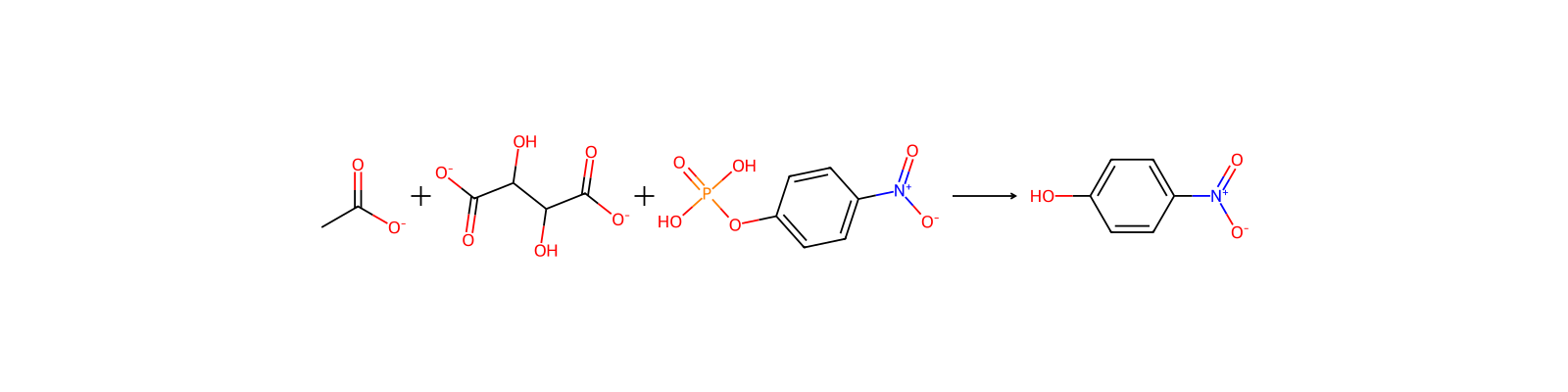
2

Notizen zur Verbindung
Wird geladen…