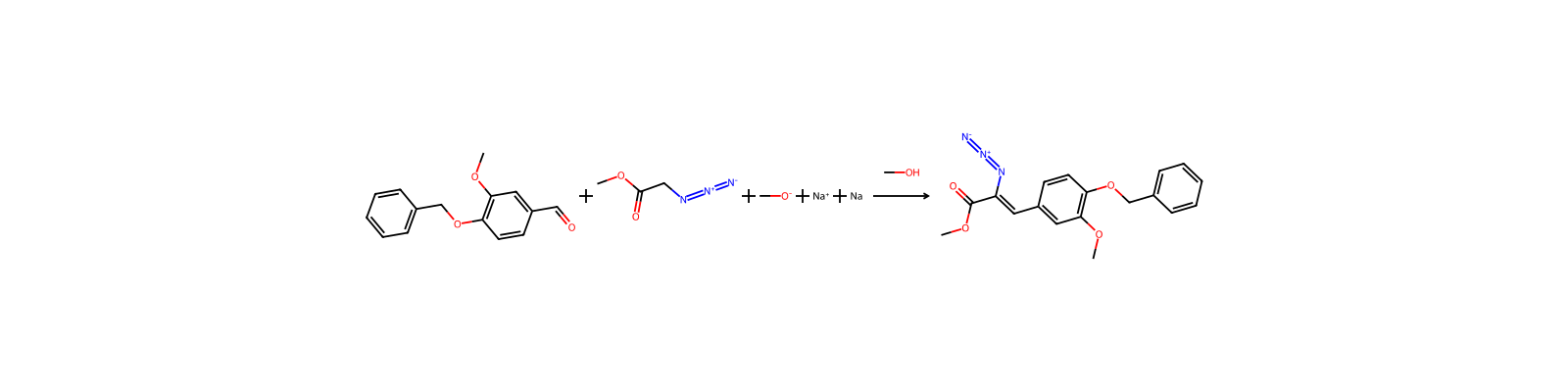
Methyl 2-azidoacetate

Grundinformationen
- CAS
1816-92-8- Standard-SMILES
COC(=O)CN=[N+]=[N-]- InChIKey
RXYCUKSOYJWGPE-UHFFFAOYSA-N- Summenformel
- C3H5N3O2
- Durchschnittliche Molmasse
- 115,09 g/mol
- Monoisotopische Masse
- 115,0381764
Namen und Bezeichner
- Bevorzugter Name
- Methyl 2-azidoacetate
- IUPAC
- methyl 2-azidoacetate
- Englischer Name
- Azidoacetic acid methyl ester
- Summenformel
- C3H5N3O2
- Molmasse
- 115.0907
Namen und Synonyme
Methyl 2-azidoacetate1816-92-8DTXSID70398587RefChem:1089321DTXCID00349446Methyl azidoacetateMETHYLAZIDOACETATEMFCD01311034Acetic acid, 2-azido-, methyl estermethyl 3-diazo-3-azaprop-3-enoateAzidoacetic acid methyl esterAcetic acid, azido-, methyl ester
Weitere Namen anzeigen
Methyl 2-azidoacetate 97%Methyl Azido Acetate-BulkMethyl 2-azidoacetate - M34612-Azido-acetic acid Methyl ester
azido-acetic acid methyl esterAzidoacetic acid, methyl estermethyl azido acetatemethyl azido-acetatemethyl-2-azidoacetateMethyl 2-azidoacetate, 97%SCHEMBL13482799SBB001917
Datenbank-Bezeichner
- CAS
1816-92-8- PubChem CID
- 4020482
- DTXSID
DTXSID70398587- EC Number
- 687-878-4
- Nikkaji
- J1.247.582I
Eigenschaften
Berechnete Struktureigenschaften
- XLogP
- 1,2
- Polarare Oberfläche (TPSA)
- 40,7 Ų
- H-Brücken-Donoren
- 0
- H-Brücken-Akzeptoren
- 4
- Frei drehbare Bindungen
- 3
- Schwere Atome
- 8
- Formalladung
- 0
- Komplexität
- 126
Physikochemische Eigenschaften
- Siedepunkt
- 35 °C · 35 °C
- Dichte
- 1.182 g/mL · 1.182 g/mL at 25 °C
- Brechungsindex
- 20 · n20/D1.440
- Flammpunkt
- 48 ℃ · 48℃
- Aggregatzustand
- liquid
- InChI
- InChI=1S/C3H5N3O2/c1-8-3(7)2-5-6-4/h2H2,1H3
- InChIKey
- RXYCUKSOYJWGPE-UHFFFAOYSA-N
- SMILES
- C(=O)(OC)CN=[N+]=[N-]
Sicherheit und Regulatorisches
Sicherheitsangaben dienen nur zur Orientierung und ersetzen weder das Sicherheitsdatenblatt (SDB) des Lieferanten noch geltende Vorschriften oder eine fachliche Bewertung.
GHS-Klassifizierung
GHS Classification
Warning
H226 (100%): Flammable liquid and vapor [Warning Flammable liquids]
P210, P233, P240, P241, P242, P243, P261, P264, P264+P265, P271, P280, P302+P352, P303+P361+P353, P304+P340, P305+P351+P338, P319, P321, P332+P317, P337+P317, P362+P364, P370+P378, P403+P233, P403+P235, P405, and P501 (click each P-code to see the statement)
Aggregated GHS information provided per 39 reports by companies from 2 notifications to the ECHA C&L Inventory. Each notification may be associated with multiple companies.
Gefahrenhinweise
Hazard Classes and CategoriesFlam. Liq. 3 (100%)
Sicherheitsdaten
- wgk
- 3
- ridadr
- UN 1993C 3 / PGIII
- risk_code
- 5-10-36/37/38
- hazard_code
- Xi
- safety_code
- 26
- hazard_class
- 3
- Speicherklasse
- 3 - Flammable liquids
- Hazard Classifications
- Eye Irrit. 2Flam. Liq. 3Skin Irrit. 2STOT SE 3
Chemie und Industrie
Anwendungen
VerwendenMethyl 2-azidoacetate is widely used as a precursor to build triazole derivatives via alkyne-azide click chemistry. Some of the examples include the synthesis of coumarin-triazole derivatives as potential antiplasmodial agents and macrocyclic triazole containing largazole analogs as histone deacetylases-1 (HDAC1) inhibitors.It can be used to synthesize various pyrrole derivatives by Knoevenagel condensation as in the synthesis of near-infrared boron dipyrromethene (BODIPY) donors for organic tandem solar cells.It can also be used in Hemetsberger-Knittel synthesis of substituted 5-, 6-, and 7-azaindoles.Synthesis of highly fluorescent pyreno[2,1-b]pyrroles using methyl 2-azidoacetate as one of the reagents.
Vor- und nachgelagerte Produkte
Vorgelagerte Rohstoffe
Nachgelagerte Produkte
Zugehörige Reaktionen
62





Notizen zur Verbindung
Wird geladen…