2,2',3,3',6-Pentachlorobiphenyl
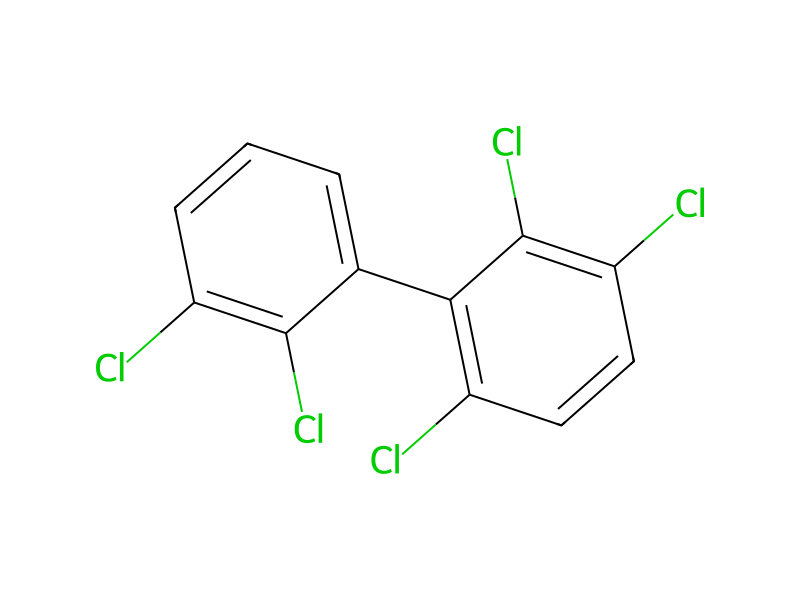
Grundinformationen
- CAS
52663-60-2- Standard-SMILES
Clc1cccc(-c2c(Cl)ccc(Cl)c2Cl)c1Cl- InChIKey
QVWUJLANSDKRAH-UHFFFAOYSA-N- Summenformel
- C12H5Cl5
- Durchschnittliche Molmasse
- 326,4 g/mol
- Monoisotopische Masse
- 323,883389
Überblick
2,2',3,3',6-Pentachlorobiphenyl is one of 209 polychlorinated biphenyls (PCBs). PCBs are a group of synthetic organic compounds with 1-10 chlorine atoms attached to biphenyl. They were manufactured as commercial mixtures but banned in the 1970's because they were found to bioaccumulate and cause harmful health effects. However, PCBs do not break down readily and are still found in the environment. (L4)
Namen und Bezeichner
- Bevorzugter Name
- 2,2',3,3',6-Pentachlorobiphenyl
- IUPAC
- 1,2,4-trichloro-3-(2,3-dichlorophenyl)benzene
- Englischer Name
- 2,2',3,3',6-Pentachlorobiphenyl
- Summenformel
- C12H5Cl5
- Molmasse
- 326.43
Namen und Synonyme
2,2',3,3',6-PENTACHLOROBIPHENYL52663-60-2PCB 842,2',3,3',6-Pentachloro-1,1'-biphenyl1,2,4-trichloro-3-(2,3-dichlorophenyl)benzeneVIF9S75RZVDTXSID0073536RefChem:53428DTXCID4041234690-209-91,1'-Biphenyl, 2,2',3,3',6-pentachloro-UNII-VIF9S75RZV
Weitere Namen anzeigen
PCB NO 84PCB No. 84 in Cyclohexane
Pcb No. 84SCHEMBL4447012SCHEMBL306219412,2',3,3',6-Pentachloro-1,1'-biphenyl #Q27291845
Datenbank-Bezeichner
- CAS
52663-60-2- PubChem CID
- 40468
- DTXSID
DTXSID0073536- UNII
- VIF9S75RZV
- EC Number
- 690-209-9
- Nikkaji
- J126.406K
Eigenschaften
Berechnete Struktureigenschaften
- XLogP
- 6
- Polarare Oberfläche (TPSA)
- 0 Ų
- H-Brücken-Donoren
- 0
- H-Brücken-Akzeptoren
- 0
- Frei drehbare Bindungen
- 1
- Schwere Atome
- 17
- Formalladung
- 0
- Komplexität
- 259
Experimentelle und physikochemische Eigenschaften
LogP6.04
Collision Cross Section158.5 Ų [M]+ [CCS Type: TIMS, Method: calibration with PAHs]
Physikochemische Eigenschaften
- Schmelzpunkt
- 95.86 °C · 95.86°C (estimate)
- Siedepunkt
- 412.3 °C · 412.3°C (rough estimate)
- Dichte
- 1.522 · 1.5220 (rough estimate)
- Brechungsindex
- 1.62 · 1.6200 (rough estimate)
- Wasserlöslichkeit
- 47.02 ug/L · 47.02ug/L(20 ºC)
- Henry's Law Constant
- 5.7 · 5.7×10-2 mol/(m3Pa) at 25℃, Murphy et al. (1987)
- EPA chemische Informationen
- 2 · 2,2',3,3',6-Pentachlorobiphenyl (52663-60-2)
Sicherheit und Regulatorisches
Sicherheitsangaben dienen nur zur Orientierung und ersetzen weder das Sicherheitsdatenblatt (SDB) des Lieferanten noch geltende Vorschriften oder eine fachliche Bewertung.
GHS-Klassifizierung
GHS Classification
This chemical does not meet GHS hazard criteria for 100% (3 of 3) of all reports.
Not Classified
Aggregated GHS information provided per 3 reports by companies from 1 notifications to the ECHA C&L Inventory.
Gefahrenhinweise
Hazard Classes and CategoriesNot Classified
Sicherheit und Schutzausrüstung
Minimum Risk LevelIntermediate Oral: 0.03 ug/kg/day (L134)
Toxikologische Informationen
Treatment
There are no specific treatments for PCB poisoning, since it is not usually recognized until after substantial chronic exposure. Only preventing further exposure and treating the observed symptoms can be done. Acute inhalation can be treated by administering oxygen. (L4)
Health Effects
The most common health effects of PCBs are skin conditions such as chloracne and rashes. Chronic PCB exposure has also been shown to cause liver, stomach and kidney, damage, jaundice, edema, anemia, changes in the immune system, behavioral alterations, and impaired reproduction. (L4)
Exposure RoutesOral (L4) ; inhalation (L4) ; dermal (L4)
Toxicity Summary
Chemie und Industrie
Pharmakologische Informationen
Metabolism/Metabolites
PCBs are absorbed via inhalation, oral, and dermal routes of exposure. They are trasported in the blood, often bound to albumin. Due to their lipophilic nature they tend to accumulate in lipid-rich tissues, such as the liver, adipose, and skin. Metabolism of PCBs is very slow and varies based on the degree and position of chlorination. PCBs are metabolized by the microsomal monooxygenase system catalyzed by cytochrome P-450 enzymes to polar metabolites that can undergo conjugation with glutathione and glucuronic acid. The major metabolites are hydroxylated products which are excreted in the bile and faeces. The slow metabolism of PCBs means they tend to accumulate in body tissues. (L4, T6)
Verwendung und Herstellung
Uses
PCBs were used as coolants and lubricants in transformers, capacitors, and other electrical devices (such as fluorescent lights and refridgerators) produced before 1977. PCBs may contaminate the air and water near hazardous waste sites. In addition, PCBs bioaccumulate in the environment and may be found in fish, meat, and dairy products. (L4)
Anwendungen
Verwenden2,2'',3,3'',6-Pentachlorobiphenyl is a polychlorinated biphenyl (PCB) congeners.
Anbieter7 Anbieter
上海稳同科技有限公司02151600108 13062666369 · [email protected]
上海毕楷科技有限公司18516304666
天津阿尔塔科技有限公司022-65378550-8551 · [email protected]
Shaanxi Didu New Materials Co. Ltd
Zugehörige Reaktionen
0
Keine Reaktionsaufzeichnungen unter den aktuellen Filterkriterien.
Notizen zur Verbindung
Wird geladen…