Grundinformationen
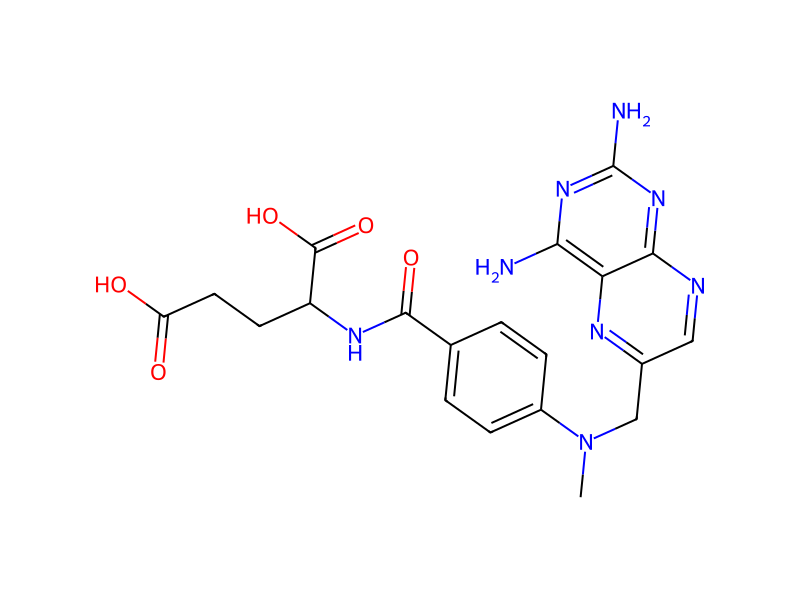
- Standard-SMILES
CN(Cc1cnc2nc(N)nc(N)c2n1)c1ccc(C(=O)NC(CCC(=O)O)C(=O)O)cc1- InChIKey
FBOZXECLQNJBKD-UHFFFAOYSA-N- Summenformel
- C20H22N8O5
- Durchschnittliche Molmasse
- 454,4 g/mol
- Monoisotopische Masse
- 454,1713158
Überblick
2-[[[4-[(2,4-diamino-6-pteridinyl)methyl-methylamino]phenyl]-oxomethyl]amino]pentanedioic acid is a member of folic acids.
Namen und Bezeichner
- Bevorzugter Name
- Methotrexate, (A+-)-
- IUPAC
- 2-[[4-[(2,4-diaminopteridin-6-yl)methyl-methylamino]benzoyl]amino]pentanedioic acid
- Lokaler Name
- N-[4-[[(2,4-Diamino-6-pteridinyl)methyl]methylamino]benzoyl]-DL-glutaminsure
- Englischer Name
- (+/-)AMETHOPTERIN
- Summenformel
- C20H22N8O5
- Molmasse
- 454.44
Namen und Synonyme
Weitere Namen anzeigen
Datenbank-Bezeichner
- CAS
51865-79-3、60388-53-6- PubChem CID
- 4112
- DTXSID
DTXSID40859034- ChEMBL
CHEMBL426- ChEBI
CHEBI:93775- UNII
- 99ITO15X8S
- EC Number
- 262-213-7
Eigenschaften
Berechnete Struktureigenschaften
- XLogP
- -1,8
- Polarare Oberfläche (TPSA)
- 211 Ų
- H-Brücken-Donoren
- 5
- H-Brücken-Akzeptoren
- 12
- Frei drehbare Bindungen
- 9
- Schwere Atome
- 33
- Formalladung
- 0
- Komplexität
- 704
Experimentelle und physikochemische Eigenschaften
Physikochemische Eigenschaften
- Schmelzpunkt
- 195 °C · 195 °C (dec.)(lit.)
- Dichte
- 1.536 · 1.536±0.06 g/cm3(Predicted)
- storage temp.
- 20 °C · −20°C
- Löslichkeit
- 2 O: · H2O: Add a minimal amount of 0.1 L NaOH to solubilize, then dilute in neutral buffer or saline. Diluted stock is stable for 1week refrigerated and for 1month frozen at20°C.
- pka
- 3.47 · 3.47±0.10(Predicted)
- Aggregatzustand
- powder
- Farbe
- yellow
Sicherheit und Regulatorisches
GHS-Klassifizierung
GHS Classification
Danger
H301 (100%): Toxic if swallowed [Danger Acute toxicity, oral]
P203, P264, P264+P265, P270, P280, P301+P316, P302+P352, P305+P351+P338, P318, P321, P330, P332+P317, P337+P317, P362+P364, P405, and P501 (click each P-code to see the statement)
The GHS information provided by 1 company from 1 notification to the ECHA C&L Inventory.
Gefahrenhinweise
Toxikologische Informationen
Treatment
Administer charcoal as a slurry. Consider gastric lavage after ingestion of a potentially life-threatening amount of poison if it can be performed soon after ingestion (generally within 1 hour). Protect airway by placement in Trendelenburg and left lateral decubitus position or by endotracheal intubation. Control any seizures first. Glucarpidase has been used intravenously in combination with thymidine and leucovorin to treat methotrexate toxicity. (T36)
Health Effects
A small percentage of patients develop hepatitis, and there is an increased risk of pulmonary fibrosis where dry cough can be an important sign. The higher doses of methotrexate often used in cancer chemotherapy can cause toxic effects to the rapidly-dividing cells of bone marrow and gastrointestinal mucosa. The resulting myelosuppression and mucositis are often prevented (termed Leucovorin "rescue"- as this is the folic acid based drug used) (L1079).
Exposure Routes
Inhalation (A314); dermal (A314); intravenous (A314) Oral absorption is dose dependent in adults and leukemic pediatric patients. In adults, peak serum levels are reached within one to two hours. At doses of 30 mg/m^2 or less, methotrexate is generally well absorbed with a mean bioavailability of 60%. At doses greater than 80 mg/m^2, the absorption of the doses is significantly less due to a saturation effect.
Toxicity Summary
Methotrexate anti-tumor activity is a result of the inhibition of folic acid reductase, leading to inhibition of DNA synthesis and inhibition of cellular replication. The mechanism involved in its activity against rheumatoid arthritis is not known.
Sicherheitsdaten
- wgk
- 3
- ridadr
- UN 1544 6.1/PG 2
- RTECS-Nr.
- MA1224100
- risk_code
- 61-25-36/38-23/24/25
- hazard_code
- T
- safety_code
- 53-26-36/37-45-36/37/39
Chemie und Industrie
Pharmakologische Informationen
Metabolism/Metabolites
After absorption, methotrexate undergoes hepatic and intracellular metabolism to form methotrexate polyglutamate, metabolites which by hydrolysis may be converted back to methotrexate. Methotrexate polyglutamates inhibit dihydrofolate reductase and thymidylate synthetase. Small amounts of these polyglutamate metabolites may remain in tissues for extended periods; the retention and prolonged action of these active metabolites vary among different cells, tissues, and tumors. In addition, small amounts of methotrexate polyglutamate may be converted to 7-hydroxymethotrexate; accumulation of this metabolite may become substantial following administration of high doses of methotrexate, since the aqueous solubility of 7-hydroxymethotrexate is threefold to fivefold lower than that of the parent compound. Following oral administration of methotrexate, the drug also is partially metabolized by the intestinal flora. Renal excretion is the primary route of elimination, and is dependent upon dosage and route of administration (A620). Route of Elimination: Renal excretion is the primary route of elimination and is dependent upon dosage and route of administration. IV administration, 80% to 90% of the administered dose is excreted unchanged in the urine within 24 hours. There is limited biliary excretion amounting to 10% or less of the administered dose. Half Life: Low doses (less than 30 mg/m^2): 3 to 10 hours; High doses: 8 to 15 hours.
Verwendung und Herstellung
Uses
Methotrexate is indicated in the treatment of gestational choriocarcinoma, chorioadenoma destruens and hydatidiform mole. In acute lymphocytic leukemia, methotrexate is indicated in the prophylaxis of meningeal leukemia and is used in maintenance therapy in combination with other chemotherapeutic agents. Methotrexate is also indicated in the treatment of meningeal leukemia. Methotrexate is used alone or in combination with other anticancer agents in the treatment of breast cancer, epidermoid cancers of the head and neck, advanced mycosis fungoides (cutaneous T cell lymphoma), and lung cancer, particularly squamous cell and small cell types. Methotrexate is also used in combination with other chemotherapeutic agents in the treatment of advanced stage non-Hodgkin's lymphomas. Methotrexate is indicated in the symptomatic control of severe, recalcitrant, disabling psoriasis. Methotrexate is indicated in the management of selected adults with severe, active rheumatoid arthritis (ACR criteria), or children with active polyarticular-course juvenile rheumatoid arthritis.
Anwendungen
VerwendenAmethopterin is an antineoplastic, antirheumatic, folic acid antagonist
Anbieter40 Anbieter
Zugehörige Reaktionen
Keine Reaktionsaufzeichnungen unter den aktuellen Filterkriterien.
Verknüpfte Notizen
Wird geladen…