
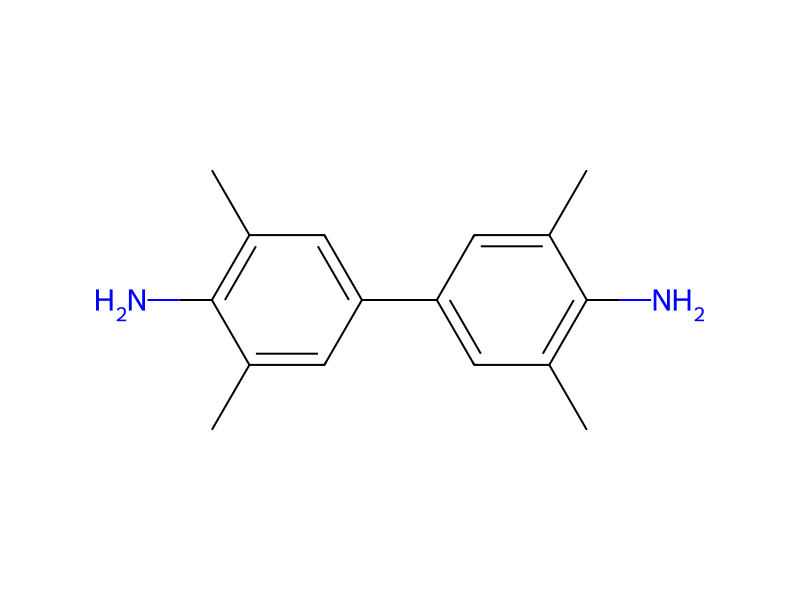
Grundinformationen
- Standard-SMILES
Cc1cc(-c2cc(C)c(N)c(C)c2)cc(C)c1N- InChIKey
UAIUNKRWKOVEES-UHFFFAOYSA-N- Summenformel
- C16H20N2
- Durchschnittliche Molmasse
- 240,34 g/mol
- Monoisotopische Masse
- 240,16264864
Überblick
3,3',5,5'-tetramethylbenzidine appears as pale yellow crystals or off-white powder. (NTP, 1992)
Namen und Bezeichner
- Bevorzugter Name
- 3,3',5,5'-Tetramethylbenzidine
- IUPAC
- 4-(4-amino-3,5-dimethylphenyl)-2,6-dimethylaniline
- Lokaler Name
- 3,3',5,5'-Tetramethylbenzidin
- Englischer Name
- Tetramethylbenzidine
- Summenformel
- C16H20N2
- Molmasse
- 240.34
Namen und Synonyme
54827-17-73,3',5,5'-TETRAMETHYLBENZIDINE3,3',5,5'-Tetramethyl-[1,1'-biphenyl]-4,4'-diamine3,5,3',5'-TetramethylbenzidineDTXSID50261203B3T5CB8EOCOLORBURST BLUE3,3',5,5'-Tetramethyl-(1,1'-biphenyl)-4,4'-diamine(1,1'-Biphenyl)-4,4'-diamine, 3,3',5,5'-tetramethyl-POTASSIUM-BLUE MAX3,3',5,5'-Tetramethyl(1,1'-biphenyl)-4,4'-diamineDTXCID406120
Weitere Namen anzeigen
TmbzTMB SUBSTRATETetramethylbenzidine (TMB)3,3',5',5-TETRAMETHYLBENZIDINE3,3,5,5-TETRAMETHYLBENZIDINE, STANDARD F OR GC4-(4-Amino-3,5-dimethylphenyl)-2,6-dimethylanilineTMB-E
[1,1'-Biphenyl]-4,4'-diamine, 3,3',5,5'-tetramethyl-3,3',5,5'-Tetramethyl[1,1'-biphenyl]-4,4'-diaminetetramethyl benzidineRefChem:4848623,3',5,5'-TMP259-364-6TMBMFCD00007748
Datenbank-Bezeichner
- CAS
54827-17-7- PubChem CID
- 41206
- DTXSID
DTXSID5026120- ChEMBL
CHEMBL1331128- UNII
- 3B3T5CB8EO
- EC Number
- 259-364-6
- Nikkaji
- J338G
Eigenschaften
Berechnete Struktureigenschaften
- XLogP
- 3,6
- Polarare Oberfläche (TPSA)
- 52 Ų
- H-Brücken-Donoren
- 2
- H-Brücken-Akzeptoren
- 2
- Frei drehbare Bindungen
- 1
- Schwere Atome
- 18
- Formalladung
- 0
- Komplexität
- 226
Experimentelle und physikochemische Eigenschaften
Chemical ClassesNitrogen Compounds -> Benzidine and Derivatives
Solubilityless than 1 mg/mL at 68 °F (NTP, 1992)
Endocrine DisruptorsPotential endocrine disrupting compound
DecompositionWhen heated to decomp it emits toxic fumes of /nitrogen oxides/.
Melting Point
334 to 336 °F (NTP, 1992)
168.5 °C
Vapor Pressure0.0000005 [mmHg]
Physical Description
3,3',5,5'-tetramethylbenzidine appears as pale yellow crystals or off-white powder. (NTP, 1992)
Pale yellow or off-white solid; [CAMEO] White or light yellow solid; [MSDSonline]
Collision Cross Section175.7 Ų [M+H]+ [CCS Type: DT; Buffer gas: N2; Ionization: APCI+; Dataset: TOXCAST; Source Identifier: DTXSID5026120]
Physikochemische Eigenschaften
- Schmelzpunkt
- 168 · 168-171 °C(lit.)
- Siedepunkt
- 100 °C · 100 °C
- Dichte
- 1 · 1
- Brechungsindex
- 1.5519 · 1.5519 (estimate)
- storage temp.
- 2 · 2-8°C
- Löslichkeit
- 0.1 g/100 · Slightly soluble. <0.1 g/100 mL at 20°C.
- pka
- 4.49 · 4.49±0.10(Predicted)
- Aggregatzustand
- tablet
- Farbe
- Cream
- Wasserlöslichkeit
- 0.1 g/100 · Slightly soluble. <0.1 g/100 mL at 20 ºC
- BRN
- 2808541 · 2808541
- Henry's Law Constant
- 1.3 · 1.3×105 mol/(m3Pa) at 25℃, HSDB (2015)
- Stabilität
- Stable, but moisture sensitive and may be light sensitive. Incompatible with water, strong oxidizing agents.
- InChI
- 1S/C16H20N2/c1-9-5-13(6-10(2)15(9)17)14-7-11(3)16(18)12(4)8-14/h5-8H,17-18H2,1-4H3
- InChIKey
- UAIUNKRWKOVEES-UHFFFAOYSA-N
- SMILES
- Cc1cc(cc(C)c1N)-c2cc(C)c(N)c(C)c2
- CAS Datenbank
- 54827 · 54827-17-7(CAS DataBase Reference)
- EPA chemische Informationen
- 3 · 3,3',5,5'-Tetramethylbenzidine (54827-17-7)
Sicherheit und Regulatorisches
GHS-Klassifizierung
GHS Classification
This chemical does not meet GHS hazard criteria for 2.8% (2 of 72) of reports.
Warning
H302 (29.2%): Harmful if swallowed [Warning Acute toxicity, oral]
P203, P261, P264, P264+P265, P270, P271, P280, P301+P317, P302+P352, P304+P340, P305+P351+P338, P318, P319, P321, P330, P332+P317, P337+P317, P362+P364, P403+P233, P405, and P501 (click each P-code to see the statement)
Aggregated GHS information provided per 72 reports by companies from 15 notifications to the ECHA C&L Inventory. Each notification may be associated with multiple companies.
Gefahrenhinweise
Regulatory Information
Chemical: [1,1'-Biphenyl]-4,4'-diamine, 3,3',5,5'-tetramethyl-
[1,1'-Biphenyl]-4,4'-diamine, 3,3',5,5'-tetramethyl-: Does not have an individual approval but may be used under an appropriate group standard
Fire HazardsFlash point data for this chemical are not available, however, it is probably combustible. (NTP, 1992)
Hazards SummaryAn irritant; Harmful if swallowed; May induce methemoglobinemia if absorbed; [Alfa Aesar MSDS] See Benzidine.
Reactive GroupAmines, Aromatic
Reactivity Profile
3,3',5,5'-TETRAMETHYLBENZIDINE is sensitive to prolonged exposure to light (NTP, 1992). Neutralizes acids in exothermic reactions to form salts plus water. May be incompatible with isocyanates, halogenated organics, peroxides, phenols (acidic), epoxides, anhydrides, and acid halides. Flammable gaseous hydrogen may be generated in combination with strong reducing agents, such as hydrides.
Air and Water ReactionsInsoluble in water.
Hazard Classes and CategoriesAcute Tox. 4 (29.2%)
Sicherheit und Schutzausrüstung
Fire FightingFires involving this compound can be controlled using a dry chemical, carbon dioxide, or Halon extinguisher. (NTP, 1992)
First Aid
EYES: First check the victim for contact lenses and remove if present. Flush victim's eyes with water or normal saline solution for 20 to 30 minutes while simultaneously calling a hospital or poison control center. Do not put any ointments, oils, or medication in the victim's eyes without specific instructions from a physician. IMMEDIATELY transport the victim after flushing eyes to a hospital even if no symptoms (such as redness or irritation) develop.
Nonfire Spill Response
SMALL SPILLS AND LEAKAGE: If a spill of this chemical occurs, FIRST REMOVE ALL SOURCES OF IGNITION, then you should dampen the solid spill material with acetone and transfer the dampened material to a suitable container. Use absorbent paper dampened with acetone to pick up any remaining material. Seal your contaminated clothing and the absorbent paper in a vapor-tight plastic bag for eventual disposal. Solvent wash all contaminated surfaces with acetone followed by washing with a soap and water solution. Do not reenter the contaminated area until the Safety Officer (or other responsible person) has verified that the area has been properly cleaned.
Preventive Measures
SRP: At the time of review, criteria for land treatment or burial (sanitary landfill) disposal practices are subject to significant revision. Prior to implementing land disposal of waste residue (including waste sludge), consult with environmental regulatory agencies for guidance on acceptable disposal practices.
Protective Action Criteria (PAC)
0.44 [mg/m3]
4.9 [mg/m3]
29 [mg/m3]
Personal Protective Equipment (PPE)
RECOMMENDED RESPIRATOR: Where the neat test chemical is weighed and diluted, wear a NIOSH-approved half face respirator equipped with an organic vapor/acid gas cartridge (specific for organic vapors, HCl, acid gas and SO2) with a dust/mist filter. (NTP, 1992)
Toxikologische Informationen
Environmental Fate
TERRESTRIAL FATE: Based on a classification scheme(1), an estimated Koc value of 4,000(SRC), determined from an estimated log Kow of 4.11(2) and a regression-derived equation(3), indicates that 3,3',5,5'-tetramethylbenzidine is expected to have slight mobility in soil(SRC). The first pKa of 3,3',5,5'-tetramethylbenzidine is estimated as 4.2(SRC), using an estimation method based on perturbed molecular orbital theory and linear free energy (LFER) methods(4). This pKa indicates that 3,3',5,5'-tetramethylbenzidine will partially exist in the protonated form under acidic conditions and cations have greater adsorption to soil than neutral molecules(SRC). Furthermore, 3,3',5,5'-tetramethylbenzidine is an aromatic amine which may form covalent bonds with humic materials resulting in relatively immobile quinone-like complexes(5). Volatilization of the neutral species of 3,3',5,5'-tetramethylbenzidine from moist soil surfaces is not expected to be an important fate process(SRC) based upon an estimated Henry's Law constant of 7.7X10⁻¹¹ atm-cu m/mole(SRC), developed using a fragment constant estimation method(6). The conjugate acid of 3,3-dimethylbenzidine will not volatilize since cations are non-volatile(SRC). 3,3',5,5'-Tetramethylbenzidine is not expected to volatilize from dry soil surfaces(SRC) based upon an estimated vapor pressure of 5X10⁻⁷ mm Hg(SRC), determined from a fragment constant method(7). No data on the biodegradation of 3,3',5,5'-tetramethylbenzidine in soil were found(SRC), but a similar compound (3,3'-dimethylbenzidine) was reported to be resistant to biodegradation in the Japanese MITI test(8), suggesting biodegradation in soil will most likely occur slowly(SRC). Benzidine-based compounds such as 3,3',5,5'-tetramethylbenzidine are rapidly oxidized by Fe(III) and several other cations which are frequently found in soils and clay minerals(9).
AQUATIC FATE: Based on a classification scheme(1), an estimated Koc value of 4,000(SRC), determined from an estimated log Kow of 4.11(2) and a regression-derived equation(3), indicates that 3,3',5,5'-tetramethylbenzidine is expected to adsorb to suspended solids and sediment(SRC). The first pKa of 3,3',5,5'-tetramethylbenzidine is estimated as 4.2(SRC), using an estimation method based on perturbed molecular orbital theory and linear free energy (LFER) methods(4). This pKa indicates that 3,3',5,5'-tetramethylbenzidine will partially exist in the protonated form under acidic conditions and cations have greater adsorption to suspended solids and sediment than neutral molecules(SRC). Volatilization of the free base from water surfaces is not expected(3) based upon an estimated Henry's Law constant of 7.7X10⁻¹¹ atm-cu m/mole(SRC), developed using a fragment constant estimation method(5). The conjugate acid of 3,3',5,5'-tetramethylbenzidine will not volatilize since cations are non-volatile(SRC). According to a classification scheme(6), an estimated BCF of 290(SRC), from its estimated log Kow(2) and a regression-derived equation(7), suggests the potential for bioconcentration in aquatic organisms is high(SRC). No data on the biodegradation of 3,3',5,5'-tetramethylbenzidine in natural waters were found(SRC), but a similar compound (3,3'-dimethylbenzidine) was reported to be resistant to biodegradation in the Japanese MITI test(8), suggesting biodegradation in water will most likely occur slowly(SRC). Benzidine-based compounds such as 3,3',5,5'-tetramethylbenzidine are rapidly oxidized by Fe(III) and several other cations which are frequently found in environmental waters, complexes of fulvic acids and in clay minerals(9).
ATMOSPHERIC FATE: According to a model of gas/particle partitioning of semivolatile organic compounds in the atmosphere(1), 3,3',5,5'-tetramethylbenzidine, which has an estimated vapor pressure of 5X10⁻⁷ mm Hg at 25 °C(SRC), determined from a fragment constant method(2), is expected to exist in both the vapor and particulate phases in the ambient atmosphere. Vapor-phase 3,3',5,5'-tetramethylbenzidine is degraded in the atmosphere by reaction with photochemically-produced hydroxyl radicals(SRC); the half-life for this reaction in air is estimated to be 5 hours(SRC), calculated from its rate constant of 7.6X10⁻¹¹ cu cm/molecule-sec at 25 °C (SRC) determined using a structure estimation method(3). Since 3,3',5,5'-tetramethylbenzidine absorbs light greater than 290 nm(4), it may be susceptible to direct photolysis in the environment(SRC). Particulate-phase 3,3',5,5'-tetramethylbenzidine may be removed from the air by wet and dry deposition(SRC).
Adverse EffectsMethemoglobinemia - The presence of increased methemoglobin in the blood; the compound is classified as secondary toxic effect
Soil Adsorption/Mobility
The Koc of 3,3',5,5'-tetramethylbenzidine is estimated as 4,000(SRC), using an estimated log Kow of 4.11(1) and a regression-derived equation(2). According to a classification scheme(3), this estimated Koc value suggests that 3,3',5,5'-tetramethylbenzidine is expected to have slight mobility in soil(SRC). The first pKa of 3,3',5,5'-tetramethylbenzidine is estimated as 4.2, using an estimation method based on perturbed molecular orbital theory and linear free energy (LFER) methods(4). This estimated pKa indicates that 3,3',5,5'-tetramethylbenzidine will partially exist in the protonated form under acidic conditions and cations have greater adsorption to soils than neutral molecules(SRC). Furthermore, 3,3',5,5'-tetramethylbenzidine is an aromatic amine which may form covalent bonds with humic materials resulting in relatively immobile quinone-like complexes(5).
Artificial Pollution Sources3,3',5,5'-Tetramethylbenzidine's production and use as a clinical reagent for testing blood(1) may result in its release to the environment through various waste streams(SRC).
Environmental Biodegradation
No biodegradation data for 3,3',5,5'-tetramethylbenzidine were found(SRC). Structurally similar compounds such as 3,3'-dimethylbenzidine have been shown to undergo biodegradation slowly in screening tests(1), suggesting that 3,3',5,5'-tetramethylbenzidine is also resistant to biodegradation(SRC).
Environmental Bioconcentration
An estimated BCF of 290 was calculated for 3,3',5,5'-tetramethylbenzidine(SRC), using an estimated log Kow of 4.11(1) and a regression-derived equation(2). According to a classification scheme(3), this BCF suggests the potential for bioconcentration in aquatic organisms is high(SRC).
Volatilization from Water/Soil
The first pKa of 3,3',5,5'-tetramethylbenzidine is estimated as 4.2(SRC), using an estimation method based on perturbed molecular orbital theory and linear free energy (LFER) methods(1). This estimated pKa indicates that 3,3',5,5'-tetramethylbenzidine will partially exist in the protonated form under acidic conditions and cations will not volatilize from water or soil surfaces(SRC). The Henry's Law constant for the neutral species (free base) of 3,3',5,5'-tetramethylbenzidine is estimated as 7.7X10⁻¹¹ atm-cu m/mole(SRC) using a fragment constant estimation method(2). This Henry's Law constant indicates that 3,3',5,5'-tetramethylbenzidine is expected to be essentially nonvolatile from water surfaces(3). 3,3',5,5'-Tetramethylbenzidine's Henry's Law constant(2) indicates that volatilization from moist soil surfaces is not expected(SRC). 3,3',5,5'-Tetramethylbenzidine is not expected to volatilize from dry soil surfaces(SRC) based upon an estimated vapor pressure of 5X10⁻⁷ mm Hg(SRC), determined from a fragment constant method(4).
Non-Human Toxicity Excerpts
...HAS PRODUCED NO TUMORS SPECIFICALLY ATTRIBUTABLE TO IT WHEN INJECTED SC INTO RATS IN DOSES GREATER THAN THOSE IN WHICH BENZIDINE & O-TOLIDINE CAUSE HIGH YIELD OF NEOPLASMS.
MUTAGENICITY OF URINE FROM RATS TREATED WITH ARYLAMINES (0.25 MMOL/KG IP) WAS STUDIED USING AMES ASSAY (SALMONELLA TYPHIMURIUM). NO MUTAGENICITY WAS OBSERVED IN URINE COLLECTED 24 HR AFTER ADMIN OF 3,3'-5,5'-TETRAMETHYLBENZIDINE.
ANALOGS OF BENZIDINE WERE ASSAYED FOR MUTAGENIC ACTIVITY TOWARD SALMONELLA TYPHIMURIUM TA-1538 IN PRESENCE & ABSENCE OF RAT LIVER ENZYME PREPARATION. 3,3',5,5'-TETRAMETHYLBENZIDINE HAD NO MUTAGENIC ACTIVITY ALONE OR IN CONJUNCTION WITH A LIVER PREPARATION.
PROLONGED SC ADMIN TO RATS GAVE NEGLIGIBLE YIELD OF TUMORS, UNLIKE RESULTS OF ADMIN OF BENZIDINE & O-TOLIDINE. THIS SENSITIVE & SPECIFIC AGENT FOR DETECTION OF BLOOD MIGHT DISPLACE USE OF LATTER SUBSTANCES.
For more Non-Human Toxicity Excerpts (Complete) data for 3,3',5,5'-TETRAMETHYLBENZIDINE (6 total), please visit the HSDB record page.
Environmental Abiotic Degradation
The rate constant for the vapor-phase reaction of 3,3',5,5'-tetramethylbenzidine with photochemically-produced hydroxyl radicals has been estimated as 7.6X10⁻¹¹ cu cm/molecule-sec at 25 °C(SRC) using a structure estimation method(1). This corresponds to an atmospheric half-life of about 5 hours at an atmospheric concentration of 5X10+5 hydroxyl radicals per cu cm(1). The first pKa of 3,3',5,5'-tetramethylbenzidine is estimated as 4.2(SRC), using an estimation method based on perturbed molecular orbital theory and linear free energy (LFER) methods(2). This pKa indicates that 3,3',5,5'-tetramethylbenzidine will partially exist in the protonated form under acidic conditions(SRC). 3,3',5,5'-Tetramethylbenzidine absorbs light greater than 290 nm(3) and may be susceptible to photolysis in the environment(SRC). Benzidine-based compounds such as 3,3',5,5'-tetramethylbenzidine are rapidly oxidized by Fe(III) and several other cations which are frequently found in environmental waters, complexes of fulvic acids and in clay minerals(3). 3,3',5,5'-Tetramethylbenzidine is not expected to undergo hydrolysis due to a lack of hydrolyzable functional groups(4).
Probable Routes of Human ExposureOccupational exposure to 3,3',5,5'-tetramethylbenzidine may occur through inhalation and dermal contact with this compound at workplaces where 3,3',5,5'-tetramethylbenzidine is produced or used. (SRC)
Environmental Fate/Exposure Summary
3,3',5,5'-Tetramethylbenzidine's production and use as a clinical reagent for testing blood may result in its release to the environment through various waste streams. If released to air, an estimated vapor pressure of 5X10⁻⁷ mm Hg at 25 °C indicates 3,3',5,5'-tetramethylbenzidine will exist in both the vapor and particulate phases in the ambient atmosphere. Vapor-phase 3,3',5,5'-tetramethylbenzidine will be degraded in the atmosphere by reaction with photochemically-produced hydroxyl radicals; the half-life for this reaction in air is estimated to be 5 hours. 3,3',5,5'-Tetramethylbenzidine absorbs light greater than 290 nm, and it may be susceptible to direct photolysis in the environment; however, the rate of this potential reaction is unknown. Particulate-phase 3,3',5,5'-tetramethylbenzidine will be removed from the atmosphere by wet and dry deposition. If released to soil, 3,3',5,5'-tetramethylbenzidine is expected to have slight mobility based upon an estimated Koc of 4,000. The first pKa of 3,3',5,5'-tetramethylbenzidine is estimated as 4.2, which indicates that this compound will partially exist in the protonated form under acidic conditions and cations have greater adsorption to soils than neutral molecules. Furthermore, 3,3',5,5'-tetramethylbenzidine is an aromatic amine which may form covalent bonds with humic materials resulting in relatively immobile quinone-like complexes. Volatilization from moist soil surfaces is not expected to be an important fate process for 3,3',5,5'-tetramethylbenzidine because cations do not volatilize, and the estimated Henry's Law constant of the neutral species is 7.7X10⁻¹¹ atm-cu m/mole. 3,3',5,5'-Tetramethylbenzidine is not expected to volatilize from dry soil surfaces based upon its estimated vapor pressure. No data regarding the biodegradation of 3,3',5,5'-tetramethylbenzidine in soil or natural water were found; however, a screening study on a similar compound, 3,3'-dimethylbenzidine, using sewage sludge inoculum, suggests biodegradation will occur slowly in the environment. Benzidine-based compounds such as 3,3',5,5'-tetramethylbenzidine are rapidly oxidized by Fe(III) and several other cations which are frequently found in environmental waters and soil. If released into water, 3,3',5,5'-tetramethylbenzidine is expected to adsorb to suspended solids and sediment based upon the estimated Koc. Volatilization from water surfaces is not expected to be an important fate process for either the free base or its conjugate acid based upon this compound's estimated Henry's Law constant and the fact that cations are non-volatile. An estimated BCF of 290, suggests the potential for bioconcentration in aquatic organisms is high. 3,3',5,5'-Tetramethylbenzidine is not expected to undergo hydrolysis due to a lack of hydrolyzable functional groups. Occupational exposure to 3,3',5,5'-tetramethylbenzidine may occur through inhalation and dermal contact with this compound at workplaces where 3,3',5,5'-tetramethylbenzidine is produced or used. (SRC)
Antidote and Emergency Treatment
Basic treatment: Establish a patent airway. Suction if necessary. Watch for signs of respiratory insufficiency and assist ventilations if needed. Administer oxygen by nonrebreather mask at 10 to 15 L/min. Monitor for pulmonary edema and treat if necessary ... . Monitor for shock and treat if necessary ... . Anticipate seizures and treat if necessary ... . For eye contamination, flush eyes immediately with water. Irrigate each eye continuously with normal saline during transport ... . Do not use emetics. For ingestion, rinse mouth and administer 5 ml/kg up to 200 ml of water for dilution if the patient can swallow, has a strong gag reflex, and does not drool ... . Cover skin burns with dry sterile dressings after decontamination ... . /Poison A and B/
Advanced treatment: Consider orotracheal or nasotracheal intubation for airway control in the patient who is unconscious, has severe pulmonary edema, or is in respiratory arrest. Positive pressure ventilation techniques with a bag valve mask device may be beneficial. Monitor cardiac rhythm and treat arrhythmias as necessary ... . Start an IV with D5W /SRP: "To keep open", minimal flow rate/. Use lactated Ringer's if signs of hypovolemia are present. Watch for signs of fluid overload. Consider drug therapy for pulmonary edema ... . For hypotension with signs of hypovolemia, administer fluid cautiously. Watch for signs of fluid overload ... . Treat seizures with diazepam (Valium) ... . Use proparacaine hydrochloride to assist eye irrigation ... . /Poison A and B/
Sicherheitsdaten
- F
- 8-10
- wgk
- 3
- tsca
- TSCA listed
- ridadr
- UN 2796 8/PG 2
- hs_code
- 29215990
- RTECS-Nr.
- DV2300000
- risk_code
- 36/38-36/37/38-22-41
- hazard_code
- Xi,Xn
- safety_code
- 26-36-36/37-39
- hazard_class
- 6.1
- Speicherklasse
- 11 - Combustible Solids
- Giftige Stoffe Daten
- 54827-17-7(Hazardous Substances Data)
- Hazard Classifications
- Acute Tox. 4 OralAquatic Chronic 4Carc. 2
Chemie und Industrie
Pharmakologische Informationen
Mechanism of Action
Histological analysis of surgically removed adrenal masses often fails to differentiate between benign and malignant tumors. In normal cells, the telomeric ends of the chromosomes are shortened with each cell division, leading to chromosome destabilization and cellular senescence after a critical number of cell cycles. In tumor cells, telomere shortening is prevented by a specific DNA polymerase, called telomerase. In an effort to clarify the role of telomerase in the pathogenesis of adrenal tumors, and to test whether its activity could serve as marker of malignancy, we measured telomerase activity in 41 human adrenal tissue samples that were classified both by the clinical course and by histological examination. Telomerase activity was determined by TRAP ELISA and expressed as high (>50% of positive control telomerase activity), medium (31-50%), low (11-30%), very low (< or = 10%), or absent (0%). The 8 normal adrenal tissue samples showed very low levels of telomerase activity. Mean telomerase activity also very low in 3/3 incidentalomas, 6/6 Cushing adenomas, 6/6 Conn adenomas, 7/7 adrenocortical carcinomas, 8/8 benign pheochromocytomas, and 2/3 malignant pheochromocytomas. In contrast, one malignant pheochromocytoma showed high telomerase activity. These data indicate that telomerase activity may not be a suitable marker for malignancy in the adrenal gland. Our results also challenge the current dogma of close correlation between cell dedifferentiation and telomerase activity.
Earlier investigations of the oxidation of 3,5,3',5'-tetramethylbenzidine (TMB) using horseradish peroxidase and prostaglandin H-synthase have shown the formation of a cation free radical of TMB in equilibrium with a charge-transfer complex, consistent with either a two- or a one-electron initial oxidation. In this work, we exploited the distinct spectroscopic properties of myeloperoxidase and its oxidized intermediates, compounds I and II, to establish two successive one-electron oxidations of TMB. By employing stopped-flow techniques under transient-state and steady-state conditions, we also determined the rate constants for the elementary steps of the myeloperoxidase-catalyzed oxidation of TMB at pH 5.4 and 20 degrees C. The second-order rate constant for compound I formation from the reaction of native enzyme with H2O2 is 2.6 x 10(7) M-1 s-1. Compound I undergoes a one-electron reduction to compound II in the presence of TMB, and the rate constant for this reaction was determined to be (3.6 +/- 0.1) x 10(6) M-1 s-1. The spectral scans show that compound II accumulates in the steady state. The rate constant for compound II reduction to native enzyme by TMB obtained under steady-state conditions is (9.4 +/- 0.6) x 10(5) M-1 s-1. The results are applied to a new, more accurate assay for myeloperoxidase based upon the formation of the charge-transfer complex between TMB and its diimine final product.
Metabolism/Metabolites
Enteric bacterial and hepatic azoreductase enzymes are capable of reducing azo dyes to yield the constituent aromatic amines. Azo dyes based on benzidine and benzidine congeners have received particular attention because of their widespread use and the known carcinogenicity of benzidine to humans. Azo dyes based on beta-diketone coupling components exist preferentially as the tautomeric hydrazones. A series of hydrazone dyes based on benzidine and benzidine congeners was prepared and characterized by NMR and UV-visible spectroscopy. These dyes were tested for mutagenicity using a modified Ames assay and, unlike the true azo dyes, showed no significant mutagenic activity. The hydrazone dyes were resistant to enzymatic reduction by FMN-supplemented hamster-liver post-mitochondrial supernatant (S-9); under identical conditions, azo dyes such as trypan blue were rapidly reduced.
Benzidine and several derivatives are activated to mutagenic species in an H2O2-dependent Ames test system. Optical and electron paramagnetic resonance (EPR) spectroscopy are employed in studies of the H2O2-dependent oxidation of benzidine and 3,5,3',5'-tetramethylbenzidine (TMB) catalyzed by intact bacteria, and provide direct evidence for peroxidase activity in Salmonella typhimurium. The acetylase-proficient Ames tester strain TA98 and its acetylase-deficient derivative TA98/1,8-DNP6 are equally responsive to H2O2-dependent mutagenicity; enzymatic acetylation appears not to be involved in activation of benzidine, in this system. The H2O2-dependent mutagenicity of benzidine and oxidation of TMB are observed when the assays are carried out in acetate buffer (pH 5.5), but not in 2-[N-morpholino]ethane sulfonic acid (MES) buffer, at the same pH. This difference is interpreted in terms of the effects of these buffers on the intracellular pH of the bacteria. The H2O2-dependent mutagenicity of several benzidine congeners is also described.
Dichlorobenzidine can be peroxidatively activated in Salmonella typhimurium Ames tester strains. Mutagenicity is observed when an S. typhimurium strain which is sensitive to frame-shift mutagens is incubated with dichlorobenzidine and hydrogen peroxide. In this paper, we show that the bacterial enzyme, hydroperoxidase I, is responsible for much of this activation. We constructed isogenic tester strains which lack hydroperoxidase I or II, due to Tn10 insertions in the structural genes encoding these proteins. Hydrogen peroxide-dependent mutagenicity of dichlorobenzidine was measured in each strain. A tester strain lacking hydroperoxidase I activity was much less sensitive than was the parent strain. When hydroperoxidase I activity was restored in this strain, via a plasmid-borne copy of the gene encoding the Escherichia coli protein, sensitivity to peroxide-dependent dichlorobenzidine mutagenicity was enhanced.
An accumulation of insoluble, finely granular material has been observed under the pigmented surface of Xenopus eggs by a specialized "dry fracture" technique and scanning electron microscopy. Cortical granules and pigment granules can be recognized with the techniques and can be seen to be embedded in the material. Thin sections show that the region also contains mitochondria and membranous vesicles or reticula. Yolk platelets are largely excluded from the heaviest accumulations of the material. The substance is most dense just under the cortex and grades off gradually into the more diffuse, yolk-containing network of the endoplasm. The accumulation of material is much thicker in the animal hemisphere of the egg than in the vegetal hemisphere, and the pigment embedded in it defines the pigmented area of the animal hemisphere. In the pigmented area the material excludes yolk for a thickness of 3-7+ microns from the surface. In the vegetal hemisphere there is no such accumulation and yolk platelets can be found almost touching the plasmalemma. Cortical contractions have been experimentally induced in eggs. Their relative strength correlates with the relative thickness of the finely granular, subcortical material. During contraction the material accumulates to much greater thicknesses, excluding yolk from thicknesses of 15-30+ microns from the surface. The contracting entity is, or is in, the finely granular material. Injection of cytochalasins into the eggs inhibits cleavage furrow operation but does not inhibit the induced cortical contractions. The thus do not seem to be dependent on actin microfilamentogenesis as is the operation of the contractile ring of the cleavage furrow. The differential sensitivity to cytochalasins of the contractile ring and the system responding in the induced cortical contractions, suggests a two-component system for cortical contractions in the egg. A model is presented which accommodates the available data.
For more Metabolism/Metabolites (Complete) data for 3,3',5,5'-TETRAMETHYLBENZIDINE (6 total), please visit the HSDB record page.
MeSH Pharmacological Classification
Colorless, endogenous or exogenous pigment precursors that may be transformed by biological mechanisms into colored compounds; used in biochemical assays and in diagnosis as indicators, especially in the form of enzyme substrates. Synonym: chromogens (not to be confused with pigment-synthesizing bacteria also called chromogens).
Verwendung und Herstellung
Uses
Used as a clinical reagent for testing blood; [HSDB]
Clinical reagent for testing blood
General Manufacturing Information
[1,1'-Biphenyl]-4,4'-diamine, 3,3',5,5'-tetramethyl-: ACTIVE
.../PRC: USED/ AS SENSITIVE SUBSTITUTE FOR BENZIDINE IN DETECTION OF BLOOD... IN VIEW OF ITS CLOSE RELATIONSHIP TO...CARCINOGENS, HOWEVER, MORE COMPREHENSIVE BIOLOGICAL TESTS SEEM DESIRABLE BEFORE IT IS ACCEPTED AS SAFE FOR WIDESPREAD LABORATORY USE.
THE DERIVATION & SYNTHESIS OF 3,4,3',5'-TETRAMETHYL BENZIDINE ARE DESCRIBED.
Anwendungen
BeschreibungTetramethylbenzidine(TMB) is a chromogenic substrate used in staining procedures in immunohistochemistry as well as being a visualising reagent used in enzyme-linked immunosorbent assays (ELISA). It is a white solid that forms a pale blue-green liquid in solution with ethyl acetate. TMB is degraded by sunlight and by fluorescent lights. It is a soluble chromogen substrate for horseradish peroxidase detection systems. Tetramethylbenzidine is recommended for ELISA procedures.
Darstellung
synthetischeThe synthesis of 3,3',5,5'-Tetramethylbenzidine involved using 2,6-dimethylaniline as the raw material. The process included activation, oxidative coupling, and purification, resulting in the production of pure material. The yield of 3,3,5,5-tetramethylbenzidine was 65%.
Vor- und nachgelagerte Produkte
Vorgelagerte Rohstoffe
Anbieter50 Anbieter
国药集团化学试剂有限公司86-21-63210123 · [email protected]
北京华美互利生物化工010-56205725 · [email protected]
梯希爱(上海)化成工业发展有限公司021-67121386 · [email protected]
上海阿拉丁生化科技股份有限公司400-6206333 13167063860 · [email protected]
上海博尼麦德新材料科技有限公司13764849732 13764849732
INTATRADE GmbH+49 3493/605464 · [email protected]
爱斯特(成都)生物制药股份有限公司+86-28-85122536 85324413 · [email protected]
上海如吉生物科技发展有限公司+86-21-65211385-8001 36031160 · [email protected]
上海斐珑化学品有限公司021-68735616 · [email protected]
韶远科技(上海)有限公司021-50795510 4000665055 · [email protected]
科瑞迪化学400-821-5857 021-64326257 · [email protected]
上海迈瑞尔生化科技有限公司4006356688 18621169109 · [email protected]
大连美仑生物技术有限公司0411-62910999 13889544652 · [email protected]
阿法埃莎(中国)化学有限公司400-6106006 · [email protected]
安耐吉化学&3A(安徽泽升科技股份有限公司)400-0056266 · [email protected]
南京奥生化学技术有限公司+86 (25) 82263158
上海恩诺生物科技有限公司+86 (21) 6435-5022
上海瀚鸿科技股份有限公司021-54306202 13764082696 · [email protected]
上海萃森医药科技有限公司13472757003
泰州凯美迪生物医药技术有限公司0523-86200218 18994667082 · [email protected]
上海泰坦科技股份有限公司400-6009262 15618770481 · [email protected]
MedChemexpress LLC021-58955995 · [email protected]
武汉丰泰威远科技有限公司027-87465837 19945049750 · [email protected]
南京美博生物科技有限公司025-58619198 · [email protected]
山东西亚化学有限公司13355009207 13355009207 · [email protected]
唐山默内德贸易有限公司0315-8309571 15633399667 · [email protected]
四川库利南科技有限公司400-1166-196 18981987031 · [email protected]
天津希恩思生化科技有限公司400 638 7771 · [email protected]
湖南汇百侍生物科技有限公司0731-85526065 13308475853 · [email protected]
广州科瑞生物技术有限公司20-66003216 18666003216 · [email protected]
斯百全化学(上海)有限公司021-021-021-67601398-809-809-809 15221380277 · [email protected]
上海源叶生物科技有限公司13636370518 · [email protected]
艾科试剂4008-755-333 18080918076 · [email protected]
上海思域化工科技有限公司86-21-34053660 · [email protected]
赛默飞世尔科技(中国)有限公司800-810-5118 · [email protected]
北京伊诺凯科技有限公司400-810-7969 010-59572699 · [email protected]
TOKYO CHEMICAL INDUSTRY CO., LTD.03-36680489 · [email protected]
上海贤鼎生物科技有限公司4009209199 · [email protected]
山东康赛德生物科技有限公司18615616891 · [email protected]
Shanghai Witofly Chemical Co.,Ltd[email protected]
越林试剂021-62960152 · [email protected]
南京杜莱生物技术有限公司025-84699383-8003;025-846993838003-8003 18013301590 · [email protected]
上海汇凯化学科技有限公司021-61995394 18916691159 · [email protected]
上海倍卓生物科技有限公司021-61119791,13386096464 · [email protected]
北京环宇世纪化学科技有限公司hysj_bj.com
上海将来实业股份有限公司400-0066400 13621662912 · [email protected]
上海将来实业股份有限公司021-61552785 · [email protected]
安徽科迪达化工有限公司0554-2106669 · [email protected]
HBCChem, Inc.+1-510-219-6317 · [email protected]
成都零六生物科技有限公司400-1166-196 13458535857 · [email protected]
Zugehörige Reaktionen
3


Verknüpfte Notizen
Wird geladen…