

Grundinformationen
- CAS
31828-71-4- Standard-SMILES
Cc1cccc(C)c1OCC(C)N- InChIKey
VLPIATFUUWWMKC-UHFFFAOYSA-N- Summenformel
- C11H17NO
- Durchschnittliche Molmasse
- 179,26 g/mol
- Monoisotopische Masse
- 179,13101417
Überblick
Mexiletine is an aromatic ether which is 2,6-dimethylphenyl ether of 2-aminopropan-1-ol. It has a role as an anti-arrhythmia drug. It is an aromatic ether and a primary amino compound.
Namen und Bezeichner
- Bevorzugter Name
- Mexiletine
- IUPAC
- 1-(2,6-dimethylphenoxy)propan-2-amine
- Lokaler Name
- Mexiletin
- Englischer Name
- 1-(2,6-Dimethylphenoxy)-2-propanamine
- Summenformel
- C11H17NO
- Molmasse
- 179.26
Namen und Synonyme
Mexiletine31828-71-41-(2,6-dimethylphenoxy)propan-2-amineMexiletina1-(2,6-Dimethylphenoxy)-2-propanamineMexiletinumdl-mexiletine(RS)-Mexiletine1-Methyl-2-(2,6-xylyloxy)ethylamine2-Propanamine, 1-(2,6-dimethylphenoxy)-2-(2-aminopropoxy)-1,3-dimethylbenzeneETHYLAMINE, 1-METHYL-2-(2,6-XYLYLOXY)-
Weitere Namen anzeigen
MEXILETINC07220MexiluxMexilitineMexileteneMexilitine RMexiletine - API
1-(2',6'-Dimethylphenoxy)-2-aminopropane1-methyl-2-(2,6-xylyloxy)ethanamine1U511HHV4Z(2RS)-1-(2,6-dimethylphenoxy)-2-aminopropaneCHEBI:6916DTXSID8048446(+-)-1-(2,6-dimethylphenoxy)propan-2-amineMexityl
Datenbank-Bezeichner
- CAS
31828-71-4- PubChem CID
- 4178
- DTXSID
DTXSID8048446
Eigenschaften
Berechnete Struktureigenschaften
- XLogP
- 2,1
- Polarare Oberfläche (TPSA)
- 35,3 Ų
- H-Brücken-Donoren
- 1
- H-Brücken-Akzeptoren
- 2
- Frei drehbare Bindungen
- 3
- Schwere Atome
- 13
- Formalladung
- 0
- Komplexität
- 139
Experimentelle und physikochemische Eigenschaften
DrugsPharmaceuticals
LogP
2.1
2.15
Solubility5.38e-01 g/L
Human Drugs
Breast Feeding; Lactation; Milk, Human; Antiarrhythmics
EMA approved medicines: Human medicine (Orphan designations)
Melting Point
203-205 °C
203 - 205 °C
Physical DescriptionSolid
Dissociation Constants
9.14
9.15
9.2
Collision Cross Section145.11 Ų [M+H]+ [CCS Type: TW; Method: calibrated with polyalanine and drug standards]
Physikochemische Eigenschaften
Sicherheit und Regulatorisches
Sicherheitsangaben dienen nur zur Orientierung und ersetzen weder das Sicherheitsdatenblatt (SDB) des Lieferanten noch geltende Vorschriften oder eine fachliche Bewertung.
GHS-Klassifizierung
GHS Classification
Warning
H302 (100%): Harmful if swallowed [Warning Acute toxicity, oral]
P264, P270, P301+P317, P330, and P501 (click each P-code to see the statement)
Aggregated GHS information provided per 2 reports by companies from 1 notifications to the ECHA C&L Inventory.
Gefahrenhinweise
Regulatory InformationREACH registered substance: Mexiletine (EC: 250-825-7)
Hazard Classes and CategoriesAcute Tox. 4 (100%)
Toxikologische Informationen
Hepatotoxicity
In clinical trials, mexiletine was associated with a low rate of serum aminotransferase and alkaline phosphatase elevations (~0.5%). Despite wide scale use, mexiletine has only rarely been linked to cases of clinically apparent liver injury. Most cases are associated with a hypersensitivity reaction. Typically, patients present with fever, rash, eosinophilia and systemic systemics (DRESS syndrome) after 2 to 6 weeks of mexiletine therapy. Eosinophilia or atypical lymphocytosis usually accompany the liver test abnormalities but may arise or continue to worsen days or weeks after onset. The pattern of serum enzyme elevations ranges from cholestatic to hepatocellular, but jaundice is usually mild or absent. Autoimmune features are uncommon. Cases of Stevens Johnson and DRESS syndrome due to mexiletine have also been reported. Corticosteroids were often used, but largely for the fever and skin rash rather than the liver disease which was typically mild. Rare instances of cholestatic hepatitis with mexiletine therapy have also been reported and may represent a different form of liver injury.
Adverse Effects
Chemie und Industrie
Pharmakologische Informationen
ATC Code
C - Cardiovascular system
QC - Cardiovascular system
Protein Binding50-60%
Pharmacodynamics
Mexiletine is a local anesthetic, antiarrhythmic agent (Class Ib), structurally similar to lidocaine, but orally active. Mexiletine has fast onset and offset kinetics, meaning that they have little or no effect at slower heart rates, and more effects at faster heart rates. It shortens the action potential duration, reduces refractoriness, and decreases Vmax in partially depolarized cells with fast response action potentials. Mexiletine either does not change the action potential duration, or decreases the action potential duration.
Mechanism of Action
Mexiletine, like lidocaine, inhibits the inward sodium current required for the initiation and conduction of impulses, thus reducing the rate of rise of the action potential, Phase 0. It achieves this reduced sodium current by inhibiting sodium channels. Mexiletine decreases the effective refractory period (ERP) in Purkinje fibers in the heart. The decrease in ERP is of lesser magnitude than the decrease in action potential duration (APD), which results in an increase in the ERP/APD ratio. It does not significantly affect resting membrane potential or sinus node automaticity, left ventricular function, systolic arterial blood pressure, atrioventricular (AV) conduction velocity, or QRS or QT intervals
Biological Half-Life10-12 hours
Metabolism/MetabolitesPrimarily hepatic (85%) via CYP2D6 and CYP1A2 (primarily CYP2D6).
FDA Pharmacological Classification
1U511HHV4Z
MEXILETINE
Established Pharmacologic Class [EPC] - Antiarrhythmic
Mexiletine is an Antiarrhythmic.
MeSH Pharmacological Classification
Zugehörige Reaktionen
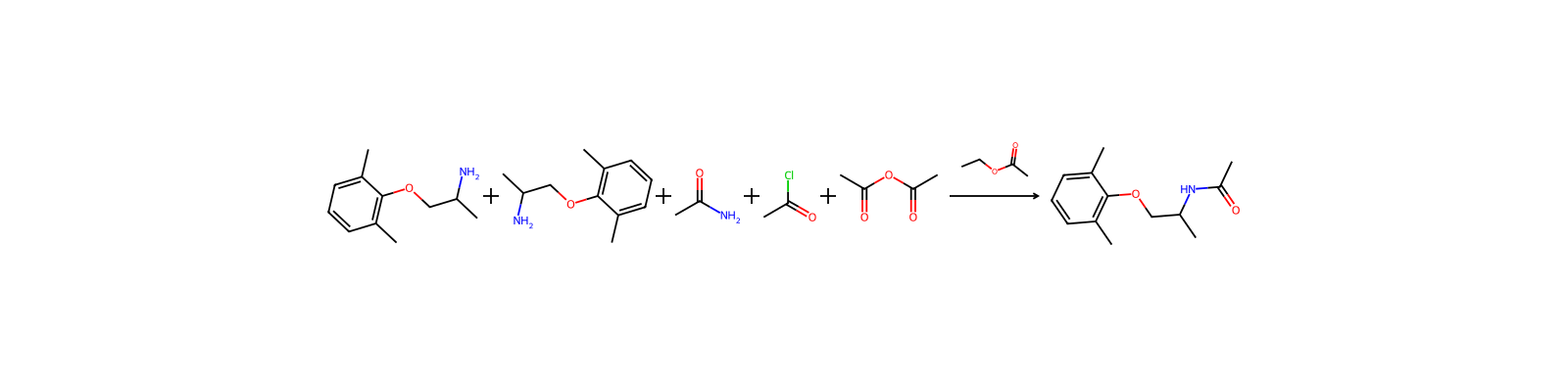
2
Notizen zur Verbindung
Wird geladen…